A demonstration unit is with a customer. Another unit has gone to a repairer. A third has been agreed for purchase, but nobody has completed the sale instruction. A stock total alone cannot tell the business which items are available, who has custody or what must happen next.
Follow the individual unit until its loan arrangement reaches an approved outcome. Record custody, ownership, condition and commercial disposition as separate facts. A loan-stock coordinator owns the follow-up; the commercial owner approves a sale, and finance assesses the resulting accounting and tax treatment.
The following walkthrough uses fictional unit D-104 in a Singapore equipment business. It is an example of a custody record, not a client story or a claim about the tax treatment of every equipment loan.
The coordinator records the unit identifier, model, accessories, starting condition, customer entity, destination and person accepting custody. The record links to the approved loan terms and expected return date. Any restrictions on use or movement should come from the agreement and responsible operational assessment.
The handover evidence should establish what actually left. A model number alone may describe several identical units. A photograph can help show condition, but should avoid unnecessary personal information and should not substitute for an agreed handover record.
Record what the transaction is intended to be. A free demonstration loan, a paid hire and a sale-on-approval arrangement are different commercial possibilities. Calling them all “demo stock” in an internal category does not establish their legal, accounting or GST treatment.
If money is collected, record its purpose and terms separately. For a GST-registered supplier, IRAS distinguishes a deposit that forms part of payment from security for obligations such as the safe return of goods. The label “refundable” alone does not settle that distinction. Finance needs the underlying arrangement before applying the relevant treatment.
D-104 is expected back on Friday. The customer says it needs another week. The coordinator can record the request, but should not silently move the due date and erase the overdue history.
The responsible owner decides whether to extend the loan under the agreement. Record the new date, reason, approval and any changed conditions. Check whether another customer has already been promised that unit. Extending one loan can create an availability problem elsewhere even when no sale has been lost yet.
Automation can prepare the reminder, show the agreed date and alert the coordinator to an unanswered request. It should not approve an extension simply because the customer replies. An indefinite succession of revised dates would make the stock appear controlled while nobody has made a deliberate availability decision.
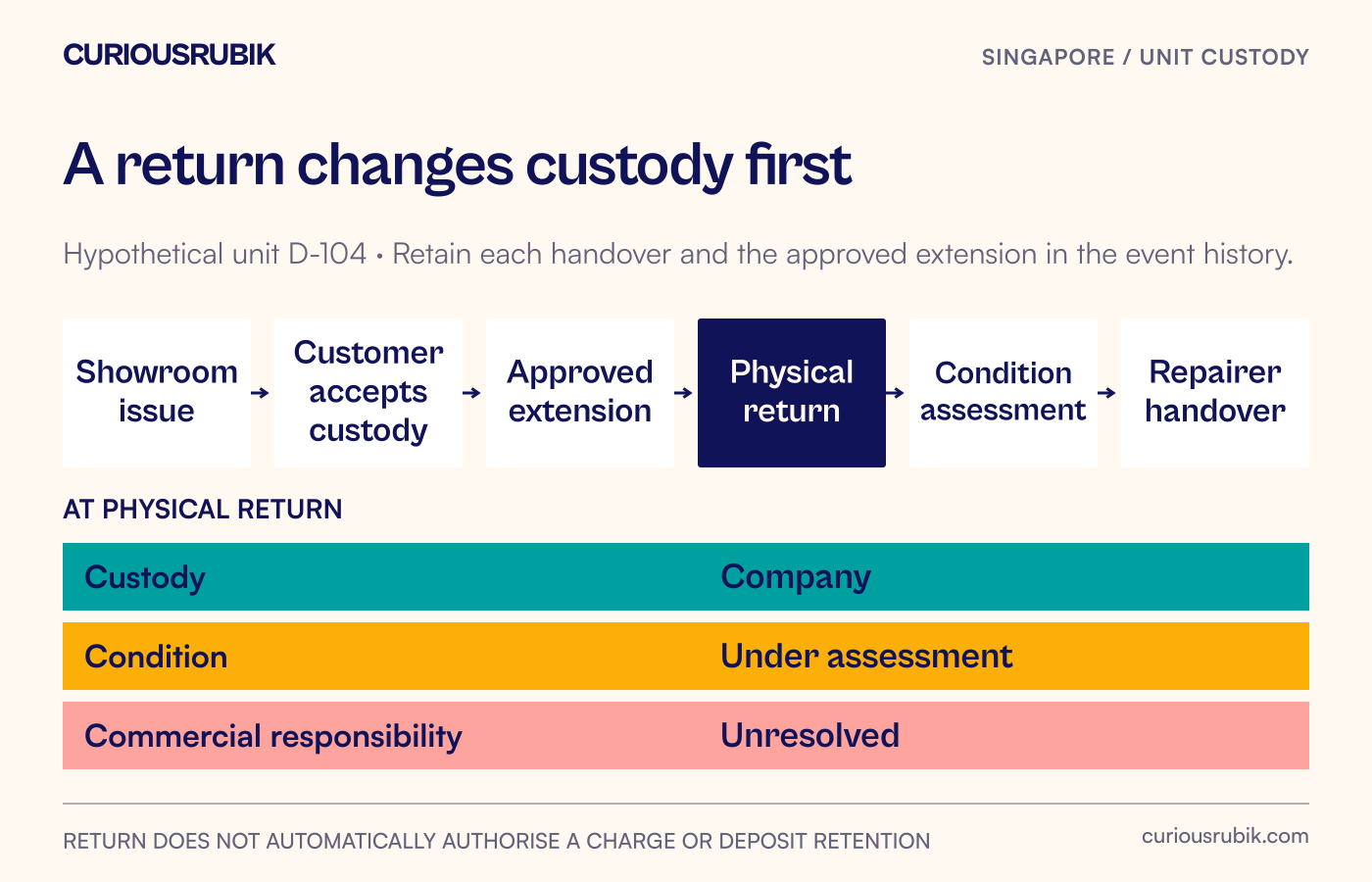
Keep “customer confirms possession” separate from “physically returned”. The first is useful location evidence. The second changes custody and needs its own record.
Suppose D-104 returns with an accessory missing and an operating fault. The receiver checks identity, accessories and condition against the outgoing record. The coordinator records physical return, but the unit remains unavailable for the next demonstration until the responsible person assesses it.
Do not leave it marked as loaned merely because damage is unresolved. That would overstate customer custody and hide the unit's actual location. Use separate fields: custody at company; condition under assessment; commercial responsibility unresolved.
The operations owner decides whether to inspect, repair, hold or retire the unit. Any charge to the customer needs contractual support and the appropriate commercial approval. Missing equipment is evidence to investigate, not automatic permission to retain a deposit or issue an invoice.
CURIOUSRUBIK SINGAPORE / UNIT CUSTODY A return changes custody first Hypothetical unit D-104 · Retain each handover and the approved extension in the event history. Showroom issue Customer accepts custody Approved extension Physical return Condition assessment Repairer handover AT PHYSICAL RETURN Custody Company Condition Under assessment Commercial responsibility Unresolved RETURN DOES NOT AUTOMATICALLY AUTHORISE A CHARGE OR DEPOSIT RETENTION curiousrubik.com
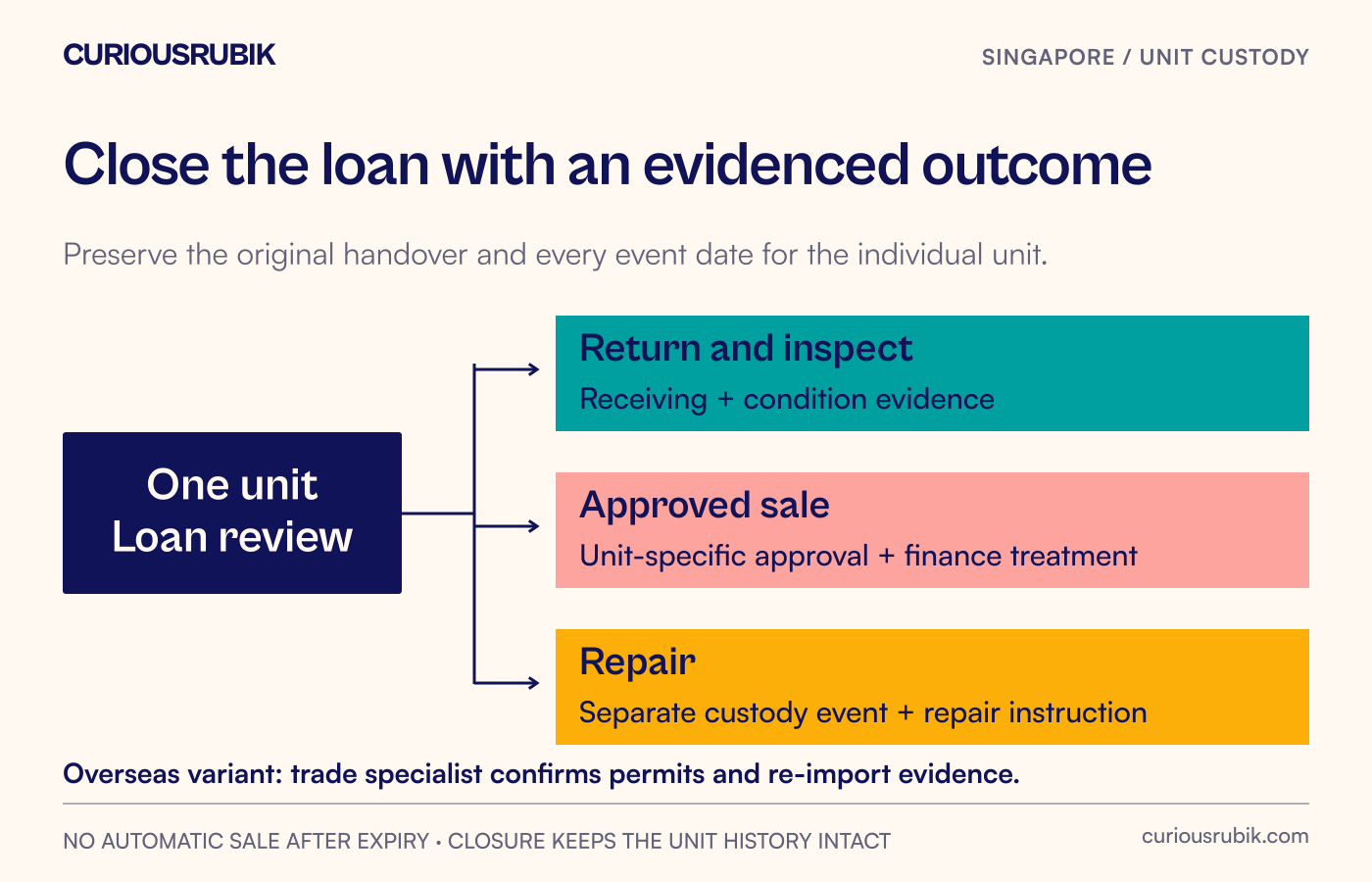
If a repairer receives D-104, create another custody event with the repair instruction and expected return. The customer loan and repair movement should remain connected without being treated as the same outstanding handover. Otherwise staff may continue chasing the customer while the unit is on a repair bench.
A different outcome is an agreed purchase while D-104 remains at the customer's premises. The physical location may not change, but the commercial and inventory records do.
The authorised commercial owner confirms the unit, price, condition accepted, accessories and effective terms. Finance prepares the appropriate sale documentation and reviews the treatment of any amount already held. The coordinator closes the loan only when the approved conversion is reflected in the relevant records, with the decision evidence linked.
Avoid using an overdue-return rule to force a sale. A loan agreement may contain relevant terms, but their application needs review. An elapsed date in a register is not enough to establish that the customer has purchased the unit.
Keep the tax assessment explicit. For GST-registered businesses, IRAS has specific GST timing guidance for goods supplied on approval or sale-or-return terms, including a twelve-month trigger in that defined scenario. An ordinary loan is not automatically that arrangement. Finance should establish the facts rather than applying a sale-or-return clock to every unit labelled “demo”.
CURIOUSRUBIK SINGAPORE / UNIT CUSTODY Close the loan with an evidenced outcome Preserve the original handover and every event date for the individual unit. One unit Loan review Return and inspect Receiving + condition evidence Approved sale Unit-specific approval + finance treatment Repair Separate custody event + repair instruction Overseas variant: trade specialist confirms permits and re-import evidence. NO AUTOMATIC SALE AFTER EXPIRY · CLOSURE KEEPS THE UNIT HISTORY INTACT curiousrubik.com
If a unit leaves Singapore temporarily, involve the trade specialist before dispatch. The applicable Customs route, permits and later re-import evidence need to be connected to the same unit. A domestic loan record does not establish that an overseas movement qualifies for a particular treatment.
Singapore Customs' temporary-export procedures require the relevant permit before export and a link to the previous temporary-export permit on re-import. Its duration guidance specifies three months for trade samples and goods exported for repair, rather than a universal limit for every temporary export. Late trade-sample or repair cases require an explanation for Customs' assessment.
Keep the commercial return date and Customs-related action separate. A customer-approved extension does not determine the Customs outcome. If the customer wants to buy the unit abroad, the trade specialist must assess the changed movement and documentation before the team treats the loan as closed.
The core control is still unit-level accountability: which item moved, why, under what authority and what remains to be done. The cross-border record adds another specialist-owned obligation to that history.
A useful custody register shows the latest confirmed location, current custodian, expected next movement, condition, commercial state and open exception owner. Link the original handover, extensions, return inspection, repair movement or sale decision. Do not replace the entire history with the most recent status.
The coordinator should review units with no recent location confirmation, overdue returns and closed loans lacking an approved outcome. Finance should review units invoiced or written off without the required decision evidence. These measures are more informative than counting reminder messages.
Test the register by asking someone unfamiliar with D-104 to explain its current position. Can they locate it, establish whether it is available and identify the person resolving the remaining issue? If the answer depends on remembering a conversation, the handoff is unfinished.
Start with the oldest open demonstration loan. Decide whether it needs a return, an approved extension, repair follow-up or a commercial conversion. Finish that specific decision before broadening the exercise into a general stock clean-up.