A parent agrees to take leave in three blocks. The team arranges cover for the first block, payroll records the full allocation, and a manager keeps a separate calendar. When the last block changes, only the calendar is updated. Cover is now booked for the wrong week, and the reimbursement preparation still reflects the earlier plan.
The difficult part of staggered leave is keeping several valid records aligned as time passes. An allocation says how much leave belongs to the employee. An agreed plan says when it will be taken. Actual leave records say what happened. Payroll and reimbursement records describe their own actions. Treating these as one status called “approved” hides the differences.
Singapore's shared parental leave scheme provides ten shared weeks for eligible parents where the relevant birth, estimated delivery or formal-intent-to-adopt date is on or after 1 April 2026. This is a shared entitlement with eligibility and allocation conditions, not ten weeks automatically available to every employee.
MOM explains that non-continuous leave requires employer agreement and must fit the applicable permitted period. Its guidance also sets notice requirements and a default continuous-block route where agreement cannot be reached. HR should check the actual scheme and circumstances rather than treating a preferred calendar as an agreed arrangement.
This article concerns the operating records after the relevant entitlement and scheduling questions have been checked. A manager's coverage difficulty does not remove an employee's entitlement. Equally, a proposed date change should not silently replace agreed dates. Keep the request, applicable decision and resulting agreement visible.
The same distinction matters when the number of weeks allocated between parents changes. MSF's guidance separates changes within the first four weeks after the relevant birth or adoption date from later changes, for which employer agreement documentation is required. A changed allocation and a changed leave-taking plan need their respective checks; neither should be inferred from an edited team calendar.
Use a stable block reference, such as A, B or C, alongside its current agreed dates. If block C moves, retain C and record a new version. Otherwise, the old dates can look like cancelled leave while the new dates look like an additional block, creating double counting or a missed cancellation of cover.
A compact reconciliation record can contain:
| Record | Question it answers | Responsible owner |
|---|---|---|
| Verified allocation | How much SPL is allocated to this employee? | HR |
| Agreed block version | Which dates have been agreed, and on what basis? | HR with employee and manager |
| Cover commitment | Who covers those dates, with what competing commitments? | Functional manager |
| Actual leave | Which dates were taken? | HR or designated leave administrator |
| Payroll and claim reference | What was paid, included in a claim or left for review? | Payroll and claim owner |
The references should connect these records without exposing unnecessary family information. A covering colleague needs dates and work responsibilities, not the employee's complete eligibility documents. The claim owner needs the evidence relevant to the claim, with controlled access.
Do not convert calendar weeks into payable or claimable days using a casual rule. The responsible specialist should use the employee's working arrangement and current scheme calculation requirements. A planning table is not a reimbursement calculator.
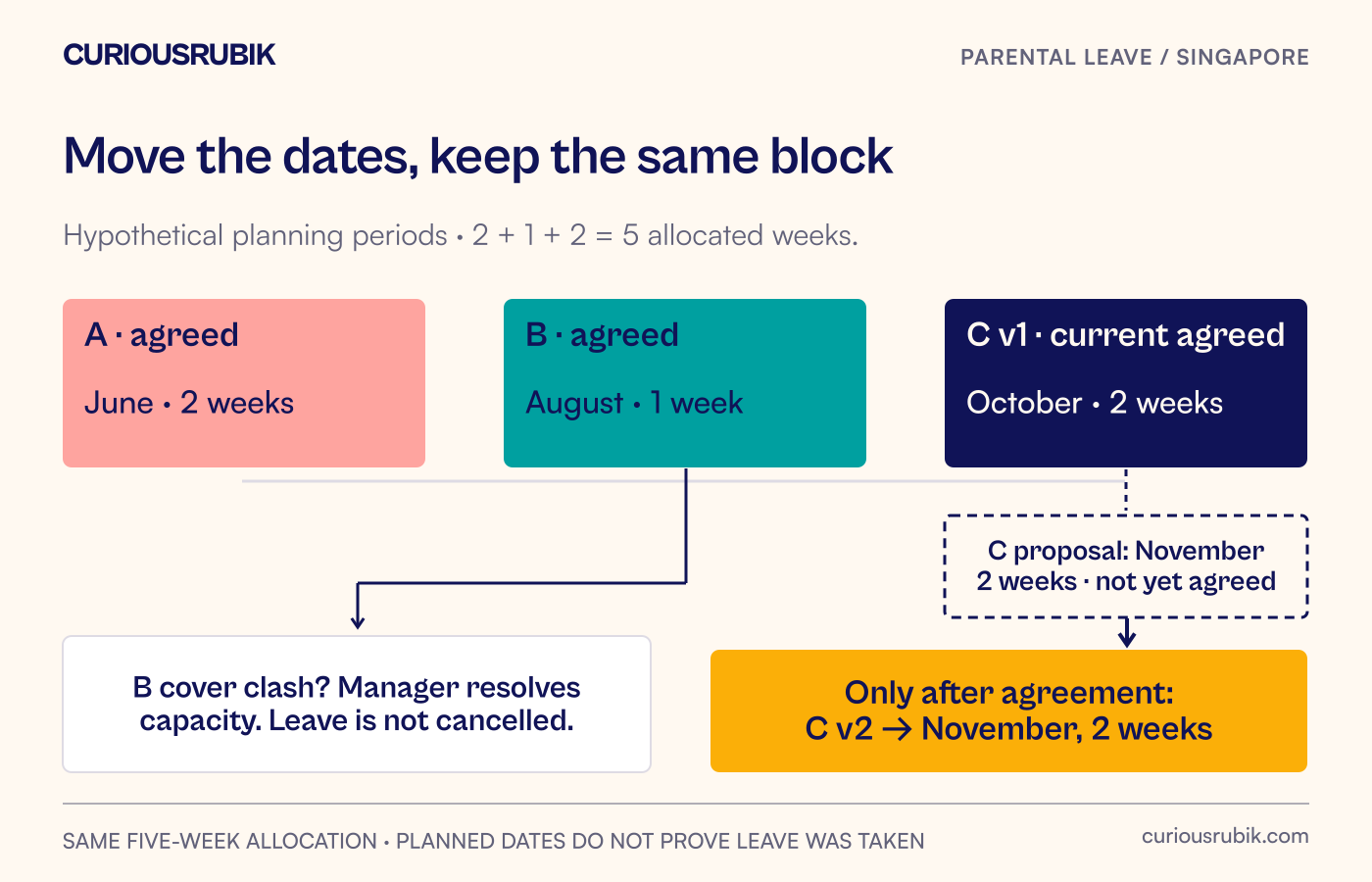
Consider a hypothetical employee whose eligibility and five-week allocation have been verified. The employee and employer have agreed three non-continuous blocks within the permitted period, after the relevant prior leave has been taken: block A for two weeks in June, block B for one week in August and block C for two weeks in October. These are illustrative planning periods, not an eligibility example.
After A finishes, HR records the actual dates. Payroll confirms its corresponding entries. The claim owner records whether those dates have been included in a submitted claim, without treating the remaining three planned weeks as already taken.
Before B, the manager checks that the covering colleague is still available. A separate project now needs that colleague during the same week. The manager resolves this capacity clash through staffing or work allocation; the system does not respond by cancelling the employee's agreed leave.
Later, a request is made to move C to November. HR checks the permitted period, notice and agreement requirements. While that check is pending, October remains the current agreed version and November is clearly marked proposed. No one should receive an apparently confirmed new rota from a draft change.
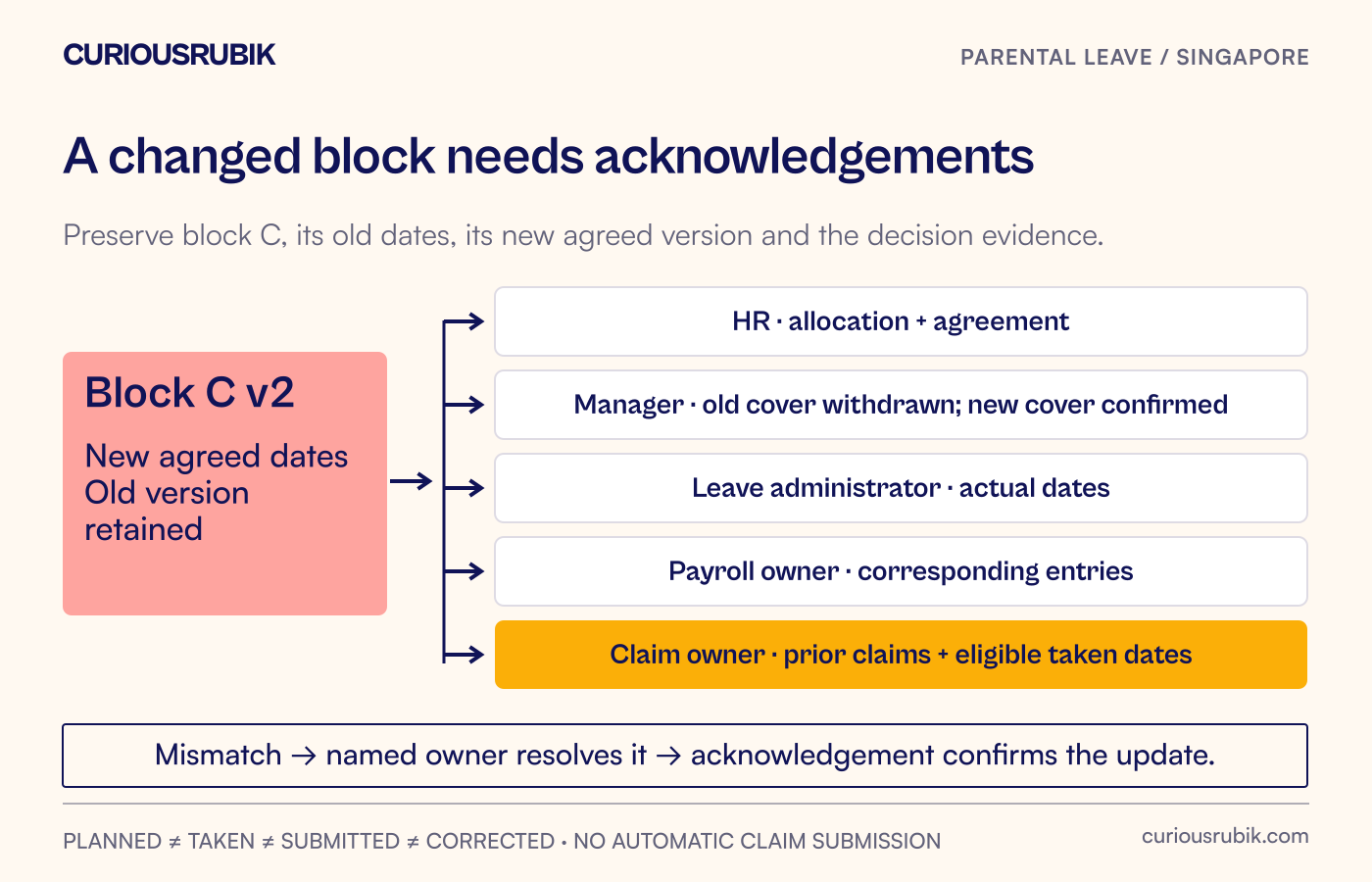
Once the change is properly agreed, the same block C receives a new version. The manager withdraws the old cover booking and confirms the new one. Payroll and the claim owner acknowledge the changed dates. The total allocation remains five weeks unless a separate valid allocation change has also occurred.
CURIOUSRUBIK PARENTAL LEAVE / SINGAPORE Move the dates, keep the same block Hypothetical planning periods · 2 + 1 + 2 = 5 allocated weeks. A · agreed June · 2 weeks B · agreed August · 1 week C v1 · current agreed October · 2 weeks C proposal: November 2 weeks · not yet agreed B cover clash? Manager resolves capacity. Leave is not cancelled. Only after agreement: C v2 → November, 2 weeks SAME FIVE-WEEK ALLOCATION · PLANNED DATES DO NOT PROVE LEAVE WAS TAKEN curiousrubik.com
A person who returns between blocks may resume some responsibilities while a colleague finishes others. Record that handback explicitly. A case accepted by the covering colleague during A might still need their decision after the employee returns; sending it back automatically can cause another unnecessary handoff.
At each boundary, answer three questions. What remains with the covering colleague? What returns to the employee? What needs to be prepared again before the next block? The answers may differ from those agreed before A because the work has changed.
Keep temporary authority and access proportionate to the actual arrangement. Some permissions may end after a block; others may remain justified for an agreed continuing responsibility. The authorised owner should decide and record this, rather than leave an indefinite delegation because more leave is planned later.
Also close the administrative facts for the completed block. Confirm actual dates, resolve discrepancies and connect the payroll result. Do not wait until the final block to discover that one day appears in both an attendance record and a leave record.
The employee should not have to keep reconciling internal records while on leave. Give HR responsibility for resolving mismatches with payroll and managers, asking the employee only for information genuinely needed through an appropriate channel.
MSF allows employers to claim reimbursement for leave already taken without waiting for all SPL to finish, and permits multiple claims for the employee. It specifies submission no later than three months after the last date of the employee's SPL. The claim owner should verify the applicable dates and requirements rather than infer a deadline from the first block or an old plan.
This makes claim history important. For each actual leave period, record the claim reference and status. Before preparing a further claim, compare the proposed dates with those already submitted. A changed plan should not erase earlier claims or cause previously claimed dates to be selected again.
If an earlier claim or payroll record contains an error, route it through the relevant correction process. Do not simply overwrite the local total and assume the submitted record changed too. Keep the corrected evidence, action taken and confirmation together.
CURIOUSRUBIK PARENTAL LEAVE / SINGAPORE A changed block needs acknowledgements Preserve block C, its old dates, its new agreed version and the decision evidence. Block C v2 New agreed dates Old version retained HR · allocation + agreement Manager · old cover withdrawn; new cover confirmed Leave administrator · actual dates Payroll owner · corresponding entries Claim owner · prior claims + eligible taken dates Mismatch → named owner resolves it → acknowledgement confirms the update. PLANNED ≠ TAKEN ≠ SUBMITTED ≠ CORRECTED · NO AUTOMATIC CLAIM SUBMISSION curiousrubik.com
Automation can show differences between block versions, notify affected owners and identify overlapping cover commitments. It can compare actual leave dates with claim history and flag a mismatch for review. It should not approve an allocation change, decide eligibility or submit a claim merely because several fields agree.
A useful change record lists the old and new dates, decision evidence, records affected and each owner's acknowledgement. A failed notification remains an open task. If the payroll owner is absent, a named authorised substitute receives it before the relevant processing deadline.
Review the next staggered arrangement at its first return. Can HR explain the remaining allocation? Can the manager identify the next cover commitment? Can payroll and the claim owner distinguish taken leave from planned leave? If those answers come from incompatible versions, reconcile them then. Each completed block is an opportunity to make the next one easier for both the employee and the team.