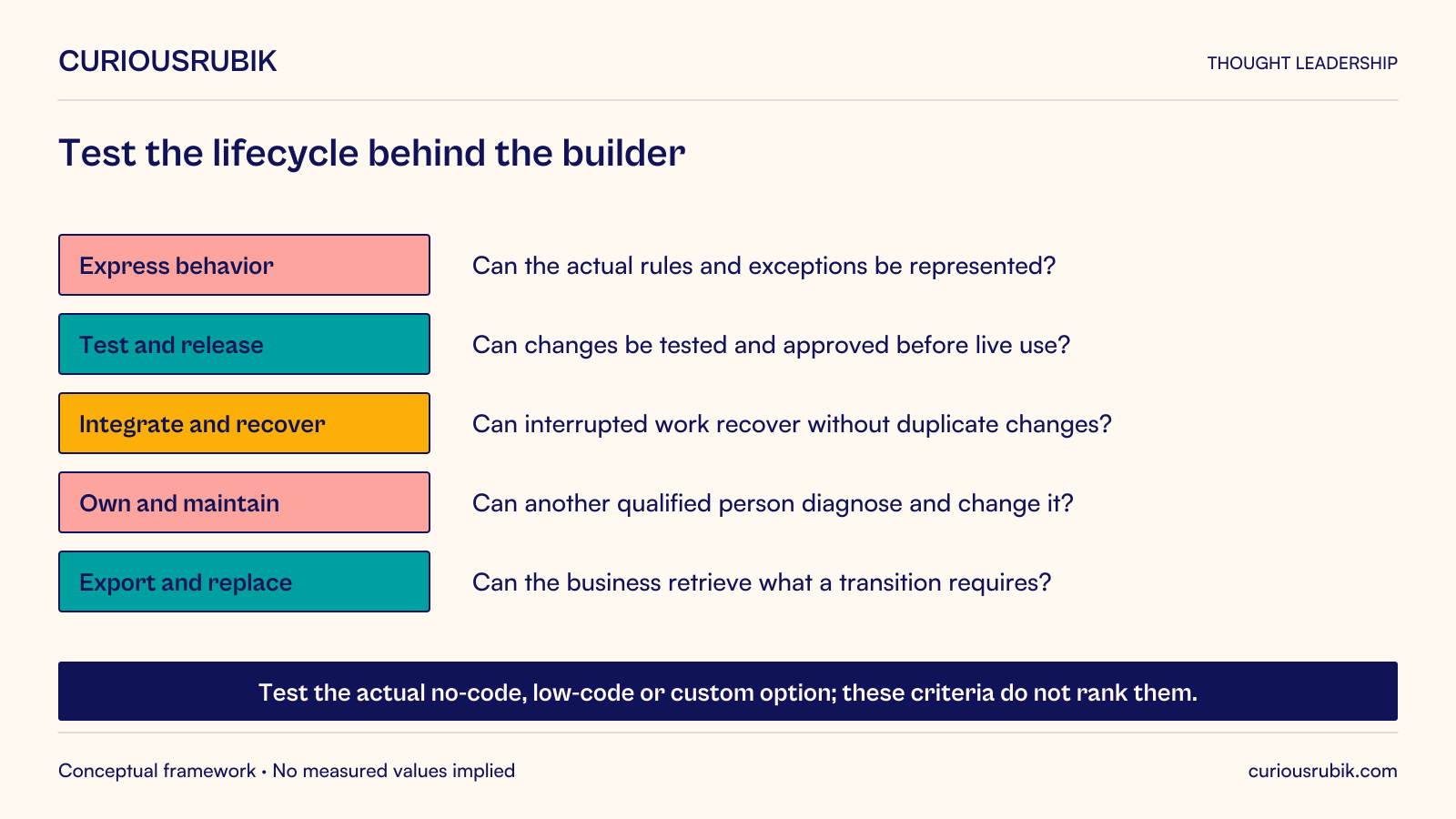
The most revealing platform demonstration is often a change made after the first application works. Can the team modify a rule, test it independently, promote it through environments and recover if the change fails? Can another person understand and maintain it? Those questions expose the operating model behind an attractive development interface.
Low-code, no-code and custom development differ in where behavior is expressed and which controls the team can exercise directly. Product labels vary, so this article uses no-code for configuration-led development aimed at avoiding general-purpose programming, low-code for platforms combining higher-level configuration with code or extensions, and custom development for applications built primarily through general-purpose software engineering. Actual products can cross these boundaries.
For an enterprise buyer, the choice should turn on the application’s constraints, the team’s capabilities and the complete change-and-support lifecycle. The fastest initial prototype is not automatically the easiest application to operate responsibly.
Start with the workload, data, user roles, integrations and operating conditions the application must support. Include performance, recovery, access control, accessibility and audit needs where they matter.
Translate broad terms into testable scenarios. A requirement to process supplier files needs representative file sizes, validation rules, exception behavior and a definition of completion. A requirement for secure access needs actual role and record boundaries, not only a login screen.
Distinguish necessary constraints from preferences. A platform may support a different interface pattern that meets the user need. Conversely, a familiar visual builder is not a reason to accept a missing control that the business considers essential.
Evaluate the product and service tier actually proposed. Capabilities, usage limits, environment support and connector access can depend on the specific offering. Do not assume that a feature shown in a demonstration is included in the commercial and operating arrangement under review.
Ask where business behavior lives. It may be distributed across visual workflows, formulas, data rules, external functions, scripts and connected services. An application can contain substantial complexity even when little traditional code is visible.
Determine whether a change can be identified, reviewed and tested as a coherent unit. Can the team compare versions, understand dependencies and promote the intended change without accidentally moving unrelated configuration? What happens when two people edit the same application?
For custom development, the team may have broad control over those mechanisms but must establish and maintain them. For a platform, some mechanisms may be supplied and others constrained. Neither arrangement eliminates the need to verify the actual development workflow.
Assess changes that cross the platform boundary. A simple form may depend on a custom service whose release cycle and access permissions differ from the form’s. The chosen approach needs a way to coordinate that relationship.
Consider a hypothetical wholesaler building a supplier price-file intake application. The example uses an invented workload of fifteen thousand rows per file to make the evaluation concrete; it is not a platform limit or industry benchmark.
The visible workflow is straightforward: receive a file, validate it, let an authorized reviewer resolve exceptions and release approved changes. A small demonstration with fifty clean rows makes several development approaches look suitable.
The real evaluation includes duplicate product identifiers, unsupported values, missing references and an interrupted processing run. The business requires proposed changes to remain in a staging state until the necessary checks and approval are complete. The team must explain whether a failed run can resume or restart without duplicating changes or leaving an ambiguous partial result.
A configuration-led tool may be entirely suitable if it demonstrates those behaviors at the required workload and can be operated by the available team. A low-code approach may use a platform for intake and review while a separately governed service handles complex parsing. Custom development may offer useful control if the constraints cannot be met otherwise, but adds its own engineering and support obligations.
The decision should follow the demonstrated behavior and lifecycle evidence. It should not assume that no-code cannot handle significant work or that custom code automatically handles it well.
Platforms often provide ways to extend behavior. The existence of an extension point does not establish that the organization can support the resulting solution.
Ask how an extension is authenticated, deployed, monitored and versioned. Can it participate in the application’s error handling and recovery? Which team investigates a failure that crosses the boundary? Does the platform expose enough evidence to distinguish an invalid request from an unavailable dependency?
Test the extension with representative failure conditions. A connector that works for one successful transaction may behave differently under repeated requests, rate limits or uncertain responses. The design needs the actual provider’s semantics, not a generic assumption that retrying is harmless.
Keep extension scope bounded. If most consequential behavior has moved into custom services while the platform adds licensing and integration complexity, revisit whether the original platform choice still helps. Conversely, a small well-owned extension can be a sensible way to preserve a useful platform foundation.
Show how the team will test a rule before it affects live work. Include representative data, role-based behavior, integration failures and the effect of platform updates or dependency changes.
Separate development and production responsibilities appropriately. An application that can be changed directly by its creator without review may be acceptable only within a deliberately bounded context; it should not become a critical service by accident. The organization’s control requirements need an implemented workflow.
Verify how configuration, data and environment-specific settings move between stages. A successful deployment that also carries unintended test data or the wrong connection is not a reliable release process. The mechanisms differ by platform, so require evidence for the actual design.
Security work remains necessary regardless of development style. NIST’s 2022 Secure Software Development Framework recommends practices that can be integrated into different software-development lifecycles and used in supplier discussions. It does not certify a platform or imply that a visual builder removes security responsibilities. NIST SSDF Version 1.1.
A business team may be well placed to maintain simple rules and forms, while needing specialist support for access design, integrations or recovery. A professional engineering team may be able to sustain a custom application but still lack the domain knowledge to change a business rule safely.
Define the division of responsibility. Who approves behavior, who builds it, who reviews it, who releases it and who supports it? Identify the capacity and skills required for each responsibility rather than assuming the original creator will remain available indefinitely.
Plan for the creator’s absence. The application should not depend on a personal account, undocumented connection or private knowledge that the organization cannot replace through its approved processes. Appropriate identity and access arrangements need review by the responsible teams.
Use a maintenance exercise in the evaluation. Ask someone other than the original builder to diagnose a failed case and implement a bounded change using the available documentation and tools. The result can reveal whether apparent ease of creation translates into sustainable ownership.
Compare the full operating commitment, including platform charges, environments, connectors, custom extensions, testing, support and maintenance. For usage-based components, model the actions the application actually performs rather than only counting business transactions.
In the price-file example, one incoming file can trigger many validations, lookups and writes. Logical operations are not automatically billable units; the commercial model must be checked against the provider’s terms. The point is to make the workload visible before relying on a low introductory estimate.
Include internal review and exception work. A platform that accelerates construction but leaves users reconciling partial results may have a different total cost from the demonstration suggests.
Test growth and change scenarios. What happens when another business unit uses the application, transaction volume increases or an integration changes? Avoid presenting one current workload as a complete long-term cost forecast.
Determine what can be exported and in what usable form: data, configuration, workflows, source code where applicable and operational history. An export button does not necessarily provide everything required to reproduce the service elsewhere.
Identify dependencies that would remain during transition. A custom application can still depend on specialized services and libraries. A platform application can contain business logic that is difficult to translate. Evaluate the actual replacement work rather than treating one development style as inherently free of lock-in.
Keep documentation of important rules outside the assumptions of one builder. The organization should be able to explain the intended behavior even if the implementation technology changes.
Choose the approach that the organization can change, test and support under its real constraints. Begin with a demanding representative task, then demonstrate a rule change, a failure, a handover and a plausible transition. That evaluation offers a stronger basis for the decision than the speed of creating the first screen.