An employee submits a receipt. Finance asks for the business purpose. The manager approves it. Finance then asks whether the employee paid personally, whether part of the bill was private and whether a clearer copy exists. By the time the claim is ready, several people have handled it more than once.
A better expense process asks the right questions together, at the point when the employee still remembers the transaction. It also keeps business approval, reimbursement and tax treatment separate enough that one decision does not silently stand in for the others.
Different expenses create different questions. A form that asks every employee every possible question becomes frustrating. A form that asks only for an amount and photograph leaves finance to reconstruct the rest.
Create a short matrix by expense type. For each type, specify the information the employee provides, the question the manager answers and the evidence finance needs for reimbursement and tax review. Keep the matrix practical enough to use while submitting a claim.
For a business journey, the employee can identify the date, work purpose, relevant receipt and whether the company has already paid any part. The manager confirms the connection to the work. Finance checks the documentation, amount and treatment under the company's policy.
For a client meal, the work purpose and relevant attendee context may matter alongside the receipt. Collect only what is needed for the business and tax purpose, using proportionate access. A free-text invitation to upload an entire conversation can draw in unnecessary personal or commercial information.
For a personal bill with a business element, ask for the proposed business portion and the basis for it. This should enter a review route instead of being automatically treated as an ordinary fully business expense.
The matrix is a company process recommendation. It does not replace IRAS conditions or determine whether every expense in a category qualifies for a GST claim.
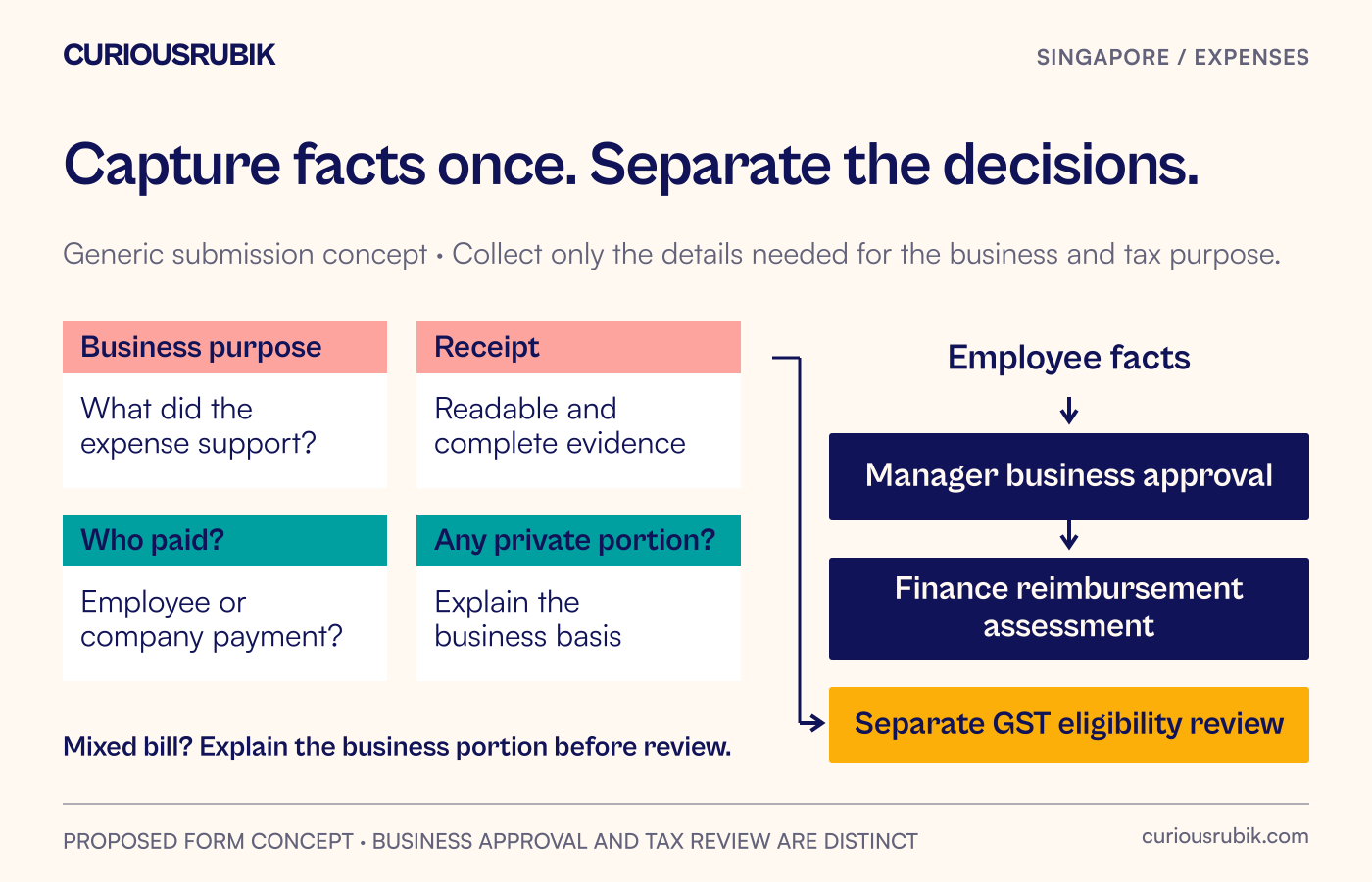
The employee's declaration describes what happened and what they are claiming. The manager's approval confirms the business purpose and whether the expense falls within delegated spending authority. Finance determines the reimbursement amount and accounting treatment. A GST review, where relevant, establishes whether the input-tax requirements are met.
Those decisions can share evidence without becoming a single decision. A manager may reasonably authorise reimbursement under company policy even when the documentation does not support a GST claim. Conversely, a tax-valid document does not prove that an employee's purchase was authorised.
Make the employee-facing status understandable. “Manager approved; finance checking the business portion” is more useful than “pending”. If finance needs more information, the request should explain the exact missing fact and who can supply it. Employees should not have to guess which of several reviewers returned the claim.
CURIOUSRUBIK SINGAPORE / EXPENSES Capture facts once. Separate the decisions. Generic submission concept · Collect only the details needed for the business and tax purpose. Business purpose What did the expense support? Receipt Readable and complete evidence Who paid? Employee or company payment? Any private portion? Explain the business basis Employee facts Manager business approval Finance reimbursement assessment Separate GST eligibility review Mixed bill? Explain the business portion before review. PROPOSED FORM CONCEPT · BUSINESS APPROVAL AND TAX REVIEW ARE DISTINCT curiousrubik.com
Singapore's GST guidance makes the agency relationship important when an invoice is addressed to an employee. IRAS allows a GST-registered business to claim input tax in such cases only where it can establish that the employee received the supply as its agent and the other conditions are met. Its examples include retaining reimbursement evidence and recording the bill as a business expense.
A blanket rejection of all employee-name invoices can therefore create unnecessary work. A blanket acceptance of all reimbursed invoices is equally weak. Finance needs to understand the circumstances and documentary requirements.
IRAS also requires private expenses to be separated from business expenses for this purpose. Paying the employee the whole bill does not make the private portion's GST recoverable. For partial reimbursement, any otherwise eligible GST claim is limited in proportion to the amount reimbursed, subject to the other conditions. The tax reviewer should resolve the actual facts rather than applying a universal percentage from another expense type.
Build those questions into the relevant submission route. Do not ask every claimant to interpret tax law. Ask for observable facts: whose name appears, who paid, what the expense supported, what portion was private and what amount the company is reimbursing.
The following cases are hypothetical. They show how a focused intake can reduce repeated questions without predetermining the outcome.
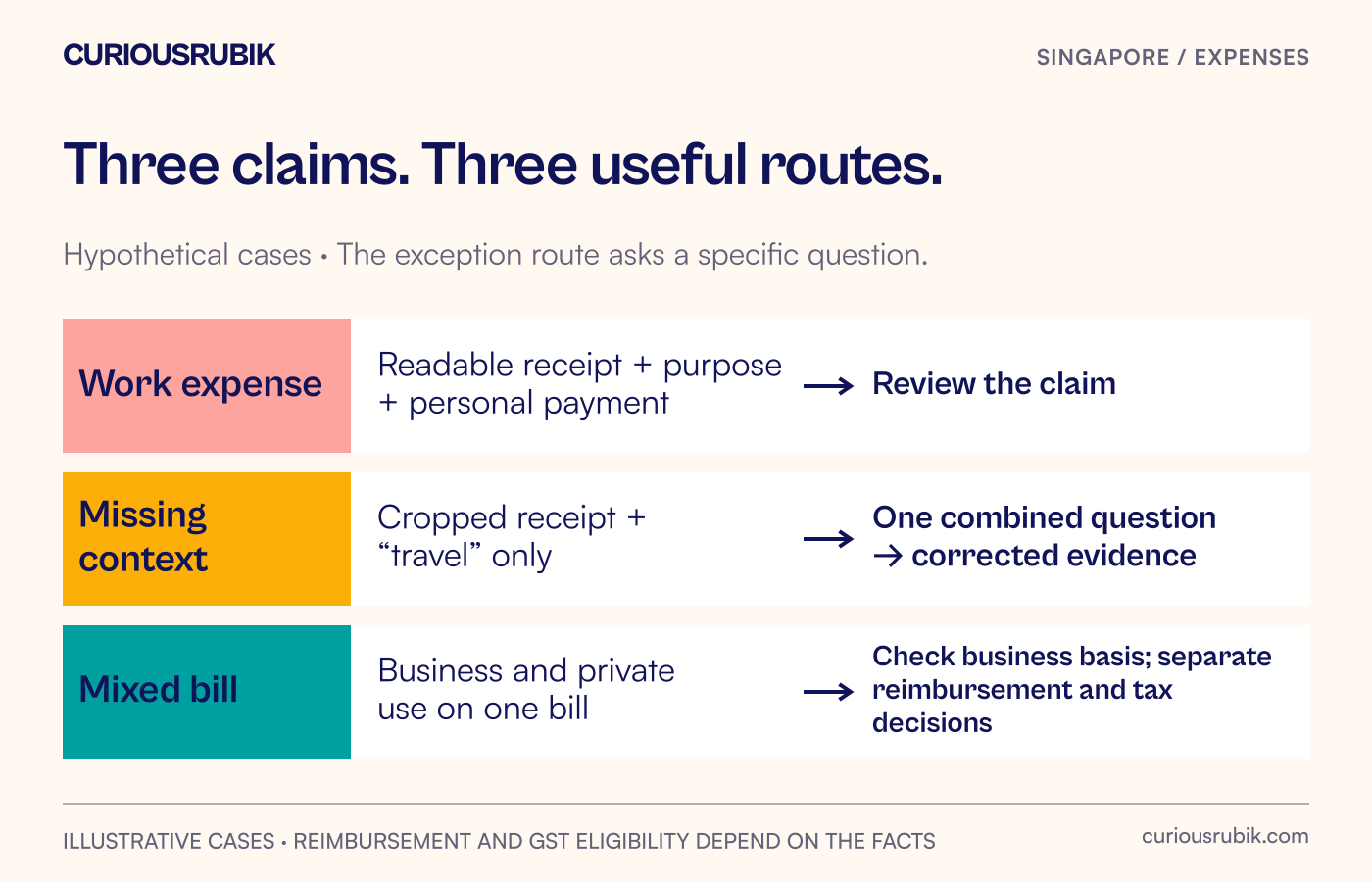
A straightforward work expense. An employee provides a readable receipt, a specific work purpose and confirmation that they paid personally. The manager confirms the purpose and authority. Finance checks policy, duplicate indicators and reimbursement details, then assesses any tax treatment separately. No extra narrative is needed simply because a long form has room for it.
A receipt with missing context. A claim says only “travel”, and the image has cut off the supplier details. The expense administrator sends one combined request for the work journey information and a complete receipt. The manager can review the business purpose once that information is supplied. Passing the incomplete claim around several queues would add delay without adding evidence.
A mixed bill. An employee submits a bill covering both work and private use and proposes a business portion. Finance asks for the basis, checks what was reimbursed and determines the treatment. The claim can have an approved reimbursement outcome while a tax question remains unresolved. A clear record prevents a later reviewer from assuming that the payment itself settled the tax question.
CURIOUSRUBIK SINGAPORE / EXPENSES Three claims. Three useful routes. Hypothetical cases · The exception route asks a specific question. Work expense Readable receipt + purpose + personal payment Review the claim Missing context Cropped receipt + “travel” only One combined question → corrected evidence Mixed bill Business and private use on one bill Check business basis; separate reimbursement and tax decisions ILLUSTRATIVE CASES · REIMBURSEMENT AND GST ELIGIBILITY DEPEND ON THE FACTS curiousrubik.com
An employee may genuinely lose a receipt. The process should let them report that fact without inventing a document or repeatedly uploading an irrelevant image to satisfy a mandatory field.
Provide an exception route with the transaction date, amount, purpose, available alternative evidence and reason the original is unavailable. State who can approve reimbursement under company policy and who decides the accounting and tax consequences. Alternative evidence should not be described as automatically equivalent to a valid tax invoice.
If the same person or category repeatedly uses the exception route, investigate the cause. Perhaps receipts are routinely issued to a shared mailbox the employee cannot access. Perhaps the submission process takes too long on a phone. A better intake route may solve the pattern more effectively than additional warning messages.
Set an owner and due date for unresolved claims. Where a claim has several independent items, consider whether completed items can proceed under policy while an incomplete item is resolved. Make any partial reimbursement clear to the employee and preserve the link to the original submission.
Receipt extraction can prefill the merchant, date and amount. Duplicate checks can compare likely matches across employee claims and company-paid expenses. Routing can send unusual claims directly to the person who knows how to assess them.
Treat extracted values as proposals. A receipt may contain a total, a balance due and a previous payment, all plausible-looking amounts. Show the original next to the extracted fields and highlight uncertainty. Do not make the employee retype fields that are already correct merely to prove they reviewed the claim.
A duplicate flag also needs interpretation. Two employees may incur similar legitimate expenses on the same day. One employee may submit a corrected image of the same claim. The reviewer needs a way to connect a revision, clear a false match or stop an actual duplicate with a recorded reason.
Keep payment destination changes outside casual expense editing. The person reviewing a meal receipt should not accidentally authorise a new reimbursement account. Different risks deserve different controls even when they appear in the same employee journey.
Start with one common category and review a small sample of recent claims. Record the number of returns, the question asked on each return, the elapsed time and the people involved. Identify questions that could have been collected together at first submission.
After changing the form, measure first-pass completeness, time to an approved reimbursement, repeated exception reasons and later corrections. Do not judge success by the number of auto-approved claims alone. A process that accepts claims quickly but sends tax corrections to finance later has moved work rather than removed it.
Keep employee effort in the assessment. Five additional mandatory fields may save the administrator a minute while costing every claimant more time. Ask whether each field changes a decision, establishes necessary evidence or prevents a real error. Remove fields that do none of these.
Take the last five returned claims to the next finance meeting. If the same missing question appears repeatedly, add it to the right expense route and make the exception owner explicit. That is a useful improvement employees will feel at the next submission.