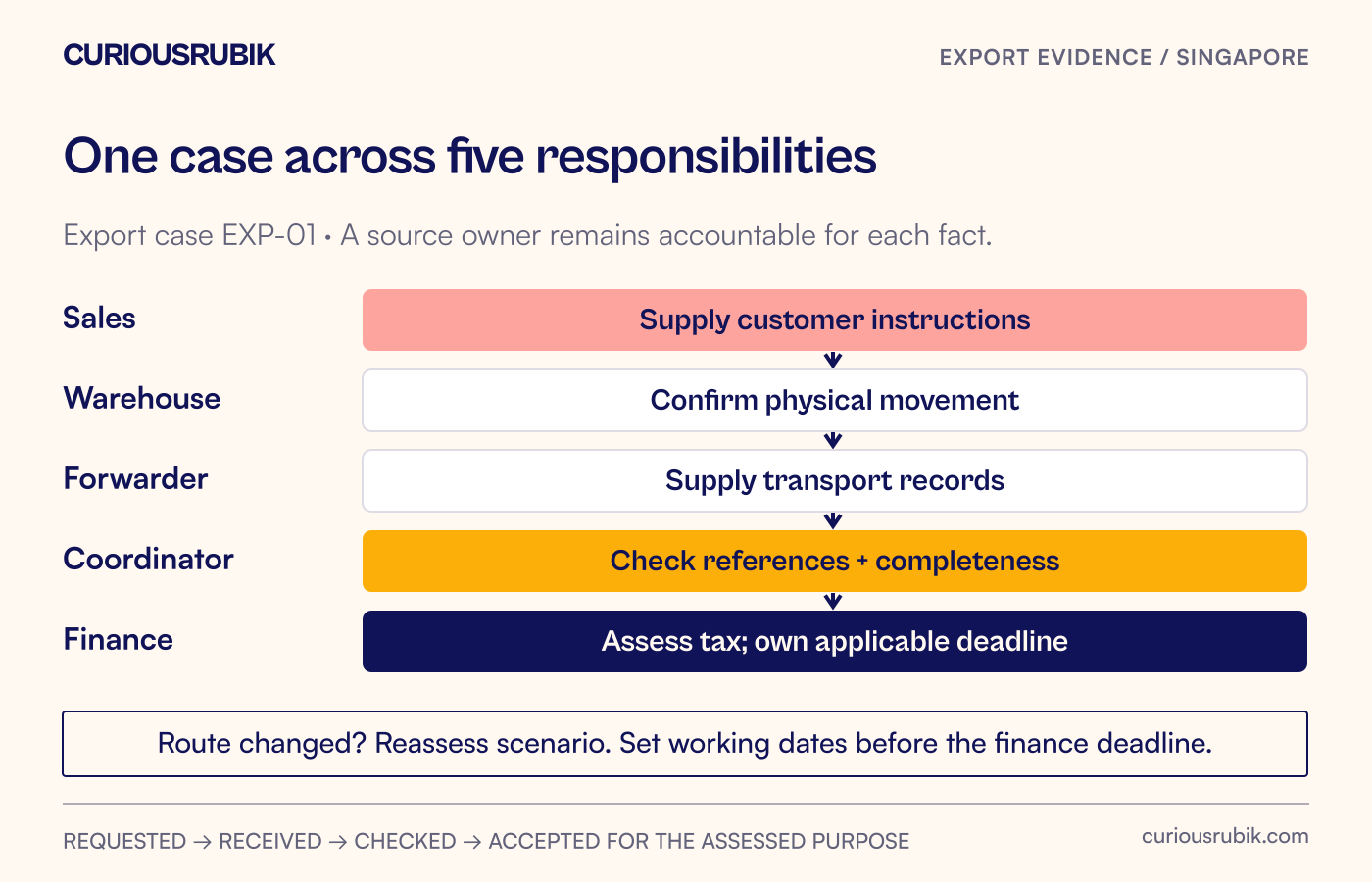
Sales holds the order. The warehouse has the collection note. The freight forwarder has the transport record. Finance sees an overseas customer and an invoice marked for export, but nobody can say whether the evidence set is complete.
An export coordinator does not need to create every document or make the tax decision. Their job is to know which evidence the transaction requires, who will provide it, when it is due and what must happen if the records do not agree. That ownership should begin before dispatch.
An overseas billing address does not describe the movement of the goods. The supplier may arrange transport, the customer may nominate a forwarder, or the goods may first move to another party in Singapore. Those differences can change the evidence needed and the tax assessment.
For a GST-registered supplier seeking zero-rating, IRAS requires the relevant export conditions and supporting documents. Its guidance distinguishes direct and indirect export arrangements and directs businesses to scenario-specific requirements. The coordinator should therefore start from an arrangement confirmed by logistics and the commercial owner, then have the tax or trade specialist identify the applicable route.
Record who has custody, who controls the export, where the goods will move and which party can obtain the transport evidence. If these facts change, reopen the assessment. An evidence checklist approved for one arrangement should not silently follow the order into a different one.
The operating design here supports that assessment. It does not replace the relevant IRAS guidance, permit conditions or specialist judgment.
IRAS generally allows up to sixty days from the time of supply to export the goods and collate the required export evidence. Its guidance identifies conditional exceptions and extensions. The clock should not simply start at warehouse dispatch: for exports, the relevant time-of-supply events include invoice issuance and receipt of payment.
Finance should confirm the applicable start date, deadline and any properly supported exception. The coordinator then sets earlier working dates for obtaining and checking documents. Those internal dates create time to resolve problems; they are not extra statutory deadlines.
Keep the distinction visible. “Transport evidence expected next Tuesday” is a working commitment from a source party. “Tax review required before the applicable deadline” is a separate control. If an expected document is late, the owner needs enough time to escalate rather than discover the issue at the end of the allowed period.
Do not assume an extension because the shipment is delayed. IRAS's export guide sets conditions for specified extended scenarios and requires prior approval for other scenarios outside them. An unresolved case belongs with the qualified reviewer before the business relies on an exception.
One row per required evidence item can work well. Link the rows through a stable export-case reference and include:
Use precise status labels. “Requested”, “received”, “checked” and “accepted for the assessed purpose” are different stages. A received file may be unreadable, incomplete or unrelated to the goods in the invoice.
Where documents cover several orders or partial shipments, record the relationship explicitly. A single transport reference pasted onto every order may conceal goods that did not move in that shipment. Quantity and reference matching should reflect the actual movement.
CURIOUSRUBIK EXPORT EVIDENCE / SINGAPORE One case across five responsibilities Export case EXP-01 · A source owner remains accountable for each fact. Sales Supply customer instructions Warehouse Confirm physical movement Forwarder Supply transport records Coordinator Check references + completeness Finance Assess tax; own applicable deadline Route changed? Reassess scenario. Set working dates before the finance deadline. REQUESTED → RECEIVED → CHECKED → ACCEPTED FOR THE ASSESSED PURPOSE curiousrubik.com
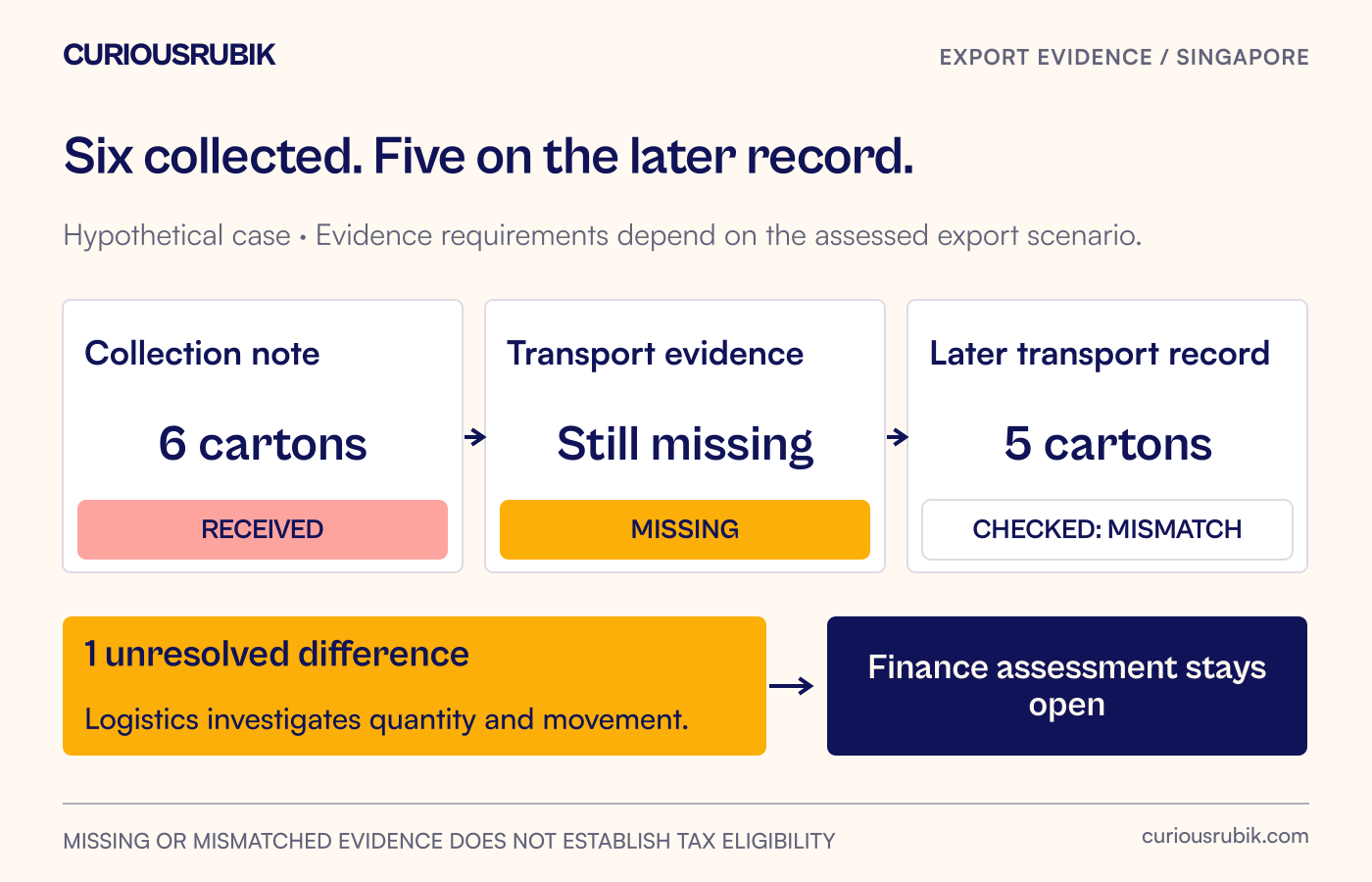
Consider a hypothetical Singapore supplier whose overseas customer appoints a local forwarder. The warehouse confirms collection of six cartons. Sales assumes the order is finished because the goods left the premises. The export coordinator sees that the specialist-approved evidence list still includes transport evidence and relevant customer instructions.
The coordinator follows up with the designated source parties and records the expected dates. A forwarder's acknowledgement of collection helps explain one stage of the movement; it does not automatically answer every question needed for the tax assessment.
Now suppose the later transport document identifies five cartons. Logistics investigates whether the sixth travelled separately, whether the description differs or whether the record is wrong. The case remains visibly unresolved until the discrepancy is explained with appropriate evidence. Finance assesses the consequence for the affected supply.
This example does not establish eligibility for zero-rating. It shows why a coordinator needs to test coherence as well as presence. Six attached files are not necessarily a complete story about six cartons.
CURIOUSRUBIK EXPORT EVIDENCE / SINGAPORE Six collected. Five on the later record. Hypothetical case · Evidence requirements depend on the assessed export scenario. Collection note 6 cartons RECEIVED Transport evidence Still missing MISSING Later transport record 5 cartons CHECKED: MISMATCH 1 unresolved difference Logistics investigates quantity and movement. Finance assessment stays open MISSING OR MISMATCHED EVIDENCE DOES NOT ESTABLISH TAX ELIGIBILITY curiousrubik.com
The coordinator should be able to state the blocker in a sentence: the transport record is missing, the quantities conflict, the customer changed the route, or the specialist has not assessed an exception.
Route that blocker to the person who can resolve it. Logistics confirms movement. Sales obtains customer instructions. The source party corrects its document through the appropriate process. Finance or the tax specialist decides treatment and any required adjustment when evidence is inadequate or late.
Repeated reminders to a shared mailbox can make the process look active while leaving the decision untouched. Set an escalation point based on the remaining time and consequence. An item nearing its applicable deadline deserves a direct review of the options and required action, not a sixth copy of the same request.
Preserve the original record when a corrected document is obtained. The reviewer should understand what changed, who issued the correction and how it resolves the discrepancy. Do not edit another party's evidence internally to make it match the invoice.
A delivered order may be closed in the sales workflow while the tax-evidence case remains open. Allow that distinction. Otherwise, the commercial closure can remove the very reminders needed to finish the evidence.
Once complete, retain the relevant records under the applicable tax, trade and company requirements. Singapore Customs has its own trade-document retention obligations. The coordinator should hand the completed set into the established retention process rather than deciding a deletion date from the shipping status.
Also confirm access. A document that exists only in a forwarder's temporary download area may be unavailable when the company later needs it. Ensure the authorised record owner has an appropriate retained copy or durable access, with the source and version preserved.
Automation can generate the evidence tasks from an approved scenario, compare references and flag missing or inconsistent records. It can show ageing by source party and alert the coordinator when the commercial arrangement changes.
Keep tax eligibility and unusual discrepancies with qualified people. A scan that reads the same invoice number on two files does not establish that the goods were exported. If extraction is uncertain, show the original document and the disputed field to the reviewer.
For a pilot, choose one recurring export arrangement and follow its cases through to evidence closure. Measure time from dispatch to a reviewed complete set, unresolved mismatches, late escalation and the amount of chasing needed from each source party.
At the next dispatch meeting, identify the person who will still own the case after the warehouse marks it shipped. Give that person the scenario, source-party contacts and finance reviewer. That is the point at which separate documents can become a controlled evidence process.