The difficult part of replacing a legacy application is often the period when the business must depend on both the old and the new. Work is already in progress. Downstream systems expect familiar identifiers and messages. Employees know exceptions that never reached the documentation. A replacement can pass its feature tests and still disrupt operations when those dependencies meet a new transaction path.
Modernization therefore needs a transition design as well as a destination architecture. The objective is to control disruption and maintain service within agreed limits; no responsible plan can promise that change carries zero risk.
For a business sponsor and technology leader, the key decision is how to move a bounded part of the operation, demonstrate that it works and retain a credible response when the evidence does not support further expansion.
Age alone is an incomplete investment case. Establish the specific problem: unsupported components, difficult changes, unreliable operation, scarce skills, unacceptable security exposure or a capability the business cannot deliver. Different problems can justify different treatments.
An infrastructure refresh may address a support deadline without improving a tangled workflow. Replacing a user interface can help employees while leaving a critical dependency untouched. A complete rewrite may remove some constraints but introduce a lengthy period of duplicated cost and uncertain behavior.
Describe the intended outcome and the part of the system responsible for it. This limits the tendency to treat modernization as permission to rebuild everything. It also makes it possible to compare replacement with containment, targeted improvement or retirement of unused functions.
A decision to retain a component should be explicit, with an owner and a review condition. A program that quietly leaves the hardest dependency until last can run out of time while the original risk remains.
Inventory the application’s consumers and outputs, including reports, scheduled jobs, exports and manual procedures. Ask who relies on each one and what happens if its timing or meaning changes. A file that looks obsolete to the development team may support a weekly reconciliation outside the application.
Observe representative work and unusual cases. Historical behavior can reflect valid business rules, deliberate accommodations or defects people have learned to work around. Do not automatically reproduce every behavior, but do not remove it merely because nobody remembers its origin.
Classify important differences as preserve, deliberately change or investigate. Give business owners authority over intended operational changes and record their consequences. Comparing old and new outputs is useful only when the team knows which differences are acceptable.
Use examples to make implicit rules testable. Include incomplete records, cancellations, work spanning accounting or operating periods, and transactions that are already underway. The boundary cases often determine whether a transition can be performed safely.
Incremental replacement can reduce the amount of work exposed to a single change, but only if the selected boundary is meaningful. A small screen may still affect a large shared transaction. A bounded service or cohort can be a better unit when its inputs, effects and ownership are clear.
Martin Fowler’s original 2004 description of the Strangler Fig approach proposes gradually building a replacement around an existing application. It is an architectural option for consideration, not evidence that incremental replacement always costs less or succeeds. Fowler, Original Strangler Fig Application.
Evaluate whether the old system can expose a reliable interface or routing point. Determine how work will be assigned, how identity will remain stable and how the team will detect a transaction taking the wrong path. If a useful boundary cannot be established without extensive fragile changes, the staged approach may create more risk than it removes.
A coordinated cutover can be appropriate where the operation cannot tolerate prolonged coexistence or where the data and transaction model cannot be divided safely. That choice demands stronger preparation for the larger transition event. Neither approach removes the need for evidence and recovery planning.
Consider a hypothetical commercial laundry business replacing its job-tracking application. Jobs may remain open for several days, moving through collection, processing, quality checks and return delivery. Switching every open job at midnight would require the new system to interpret partially completed states accurately.
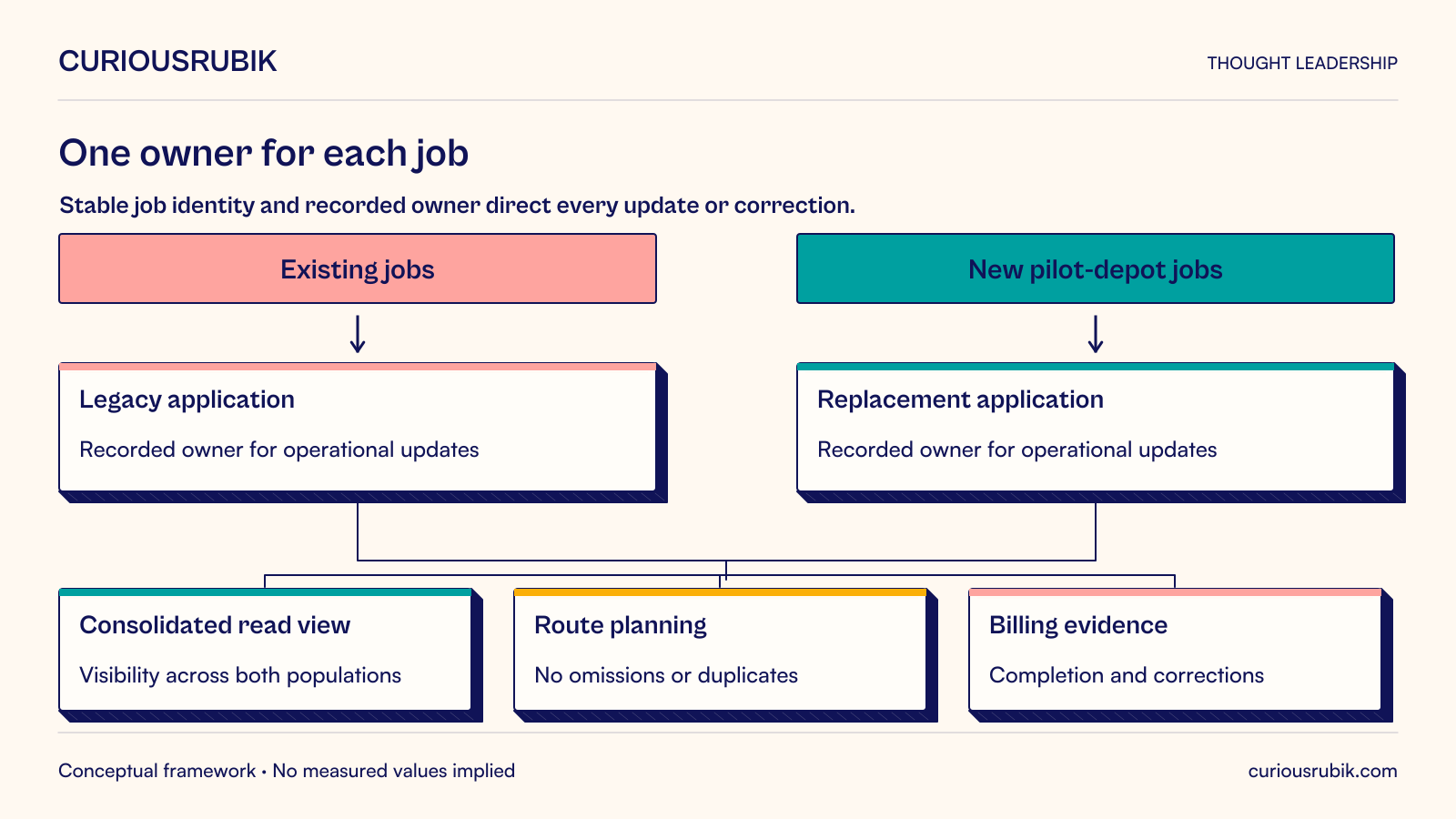
One possible transition rule keeps existing jobs in the legacy application and routes newly created jobs for a defined pilot depot into the new application from an agreed point. Each job has a stable identifier and a recorded owning system. Staff looking up a job are directed to that owner rather than choosing whichever screen is convenient.
This is only viable if shared dependencies are handled. Customer service needs a complete view across both populations. Route planning must avoid omitting jobs from one source or including a job twice. Billing needs a clear rule for receiving completion evidence, including corrections after the initial event.
The distinction is between visibility and authority. A consolidated view can display both populations without becoming another place that changes job status. During coexistence, the team should know which system can commit each transition and where a correction must originate.
The pilot is not a claim that all depots behave alike. Different contract rules, operating patterns or equipment may require further evidence before the routing rule expands.
Temporary architecture can become the most demanding part of the program. It needs monitoring, support ownership and tests just as the final application does. Labeling an adapter temporary does not make its failures less consequential.
Define the information exchanged between systems, its meaning and the permitted delay. Record whether a value is copied for display, used for a decision or authoritative for a business action. These uses carry different freshness and reconciliation requirements.
Avoid casual dual writing, where two applications independently update the same fact and the team hopes that both changes succeed. If a transition requires coordinated updates, design how partial completion, duplicate delivery and conflicting changes will be detected and resolved. The business must understand the state it can safely rely on while resolution is pending.
Run operational rehearsals with staff who will support the combined service. Include a missing message, an unavailable dependency and a correction to a previously completed job. A transition that only the project architect can diagnose is not yet ready for routine operation.
Parallel evaluation can help establish whether the replacement interprets representative inputs correctly. However, running both systems must not cause two collections, two customer notifications or two bills.
Where appropriate, execute the new logic in a controlled comparison mode that suppresses external effects. Compare intended outputs and investigate differences against approved rules. Protect production information and ensure the comparison cannot accidentally become an active transaction path.
Do not treat the legacy result as universally correct. It is evidence of current behavior, which may contain known errors. The expected result should come from an authorized interpretation of the business requirement, with old-system comparison used to expose differences that need explanation.
Measure operational outcomes in the active pilot as well: unfinished jobs, correction effort, missed handoffs, support demand and completion timing. A high agreement rate on a narrow calculation does not establish that the end-to-end service is ready.
A rollback button can restore a software version without restoring the business to its previous state. Once the new application has accepted work or triggered an external effect, recovery must account for those facts.
Before launch, distinguish stopping new intake, restoring read access, returning ownership of eligible work and correcting completed effects. Some jobs may need to finish in the new system even if further pilot intake is paused. Others may be transferable only after reconciliation and an explicit ownership change.
In the laundry example, switching the routing rule back does not move an already processed job’s history into the legacy application. The team needs a supported way to see and complete that job. Recreating it blindly risks duplicate collection or billing.
Define who can pause expansion, what evidence triggers a pause and who authorizes resumption. Test the recovery steps within the time and staffing available during actual operations. A documented procedure that has never been attempted offers limited assurance.
The budget should include coexistence, reconciliation, training and support across both systems. It should also account for decommissioning the old path, removing temporary adapters and preserving required records. Otherwise, apparent delivery savings can leave the organization paying for two permanent platforms.
GAO’s 2019 review of selected critical federal legacy systems identified modernization-plan elements including milestones, the work required and the planned disposition of the legacy system. The study concerns federal systems; its planning questions are useful here without importing its findings as private-sector statistics. GAO, Information Technology: Agencies Need to Develop Modernization Plans for Critical Legacy Systems.
Set an exit condition for each temporary component. For example, the old job path can stop accepting updates only after its remaining jobs and correction obligations have been resolved or transferred under an approved process. Lack of recent user activity alone does not establish that no dependency remains.
Track business risk reduction alongside replacement progress. A program can move many low-risk screens while leaving the unsupported transaction engine unchanged. The sponsor should see whether the original reason for modernization is actually being addressed.
A useful expansion decision brings together the pilot’s operational results, unresolved differences, support capability and recovery evidence. State which conditions were tested and which remain outside the demonstrated boundary.
If the evidence is weak, pause or change the transition design rather than treating the next cohort as inevitable. A smaller release can still create valuable learning, but that learning must influence the plan.
Legacy modernization succeeds operationally when the business can understand and control each change in responsibility. The destination matters, but the path deserves equal design attention: clear ownership, supported coexistence, observable results and a credible way to finish the transition.