The choice between a monolith and microservices is a choice about boundaries, deployment and operating responsibility. It is not a contest between old and new technology. A well-structured application deployed as one unit can serve a business effectively. A collection of services can help teams change and scale capabilities independently, but it also introduces coordination and failure conditions that the organization must manage.
For a business sponsor and architecture lead, the useful question is where independent deployment or operation creates enough value to justify those additional obligations. The answer should follow the application’s workload, change patterns and team capabilities.
Counting services is not a measure of architectural maturity. The decision is successful when the structure helps the business deliver reliable changes at an acceptable continuing cost.
A monolith is commonly deployed as one application unit, but its internal design can still have clear modules and responsibilities. Those boundaries can make the code easier to understand and test without introducing network communication between every capability.
Microservices place selected boundaries between independently deployed services. That can allow one capability to change or scale without redeploying the whole application, provided the contracts and dependencies actually support that independence.
James Lewis and Martin Fowler’s 2014 description emphasizes independently deployable services organized around business capabilities. It also notes that service boundaries introduce remote communication costs and that some changes still require coordination. Their article describes an architectural style, not a universal rule that it outperforms a monolith. Lewis and Fowler, Microservices.
A system split into many processes but requiring coordinated releases for ordinary changes may carry distributed-system costs without obtaining the intended independence. Conversely, a modular application can provide useful separation even while remaining one deployment.
Ask which capability genuinely needs a different release cadence, resource profile, availability treatment or owner. The answer should be concrete enough to test.
Perhaps a computationally intensive job competes with interactive work. Perhaps two stable business capabilities change on different schedules and are maintained by teams able to own them end to end. Perhaps a component must be replaced without repeatedly redeploying an unrelated critical service.
Distinguish those needs from symptoms caused by weak internal structure or delivery practices. If the application has unclear modules and little automated testing, splitting it into services can distribute the same confusion across more locations.
Record the expected benefit of the proposed boundary. Faster independent release, isolated resource consumption and clearer ownership are different outcomes. Each requires different evidence and can fail for different reasons.
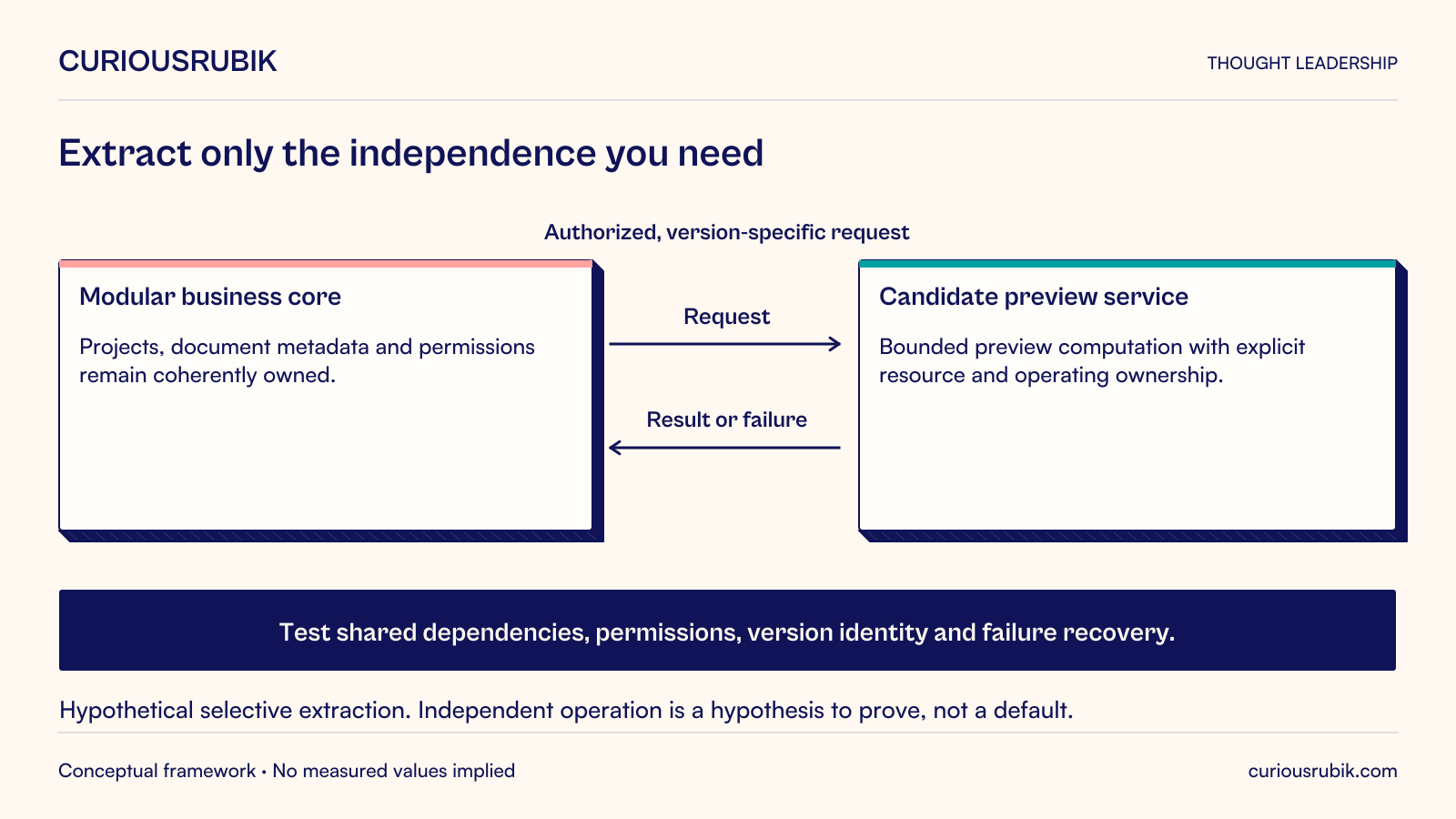
Consider a hypothetical engineering collaboration platform. Its core manages projects, document metadata and permissions. It also creates preview images from large design files. One team initially maintains the application and releases the capabilities together.
A modular core may be a sensible starting point if the work is cohesive and the team can operate it reliably. Project access and document ownership have closely related rules that should remain consistent.
As demand changes, preview generation may consume a very different resource profile from interactive document browsing. A bounded processing service could become worth evaluating. The core would authorize access and create a processing request; the worker would produce a preview under a defined contract and report its outcome.
That boundary does not mean every project or document function should become a separate service. Nor does it eliminate security responsibilities. The processing path must protect source files and outputs, and a preview must remain associated with the correct document version and authorized context.
The team should compare this option with improving the existing job execution model inside the current application. Separation earns its cost only if the measured constraint and operating requirements support it.
Study recent and planned changes. Which capabilities are repeatedly modified together? Which share rules that must remain consistent? Which can evolve through a stable interface without forcing their consumers to change at the same time?
A boundary that cuts through a frequently changing business rule can increase coordination. Teams may need to negotiate new contracts, deploy compatible versions and manage a transition period for every ordinary change.
Use concrete examples rather than assuming independence from an organization chart. Two teams may exist because of a historical staffing arrangement, while the underlying work remains tightly coupled. Conversely, one team may own two capabilities that could benefit from separate operation.
Define the contract in business terms as well as technical fields. In the preview example, the request must identify the source version, permitted output and expected outcome. A successful response should mean more than a worker process finishing without an error.
Test how the contract evolves. A boundary that cannot accommodate a routine change safely may need redesign before independent deployment becomes credible.
Inside one process and database, some operations can be coordinated within a single transaction. Across services, the design may need to handle intermediate states, retries and partial completion explicitly.
Determine which business conditions must remain immediately consistent and which can tolerate a delay. Do not adopt eventual consistency as a general slogan without explaining what users and operators will observe while the system is between states.
For preview generation, a document can remain available while its preview is pending, if that is an accepted service behavior. A failed preview should not falsely imply that the underlying document upload failed. The user and support team need to distinguish those outcomes.
Retries must avoid creating confusing duplicate work or associating an old result with a new document version. Timeouts need an outcome-reconciliation path because a missing response does not necessarily mean the worker did nothing.
These obligations can be manageable, but they are part of the cost of distribution. The architecture should make them visible before the business depends on the service boundary.
A service can scale separately only if the remaining dependencies allow it. More workers may still compete for the same storage bandwidth, connection limit or external quota.
Measure the workload and bottleneck before assuming that separation will improve throughput. A query improvement, better scheduling or bounded concurrency may resolve the problem with less operating complexity.
Consider both peaks and normal operation. Separate services can support different resource allocations, but they also need minimum operating capacity, monitoring and deployment infrastructure. The cost comparison should reflect the actual service pattern.
A monolith can also run multiple instances where its design permits. The relevant comparison is not scalable versus unscalable; it is which parts can be scaled, how efficiently and with what constraints.
For the preview example, the evidence should show whether independent processing resources protect interactive response and whether the system can recover its queue after a burst without overwhelming shared dependencies.
Each service needs accountable ownership, deployment, monitoring, security maintenance and incident response. A small team can operate multiple services, but the resulting workload should be explicit rather than assumed negligible.
Ask how an incident will be diagnosed across boundaries. Can the team trace a request, distinguish a dependency failure and determine which business work is incomplete? A collection of isolated logs without a common transaction context can lengthen investigation.
Standardize routine operating practices where useful. Independent teams do not need to invent incompatible ways to deploy, authenticate, monitor and recover every service. Shared tooling can reduce the burden while preserving appropriate capability ownership.
Do not use microservices to avoid resolving organizational responsibilities. If nobody owns the end-to-end user outcome, a request can remain broken while every team reports that its component is healthy.
The architecture should fit the organization’s demonstrated ability to build and operate it, with a credible plan for any additional capability required.
When business boundaries are still changing, an internal module can be easier to reshape than a published service contract used by several consumers. That can favor a simpler deployment while the team learns.
This is a conditional judgment, not a requirement to start every system as a monolith. A known integration boundary or distinct operating requirement may justify services from the outset. The important point is to acknowledge uncertainty rather than freeze a guess into a large distributed design.
Keep modules and dependencies clear enough that a future extraction remains possible. Avoid casual access to another module’s internal data and record significant business rules and interfaces.
At the same time, do not build speculative abstraction layers solely for imagined future scale. Preserve useful options with proportionate design, then revisit the boundary when actual change or workload evidence supports it.
Choose one candidate boundary and define the expected improvement. Measure the current release, resource or operating problem and test a limited alternative against the same service conditions.
Include contract evolution, failure recovery and support in the experiment. A demonstration that a service responds successfully proves little about whether it can be deployed independently or operated under pressure.
Compare continuing cost as well as initial extraction effort. Consider team coordination, testing, deployment, infrastructure and incident work. Avoid a business case that counts the benefits of independence while omitting the work required to sustain it.
A valid result may support extraction, retaining the module or changing the proposed boundary. The experiment should be designed to inform that decision rather than justify a predetermined architecture.
Monoliths and microservices are architectural options with different tradeoffs. The business gains little from adopting either as an identity or maturity target.
A strong decision states the independence needed, the evidence that the boundary supports it and the operating responsibilities introduced. It preserves coherent business rules and makes partial failure understandable.
The right architecture is the one that lets the organization change and operate the service reliably under its actual conditions. Sometimes that is a disciplined modular application. Sometimes it includes independently deployed services. Often the most proportionate answer is a selective combination whose boundaries have a clear reason to exist.