Imagine changing payroll provider before the next pay run. The outgoing provider can produce the latest payslips, but nobody has agreed how to hand over year-to-date balances, unresolved corrections, authorised changes or the evidence behind them. The new provider receives a file, yet the internal payroll owner cannot confirm that it describes the complete position.
This hypothetical exit rehearsal is worth performing before routine data exchange begins. It reveals what the business needs to own throughout the relationship: a clear processing purpose, an approved data handoff, reconciled outputs and a way to retrieve or appropriately dispose of information at the end.
For a Singapore employer, outsourcing payroll does not remove its responsibilities. The provider performs agreed work; the internal payroll owner remains accountable for the business's instructions and acceptance of the result, with privacy and security specialists handling the relevant data-risk decisions.
Ask what another competent provider would need to continue the payroll correctly. Likely categories include the current approved employee facts, year-to-date values, relevant historical outputs, pending changes and outstanding questions. The exact scope depends on the service, obligations and records already held by the employer.
For each category, establish who owns the source, what format is usable and how completeness will be checked. A collection of final payslips may not explain an unresolved adjustment. A cumulative total may not show which approved changes have been applied. A file export that nobody has tested is a weak exit plan.
Agree how the outgoing provider will supply the authorised information, resolve open work and confirm the status of retained copies and access. Set reasonable service and review milestones through the contract process. Do not assume that paying the final invoice settles these operational requirements.
The privacy owner determines what must be returned, retained or disposed of under the relevant obligations and agreed arrangements. Ending a supplier relationship is not an instruction to destroy records the employer still needs, or permission for the provider to retain everything without a defined basis.
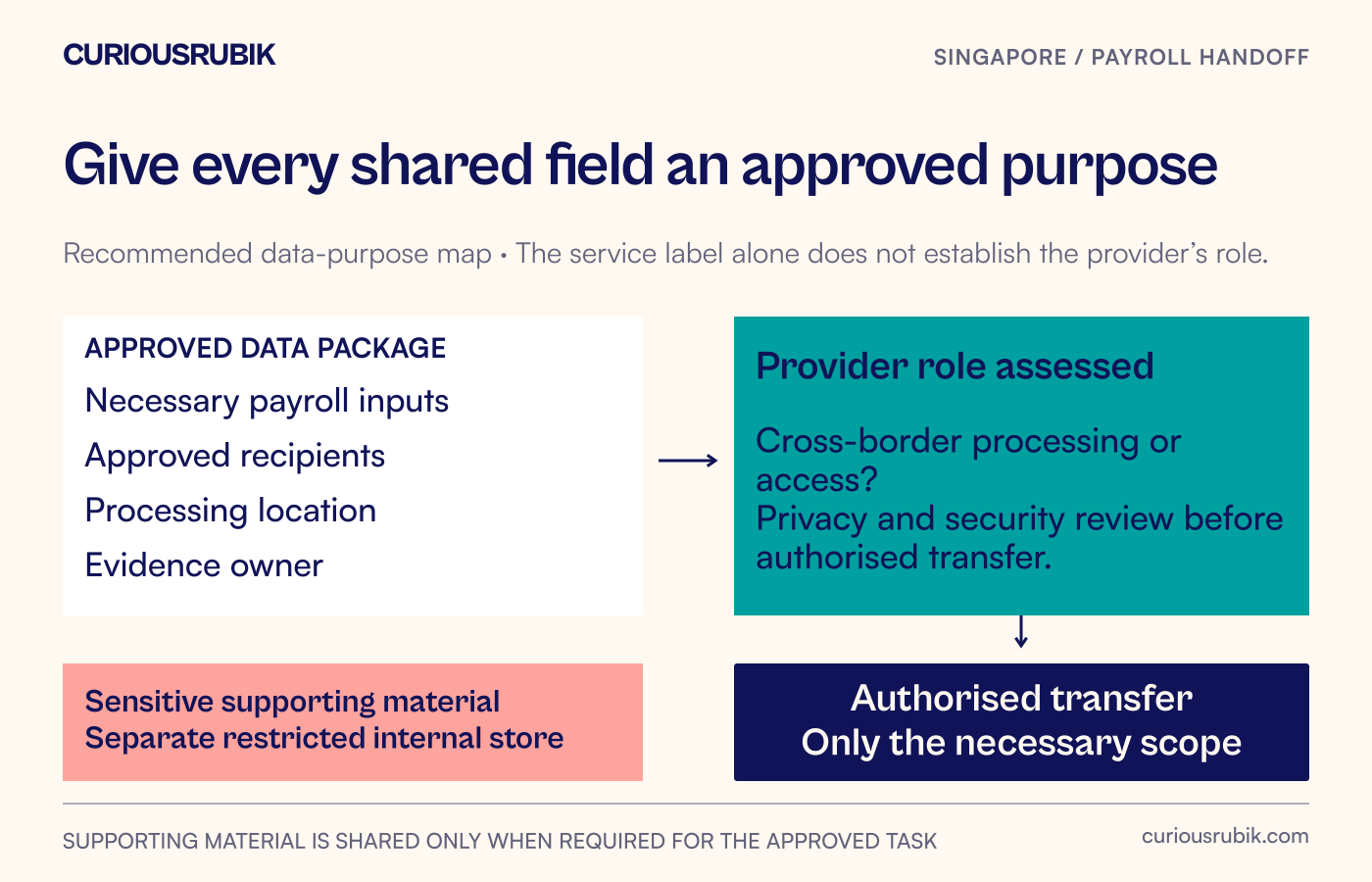
PDPC distinguishes an organisation from a data intermediary processing personal data on its behalf. The organisation retains obligations in respect of that processing. Establish the actual role and purposes rather than relying on a contract heading that labels every service provider the same way.
The provider should receive what it needs for the authorised payroll work. Explain the purpose of each data category, the people or teams that may access it and any other processors involved. An entire personnel folder is rarely an informative answer to the question “what does this payroll calculation need?”
Avoid including sensitive supporting material merely because it may explain an approved payroll instruction. In many cases the provider needs the authorised payroll consequence and relevant period, while detailed case material stays with the appropriate internal owner. The responsible specialists should determine the necessary scope for the particular task.
Where processing or access occurs overseas, assess the relevant transfer requirements and safeguards. Singapore's PDPA does not impose a universal rule that all personal data must stay in Singapore. Its transfer requirements must still be met; a supplier's general assurance is not the same as a reviewed arrangement.
CURIOUSRUBIK SINGAPORE / PAYROLL HANDOFF Give every shared field an approved purpose Recommended data-purpose map · The service label alone does not establish the provider’s role. APPROVED DATA PACKAGE Necessary payroll inputs Approved recipients Processing location Evidence owner Provider role assessed Cross-border processing or access? Privacy and security review before authorised transfer. Sensitive supporting material Separate restricted internal store Authorised transfer Only the necessary scope SUPPORTING MATERIAL IS SHARED ONLY WHEN REQUIRED FOR THE APPROVED TASK curiousrubik.com
Take a hypothetical monthly input containing approved salary changes, starters, leavers and adjustments. Assign a unique period and version. The internal payroll owner confirms which changes are authorised, their effective dates and the checks completed before transmission.
The provider acknowledges receipt of that version and identifies rejected or unclear items. An acknowledgement that “the file arrived” does not confirm that every change was accepted for processing. Capture the exception list and who will resolve it before the run proceeds.
When the output returns, reconcile the accepted inputs to the result. Compare employee counts and relevant totals, but also test the changed items. An unchanged overall total can conceal one employee being overpaid and another underpaid. The employer's reviewer needs enough detail to establish that the approved instructions were applied.
A correction after the cut-off needs an explicit treatment. Record whether it is included in the current run, deferred under an authorised decision or requires another adjustment route. Do not replace the original input file without telling the provider which version it supersedes.
MOM requires itemised payslips for employees covered by the Employment Act. The employer therefore needs reliable evidence of the required output and its delivery through the agreed process. The provider's completion notice should support that responsibility rather than become its only evidence.
Ask the provider and internal owner how they would handle a suspected disclosure, unauthorised access or misdirected payroll output. Who receives the alert? What facts must be preserved? Who contains the operational issue and who assesses any legal notification obligations?
The privacy lead owns that assessment with the relevant specialists. The contract and operating instructions should make the provider's reporting and cooperation responsibilities clear. Do not let a service desk's “resolved” ticket stand in for the organisation's assessment of consequences.
Use a controlled exercise rather than real payroll data where possible. Check whether the contact works, the available information is sufficient and the responsible people know the next decision. Avoid writing statutory reporting deadlines into a generic service worksheet without verifying the applicable circumstances and current requirements.
The same discipline applies to access changes. When a provider team member or internal reviewer changes role, confirm that access reflects the authorised work. A functioning payroll run is not proof that every person who can see its data still needs that access.
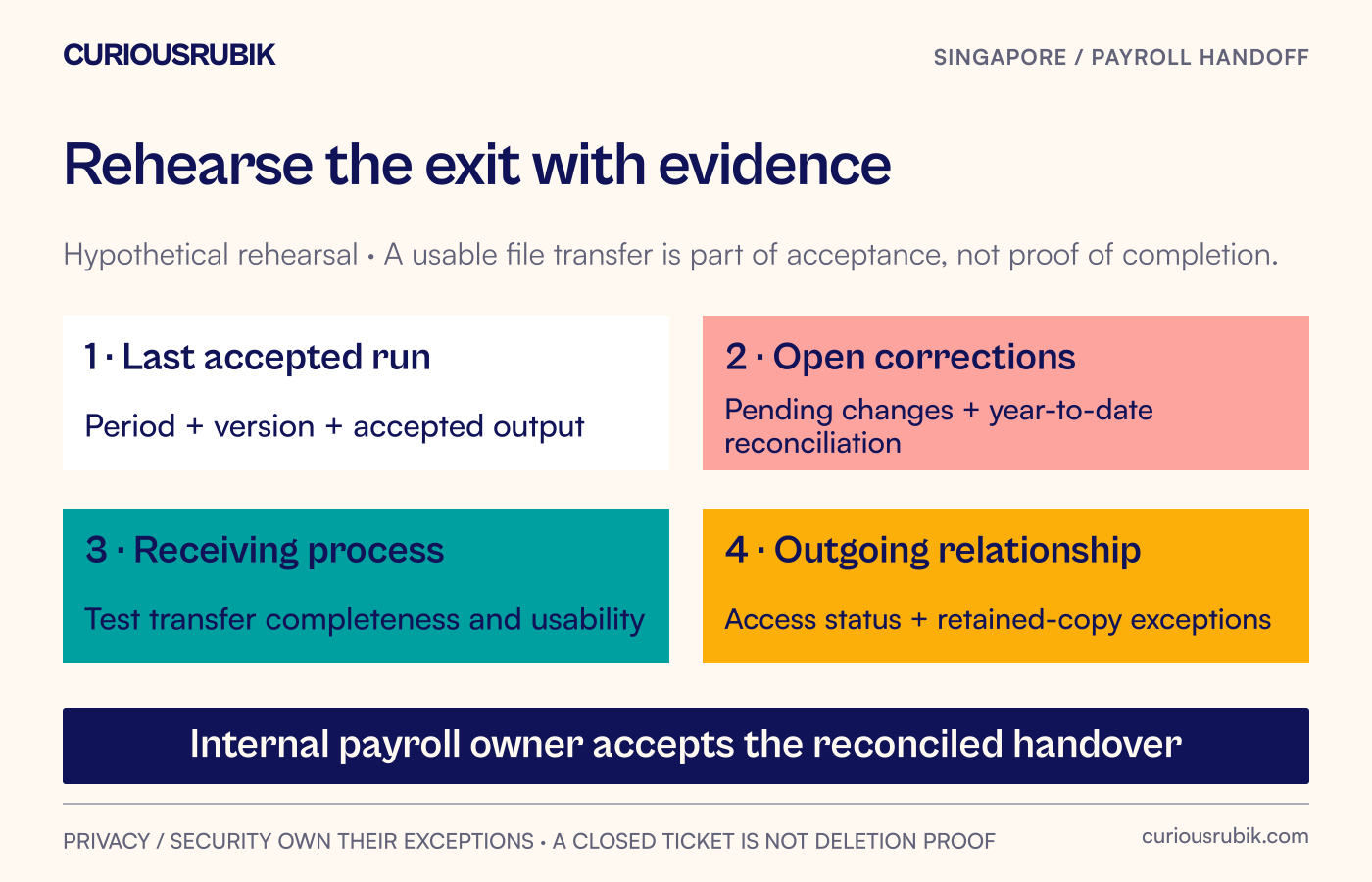
The monthly version history and exception log should make the eventual transition easier. The outgoing provider can identify the last accepted run, pending corrections and retained records. The internal owner can reconcile the handover without relying entirely on a departing contact's memory.
Test the transferred data in the receiving process before declaring the handover complete. Check selected employee records, cumulative values and unresolved changes. Use appropriate access controls and approved transfer arrangements; copying files into a broadly shared folder is not a neutral shortcut.
Confirm the agreed treatment of outgoing access, working copies, archives and any records retained for a justified purpose. A simple “deleted” statement may not describe backups or legally retained material. The evidence should match the agreed scope and explain exceptions rather than claim more than the provider can demonstrate.
CURIOUSRUBIK SINGAPORE / PAYROLL HANDOFF Rehearse the exit with evidence Hypothetical rehearsal · A usable file transfer is part of acceptance, not proof of completion. 1 · Last accepted run Period + version + accepted output 2 · Open corrections Pending changes + year-to-date reconciliation 3 · Receiving process Test transfer completeness and usability 4 · Outgoing relationship Access status + retained-copy exceptions Internal payroll owner accepts the reconciled handover PRIVACY / SECURITY OWN THEIR EXCEPTIONS · A CLOSED TICKET IS NOT DELETION PROOF curiousrubik.com
Automation can record authorised transfer events, track acknowledgements, compare versions and flag unresolved changes before the next run. It can remind owners of agreed exit tasks and retain evidence of completion.
It should not broaden the data package just because another field is available, grant provider access by default or mark a deletion complete from a generic ticket response. The business still needs to verify the meaning of each event and the authority behind it.
Measure unreconciled changes, unexplained access and exit obligations without completion evidence. Include the time taken to recover a clear account of one payroll adjustment. If that answer requires searching several private inboxes, the ongoing handoff needs improvement before the relationship ends.
Start the next provider review with the exit question: could the employer explain the last completed run and continue the next one with a controlled transfer? Work backward from the missing evidence. That approach improves the ordinary monthly service as well as the eventual change of provider.