A successful overnight job can conceal an operational failure. The application is available, the interface returned no error, and the support queue is quiet. Yet a required data feed never arrived, so the next team begins the day with an incomplete view.
Reactive support waits for someone to notice the missing result. Proactive operations defines the expected business outcome, watches the conditions that threaten it, and gives an accountable team a useful response before the problem spreads.
This shift does not require predicting every incident or purchasing an elaborate monitoring platform. It requires a disciplined connection between service commitments, observable evidence, intervention authority, and recurring improvement. For support leaders, the key decision is which operating conditions deserve active attention and what action that attention should trigger.
A server being available is necessary for many services, but it is not proof that the business can complete its work. Define the important outcomes the application supports: a complete daily data load, a usable schedule, a reconciled posting, or a timely customer response.
For each outcome, identify the population, expected timing, authoritative evidence, and acceptable exceptions. “All files received” is meaningful only if the team knows which files should arrive and when.
Include business calendars and legitimate variation. A site that does not operate on a holiday should not generate the same alert as a missing feed from an active site. A scheduled low-volume period should not be mistaken for system failure.
Keep the initial scope narrow. A few well-understood outcome checks with clear responses are more useful than hundreds of unexplained alerts.
A symptom tells the team that an outcome is affected or at risk. Diagnostic signals help explain why. A growing queue of unprocessed records is a symptom; a failing connection or changed validation rule may be a cause.
The SRE monitoring chapter distinguishes external behavior from internal instrumentation and emphasizes actionable signals. Applied to enterprise support, this means using business-facing checks to identify impact and technical evidence to guide investigation. Site Reliability Engineering, Monitoring Distributed Systems.
Avoid paging people for every internal fluctuation. If no timely action is needed, the signal may belong in a dashboard or a scheduled review. An alert should have an owner, a reason for urgency, and an initial response that can change the outcome.
Do not assume that more instrumentation automatically creates better operations. Monitoring also needs maintenance when systems, business schedules, and expected volumes change.
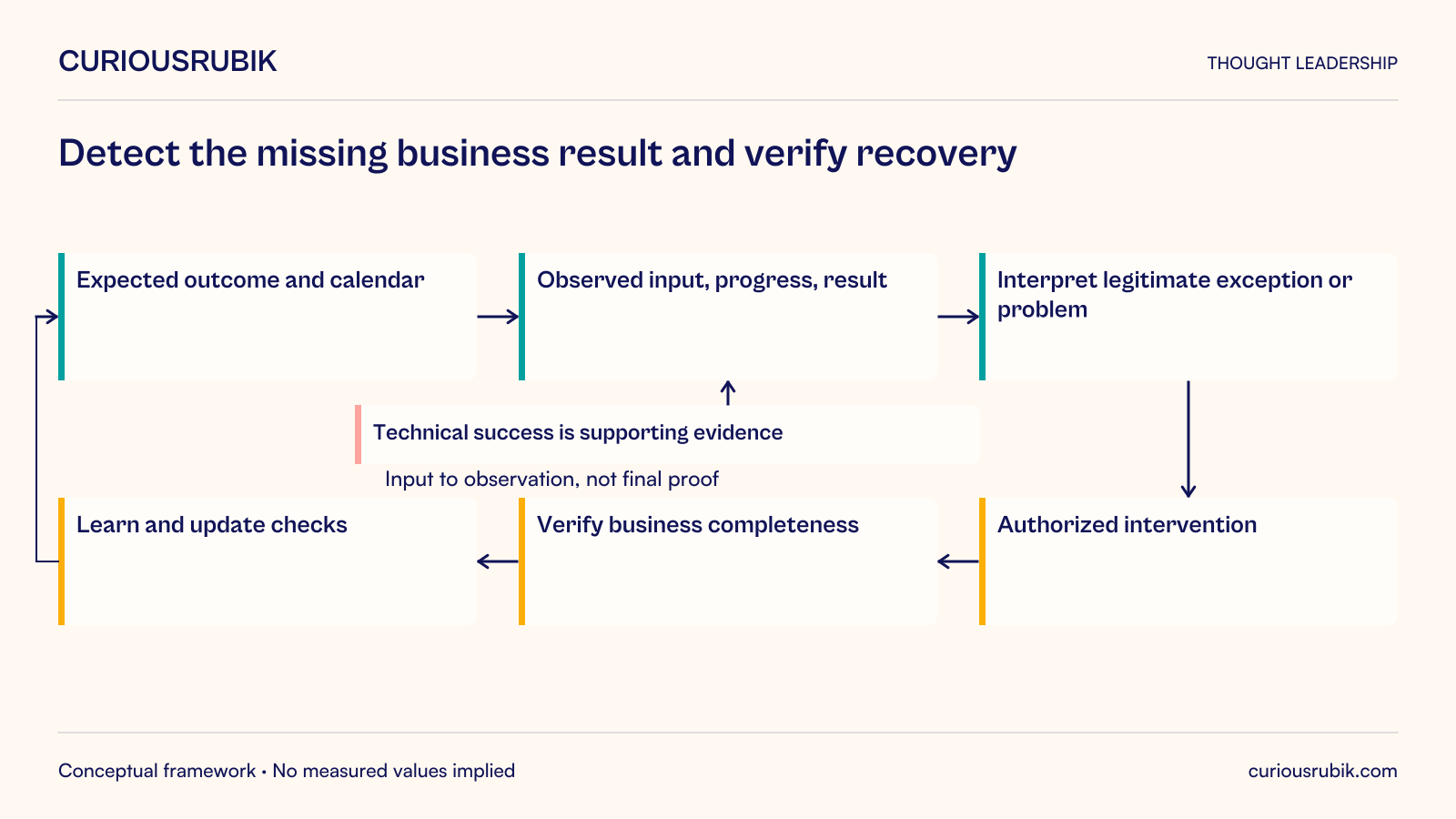
A useful working heuristic connects expectation, observation, interpretation, action, verification, and learning. This is a proposed operating method, not a formal service-management standard.
The expectation states what should happen. Observation supplies evidence. Interpretation distinguishes a genuine problem from a legitimate exception or a measurement defect.
Action belongs to an authorized role and follows a controlled procedure. Verification confirms that the business outcome has been restored. Learning changes the process, detection, or support method where appropriate.
The loop prevents two common failures: detecting a problem without anyone able to act, and closing an alert because a technical component recovered without checking the business result.
Consider a hypothetical commercial recycling company. Collection tickets from several depots feed a central system used for customer reporting and later commercial processing. The overnight integration reports success whenever it processes the files that are present.
A depot’s file occasionally arrives late. Because the job completes without error, support sees no incident. Customer operations discovers the gap later when a report omits collection activity.
The support team adds an expected-feed register based on the operating calendar and known depot schedule. It checks arrival, record completeness at agreed boundaries, and whether accepted tickets appear in the downstream view. The job’s technical success remains useful but no longer serves as the only evidence of completion.
A missing feed creates a case with the affected depot, expected period, last confirmed receipt, and customer-reporting deadline. Support first establishes whether the depot operated and whether the source data exists. It does not manufacture an empty file to make the process appear complete.
If the feed is delayed, the owner can hold the affected report or communicate a clearly bounded limitation through the approved route. If the file was received but rejected, the technical team investigates validation evidence. Reprocessing follows duplicate-prevention and reconciliation rules.
The pilot includes a holiday, a legitimate zero-activity day, a partial file, a duplicate delivery, and a late correction. It measures detection before downstream use, false alerts, investigation effort, and verified completeness. This hypothetical case illustrates proactive detection without claiming a measured reduction in incidents.
Some signals precede a failure: increasing queue age, repeated retries, shrinking storage capacity, or a growing number of unmatched records. They can justify action before users experience a full interruption.
Their meaning depends on context. A larger queue during a planned batch may be normal; a small queue containing one critical case may be urgent. Use age, deadline, work type, and consequence rather than volume alone.
Validate that the signal predicts a condition worth addressing. An attractive correlation may not be stable enough to support automated intervention. Begin with observation and controlled review when uncertainty is high.
Record what the signal does not cover. A healthy interface check may miss semantic errors in the data. A successful synthetic transaction may not represent every user role or business variant. Proactive support should remain candid about its blind spots.
A runbook should help an operator establish state and choose the next action. Include required evidence, prerequisites, authority limits, verification, and escalation.
Avoid broad “restart and retry” instructions when an action may have completed elsewhere. Repeated processing can duplicate records or external effects. The operator needs a way to identify uncertain outcomes and reconcile them.
Automate low-risk, well-understood remediation where appropriate, but preserve the same controls. A recurring failure that is automatically restarted every hour may still deserve investigation rather than being accepted as normal operation.
Keep access proportionate. Proactive support does not justify unrestricted permissions to alter business records. Separate observation, technical recovery, and business correction where their authority differs.
Tickets remain valuable evidence. Group related cases by business symptom and underlying cause rather than only by application or requester.
A series of small tickets can reveal one systemic issue: a confusing field, an unstable mapping, an aging dependency, or a rule that repeatedly creates manual correction. The support model should create time to investigate those patterns.
Use incident reviews for consequential or repeated failures. The SRE postmortem approach emphasizes learning from incidents and identifying improvements without blame-focused analysis. The useful enterprise application is to preserve the conditions that produced the failure and assign concrete follow-through. Site Reliability Engineering, Postmortem Culture.
Avoid treating the review document as the outcome. Track whether the agreed changes were implemented and whether they reduced recurrence or improved detection. An unowned action list does little to change operations.
A team may believe its intervention prevented an outage, but the counterfactual is often uncertain. Report what was observed: a queue was aging, an action was taken, and the intended outcome was completed or restored.
Track detection lead time, actionable-alert proportion, repeated causes, manual recovery effort, and verification of business outcomes. Interpret changes alongside volume and service scope.
Do not reward alert volume or claim every warning as an incident avoided. Those incentives can create noisy monitoring and inflated value claims. A useful monitoring improvement may reduce alerts while preserving or improving coverage.
Include false negatives discovered through user reports, reconciliations, or sampling. Proactive operations should learn from the failures its current checks did not detect.
A team fully occupied with immediate tickets has little capacity to remove their causes. Allocate explicit time and ownership for reliability and supportability work.
Prioritize improvements using recurrence, consequence, effort, and the likelihood of reducing future workload. A small change to an error message or reconciliation view can be more valuable than a large dashboard project.
Coordinate with the business product owner. Some recurring issues require process or policy changes rather than technical repairs. Support can provide evidence, but the appropriate business authority must make the decision.
Protect the improvement backlog from becoming an unbounded list of desirable features. Each item should describe the operating problem, expected effect, and evidence that will show whether the change helped.
New customer groups, operating schedules, integrations, and release behavior can invalidate old expectations. Include monitoring and runbook updates in change acceptance.
Review alert ownership when teams or suppliers change. An alert routed to an obsolete mailbox is a hidden support failure even if the detection rule still works.
Test the response periodically. Simulate a missing input or delayed outcome and verify that the right team can interpret the signal and act. A successful notification test alone does not prove the whole response loop.
Retire checks that no longer support a decision. Unused alerts and dashboards consume attention and make the important signals harder to see.
Ask for business-outcome coverage, not only response-time commitments for tickets. Require examples of expected-result checks, safe interventions, recurring-cause analysis, and verification after recovery.
Clarify the boundary between proactive monitoring and authority to change the system. A partner may be authorized to investigate and recommend while specific actions still require approval.
Review the evidence of improvement over time. Fewer tickets can mean better service, reduced use, or discouraged reporting. A stronger account connects demand, outcomes, detection, and the work removed from the operating process.
Proactive operations earns its value by making important failures visible early and turning that visibility into verified action. The goal is a more dependable business service, with less repeated reconstruction and fewer surprises, rather than a support team that simply watches more screens.