A monthly journal can keep running long after the reason for it has changed. The amount looks familiar, the description matches last month and the reviewer has more unusual items to investigate. That familiarity is precisely why a recurring entry needs a deliberate end condition.
The practical goal is to avoid making an accountant recheck every unchanged field while still catching the change that matters. A sound recurring-entry process starts with the business rationale, identifies who knows when it stops being true, and makes continuation a controlled decision.
Consider a hypothetical Singapore company allocating the cost of shared premises across three departments. The monthly entry uses floor area. During the year, one department relocates and another takes over its space. The premises bill remains unchanged, so an amount-based alert detects nothing. The allocation has nevertheless become questionable.
A review that merely confirms “same as last month” will miss this. The useful question is whether the allocation basis still describes how the premises are used. The facilities owner knows about the move; the accountant may not.
Another recurring journal may have a different trigger. A prepaid service has a contractual coverage period. An estimate may depend on a current activity volume. An allocation may depend on an agreed policy and current beneficiary data. Putting every entry on the same annual renewal date loses these differences.
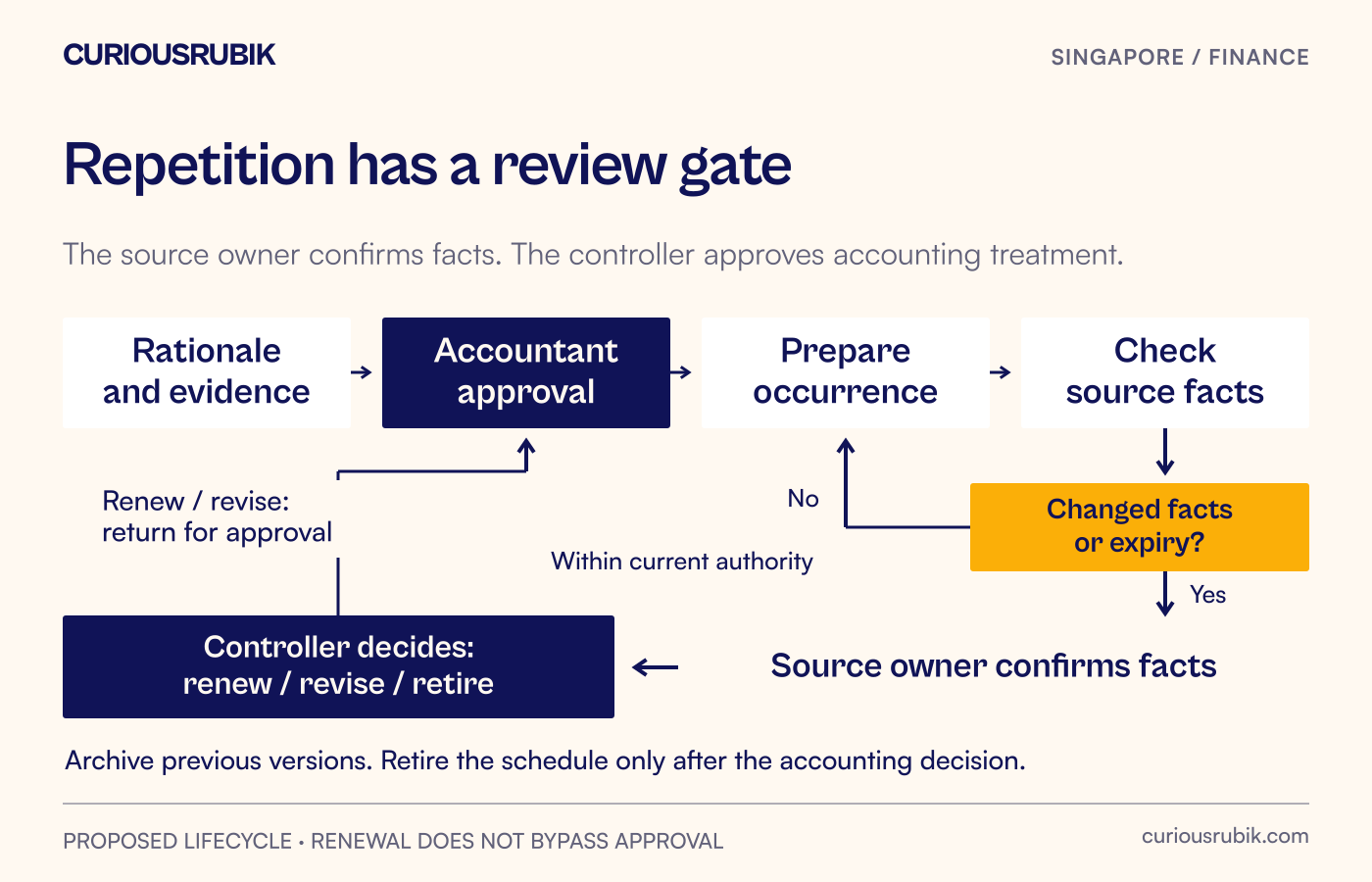
An expiry date controls the template's authority to continue. It does not determine the accounting treatment of the underlying transaction. If a template expires before finance has completed its review, the accountant still needs to decide what belongs in the accounts using the applicable framework and evidence.
A useful renewal sheet can fit on one page. It should answer the following questions without requiring the next reviewer to reconstruct the original discussion.
Give the template a stable identifier and a version. Link each posted occurrence to that version. A reviewer investigating an earlier month needs to see the rationale that applied then, rather than only the latest description.
Do not use “monthly adjustment” as the business reason. Write enough to explain the calculation and why it belongs in that entity. For the premises example, the reason might describe allocating an identified shared cost using an approved floor-area basis. The underlying agreement, affected locations and current allocation schedule should be retrievable.
CURIOUSRUBIK SINGAPORE / FINANCE Repetition has a review gate The source owner confirms facts. The controller approves accounting treatment. Rationale and evidence Accountant approval Prepare occurrence Check source facts Changed facts or expiry? No Within current authority Yes Source owner confirms facts Controller decides: renew / revise / retire Renew / revise: return for approval Archive previous versions. Retire the schedule only after the accounting decision. PROPOSED LIFECYCLE · RENEWAL DOES NOT BYPASS APPROVAL curiousrubik.com
There are at least three useful patterns. A small finance team can use all three without building a complicated review hierarchy.
For a time-limited source, align the template with the known period and make the end condition explicit. A service agreement ending in November should prompt a review before a December repetition. The reviewer must still check whether renewal, cancellation charges or an extension changed the facts.
For an entry with a variable driver, require a current input. Reusing last month's volume because this month's file is late should be a visible exception. The person approving a temporary estimate needs to know why the input is missing and when the estimate will be revisited.
For a stable allocation, use periodic confirmation plus event triggers. A department closure, transfer of staff, location change or revised cost-sharing agreement should bring the review forward. The point is to connect the journal to people who observe the event, rather than expecting finance to discover it from the ledger.
The frequency and approval level are company decisions based on risk and materiality. A small stable entry does not need the same scrutiny as a material estimate with uncertain assumptions. Document the distinction so reduced checking is deliberate and explainable.
Suppose the hypothetical allocation assigns 40%, 35% and 25% of the shared cost to three departments. These figures are illustrative, not recommended percentages. A relocation invalidates the floor-area schedule during the month.
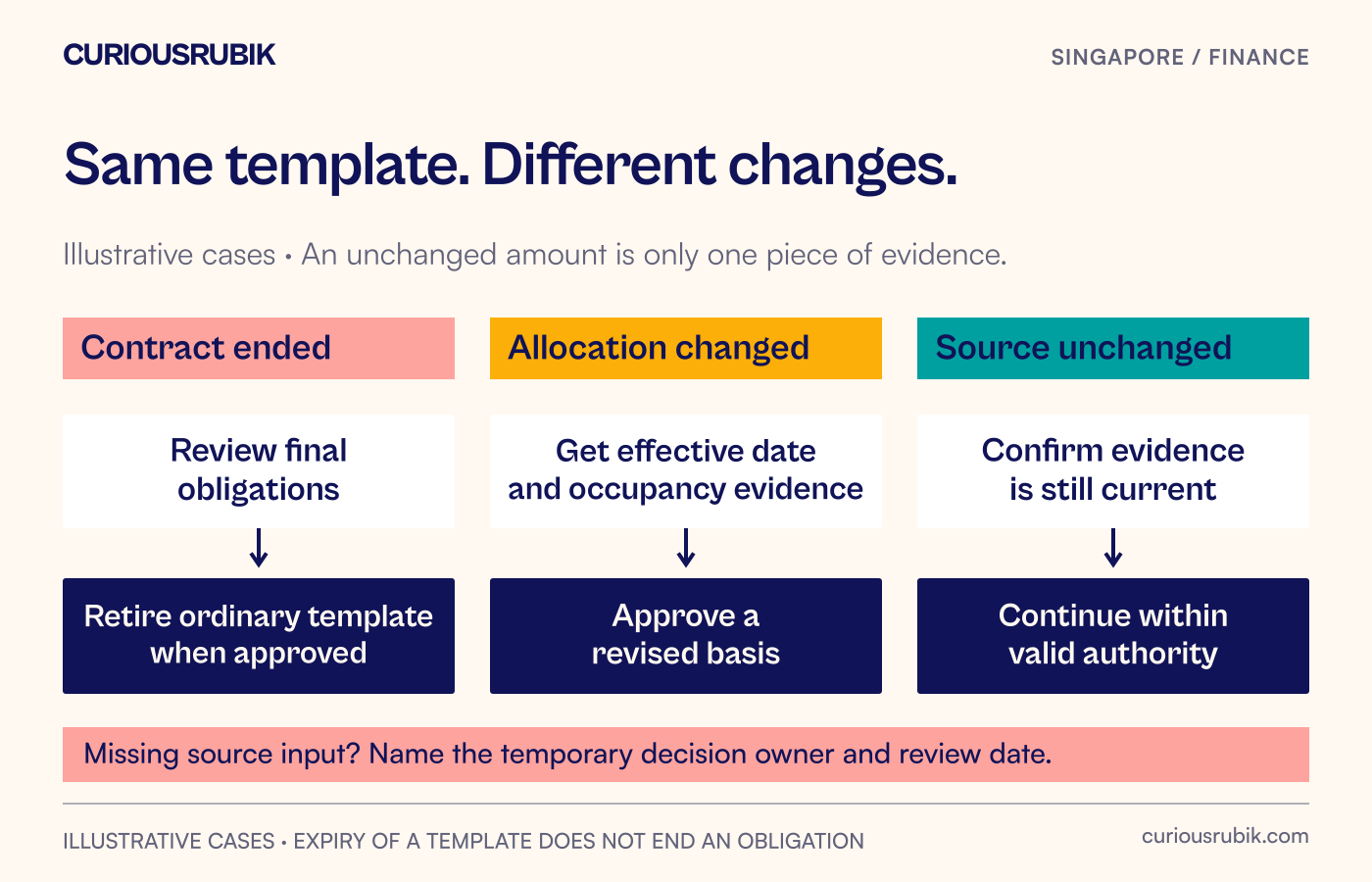
The facilities owner submits the effective date and revised occupancy evidence. Finance marks the template for review rather than overwriting the old percentages. The accountant considers the appropriate treatment of the change, including the relevant period and whether an earlier posting needs correction.
There may be a reasonable temporary route if the revised floor plan is not ready. For example, an authorised accountant could assess a supported interim basis and set a short review date. The exception record should describe the missing fact, basis used, approver and expected resolution. It should not become a permanent workaround through repeated approval of the same vague explanation.
Now consider a different case: the premises contract ended, but an invoice for a disputed exit charge is expected. Retiring the ordinary allocation does not resolve that separate question. Create an owned exception for the disputed obligation. Otherwise, “stop the recurring journal” can accidentally become “stop thinking about the liability.”
CURIOUSRUBIK SINGAPORE / FINANCE Same template. Different changes. Illustrative cases · An unchanged amount is only one piece of evidence. Contract ended Review final obligations Retire ordinary template when approved Allocation changed Get effective date and occupancy evidence Approve a revised basis Source unchanged Confirm evidence is still current Continue within valid authority Missing source input? Name the temporary decision owner and review date. ILLUSTRATIVE CASES · EXPIRY OF A TEMPLATE DOES NOT END AN OBLIGATION curiousrubik.com
Automation is well suited to preparing entries from approved templates, checking effective dates and comparing current drivers with the previous period. It can notify the source owner before a review date and prevent an expired template from continuing without attention.
The system should not renew its own authority because no one replied. Silence may mean the owner is on leave, the notification went to the wrong person or a contract change has not been recorded. Route non-response to a named backup, and show the close owner which accounting questions remain unresolved.
Watch for less obvious changes as well. A department code becoming inactive, a source agreement being replaced or the journal owner leaving should trigger review. The resulting alert should explain the affected templates and the decision required. A list of technical errors with no business owner simply shifts work to the month-end team.
Keep preparation, approval and posting permissions proportionate and explicit. Where a small team cannot separate every activity between different people, an accountable reviewer should check the relevant exception and evidence. Do not describe a single person's repeated clicks as independent review.
A retired template may still be needed to explain prior postings. Preserve its rationale, approved versions, supporting calculations and posting references under the company's records policy. Removing it from the active schedule should not erase its history.
This matters in Singapore because accounting and tax records must remain explainable. ACRA places responsibility on directors for appropriate reporting arrangements, while IRAS requires companies to retain the records supporting their transactions. Neither requirement is satisfied merely by showing that a journal ran on schedule. The renewal sheet is an editorial control recommendation, not a regulator-prescribed form.
Reviewers should also distinguish a sound process from a correct accounting conclusion. A fully completed renewal sheet can still contain an inappropriate policy or estimate. Material treatment questions belong with a qualified accountant, with specialist input where needed.
Start by listing active recurring templates and sorting them by last substantive review, value and sensitivity to changed facts. Sample entries whose source owner, contract or allocation basis has changed. Ask whether the process would have noticed without the sample.
Track expired templates still active, unsupported manual overrides, changes discovered after posting and the time required to obtain source-owner confirmation. Count repeated temporary exceptions separately. They often reveal an information handoff that needs redesign.
Your first useful improvement may be retiring a handful of obsolete templates and clarifying ownership for the rest. Before adding another recurring entry, ask the preparer to complete one sentence: this entry may continue while these facts remain true, and this person will tell us when they change.