A workshop can collect hundreds of requests without producing a dependable specification. “Support approvals,” “provide real-time reporting” and “make the process user-friendly” may accurately record what people said. They do not yet tell a delivery team what behavior to build, which conflicts to resolve or how the business will decide whether the result is acceptable.
Requirements engineering turns those expressions of need into a coherent, testable agreement. It includes understanding the problem, analyzing alternatives and conflicts, defining the required behavior, establishing evidence of acceptance and controlling changes. Gathering is an important input to that work, not its completion.
For an implementation sponsor, the practical question is whether the requirements package reduces ambiguity at the points where design, cost and operating consequences depend on it. A signed spreadsheet with vague statements can create false certainty while leaving the most consequential decisions to developers and testers.
When someone asks for a feature, ask what decision or task it supports and what goes wrong today. A request to export a spreadsheet may mean the user needs a missing calculation, a trusted reconciliation, an approval record or access when the system is unavailable. Each purpose suggests different solutions.
Observe the work where possible. Interviewing only managers can miss exceptions handled by frontline employees. Interviewing only users of the current system can preserve limitations that a different process could remove. Include the people who receive outputs, maintain controls, support failures and manage the consequences of an incorrect result.
Record the source and rationale of a requirement. That does not mean every stakeholder preference becomes mandatory. It means the team can explain why a requirement exists and who can resolve a disagreement about it.
Keep proposed solutions separate from underlying needs until the design choice is justified. Sometimes a specific solution is a real constraint, such as an established interface that must be used. In that case, record the reason and the authority behind the constraint rather than presenting it as an unexplained preference.
Different stakeholders can express valid but incompatible expectations. Operations may want rapid correction of an error, while finance wants approved records preserved. A manager may want flexible delegation, while a control owner wants restricted authority. The engineering task is to define the permitted behavior and exceptions, not choose whichever stakeholder attended the latest workshop.
Use scenarios to make the conflict concrete. What happens when an employee submits a correction after a period is closed? Who may authorize it? Does the original record remain visible? Which downstream processes must learn about the change? These questions expose policy decisions that a generic “edit timesheet” requirement conceals.
Assign an accountable decision owner and a resolution date. A requirement marked “to be confirmed” should remain an explicit assumption in estimates and design. Do not quietly treat the most convenient interpretation as approved.
NASA’s 2016 Systems Engineering Handbook provides a useful engineering reference: its requirements guidance addresses clarity, feasibility, consistency, traceability and verifiability, and links requirements to acceptance and verification planning. The handbook is written for NASA systems; an enterprise team can adapt those disciplines without importing the full aerospace process. NASA Systems Engineering Handbook, section 4.2 and Appendix C.
A useful requirement identifies the relevant actor or system, triggering condition, required behavior and observable result. Include constraints and exceptions where they affect interpretation. Avoid combining several independent obligations into one sentence that can only be marked partly complete.
For example, “The system supports timesheet corrections” leaves almost everything open. A more precise statement might require an authorized reviewer to approve a correction to a submitted timesheet while preserving the original entry and the reason for change. That still needs further decisions about eligible states, permissions and downstream effects.
Do not mistake precision for excessive detail. A requirement should constrain the solution enough to protect the business need without dictating unnecessary implementation choices. Specifying the exact internal database table is usually a design decision unless an external constraint makes it essential.
Define important terms once and use them consistently. Submitted, approved, posted and closed should not become interchangeable labels across the specification. Where systems use different terms, document the mapping and the behavior it implies.
Consider a hypothetical professional-services firm replacing its time-entry application. Its initial request is “allow easy corrections after submission.” The example illustrates requirements analysis, not a prescribed accounting policy or a client result.
The team discovers three different situations: correction before managerial approval, correction after approval but before the firm’s defined processing cutoff, and correction after the period has been closed. The business owners decide that each situation needs a different route. The implementation team should not infer those routes from the old screen’s behavior.
For the closed-period case, assume the business authorizes a proposed adjustment record rather than overwriting the original. The specification requires the employee to identify the original entry, proposed change and reason. An authorized reviewer can approve or reject the adjustment. The original entry and decision history remain available to permitted users. The relevant downstream owner receives the approved change through a defined process.
Acceptance examples then make the rules concrete. An ordinary employee cannot approve their own closed-period adjustment. A rejected adjustment does not alter the accepted original. A valid approval produces the expected adjustment record and traceable status. If downstream processing fails, the user sees a pending condition rather than a false completion message.
The team also defines the boundaries of “easy.” For an illustrative usability test, representative employees must be able to locate the original entry and submit a valid correction using a realistic task without assistance. The actual success criteria, participant selection and accessibility needs must be agreed for this implementation; the word “easy” alone cannot establish them.
The result is more than a longer requirement. It is a set of business decisions and tests that different participants can interpret consistently.
Performance, availability, security, accessibility and supportability are often recorded as adjectives. “Fast,” “secure” and “highly available” express aspirations but leave the operating conditions undefined.
For a performance requirement, specify the action being measured, start and end points, workload, data volume, environment and acceptance measure. An illustrative target might concern response time for a defined timesheet submission under a stated concurrent-user load. The organization must select the threshold based on its needs and validate that the test represents them; copying an arbitrary number from another project adds precision without justification.
For recovery, state what work must be restored, what data loss or interruption the business can tolerate and how the recovery will be demonstrated. For accessibility, identify applicable requirements and the evidence the team will use, involving appropriate specialists rather than declaring compliance through a generic checklist.
Nonfunctional requirements can conflict. Stronger controls may add steps; lower latency may increase cost; broader availability may complicate change. Record the tradeoff and responsible decision rather than pretending every desirable property can be maximized simultaneously.
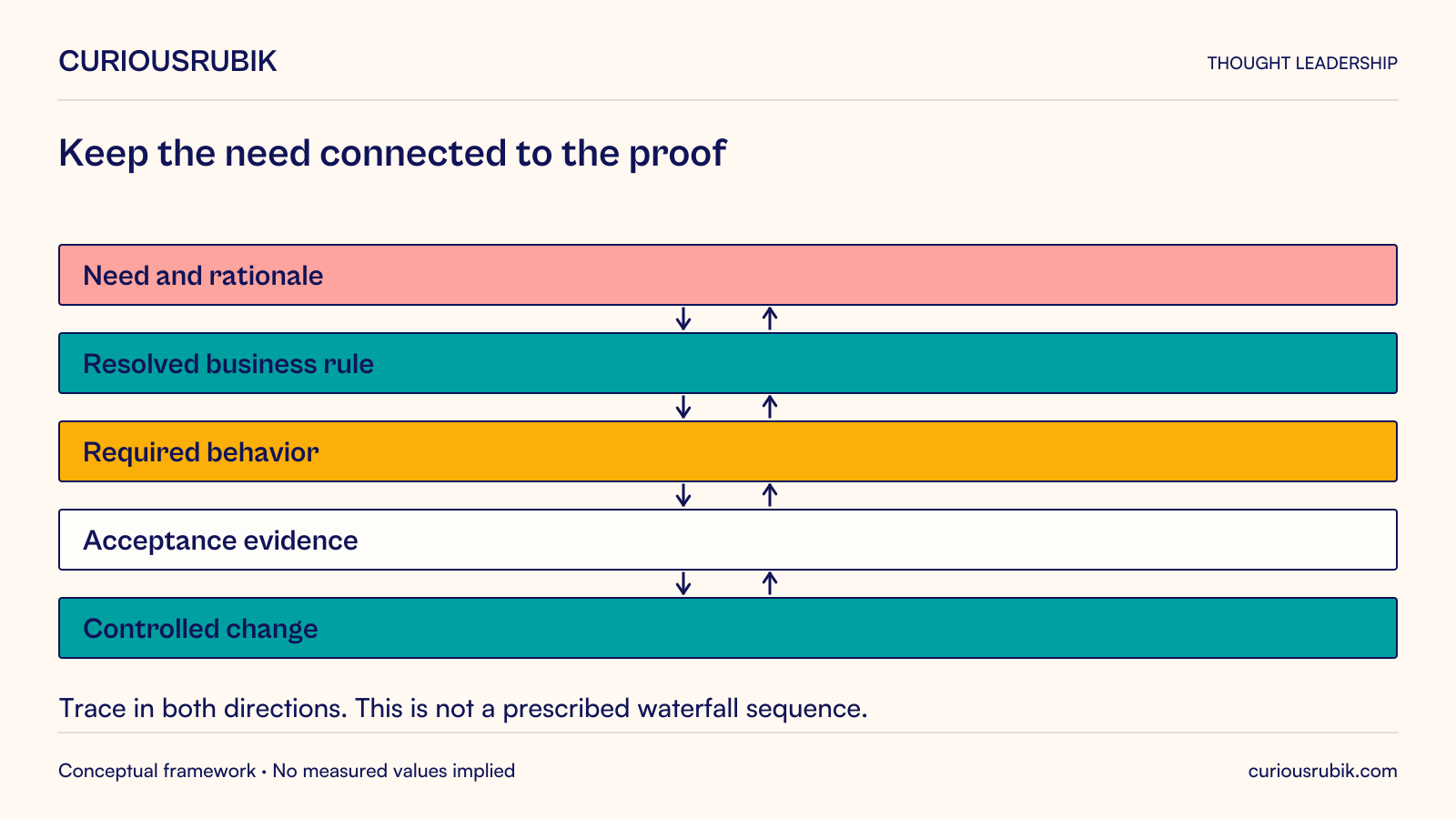
Give each consequential requirement a stable identifier and link it to its source, rationale, approved decision, design response and verification evidence. The mechanism can be lightweight for a small project, but it must allow the team to answer two questions: what proves this requirement, and what business need justifies this feature?
Plan verification while defining the requirement. Some conditions are checked through tests; others through inspection, analysis or demonstration. The chosen method should produce evidence appropriate to the claim. A screenshot of a configuration setting does not necessarily prove the end-to-end behavior users need.
Distinguish verifying the specified behavior from validating that it solves the right problem. A system can conform to an agreed specification while the workflow remains unsuitable for users. Representative task evaluation and business acceptance are therefore necessary alongside technical conformance.
Keep exceptions in the traceability chain. If an important failure route has no requirement or test, it can disappear between design and delivery even when the normal path is well documented.
Requirements will change as the team learns. The goal is to understand the consequence of a change and approve it at the right level, not to preserve an early document regardless of new evidence.
For a proposed change, identify the affected need, behavior, design, tests, data and operating responsibilities. Determine whether it is a correction of ambiguity, a newly discovered condition or an expansion of scope. Those categories inform the decision, but none automatically determines who should pay or whether the change should proceed.
Maintain a visible baseline and approved revisions. Avoid informal edits that leave delivery and testing teams using different versions. Where a decision remains open, show the assumption and the work that depends on it.
Before accepting a requirements package, select several high-consequence statements and ask a developer, a business owner and a tester to explain the expected behavior independently. Differences reveal where engineering is still needed. A dependable specification is one that guides consistent decisions and produces credible evidence, rather than one that merely records a successful workshop.