A regional office can calculate a recharge perfectly and still produce an invoice that the recipient disputes. The recipient may question whether it received the service, why a particular cost was included or why headcount was used to divide the charge.
For a Singapore-led shared-service team, those are preparation questions worth settling before billing. A repeatable recharge process needs evidence of the service, a defensible basis for identifying beneficiaries and a controlled method for allocating the approved cost pool. Automating the final calculation helps only after those decisions are clear.
“Regional support” is a weak description for both the provider and the recipient. It can cover routine administration, project work, specialist advice and activities benefiting only one company. Grouping everything into one monthly charge makes later questions harder to answer.
Define the services in operational terms. Who performed the work? During which period? Which entities used or benefited from it? What records would allow someone outside the delivery team to understand what occurred?
The answer need not be a detailed timesheet for every activity. A recurring administrative service may have a service schedule and evidence of delivery. A one-off project may need a work plan, milestone records and specific beneficiary confirmation. Choose evidence that reflects the service instead of collecting the same document for every charge.
The recipient should be able to challenge a factual mistake before billing. That does not give it an unrestricted right to choose the lowest allocation. It creates an opportunity to correct the entity, service period or population while the calculation is still a draft.
IRAS requires related-party pricing to follow the arm's length principle. The appropriate method and support depend on the actual transaction. Documentation requirements and exemptions need their own assessment; an exemption from a documentation requirement does not turn an unsupported price into an arm's length one.
A commonly quoted markup is particularly risky when detached from its conditions. IRAS describes a cost-plus 5% approach for listed routine support services where they are supplied only to related parties and all related service costs are included in the calculation. It is not a universal rate for regional recharges. A finance or tax specialist should assess the service, pricing basis and any relevant treatment in the recipient jurisdiction.
The operating team's role is to make that review possible. It supplies the facts, cost details, agreements and evidence of benefit. It should not have to invent a tax conclusion because the billing deadline is approaching.
The preparation pack described here is a recommended process. It supports analysis and repeatability; completing it does not by itself establish tax compliance.
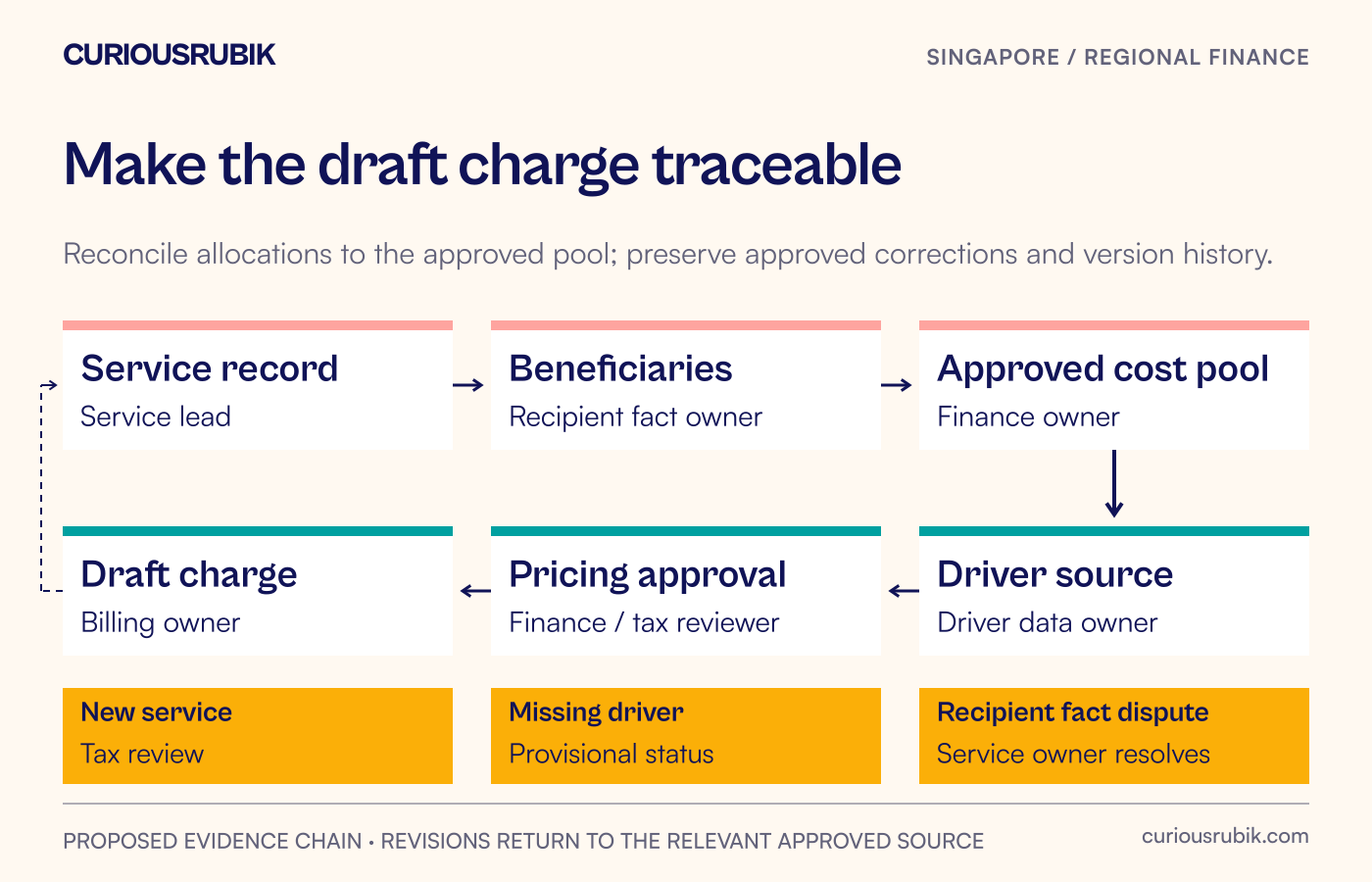
Service record. Identify the service, provider, recipients, period and evidence of delivery. Explain changes from the agreed scope and flag activities that appear to benefit a different entity.
Cost pool. Reconcile the proposed chargeable costs to the underlying records. Show inclusions, exclusions, currency and any adjustments. Keep the reviewer-approved treatment of unusual costs visible. Do not bury a one-off item inside an ordinary monthly total.
Allocation driver. Record the reason for using headcount, usage, transaction volume or another basis. Identify the source, measurement period and owner. Explain how missing data and changes during the period are handled.
Pricing approval. Reference the applicable agreement and approved pricing method, including any limitations. Separate the mathematical calculation from the specialist's judgment about whether the basis is appropriate.
Change and dispute log. Preserve the original proposal, corrections, approvals and unresolved questions. State who can amend the basis, when a change takes effect and how the effect on prior charges will be assessed.
CURIOUSRUBIK SINGAPORE / REGIONAL FINANCE Make the draft charge traceable Reconcile allocations to the approved pool; preserve approved corrections and version history. Service record Service lead Beneficiaries Recipient fact owner Approved cost pool Finance owner Driver source Driver data owner Pricing approval Finance / tax reviewer Draft charge Billing owner New service Tax review Missing driver Provisional status Recipient fact dispute Service owner resolves PROPOSED EVIDENCE CHAIN · REVISIONS RETURN TO THE RELEVANT APPROVED SOURCE curiousrubik.com
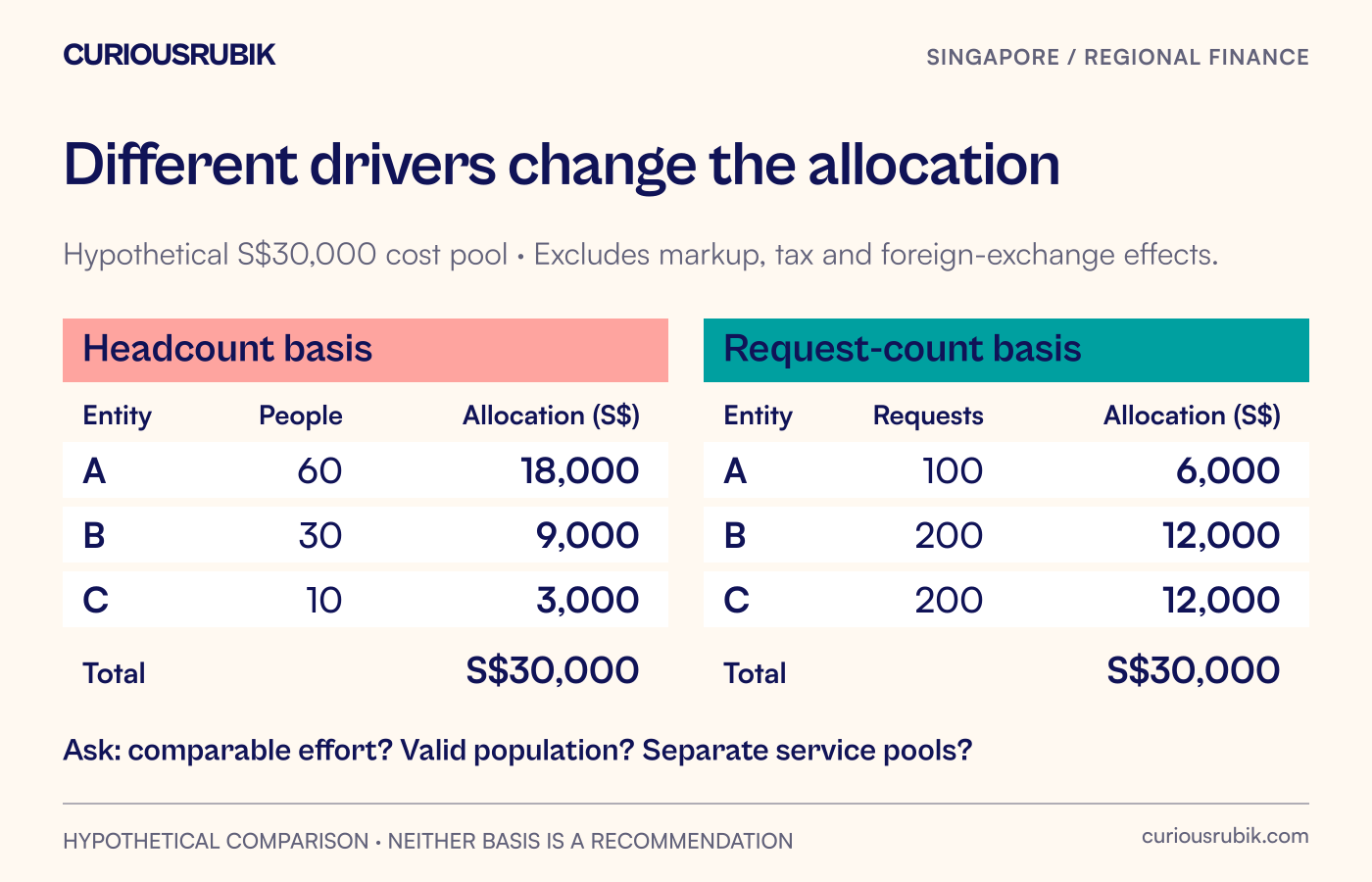
Consider a hypothetical S$30,000 support cost pool shared by three regional entities. All figures here are illustrative and exclude markup, tax and currency effects.
The entities have 60, 30 and 10 employees. A headcount allocation assigns S$18,000, S$9,000 and S$3,000. Recorded service requests, however, are 100, 200 and 200. An allocation based on request count assigns S$6,000, S$12,000 and S$12,000.
The comparison does not establish which method is correct. It reveals the consequence of the choice. Headcount may be a reasonable proxy for some people-related services. Request count may better reflect some transaction-driven work, but it could be misleading if one complex request takes far more effort than many simple ones.
The decision requires an explanation of the service and the relationship between the driver and the benefit. A specialist may conclude that the pool needs to be divided into different services before a sensible driver can be selected. The answer should come before the team builds a recurring allocation routine.
Check the source population as carefully as the formula. Does headcount include temporary staff? Does request count include reopened tickets, duplicates or work for an entity outside the agreement? An accurate percentage applied to a poorly defined population can still produce a disputed charge.
CURIOUSRUBIK SINGAPORE / REGIONAL FINANCE Different drivers change the allocation Hypothetical S$30,000 cost pool · Excludes markup, tax and foreign-exchange effects. Headcount basis Entity People Allocation (S$) A 60 18,000 B 30 9,000 C 10 3,000 Total S$30,000 Request-count basis Entity Requests Allocation (S$) A 100 6,000 B 200 12,000 C 200 12,000 Total S$30,000 Ask: comparable effort? Valid population? Separate service pools? HYPOTHETICAL COMPARISON · NEITHER BASIS IS A RECOMMENDATION curiousrubik.com
Suppose an entity joins the shared service halfway through the month. The service owner should confirm the start date and scope. Finance assesses how the approved arrangement deals with partial periods, rather than inserting the new entity into a full-month denominator by default.
If the input arrives late, show the limitation. A provisional calculation may be useful for review, but its status and permitted uses should be clear. Do not label it final merely because the automated invoice routine needs a number.
When a recipient disputes the charge, classify the issue. A missing employee in the driver is a data correction. A disagreement about the nature of the service is a factual or contractual question. A challenge to the pricing method requires the relevant finance or tax owner. Routing all three back to the billing clerk wastes time and encourages informal adjustments.
Any approved correction should preserve the earlier version and explain its effect. The team should be able to connect an adjustment with the original service period and charge. A history of unexplained credits makes it difficult to tell whether the process improved or merely stopped receiving complaints.
Direction matters. A Singapore entity providing services to an overseas related company faces a different analysis from a Singapore entity paying a non-resident service provider. The recharge workflow should record which entity is providing, receiving, invoicing and paying.
For payments to non-resident companies, IRAS's withholding-tax guidance distinguishes the nature of the payment and, for relevant services, where work is performed. An overseas address alone is not enough to decide treatment. Mixed-location work, treaty considerations and contractual terms should reach the tax reviewer with supporting facts.
Likewise, the existence of an intercompany agreement should not silently decide the GST treatment or the recipient country's obligations. Give each necessary tax review an explicit owner. The allocation engine should use approved instructions, not attempt to infer a legal conclusion from the description “management fee”.
Once the basis is approved, automation can gather driver data, check completeness, calculate allocations and prepare an invoice draft. Reconcile the allocated total back to the approved cost pool and show rounding differences explicitly.
Flag changes that can alter the analysis: a new beneficiary, a new service, a large cost movement, a missing driver or a method change. The service owner confirms delivery facts; finance reviews the calculation; the tax lead resolves pricing or treatment questions. A failed source feed should hold the affected draft for review rather than reuse last month's input without a visible warning.
Choose one recurring service for a pilot. Track disputed charges, late driver corrections, time from draft to acceptance and adjustments after billing. Ask whether recipients can explain the basis from the pack without arranging another meeting.
Before issuing the next regional recharge, ask the recipient to review three things: the service period, the benefit described and the population used in the calculation. Then ask the authorised reviewer whether the charging basis remains appropriate. Those checks tackle the disagreement while it is still inexpensive to resolve.