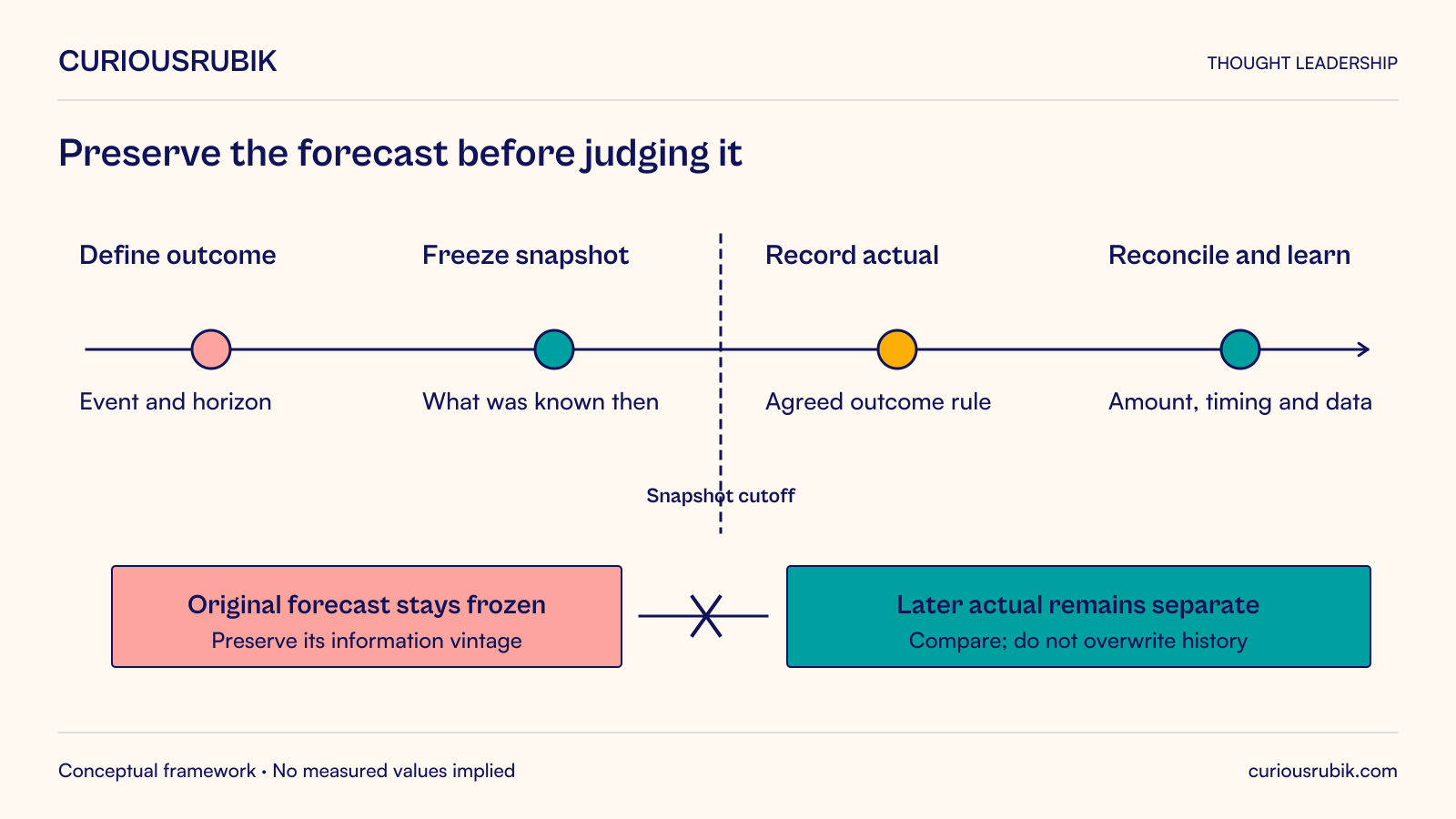
A forecast meeting cannot repair history that was never recorded. If opportunity amounts, expected close dates and stage definitions are overwritten without preserving what the team knew at the time, leaders cannot distinguish an unpredictable buyer decision from a forecast built on stale or inconsistent information. The debate becomes personal because the evidence is missing.
For a revenue-operations leader, the first improvement is therefore a trustworthy forecast record: a defined target, a fixed observation date, preserved inputs and an agreed actual outcome. Better coaching and judgment still matter. This foundation makes it possible to see where they would help, rather than asking sellers for confidence that no one can later evaluate.
The title describes a practical order of investigation, not a universal cause. Some teams have excellent data and still face uncertain markets, concentrated customers or weak commercial execution. Data discipline cannot make uncertain demand certain. It can prevent avoidable uncertainty about what the forecast means.
“Next quarter’s revenue” may mean signed orders to a sales manager, invoiced value to an operations team and recognized revenue to finance. Those measures should not share a forecast label simply because they use the same currency. Pick the event, population, period and measurement rule before discussing a number.
For a bookings forecast, define what qualifies as a booked contract, how cancellations or amendments are treated and whether multi-year amounts are included. For a financial revenue forecast, agree how commercial events feed the finance team’s accounting model. The operational forecast should not improvise recognition rules.
Then define the horizon. A forecast submitted three months before quarter-end serves a different decision from one submitted three days before it. Comparing their accuracy without preserving the horizon rewards late certainty. If leaders need a hiring or capacity decision twelve weeks ahead, measure performance at that point even when later updates become more accurate.
Finally, identify the owner of the actuals. Sales operations may maintain opportunity records, while finance certifies booked amounts under the agreed reporting definition. Reconciliation should be repeatable. An outcome that changes after review needs a visible revision history, not a silent replacement that makes the old forecast look better or worse.
A useful forecast snapshot captures the opportunity identifier, amount, currency, expected close date, stage, forecast category, relevant evidence and owner at the observation time. The exact fields depend on the business, but the record must allow someone to reconstruct the submitted forecast without looking at today’s edited opportunity.
Record both when an event happened and when the organization learned about it where that distinction matters. A customer may sign on Friday while the signed document reaches the team on Monday. A forecast made on Friday morning cannot fairly be evaluated as if it had Monday’s information.
Do not confuse a snapshot with indiscriminate data retention. Preserve the business evidence needed for forecasting under appropriate access and retention rules. Link to authoritative records rather than copying sensitive customer documents into every analytical dataset.
The reason for this discipline is statistical as well as operational. Hyndman and Athanasopoulos explain that forecast accuracy must be evaluated on observations not used to fit the model, and their rolling-origin approach uses only information preceding each forecasted observation. A historical test using information from the future gives an unfair impression of prediction quality. Forecast evaluation, time-series cross-validation.
A stage called “proposal” may mean a document was sent, a buyer reviewed a commercial option or procurement began negotiation. If different sellers use different meanings, a common stage probability is applied to different events.
Agree a small set of observable stage conditions. A condition might be that the buyer has confirmed the business requirement and decision process, or that a commercially valid proposal has been delivered to the responsible contact. Avoid criteria that require employees to assert knowledge they do not have. “Budget fully secured” is unreliable if no one can explain what evidence would establish it.
Stages should help sellers plan the next action as well as help management forecast. If a field exists only to populate a dashboard, people may update it at reporting time instead of when the deal changes. Show how the information reduces repeated questions or triggers useful support.
Keep exceptions visible. A renewal, an expansion and a first-time enterprise purchase may follow different routes. Forcing all three into identical milestones can create apparent consistency while destroying meaning. Separate routes when the decision process genuinely differs, while retaining a reconciled definition of the final outcome.
Consider a hypothetical industrial-equipment sales team. All amounts and probabilities below are invented for explanation. At the start of a quarter, it has three opportunities: A at $100,000, B at $80,000 and C at $60,000. Applying a 50% stage probability to each produces a weighted pipeline of $120,000.
That number is an arithmetic result: $50,000 plus $40,000 plus $30,000. It is not automatically a credible forecast. A has a documented purchasing decision planned for the quarter. B’s contact has requested another demonstration but has not confirmed a purchasing timetable. C depends on the same customer’s capital-approval meeting as A. The stage label conceals differences in timing and a shared source of uncertainty.
Even if the 50% probability were calibrated for comparable opportunities, $120,000 would be an expected aggregate value under the model, not a promise that the quarter will produce that amount. Correlation between A and C affects the spread of possible outcomes. It does not, by itself, invalidate adding their expected values, but it matters greatly if management uses the result to make commitments that require a minimum level of orders.
The team should separate two questions: is the business likely to be won eventually, and is it likely to be booked within this quarter? A stage conversion rate calculated over an unlimited period does not answer the second question. The estimate needs evidence about timing as well as eventual conversion.
Suppose A closes at $90,000, B moves to the next quarter and C is lost. The actual bookings are $90,000. Using the convention forecast minus actual, the signed error is positive $30,000 and the absolute error is $30,000. That one result cannot establish a reliable long-run accuracy percentage. It provides three useful explanations to investigate: amount change, timing change and loss.
A forecast review should first reconcile differences, then interpret them. Distinguish amount changes, timing movements, unexpected wins or losses, omitted opportunities and data defects. These categories are a practical diagnostic, not a statistical decomposition that guarantees unique causal attribution.
An opportunity can contribute to more than one difference. A delayed contract may also shrink in scope. Decide how to record the bridge so the financial amounts reconcile without double counting. Preserve secondary explanation tags if necessary, but do not sum overlapping categories as if they were independent losses.
A repeated amount error may call for better commercial qualification. A timing error may call for stronger understanding of procurement steps. An omitted-opportunity error may come from late CRM entry. A data defect may come from currency handling or duplicate records. Asking sellers to become “more accurate” does not distinguish these interventions.
Also record what was genuinely unknowable. A buyer’s sudden change in funding is not necessarily evidence of poor diligence. The review should evaluate whether the team used reasonable information available at the forecast date, while learning whether the model should allow more uncertainty around similar situations.
Use signed error to see directional bias and absolute error to see typical miss size. State the sign convention clearly; organizations use both forecast-minus-actual and actual-minus-forecast. A team with alternating positive and negative misses can have a small average signed error while making poor planning predictions.
Currency error is useful for a capacity or spending decision. Percentage error can aid some comparisons, but becomes unstable when actual outcomes are near zero and undefined at zero. The forecasting text explicitly explains this limitation. Do not rank small teams by a percentage measure without examining the underlying amounts and deal counts. Limitations of percentage-error measures.
Compare forecasts at the same horizon and against a simple baseline. Depending on the business, a baseline might use the previous comparable period or a transparent historical conversion rule. The point is not that a simple method must win. It is that a complex model or management adjustment should demonstrate value beyond something easy to reproduce.
Keep model and judgment contributions separately recorded. If a manager adjusts the statistical estimate, preserve the original estimate, adjustment, reason and subsequent outcome. Otherwise, the organization cannot tell whether overrides improved the forecast or merely made it align with a target.
Targets express ambition or required performance. Forecasts describe an expectation under stated information and assumptions. When a lower forecast is treated as disloyalty, sellers have an incentive to report the target rather than the evidence. Better software will not resolve that conflict.
Give the forecast an explicit decision use: scheduling installation teams, planning supply, managing recruiting or setting a cash-planning input. Different decisions tolerate different risks. A single point forecast may be insufficient when a few large deals dominate the outcome. Discuss a small set of coherent scenarios and the action management would take under each.
Start with one business segment and one forecast horizon. Define the target, preserve snapshots, reconcile actuals and conduct several comparable review cycles. Expand once the organization can explain both the number and its limitations. The first success is a forecast process that can learn from its own record. Improvements in prediction can then be tested rather than asserted.