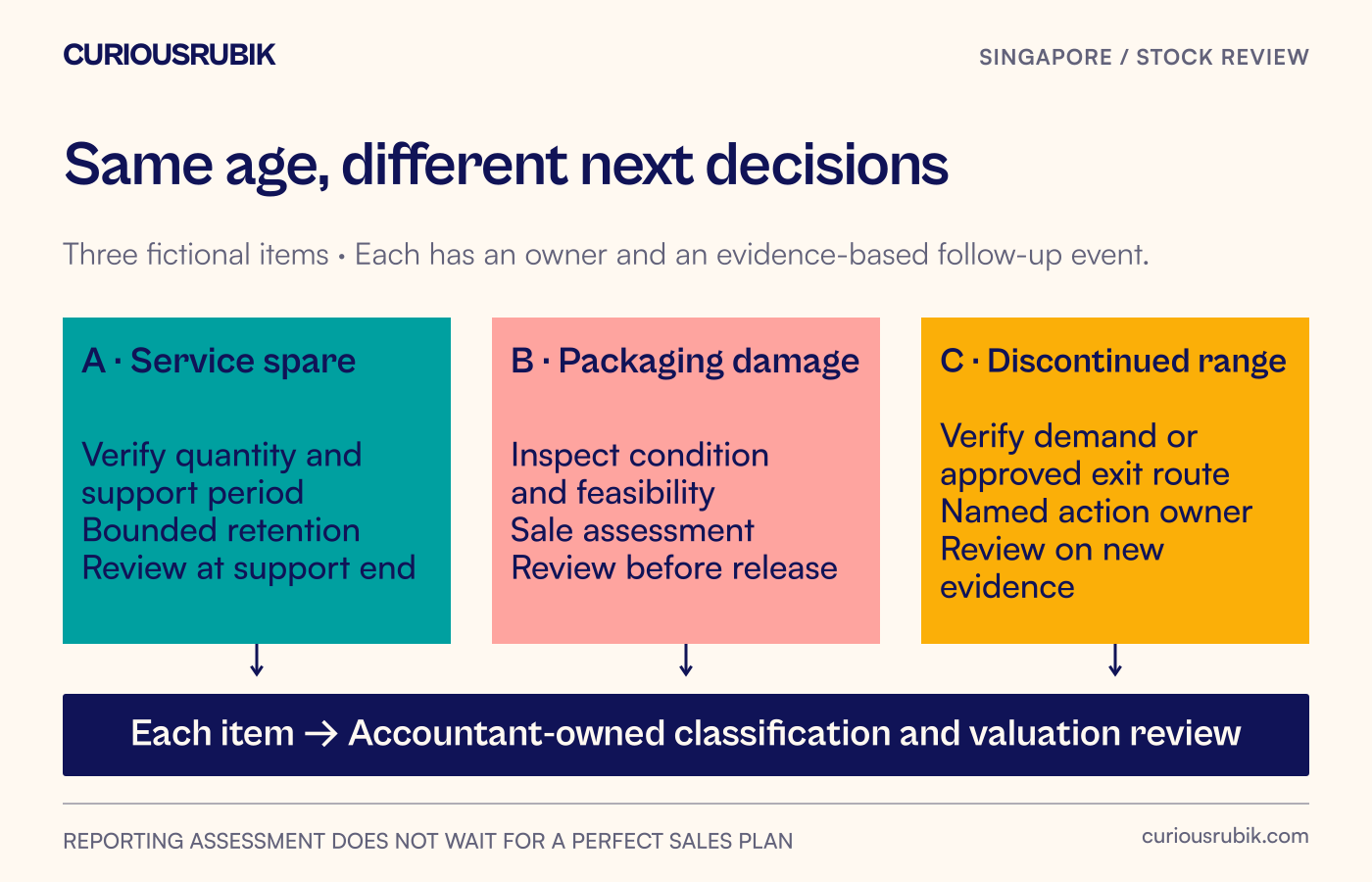
An ageing report flags three items held for the same length of time. One is a spare needed to support an active customer agreement. Another has packaging damage but may still have a sale route. The third belongs to a discontinued range with no credible demand evidence.
A single age-based action would ignore the reason each item remains. At the same time, leaving all three untouched until sales produces a perfect plan can delay necessary accounting judgments. The operating decision and the valuation assessment need shared evidence and separate authority, with neither used to avoid the other.
Bring the service owner, commercial owner and accountant into a focused review of the flagged stock. The aim is a reasoned next action for each item, supported by facts that finance can also use in its own assessment.
In a hypothetical Singapore equipment distributor, Item A has not moved for eighteen months. The service manager says it protects an active support commitment. That is a plausible reason to hold it, but the meeting needs evidence of the equipment covered, remaining service period, expected need and available alternatives.
Ask whether the quantity held is proportionate to that need. A valid reason for keeping one unit does not justify an unlimited reserve. Ask whether the item remains compatible with the equipment in service and whether a replacement can be obtained within the required response time.
The proposed operating decision might be to retain a defined quantity for a stated purpose and review it when the support arrangement ends. Record the owner and event. Avoid a permanent “strategic stock” label with no supporting explanation.
Finance independently assesses the accounting classification and carrying amount under the entity's applicable framework. A service-purpose label does not automatically establish full value, and the fact that an item is held for support can itself require consideration of its proper accounting classification. The review should supply facts rather than instruct the accountant to protect a preferred margin.
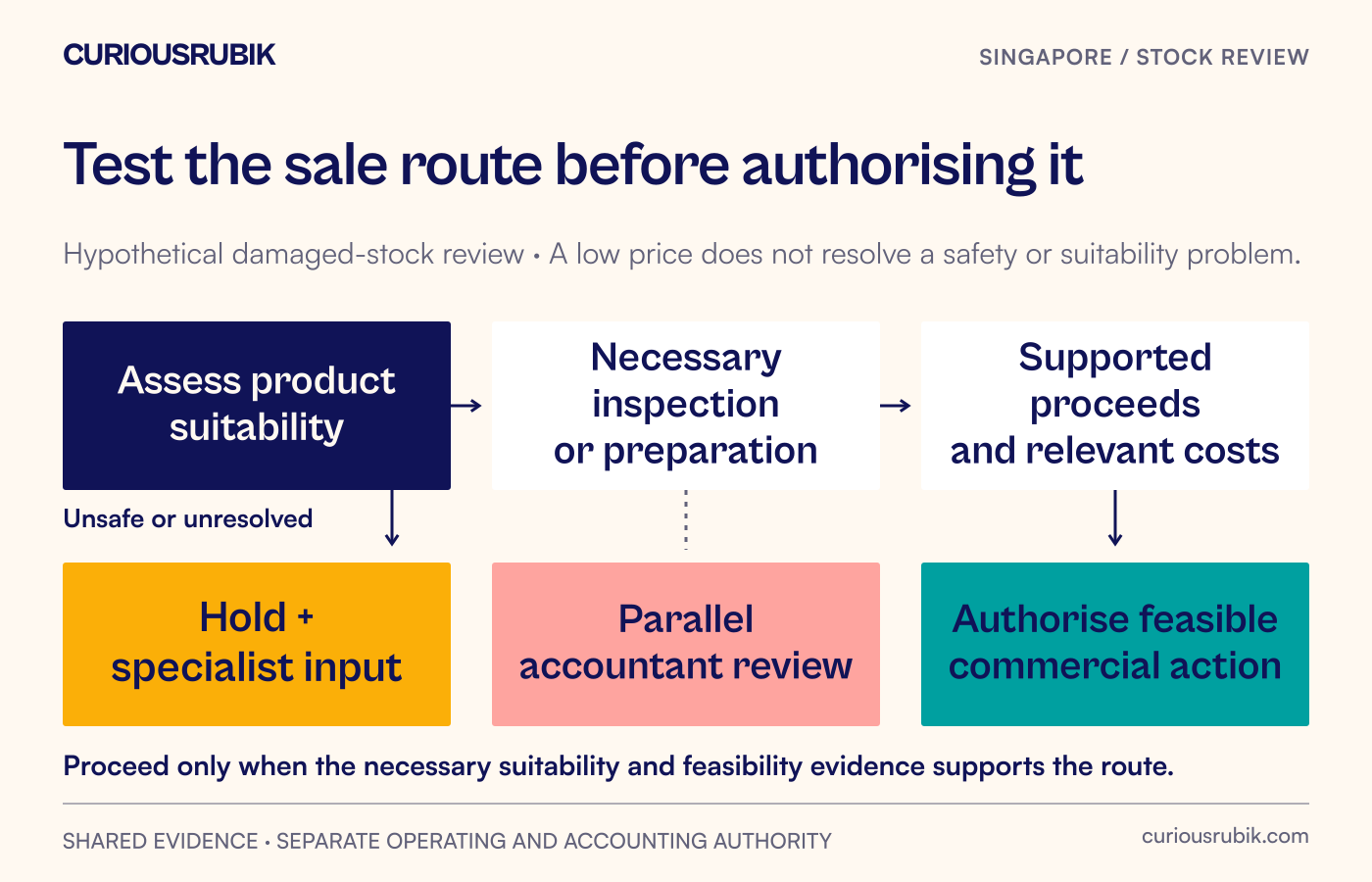
Item B has damaged packaging. The commercial owner proposes a discounted sale. Before approving that action, establish whether the product itself is safe and usable, what inspection or repacking is necessary and whether the proposed customer channel is appropriate.
Do not describe a disposal or discount option as executable while a quality question remains unresolved. The operational owner needs a specific assessment and any required specialist input. A low price cannot make an unsuitable product acceptable.
For a legitimate sale option, identify likely proceeds and the costs required to reach that outcome. A selling price without repacking, transport or other relevant costs can exaggerate the expected recovery. Use supported estimates, state uncertainty and update them when actual evidence arrives.
The approval should specify the item, quantity, permitted channel or price authority and the evidence needed to close the action. “Sales to clear stock” gives neither a boundary nor a testable result.
CURIOUSRUBIK SINGAPORE / STOCK REVIEW Test the sale route before authorising it Hypothetical damaged-stock review · A low price does not resolve a safety or suitability problem. Assess product suitability Necessary inspection or preparation Supported proceeds and relevant costs Unsafe or unresolved Hold + specialist input Parallel accountant review Authorise feasible commercial action Proceed only when the necessary suitability and feasibility evidence supports the route. SHARED EVIDENCE · SEPARATE OPERATING AND ACCOUNTING AUTHORITY curiousrubik.com
For Item C, the buyer says demand may return. The item belongs to a discontinued range, and no current customer commitment supports the claim. Ask what would change the decision: a live enquiry, a credible replacement use, a supplier return agreement or another documented route.
An old sales forecast is weak evidence if the market, product or customer requirement has changed. Give speculative demand an explicit status and review event. It should not be presented as a firm order simply to keep the item outside an exception report.
The commercial owner may decide to seek a return, offer the goods through an approved channel or propose disposal. Each option has different constraints. A supplier return needs agreement and physical evidence; disposal needs appropriate authority and handling; a discounted sale needs its own commercial review.
If an option depends on another person's approval, record that dependency. Do not count a proposed return as recovered value or mark an item disposed of because a request has been sent.
An ageing report is one input to an accounting assessment. The accountant needs the item's condition, purpose, relevant demand evidence, expected recovery and costs, together with the applicable accounting policy and reporting framework.
The international IAS 2 overview explains inventory measurement by reference to cost and net realisable value. Singapore entities must establish their applicable local framework and the relevant standard's scope before using an international summary to prescribe treatment. ACRA's accounting-standards guidance expressly directs entities to the applicable framework and statement of applicability.
For this operating review, the useful boundary is clear: do not use age alone as an unsupported instruction to write off stock, and do not use a commercial intention to retain stock as proof that no valuation adjustment is needed. Ask the responsible accountant to determine the treatment using the actual facts.
The reporting timetable continues while sales investigates options. If evidence is incomplete at a reporting date, finance must make the appropriate assessment and document its basis. A later sale or disposal decision does not excuse postponing required accounting work.
The meeting record should distinguish the operational disposition from the accounting conclusion. Item A may have an approved retention purpose while its carrying amount is assessed separately. Item B may need inspection before a sale is permitted. Item C may have an approved commercial action that is still awaiting execution.
Use a compact decision sheet for each material item or sensible group: identity and quantity, age, condition, reason held, evidence, proposed action, authorised owner, due date and next review event. Link the accountant's conclusion rather than rewriting it as a warehouse instruction.
A physical write-off or disposal should have completion evidence. An accounting reduction does not mean the goods have vanished, and retaining physical custody does not necessarily mean their carrying amount remains unchanged. Keep those records connected and distinct.
CURIOUSRUBIK SINGAPORE / STOCK REVIEW Same age, different next decisions Three fictional items · Each has an owner and an evidence-based follow-up event. A · Service spare Verify quantity and support period Bounded retention Review at support end B · Packaging damage Inspect condition and feasibility Sale assessment Review before release C · Discontinued range Verify demand or approved exit route Named action owner Review on new evidence Each item → Accountant-owned classification and valuation review REPORTING ASSESSMENT DOES NOT WAIT FOR A PERFECT SALES PLAN curiousrubik.com
At the next review, ask what changed. Was the service need confirmed? Was inspection completed? Did the supplier accept the return? Compare the promised evidence and action with what actually happened.
Automation can prepare the ageing and movement information, bring in relevant demand references and flag an agreed action that has passed its review date. It should not change valuation, approve disposal or infer demand from a loosely similar product without the responsible review.
Keep reason changes visible. If “retain for service” becomes “awaiting buyer decision”, preserve why. Otherwise the same stock can move between categories for months while appearing newly reviewed each time.
Measure actions completed, recurring items without current evidence and unsupported overrides of the accounting assessment. Track quantity and value where they are reliable, but avoid presenting every reduction in ageing stock as a saving. A transfer to another location or an unsupported write-off can improve the headline while leaving the economic problem unresolved.
For the next slow-stock meeting, choose three items of similar age with different operating purposes. Ask for the fact that changes each decision and the person responsible for establishing it. That conversation will produce more useful work than applying one percentage to every line and hoping the underlying stock problem disappears.