Two order desks check the same customer account. Both see enough unused credit for their own order. Both approve a release. Together, the orders exceed the company's intended limit because each decision spent the same available headroom.
The calculation on either screen may be correct at the moment it is viewed. The missing control is a shared record of commitments being made between the credit check and actual release. A reservation, followed by revalidation and an accountable transition into released exposure, can close that gap.
For a Singapore distributor with several order desks or regional sales channels, the reservation must apply to the correct customer entity and policy currency. It is an internal control design, not a universal credit model or a recommendation about how much credit to extend.
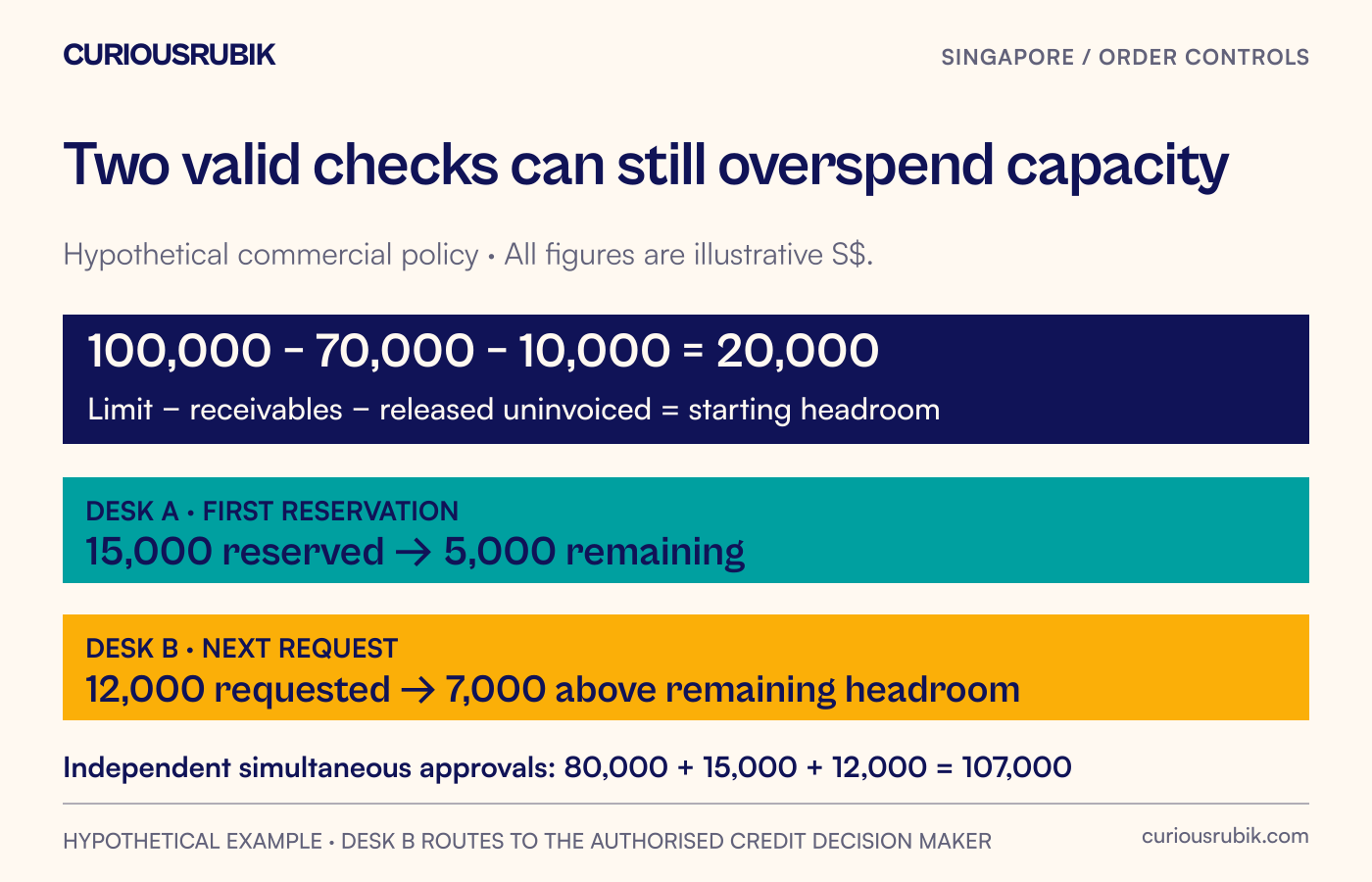
Use a hypothetical company policy with a S$100,000 customer limit. Current exposure is S$80,000, comprising S$70,000 of receivables and S$10,000 of released, uninvoiced orders. The available headroom is S$20,000 on this illustrative basis.
Desk A is considering a S$15,000 order. Desk B is considering a S$12,000 order. Each sees the same S$20,000 available. If both proceed independently, total exposure becomes S$107,000. The combined excess is S$7,000, even though neither order exceeded the starting headroom alone.
A faster refresh may reduce the chance of this happening, but it does not establish who has committed the capacity during the interval. The control needs a single accountable decision about each reservation against the shared remaining balance.
Under the proposed process, Desk A obtains an authorised S$15,000 reservation first. Remaining unreserved headroom becomes S$5,000. Desk B's S$12,000 request is then presented as exceeding that remaining amount by S$7,000. The credit owner can consider the relevant policy decision, rather than discovering the combined position after dispatch.
CURIOUSRUBIK SINGAPORE / ORDER CONTROLS Two valid checks can still overspend capacity Hypothetical commercial policy · All figures are illustrative S$. 100,000 − 70,000 − 10,000 = 20,000 Limit − receivables − released uninvoiced = starting headroom DESK A · FIRST RESERVATION 15,000 reserved → 5,000 remaining DESK B · NEXT REQUEST 12,000 requested → 7,000 above remaining headroom Independent simultaneous approvals: 80,000 + 15,000 + 12,000 = 107,000 HYPOTHETICAL EXAMPLE · DESK B ROUTES TO THE AUTHORISED CREDIT DECISION MAKER curiousrubik.com
A reservation is an approved claim on available capacity for a specified order or release scope. It should not be confused with stock allocation, invoice issuance or a customer's promise to pay. Define its effect in the credit policy before creating the workflow.
Record a unique reservation reference, customer and seller entities, order or line scope, amount and currency, policy-conversion basis where applicable, decision time, approver and release condition. Include an expiry or review event appropriate to the process, plus the current state.
The credit controller owns the policy and exceptions. The order desk supplies the intended commitment. Fulfilment confirms what actually released. Finance provides the receivable and receipt events that affect exposure. A shared register is useful only if these handoffs have an agreed meaning.
Choose which event consumes headroom. If a draft quotation does not commit capacity, it should not be treated like an authorised order release. Conversely, if a released but uninvoiced order creates exposure under the policy, it must remain represented until its successor event is recorded.
When Desk A's order releases, the record should move from reserved capacity to the appropriate released-order exposure. The S$15,000 should not disappear between states or remain counted in both.
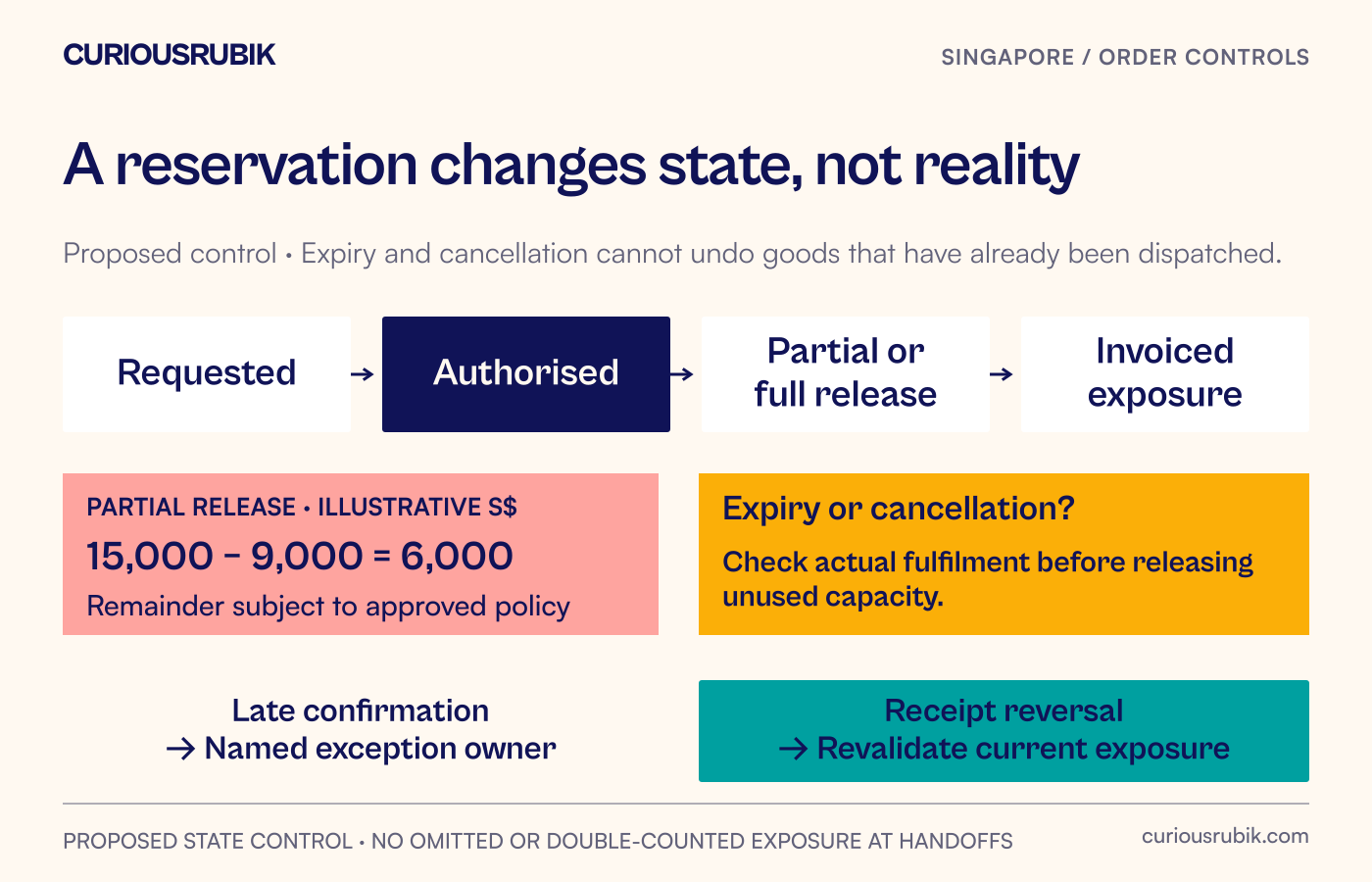
If only S$9,000 releases, record the partial event and establish what happens to the remaining S$6,000 reservation. It may remain valid for the outstanding portion or require a new decision, depending on the approved policy. Do not close the entire reservation merely because the first dispatch occurred.
Use the same principle when the released order becomes an invoice. Transfer its representation into the receivable component without double counting or a temporary omission. The control's reliability depends on those transitions as much as on the original approval.
Keep an event history that explains each movement: requested, authorised, partially used, fully used, cancelled or reviewed. A single editable “available credit” number cannot show whether capacity changed because a customer paid or because someone deleted a reservation.
An expiry date can stop an abandoned order from holding capacity indefinitely. It can also create a dangerous gap if the goods have already been released but the confirmation has not arrived.
Before freeing an expired reservation, establish whether any associated commitment has occurred. Check the order and fulfilment evidence. If a release is pending confirmation, retain a visible exception for the responsible owner rather than automatically returning the capacity to the shared pool.
Cancellation needs similar care. The order desk's cancellation instruction does not prove that the warehouse or delivery partner stopped the goods. The coordinator must confirm the affected scope and actual state before the credit record is adjusted.
This makes expiry a controlled review event where necessary. An automated timer can prepare the review and identify apparently unused reservations. It should not erase exposure that still exists because the business's records are late.
CURIOUSRUBIK SINGAPORE / ORDER CONTROLS A reservation changes state, not reality Proposed control · Expiry and cancellation cannot undo goods that have already been dispatched. Requested Authorised Partial or full release Invoiced exposure PARTIAL RELEASE · ILLUSTRATIVE S$ 15,000 − 9,000 = 6,000 Remainder subject to approved policy Expiry or cancellation? Check actual fulfilment before releasing unused capacity. Late confirmation → Named exception owner Receipt reversal → Revalidate current exposure PROPOSED STATE CONTROL · NO OMITTED OR DOUBLE-COUNTED EXPOSURE AT HANDOFFS curiousrubik.com
Return to the hypothetical example. A verified S$10,000 receipt is correctly allocated, reducing the original receivables from S$70,000 to S$60,000. With S$10,000 of existing released orders and Desk A's S$15,000 reservation, the policy exposure is now S$85,000. Desk B's S$12,000 request would take it to S$97,000, subject to the other checks.
The receipt must not be counted once in the receivables balance and again as an extra headroom adjustment. Its customer entity, allocation and current validity must be established by the responsible finance process.
Now suppose that receipt is reversed after both commitments are made. Exposure on the same illustrative basis rises from S$97,000 to S$107,000. The system should surface the changed position to the credit owner and identify the affected reservations or unreleased work. It should not invent a cancellation of goods already dispatched or quietly retain the earlier approval as if its facts remained true.
The credit owner decides the permitted next action under company policy. That may include reviewing remaining releases, obtaining further evidence or authorising a specific exception. A changed balance creates a decision; it does not dictate a universal commercial response.
At release, confirm the reservation still covers the correct order, amount, entity and relevant conditions. Recheck material changes since approval, including other commitments, receipt reversals or revised order values. Record which version of the decision the release used.
If several requests arrive together, the shared control must process them against one current view so that the same capacity cannot be reserved twice. The technical implementation may vary. The business requirement is that a successful reservation is reflected before another conflicting request is authorised.
A failed or repeated request also needs a clear outcome. Retrying the same reservation should not consume headroom twice. An uncertain response should lead the order desk to check the existing reference, rather than create a second request with a new identifier to bypass the uncertainty.
Use controlled examples for simultaneous requests, partial dispatch, cancellation after picking, expiry with late confirmation and a reversed receipt. Ask whether every change can be reconstructed from evidence and whether any interval frees capacity that remains committed.
Measure releases made on stale headroom, duplicate reservations, unused reservations awaiting review and missing or double-counted transitions. Include the operational cost of unnecessary holds. A register that reserves every draft indefinitely may avoid overspending by preventing useful work altogether.
Start with two order desks and one account that receives concurrent requests. Trace the time between credit approval and fulfilment confirmation. Agree how that interval will be represented, who owns uncertainty and what evidence releases the capacity. That is the control that stops two individually reasonable decisions from creating one unintended exposure.