A cutover plan is often presented as a long list of tasks with start times. During execution, that list becomes difficult to use when one task finishes late, a reconciliation fails, or two teams disagree about whether a dependency is complete.
The plan needs to describe a controlled transition between operating states. Each important step should have a precondition, an authorized owner, evidence of completion, and a defined response if the result differs from expectation.
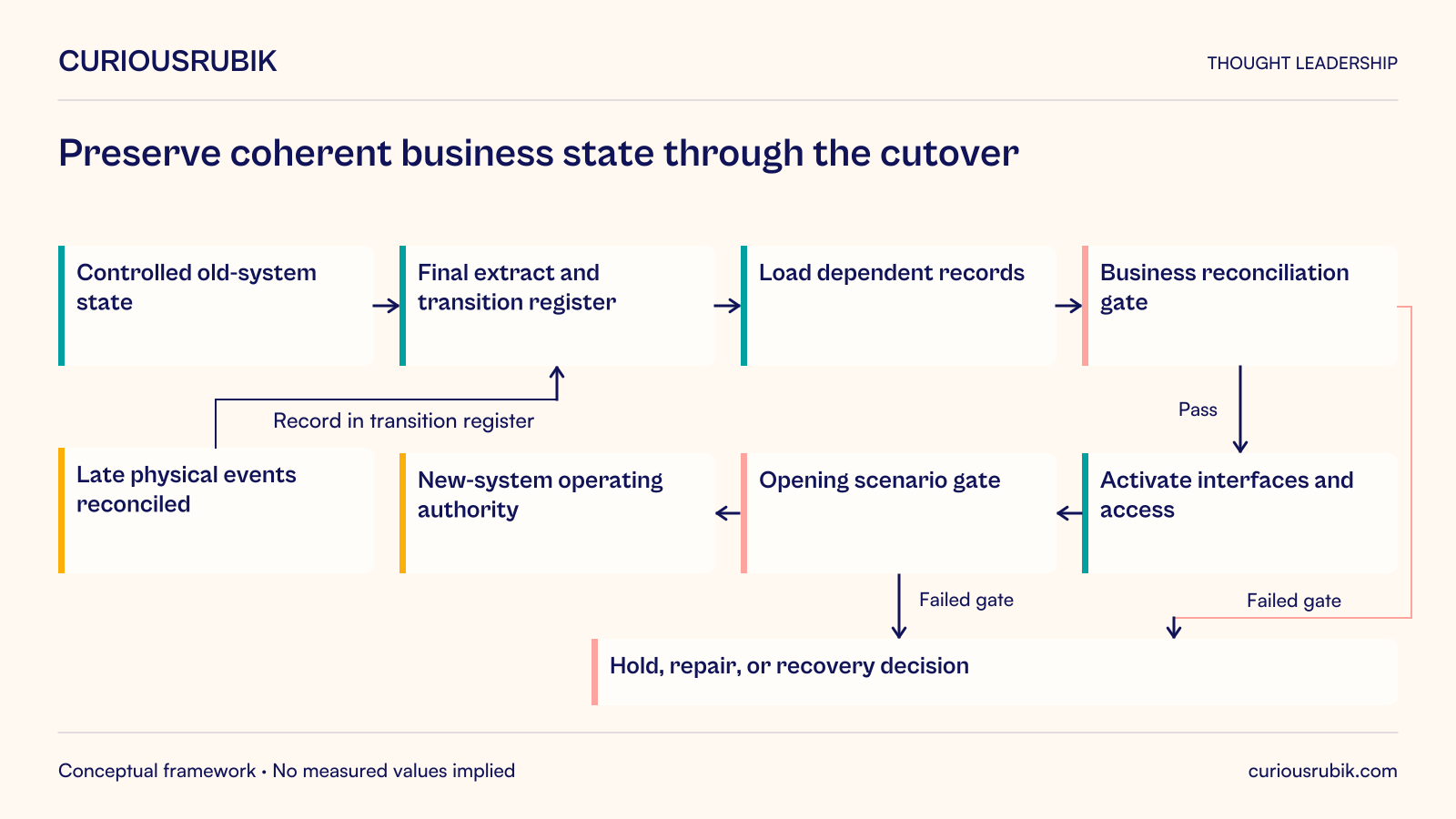
For a cutover lead, the central task is to preserve a coherent business state while applications, data, interfaces, and people change over. A detailed schedule helps, but its value depends on the logic behind it and the team’s ability to make timely decisions when reality departs from the rehearsal.
Describe what the business will stop doing in the old environment, what it will start doing in the new one, and what may continue elsewhere during the transition.
Identify the authoritative system for each relevant record at each stage. If users can update the same business object in both systems without a controlled synchronization design, the plan can create conflicting histories that are difficult to reconcile later.
State the treatment of in-flight work: open orders, active service cases, unposted transactions, scheduled jobs, and messages waiting in integration queues. Decide whether each category moves, completes in the old system, or follows a defined bridge.
The target state should include usable business operation, not merely successful deployment. Access, data, interfaces, monitoring, support, and essential operating instructions must align at the point the service opens.
A migration load may depend on a final extract, which depends on a write freeze, which depends on completing or recording active work. A business smoke test may depend on both data reconciliation and interface activation.
Model these relationships explicitly. Do not rely on task order in a spreadsheet to imply dependency. Identify which tasks can run in parallel and which require confirmed completion of an earlier step.
GAO’s Schedule Assessment Guide emphasizes integrated schedules, sequencing, credible durations, and a valid critical path. Those principles apply usefully to a cutover window even though the guide addresses broader program scheduling. GAO Schedule Assessment Guide.
Use measured rehearsal durations where available and explain uncertainty. Include the time required to inspect results and make decisions, not only the time required for scripts to run. A plan that schedules reconciliation as an instantaneous signoff has hidden work in its critical path.
A useful cutover step identifies the action, owner, backup, prerequisites, expected result, verification evidence, and escalation path. It should be understandable to the person who may execute it under pressure.
Separate the person performing the action from the person confirming a consequential result where appropriate. A data load finishing successfully does not prove that the business balances and relationships are correct.
Specify how completion is recorded. Use one controlled execution log with actual times, outcomes, decisions, and evidence references. Avoid several teams maintaining incompatible versions of progress.
This step structure is a working execution heuristic, not a formal standard. Its purpose is to make the plan usable when an action fails or the original owner is unavailable.
Consider a hypothetical equipment-rental company moving reservations and fleet availability to a new platform. Existing rentals remain active, future reservations must transfer, and equipment may return during the transition window.
The cutover plan defines a final controlled point for ordinary reservation changes in the old system. Authorized late changes enter a numbered transition register, with the responsible operator and affected equipment recorded. The business does not allow informal updates in both platforms.
The final extract includes future reservations, active rentals, equipment status, and the relationships needed to interpret them. Reconciliation checks counts and meaningful business conditions, including overlapping reservations and active rentals linked to the correct units.
Returns during the window follow a specific operating route. Staff record the physical event and necessary evidence without prematurely making the equipment available in a system whose state is still being established. The transition register is reconciled before normal processing resumes.
A rehearsal reveals that one availability calculation runs before all active rental records are loaded. The schedule is corrected to make that dependency explicit. Moving the task later is more important than preserving its original planned start time.
The final opening test includes creating a valid reservation, rejecting a genuine conflict, processing a recorded return, and confirming that the operational view matches the authoritative data. Any financial or contractual treatment remains under the company’s approved policies.
The hypothetical example shows how physical operations and system state must be coordinated. It does not imply that every rental business should use the same freeze or migration method.
A checkpoint should answer a specific question: is the extract complete, is migrated data acceptable, are critical interfaces ready, or can the business open the defined scope?
For each checkpoint, name the decision owner, required evidence, available options, and latest decision point. Options may include continuing, repeating a bounded step, narrowing scope, holding, or invoking a recovery route.
Avoid checkpoints whose only possible outcome is “continue.” If a failed reconciliation cannot change the plan, it is not functioning as a decision gate.
Set escalation expectations before the window. The cutover lead needs timely access to authorized business and technical owners. A critical decision should not depend on finding a sponsor who has assumed the team will call only if something catastrophic happens.
Some tasks can be repeated safely; others can duplicate transactions or overwrite useful evidence. Mark the difference in the plan.
A rerunnable extraction differs from a posting action that may already have created an external effect. If completion is uncertain, the team must establish what happened before repeating the action.
For data loads, define how corrections will be applied and reconciled. A broad reload may be inappropriate once users or interfaces have created new records. Preserve the relationship between the original load, corrections, and subsequent activity.
Test failure handling in rehearsal. Interruptions, partial completion, unavailable dependencies, and unexpected record counts reveal whether the team can recover within the operating window. A rehearsal that follows only the ideal sequence leaves important execution assumptions untested.
A rollback plan must account for transactions and physical events that occur after the transition begins. Restoring software does not automatically restore a coherent business history.
NIST’s contingency-planning guidance connects recovery priorities and procedures with the system lifecycle and operational needs. For cutover, the relevant application is to define what can be restored, what must be reconciled, and when an earlier state is no longer a practical destination. NIST SP 800-34 Revision 1.
Identify the points after which the recovery strategy changes. Once external messages, payments, or physical dispatches occur, a forward correction or compensating process may be necessary. The decision should be understood before the team crosses that boundary.
Keep recovery instructions separate enough to be usable during a problem, but linked to the same state model and execution log. A generic backup document is not a complete cutover recovery plan.
A useful rehearsal tests ownership, communication, evidence collection, and decision speed. Include the people expected to perform the real work and use representative data volumes and conditions where feasible.
Record actual duration and the reasons for variation. A task may finish quickly only because an expert manually corrected a problem that the final plan does not mention. Capture that work rather than treating the rehearsal time as a clean technical benchmark.
Exercise absence cover. Ask the backup owner to interpret a step and locate its evidence. Ambiguity discovered during rehearsal is cheaper than ambiguity discovered during the live window.
Review the plan after each rehearsal and control the final version. Late changes should be evaluated for their effect on dependencies, timing, verification, and recovery. Do not allow undocumented edits to undermine the rehearsed sequence.
During cutover, the coordination channel should make status and decisions clear without becoming a stream of unstructured commentary. Each task owner reports the defined outcome and evidence reference.
The cutover lead maintains the dependency view and highlights decisions needed. Technical teams can use specialist channels for detailed work, but material state changes and blockers return to the shared log.
Distinguish an estimate from a commitment. When a task slips, update the forecast based on actual dependencies rather than repeatedly preserving the original opening time. Business leaders need a credible view of the remaining options.
Keep customer and employee communication tied to confirmed facts. Avoid announcing that service is available before the opening checkpoint has passed. Prepare messages for expected states and for a delay so wording does not have to be invented under pressure.
The cutover ends when the defined operating scope is open, transition records are reconciled, monitoring and support are active, and unresolved issues have named owners. Some cleanup may continue, but it should not disappear into an informal list.
Confirm that obsolete jobs and interfaces are disabled or otherwise controlled. An old scheduled process can continue creating records after everyone believes the new system is authoritative.
Preserve the execution log, reconciliation evidence, decisions, and lessons. These records support early incident diagnosis and improve the next transition.
Ask suppliers to demonstrate the plan’s behavior when a critical task is late or partly complete. A successful cutover plan is not the one with the most rows. It is the one that keeps the business state understandable and gives authorized people workable choices throughout the transition.