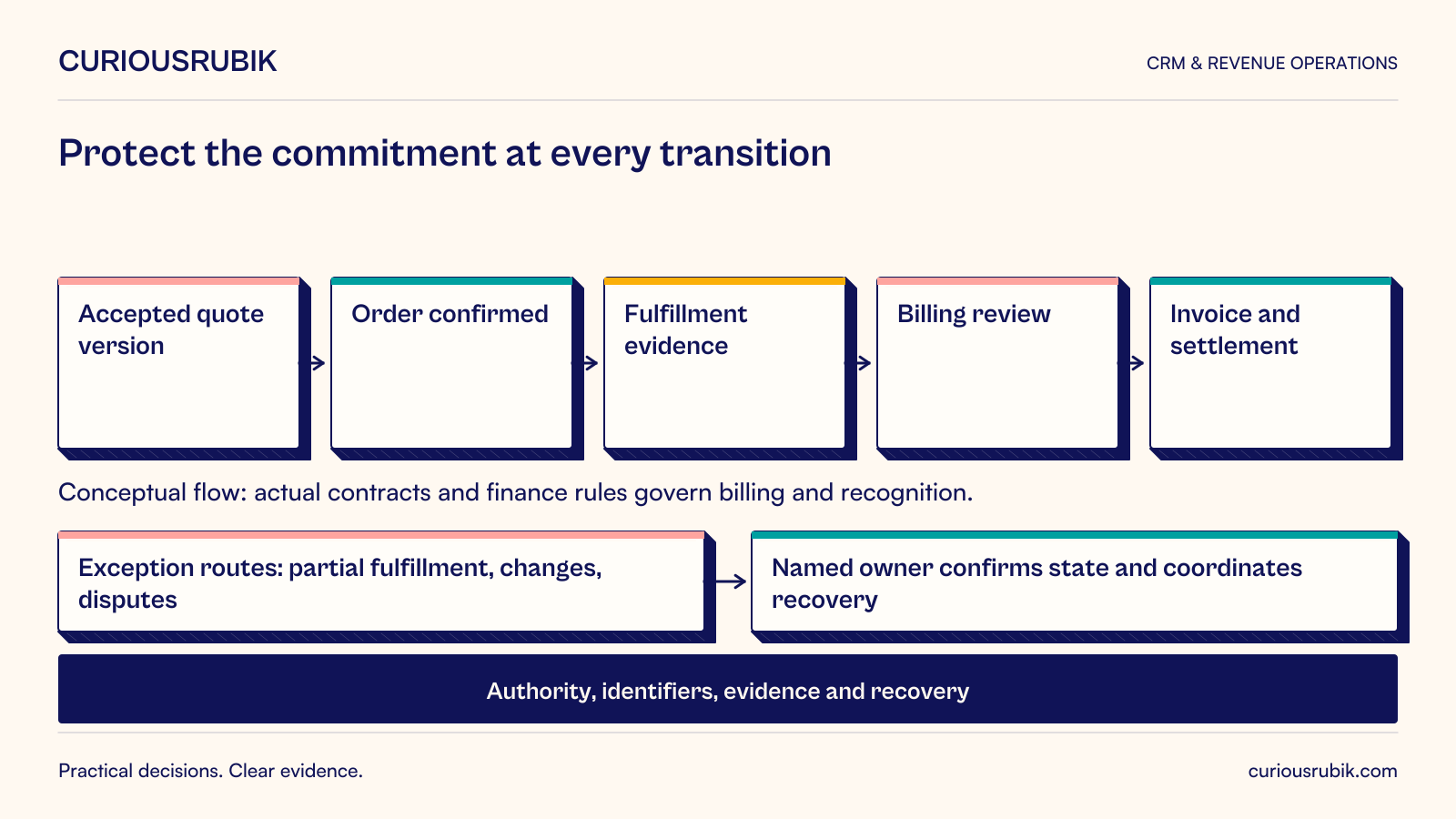
The hardest quote-to-cash failures often occur after a system reports success. A quotation is approved against an old product configuration. An order is created twice because the first response was lost. A shipment is recorded but the evidence needed for billing never reaches finance. Each application may be functioning, while the commercial transaction has become inconsistent.
A reliable architecture must preserve the meaning and authorized version of the deal across quotation, acceptance, fulfillment, billing and collection. It also needs a way to detect and repair incomplete transitions. For a revenue-operations leader and enterprise architect, the design question is therefore broader than which systems should connect: what evidence permits each business transition, and how will the organization recover when only part of it succeeds?
Performance should include correctness, explainability and recoverability alongside speed. A faster process that produces an unapproved obligation or duplicate charge has not improved the customer’s experience.
A quote contains more than a price. It can include product configuration, quantities, service scope, delivery assumptions, currency, discounts, billing conditions and acceptance requirements. Some of those terms change during negotiation. The accepted version must be identifiable after the opportunity moves into operations.
Assign stable identifiers to the commercial record and its versions. Preserve which version received internal approval and which version the customer accepted. If an approved quote changes materially, the architecture should not silently carry forward approval for a different arrangement.
Avoid using document filenames as the only version control. “Final proposal revised” does not establish which terms are authoritative. A human-readable document can remain essential, but the system needs a reliable reference to the accepted terms and any subsequent amendment.
This requirement extends to the product or service definition. If a catalog item changes after a sale, the order should retain the configuration actually committed to that customer. Otherwise, downstream teams may fulfill today’s catalog definition rather than the agreed one.
Map the process as states with controlled transitions. A simple teaching model might include proposed, approved, accepted, ready to fulfill, fulfilled, ready to bill, invoiced and settled. Real businesses may need partial quantities, multiple milestones, returns or disputes, so this list is a starting point rather than a universal state machine.
For each transition, define the authorized actor, required evidence, validation rules, resulting record and exception route. “Ready to fulfill” might require an accepted order, a valid delivery location and satisfaction of a credit policy. “Ready to bill” depends on the actual contract and relevant evidence; it must not be assumed to mean the same thing as “shipped” in every business.
Keep operational states separate from accounting conclusions. IFRS 15, for example, bases revenue recognition on the transfer of promised goods or services and satisfaction of performance obligations. An integration event can supply evidence for finance, but it does not replace the accounting analysis of the arrangement. IFRS 15 overview.
The architecture should make the authorized transition easy and an invalid transition visible. It should not simply prevent users from acting without explaining which condition is missing or who can resolve it.
Name the authoritative source for each business fact. A CRM may own opportunity context; a pricing service may own permitted price rules; an order system may own accepted order status; finance may own invoices and allocated receipts. The exact allocation varies, but two systems should not independently overwrite the same fact without a conflict policy.
Distinguish a command from an event. A command asks an authorized system to perform an action, such as create an order. An event reports that something has happened, such as an order being accepted. Treating a request as proof of completion is a common design error. Downstream work should rely on the confirmed result required by its business rule.
Use synchronous validation where the user needs an immediate answer before making a commitment. Use asynchronous processing where temporary delay is acceptable and the workflow can track pending work. Neither pattern is universally superior. The decision depends on the consequence of stale information, the availability of dependencies and the user’s ability to proceed safely.
Expose pending states honestly. A screen that says “submitted, awaiting order confirmation” can be more trustworthy than one that says “complete” while a background integration may still fail.
Networks can fail after the receiving system has already performed an action. A sender may therefore be uncertain whether an order or invoice was created. Blindly repeating a create request can create a duplicate unless the receiving operation has an appropriate safeguard.
HTTP’s specification defines idempotence in terms of repeated identical requests having the same intended effect as one request, and cautions against automatic retries of non-idempotent requests without a basis for knowing they are safe. That protocol principle does not automatically make a business transaction duplicate-proof. The application must define and enforce its own operation identity and behavior. RFC 9110, section 9.2.2.
For order creation, an application might use a stable business-operation key tied to the accepted quote version, with an atomic uniqueness rule and a stored result. The receiver must distinguish a repeated submission of the same operation from a genuinely different order. Define the key’s scope, retention period and response to changed payloads. A key generated anew on every retry defeats the purpose.
Where the application cannot provide these guarantees, use a controlled recovery procedure: search for the authoritative result, reconcile the business reference and let an authorized owner decide whether another action is appropriate. Do not label an uncertain result as a confirmed failure merely because a response timed out.
Consider a hypothetical manufacturer accepting an order for ten configured units. The scenario is illustrative and contains no claimed client result. The accepted quote is version 4; version 5 is an internal proposal for a possible later change and has not been accepted.
The order-creation request succeeds in the order system, but the response to the CRM is lost. A retry with the same operation identity should return or locate the existing order, not create another ten-unit commitment. The integration should also reject an attempt to use the same operation identity with materially different version-5 terms.
The manufacturer then ships six units. Its workflow must preserve ordered, fulfilled and remaining quantities separately. A single “fulfilled” checkbox cannot explain the partial state. Billing eligibility follows the actual contract and finance’s rules; the architecture should convey the six-unit fulfillment evidence without assuming that it resolves every billing or revenue question.
The customer subsequently requests cancellation of the remaining four units. That request must reach the authorized owner, who checks production status and the applicable commercial arrangement. Deleting the original order would destroy the history needed to explain what was accepted, shipped and changed. The resulting cancellation or amendment needs its own controlled record and downstream updates.
This one scenario tests version integrity, duplicate prevention, partial fulfillment and change handling. A demonstration that only converts one clean quote into one complete invoice does not test those properties.
Technical monitoring can show that messages were delivered while business records remain inconsistent. A message may be syntactically valid but refer to the wrong entity, an obsolete item or an unapproved version. Operational reconciliation should compare the business outcomes expected on each side.
Examples include accepted quotes without orders, fulfilled quantities without the required billing review, invoices without a traceable originating obligation and receipts awaiting allocation. The reconciliation should distinguish legitimate timing differences from errors and show the responsible owner.
Give support teams a traceable transaction view: business identifiers, relevant versions, timestamps, last confirmed state and recovery history. Restrict access appropriately; observability does not require exposing complete customer documents or payment information in logs.
Set escalation rules around business consequence. A failed low-value update may tolerate a later retry. An uncertain customer charge or blocked dispatch may need immediate attention. A uniform technical severity label can miss that difference.
A monolithic replacement is not always necessary to improve quote-to-cash. The most valuable first change may be preserving accepted quote versions, fixing duplicate creation, clarifying billing evidence or establishing a reliable exception queue.
Prioritize using observed failures and the cost of correction. Do not assume that an event-driven architecture, a middleware platform or a single vendor suite will resolve unclear authority. Technology can enforce a well-defined transition; it cannot decide which commercial promise the business meant to make.
Before approving a design, ask the team to demonstrate an amended quote, a lost response, a partial delivery, a rejected invoice and a disputed payment. Require both the customer-visible behavior and the internal recovery path. The architecture is ready to earn trust when ordinary operations and imperfect conditions can be explained with the same coherent transaction record.