A laboratory supervisor can rescue today’s delayed jobs and still leave next week’s delay almost certain. The immediate queue may need a scheduling decision, while the recurring problem requires a different service promise, specialist capacity, or investment. Operational excellence depends on connecting those decisions rather than asking the same daily meeting to solve every horizon.
The architecture in this article is the structure of an operating system for management: how commitments become executable work, how problems reach the right decision, and how evidence changes future plans. It is not a proposed software topology or a universal maturity score.
A COO can assess that architecture by tracing one material service failure through daily control, capacity planning, and strategic review. The hypothetical industrial calibration laboratory below shows why each horizon needs its own authority and information, while remaining connected to the others. The example concerns management of work, not technical calibration procedures or accreditation requirements.
Define the service promises that matter to customers and the conditions under which they apply. A quoted turnaround time may depend on the type of work, complete intake information, available specialist capability, and the result of an initial assessment.
Translate the promise into operating requirements. The team needs to know which work is accepted, what is ready to begin, what is blocked, and what constitutes an accepted completion. A schedule built from ambiguous states cannot reliably protect the commitment.
Keep quality and authority boundaries explicit. A job should not be called complete because the next customer is waiting if required qualified review remains open. The operating architecture must preserve those conditions rather than treat them as obstacles to utilization.
Assign ownership for the promise itself. If commercial teams can offer a service condition that operations cannot sustain, daily scheduling will inherit a policy problem. The architecture needs a route to reconcile the offer with demonstrated capability.
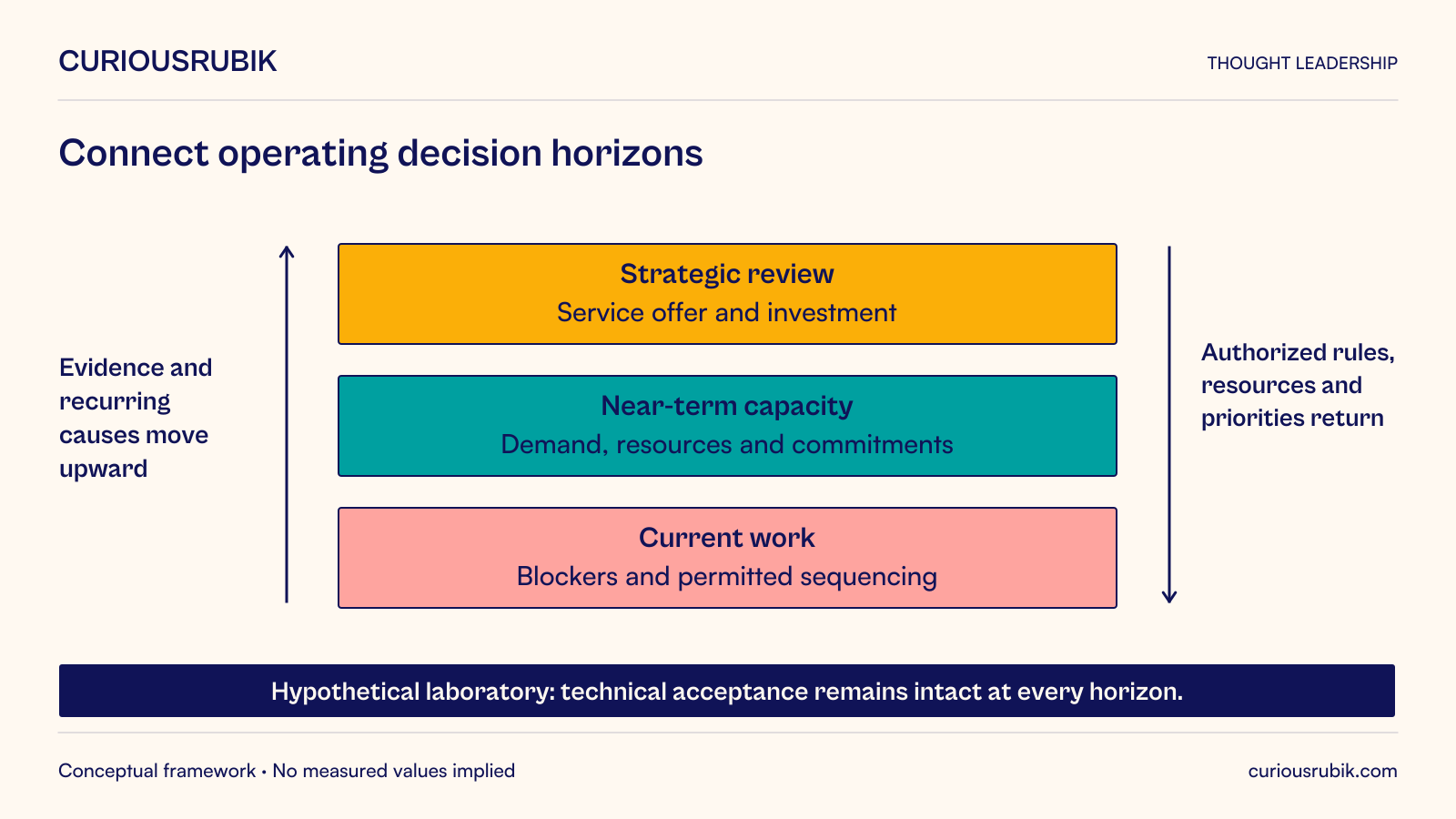
Daily operating control addresses current work. It identifies blockers, makes permitted sequencing choices, and ensures that immediate exceptions have an owner. Its information should be current enough to support those actions and detailed enough to distinguish a real capacity issue from missing evidence.
Capacity planning addresses the coming workload and the resources needed to serve it. It considers demand mix, specialist availability, maintenance, supplier dependencies, and the effect of committed work. Its decisions may change allocation or propose a service adjustment beyond the daily team’s authority.
Strategic review addresses the continuing operating model: which services to offer, which capabilities to build, where to invest, and which constraints the business will accept. It needs evidence accumulated across cases, not only the latest urgent incident.
The horizons need not correspond to fixed daily, weekly, and monthly meetings in every business. Choose timing that fits the rate at which decisions become stale. The important distinction is the kind of decision and authority, not the calendar label.
Imagine a hypothetical industrial calibration laboratory that offers a short-turnaround service for a defined instrument group. Several jobs require a specialist station and qualified personnel. An unexpected station outage creates an immediate queue and threatens accepted customer dates.
The daily control team identifies the affected jobs, checks their current state, and uses permitted sequencing and communication routes. It does not relax technical acceptance criteria to make the queue disappear. Cases requiring a changed customer commitment go to the authorized owner.
The capacity-planning review then examines the next period’s workload. It asks whether available alternatives, qualified cover, and planned maintenance can support the existing promise. If not, the commercial and operating owners must decide whether to limit new commitments or adjust the offered service under approved conditions.
Strategic review examines the pattern across time. Is the station a persistent constraint? Does demand justify additional capability? Is the short-turnaround offer valuable enough to support its required resilience? The investment question cannot be settled solely by the frustration of one bad day.
Suppose the outage reveals that the business repeatedly sold the short-turnaround service without checking the relevant workload class. The corrective decision may involve the acceptance policy as well as equipment capacity. Buying another station could help, but it would not automatically repair the promise-setting mechanism.
The architecture works when evidence travels between these horizons. Daily exceptions inform capacity and policy choices; those choices return as clear operating rules and resources. If the feedback stops at a report, supervisors continue rescuing the same problem without changing its cause.
Define important states consistently across the service. Received, accepted, ready, in progress, blocked, technically reviewed, and delivered may each mean something different. Use only the distinctions needed for decisions, but do not combine states whose consequences differ.
Maintain identifiers that connect the customer commitment, work item, resource requirement, and accepted result. Managers should be able to trace a delay without reconciling unrelated spreadsheets by memory. Shared information does not require every team to use an identical screen.
Record why work is blocked. Missing customer information, unavailable equipment, and required specialist judgment need different responses. A generic pending category makes the queue visible without making it manageable.
Protect the integrity of the measures. If one team closes a job when work is performed and another when the result is accepted, the enterprise can report incompatible completion rates. Agree on the business meaning and preserve local diagnostic measures where useful.
An operation contains dependencies between activities, not just a set of departments. Intake quality affects preparation. Preparation affects productive use of specialist time. Review capacity affects accepted output. Improving one activity can move the constraint elsewhere.
Evaluate proposed changes through those relationships. Faster intake can increase work in progress if downstream capacity is unchanged. Higher local utilization can reduce flexibility needed to keep a time-sensitive promise. Neither result is inherently wrong, but the tradeoff belongs in the management decision.
The 2021–2022 Baldrige Excellence Builder describes a nonprescriptive systems perspective connecting plans, processes, measures, and actions. That is a useful reference for integrated management; it does not certify that the architecture proposed here will produce excellent results. NIST, Baldrige Excellence Builder, 2021–2022
Use the customer outcome as a common point of reference. Departmental measures remain useful for diagnosis, but they should not reward behavior that makes the complete service less dependable. Review the whole path when local indicators improve and the customer result does not.
Define who accepts an exception, what evidence they need, and what authority they have. A dashboard alert without a receiving decision is incomplete. The response should produce an explainable state change or a deliberate escalation.
Preserve the unresolved population. Problems should not disappear because they move to another team or fall outside a reporting period. Track aging, ownership, and the condition required for resolution.
Aggregate recurring causes for improvement. A series of missing-information cases may justify an intake change. Repeated resource conflicts may require a planning or service-policy decision. Use the pattern to choose the appropriate horizon rather than adding another local workaround.
Test the resulting change and return the lesson to operations. A policy revised at an executive meeting must reach the people who accept and schedule work. A technical fix must be reflected in guidance and support where it changes behavior. Learning is complete only when the operation can use it.
Plan for absent decision-makers, unavailable systems, and changing demand. The operation needs qualified cover and an approved fallback for essential work. A management process that depends on one experienced person can appear effective until that person is unavailable.
Distinguish temporary recovery from normal service. If the laboratory uses an exceptional arrangement during an outage, record its limits, owner, and reconciliation needs. Do not let a temporary workaround quietly become the untested permanent operating model.
Keep technology responsibilities clear. Systems should provide trustworthy state, enforce appropriate rules, and support traceability. They cannot resolve every commercial priority or supply missing expert capacity. Conversely, good meetings cannot compensate for records that are unavailable or wrong.
Review whether the supporting architecture is proportionate. A small operation may need a concise shared view and a few clear decision routes. A complex network may need more formal planning and governance. Adding layers without a decision purpose creates overhead rather than excellence.
Choose a recent delayed or disputed job and reconstruct its path. Establish the original promise, the state observed, the decision taken, the authority used, and the final result. Then ask whether any learning reached capacity planning or the service offer.
Repeat the exercise with a successful case to understand what made the operation work. Excellence includes maintaining effective practices, not only investigating failure. Preserve the conditions that produced a dependable result and identify where they may not generalize.
The laboratory does not need a new management vocabulary to begin. It needs connected decisions that can protect today’s commitments and change tomorrow’s conditions. An operationally excellent enterprise builds that connection deliberately: shared meaning, appropriate authority, useful evidence, and a maintained route from observed performance to better operating choices.