Event-driven architecture is worth considering when several independently owned processes need to react to the same business fact without forcing the originating process to wait for all of them. Its value can come from separating release schedules, isolating some failures, and making new reactions easier to add. Those benefits depend on event meaning, durable capture, consumer operations, and an acceptable delay between the fact and its consequences.
For a service-operations platform owner, the decision might be whether job completion should directly invoke billing review, customer communication, and analytics, or publish a well-defined completion event for those consumers. The right choice depends on which downstream actions are part of the completion promise and which can proceed independently.
An event should describe something that has occurred. A request to complete a job is a command; a fact that an authorized completion was recorded is an event. Confusing them can cause subscribers to act before the source has established the condition they assume to be true.
Start by drawing the current call sequence. Which downstream response must the user receive before continuing? Which actions can occur later? Which failures should prevent the original operation, and which should create a separately tracked obligation?
If a technician records a completed job, an analytics outage may not justify preventing that record from being saved. A missing mandatory completion check might. The business owner should decide these distinctions explicitly. Moving a check behind a message broker does not make it optional.
The Publish-Subscribe Channel pattern describes distributing an event to multiple interested receivers. This is different from several workers competing to process one shared work item. The business design must establish which consumers each need their own copy. Enterprise Integration Patterns, Publish-Subscribe Channel
Independent consumers can evolve their internal implementation without the producer invoking each one directly. They still depend on the event’s meaning and contract. An event-driven system reduces particular forms of coupling; it does not eliminate dependence among the business processes.
A useful completion event identifies the job, source, event identity, relevant version, business-effective time, and the meaning of completion. It should explain whether required evidence was validated, what remains pending, and where authorized consumers can obtain additional details.
The event should not expose every internal field. A broad payload can create unnecessary dependencies and distribute information to consumers that do not need it. A minimal notification reduces copied data but may force every consumer to call the source for details, reintroducing runtime dependence. An event containing a suitable business snapshot can avoid that fetch but adds contract and data-governance obligations.
Choose deliberately between those designs. A consumer that needs the facts as they stood at completion may require a versioned snapshot or access to historical state. Fetching the current record later may return a corrected or reopened job, which answers a different question.
CloudEvents 1.0.2 provides a common event envelope with source, identity, type, and other context attributes. It can improve interoperability around the message, but it does not define what “job completed” means for the business or guarantee the behavior of delivery infrastructure. CloudEvents Specification 1.0.2
Give the event an accountable owner and a documented change policy. Consumers need to know how corrections, new states, and incompatible meaning changes will be communicated. A stable event name with changing meaning is especially difficult to detect through schema validation alone.
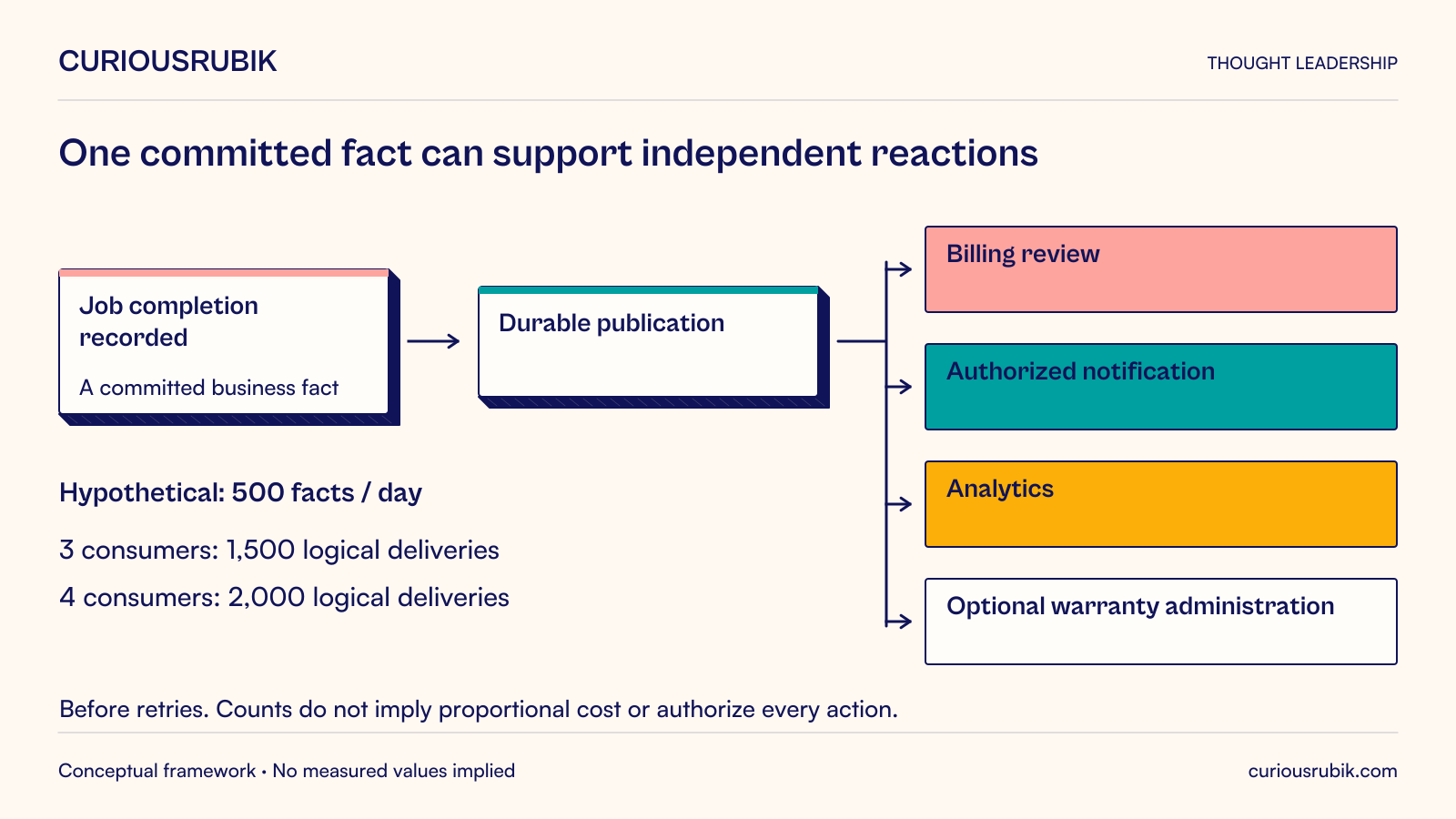
Suppose a hypothetical service business records five hundred completed jobs per day. Three downstream processes need each completion: billing review, an authorized customer-notification workflow, and operational analytics. The producer records five hundred facts, while the three logical subscriptions represent fifteen hundred expected consumer deliveries before retries or other traffic.
At noon, one job is completed and the source records the approved state and a durable outbound event. The notification workflow processes its copy at 12:01. Billing review processes its copy at 12:02. Analytics is unavailable until 14:00 and processes its retained copy afterward, assuming the selected platform’s durability and retention configuration supports that interval.
The technician does not need to repeat the completion simply because analytics was unavailable. The analytics delay is visible to its owner and governed by its own recovery objective. Billing review is still a review; the completion event does not itself authorize an invoice or determine revenue recognition.
Now the business wants to add a warranty-administration consumer. If the existing event contains the necessary approved facts and access is authorized, that consumer can subscribe without the source directly calling a fourth application. Expected logical deliveries become two thousand per day for the same five hundred completion facts. This is a workload illustration, not a statement that infrastructure cost grows in exactly the same proportion.
The new consumer must still evaluate warranty eligibility under the relevant business rules. A job-completion event is evidence of completion, not proof of every downstream entitlement. The event contract should make that boundary clear enough that a new team cannot reasonably infer more than the source promises.
The case for events is strongest here if downstream teams change independently and can accept their specified processing delay. If all four results must be confirmed before the job is considered complete, the design needs an explicit coordinated process rather than pretending they are independent reactions.
A broker or event platform adds work: provisioning, access management, retention, consumer monitoring, schema governance, replay procedures, incident response, and capacity planning. Managed infrastructure can shift some responsibilities, but it does not remove business ownership of missed or incorrect effects.
Each consumer needs an owner, a processing objective, duplicate handling, a rejection route, and a way to establish its actual outcome. An event can be delivered successfully while the consumer fails to apply it. A dead-letter queue can preserve a failed message without resolving the business obligation.
Account for historical replay. Rebuilding analytics from retained events may be useful. Replaying the same stream through a customer-notification consumer could send old messages again unless the consumer has appropriate protections. The business case should distinguish useful reprocessing from repeated external effects.
Compare these obligations with the current costs: coordinated releases, synchronous failure propagation, duplicated polling, or repeated source modifications for new consumers. Use observed change and incident histories where available. Do not assume that adopting events automatically lowers total cost or improves every latency measure.
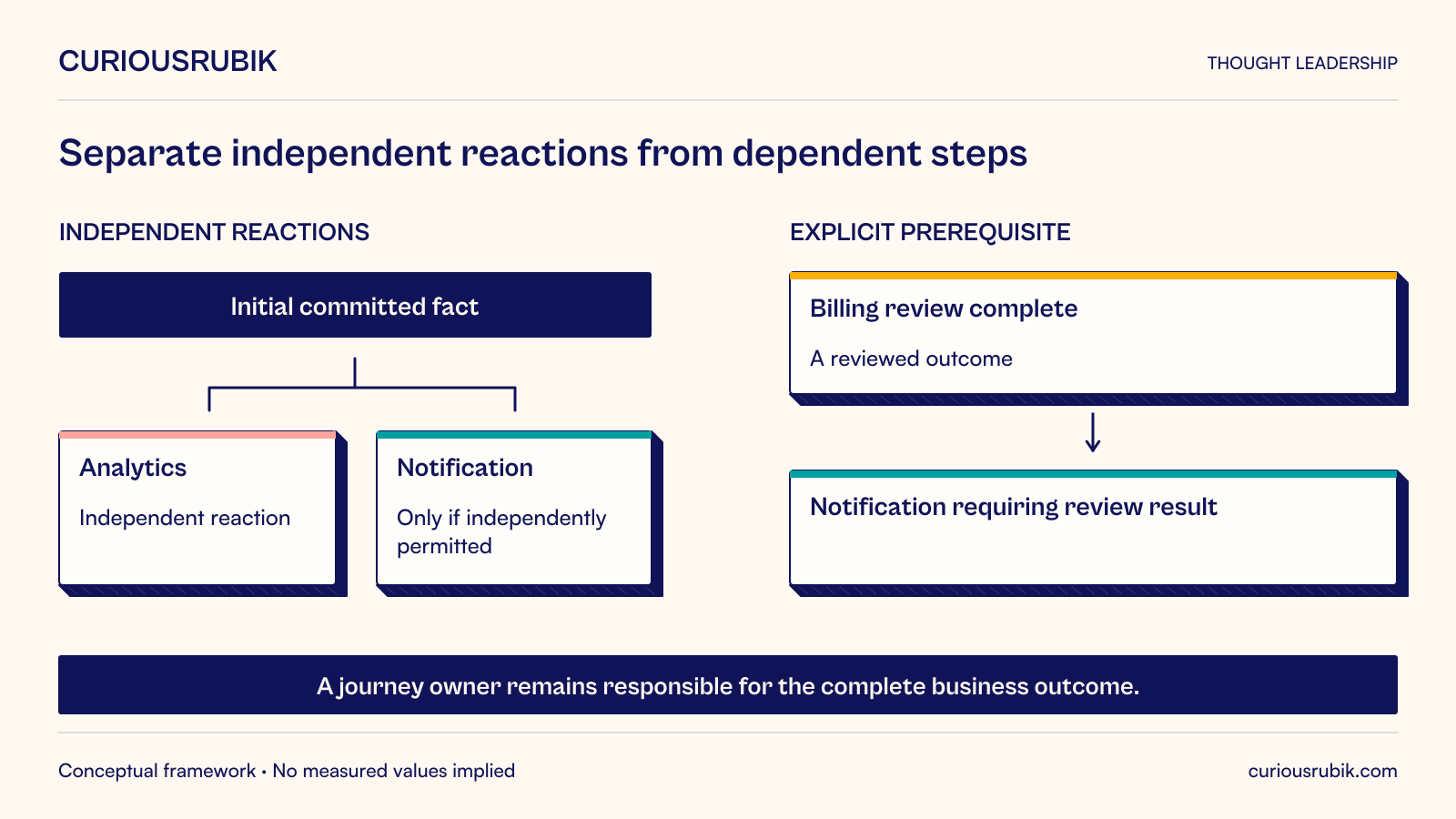
Some reactions can occur independently; others have prerequisites. If a customer notification must reflect the result of a billing review, both should not simply react to the initial completion event and race. The process may need a later event representing the reviewed state, or an explicit orchestrator that records the sequence.
Choreography lets participants react to events according to their own responsibilities. Orchestration uses a coordinator to direct and track a workflow. Neither is universally better. Choreography can suit independent reactions; orchestration can make a consequential multi-step process easier to inspect and control.
Avoid an invisible chain in which one event triggers another across many teams and no one owns the overall outcome. Maintain a view of the business journey, its milestones, and the responsible owner even if execution is distributed. Distributed processing does not justify distributed ambiguity about completion.
Ordering guarantees must match the scope of the business rule. A platform may preserve order within a partition or key under specific conditions while providing no global order across all events. Design consumers around the guarantees actually supplied and test corrections and out-of-order arrivals. A later “job reopened” fact may change what a consumer should do with an earlier completion.
Choose an event with a clear source owner, several genuine consumers, and a manageable consequence of delay. Define the fact and its correction model before choosing the platform. Verify that the source captures the event durably with the relevant state change, or provides a tested reconciliation for missed publication.
In the pilot, stop one consumer while leaving others active. Confirm that the producer’s intended behavior continues, the affected consumer’s lag is visible, and recovery produces the correct state without repeating harmful side effects. Then introduce a contract-compatible change and observe whether consumers can evolve independently as intended.
Measure end-to-end consumer outcomes, not just publish throughput. Useful evidence includes how many releases require producer coordination, whether one consumer’s outage affects unrelated work, and how quickly an operator can identify an unfinished downstream obligation. Interpret the measures alongside the added operational cost.
There are reasonable alternatives. A simple direct call may be clearer for one immediate request-response interaction. A periodic extract can be sufficient for a low-frequency analytical need. A small application may not benefit from an event platform whose governance cost exceeds the independence it creates.
Fund event-driven architecture when the organization can name the coupling it will remove and accept the new responsibilities it introduces. Begin with one well-defined business fact, prove independent consumer behavior under failure, and expand only when that independence is useful in actual operation.