Mobile integration is difficult because a short user interaction can depend on several systems with different identities, business rules, response times, and release cycles. The phone may show one order or service request, while the enterprise must coordinate customer eligibility, pricing, capacity, authorization, and transaction history before it can accept that request.
For an enterprise architect launching a field-sales application, the important decision is where to place that coordination and which promises the mobile client can safely make. Connecting the app directly to every available endpoint may be quick initially, but it can move business interpretation and recovery into a client that is difficult to update consistently.
The recommended approach is to define a stable business-facing integration contract, assign authoritative ownership of each decision, and design for older clients and uncertain outcomes. A dedicated mobile integration layer may help, but only when its responsibilities are clear. An extra service that merely forwards requests adds another failure point without resolving ambiguity.
Begin with the business facts the application needs. For each, identify the authoritative owner, permitted consumers, meaning, identifier, and expected freshness. A customer name may come from a relationship system while trading eligibility comes from an order platform. Combining them into one screen does not make one system authoritative for both.
Resolve identity mappings deliberately. A mobile visit, enterprise customer, delivery location, and billing account may be different entities. Reusing a display name as a join key is fragile. Maintain controlled identifiers and define what happens when records merge, close, or change ownership.
Record units, currencies, time interpretation, and status meaning. A quantity may be expressed in individual units, cases, or pallets. A date may mean requested delivery, committed dispatch, or expected arrival. A technically valid payload can still be commercially wrong if those meanings are inconsistent.
Give every disputed field an owner who can settle its meaning. If integration review uncovers competing definitions of an active customer or available stock, pause that capability’s acceptance criteria until the business resolves the conflict. Code cannot reliably reconcile an unresolved policy disagreement.
A mobile screen often needs a compact view assembled from several sources. It may be appropriate to provide a read model tailored to that task: customer context, permitted products, recent activity, and useful summaries in one bounded response. This can simplify the client and reduce repeated network interactions.
The read model must retain provenance and freshness where they change decisions. A cached catalog and a live credit decision should not appear equally current merely because they arrive in the same response. Mark unavailable elements and decide which missing facts block the task.
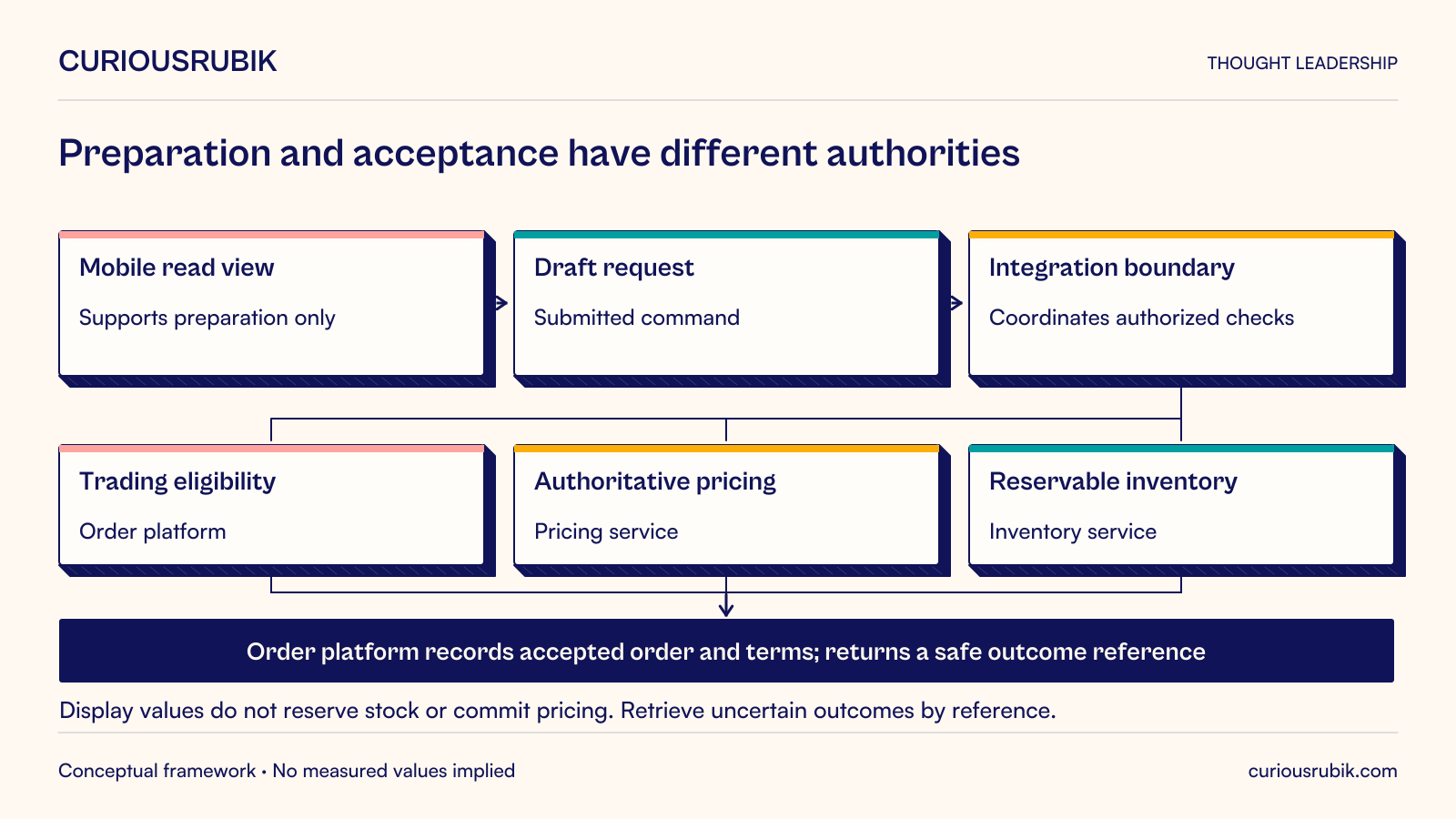
Avoid making a read model the accidental transaction authority. A displayed stock balance is an observation; it is not necessarily a reservation. A displayed price may need recalculation at acceptance. The command that creates an order should invoke the authoritative rules rather than trust values copied from the screen.
Limit aggregation to the actual use case. A response containing an entire customer history can increase exposure and delay without helping the visit. Define a bounded payload, pagination for history, and a deliberate route for deeper information when needed.
Consider a hypothetical wholesale distributor whose representatives visit independent retailers. The mobile app shows a customer’s delivery location, a relevant product range, recent orders, and proposed prices. The representative prepares a replenishment request while discussing the customer’s needs.
The underlying systems divide authority. The customer system owns contact details; the order platform owns trading eligibility and accepted orders; the pricing service owns applicable commercial terms; and the inventory service owns reservable availability. These assignments are invented for the example rather than a prescription for every distributor.
During the visit, the representative adds ten cases of a product. The app’s earlier stock view showed twelve cases available, but another channel has since reserved five. Submission must therefore check authoritative availability and return a defined outcome: accept the permitted quantity, offer a supported alternative, or reject the requested quantity according to the business’s rules.
The system should not silently reduce the order and display a generic success. The representative needs to see the accepted quantity and any changed price or delivery commitment before making statements to the customer. If further consent is required by the organization’s process, the workflow must obtain it rather than assume the original draft authorized every later change.
Now assume the order is accepted but the mobile connection fails before the response arrives. The client needs a way to retrieve the outcome using a stable request reference. The support team should be able to trace that reference through the integration boundary to the accepted order without manually searching by customer name and approximate time.
A second failure is subtler: the pricing service is unavailable while contact details and catalog data still load. The app may allow a draft, but it should not imply that an unvalidated amount is a confirmed commercial offer. Clear capability-level degradation is more useful than either crashing the entire screen or pretending every dependency succeeded.
A mobile-specific boundary can handle response composition, client-version adaptation, request correlation, and translation between external contracts and internal systems. It can also provide a consistent error vocabulary so the app does not need to understand every backend’s implementation details.
Keep authoritative business rules with an explicitly designated owner. Duplicating pricing or eligibility rules in the integration layer creates another policy implementation to maintain. If orchestration is needed, define which service coordinates the sequence and how its decisions are reconciled with systems of record.
The boundary should enforce relevant authorization rather than rely on a trusted-looking app screen. A client may be modified or send unexpected identifiers. Check that the authenticated caller is permitted to read or act on the requested customer, location, and operation. Authentication alone does not establish resource-level authority.
A dedicated layer is not always necessary. If one well-designed enterprise API already supplies the required capability, a direct client relationship may be simpler. Add an intermediary when it absorbs genuine composition, compatibility, or operational responsibility, and budget for its monitoring, deployment, and ownership.
Return errors that distinguish invalid input, missing permission, changed business conditions, temporary dependency failure, and an outcome that remains uncertain. Those categories lead to different user actions. A generic “something went wrong” message makes employees repeat submissions or call support without useful context.
HTTP idempotence concerns the intended effect of repeated requests; it does not automatically make an order-creation operation safe to repeat. Application-level duplicate handling and outcome lookup must support the mobile promise. Conditional requests such as If-Match can help protect versioned updates from overwriting a changed representation. RFC 9110, Sections 9.2.2 and 13.1.1
For a multi-system operation, describe partial progress. If an order exists but a secondary notification fails, retrying the entire business operation may be wrong. Record the accepted primary result and recover the secondary step through an owned process. Where compensation is possible, define its limits; not every external consequence can be undone.
Expose a safe correlation reference to users and support. Internal traces should connect relevant requests without leaking credentials or unnecessary customer data. A reference that ends at the API gateway is insufficient if support still cannot establish whether the authoritative transaction committed.
Mobile clients may remain on different supported versions. Design the service contract with a compatibility policy: which versions are accepted, how changes are introduced, and what happens when a client becomes unsupported. Do not assume every employee receives a release immediately.
Prefer additive changes where their meaning is safe. A new optional field is not automatically harmless if an older client interprets its absence incorrectly. Test old clients against new responses, including unknown status values and changed validation rules. Use explicit versioning when the contract genuinely changes.
A forced upgrade can protect a critical requirement, but it can also stop work. Define the business consequence, communication plan, supported fallback, and release readiness before enforcing one. Coordinate application, identity, and backend changes so an upgrade does not strand users between incompatible components.
Use contract tests across the supported matrix. These should verify the user-visible behavior for success, rejection, partial unavailability, and uncertain outcomes. Schema validation alone cannot show that an older app gives the right explanation when the accepted quantity differs from the draft.
Before rollout, walk a representative transaction through the actual support process. Ask an operator to locate a delayed request, identify the responsible system, explain the current outcome, and choose the permitted recovery action. Record which tools and permissions that requires.
Measure the whole interaction rather than each API in isolation. A sequence of individually acceptable calls can produce an unacceptable mobile wait. Test representative payload sizes, concurrent users, and dependency failures. Keep performance claims bounded to the conditions measured.
Establish ownership for changing reference data and mappings. Customer merges, product replacements, new units of measure, and delivery-location changes can break assumptions without any application release. Include these changes in operational review instead of treating integration as complete once the first connection works.
The next practical step is to select one consequential mobile transaction and write its contract in business language. Identify who owns each fact, what is provisional, what establishes acceptance, and how the result is recovered after failure. Build the integration around that agreement, then test it with an older client and a failed dependency. That provides a stronger foundation than connecting every available system and hoping the phone can reconcile their differences.