A controller deciding whether to replace a critical workbook should first identify the job it performs. A spreadsheet used to explore an uncertain assumption is different from one that routes payment approvals, maintains the only customer mapping, or assembles the statutory reporting pack. The decision should turn on operational dependence and recoverability, not the file extension.
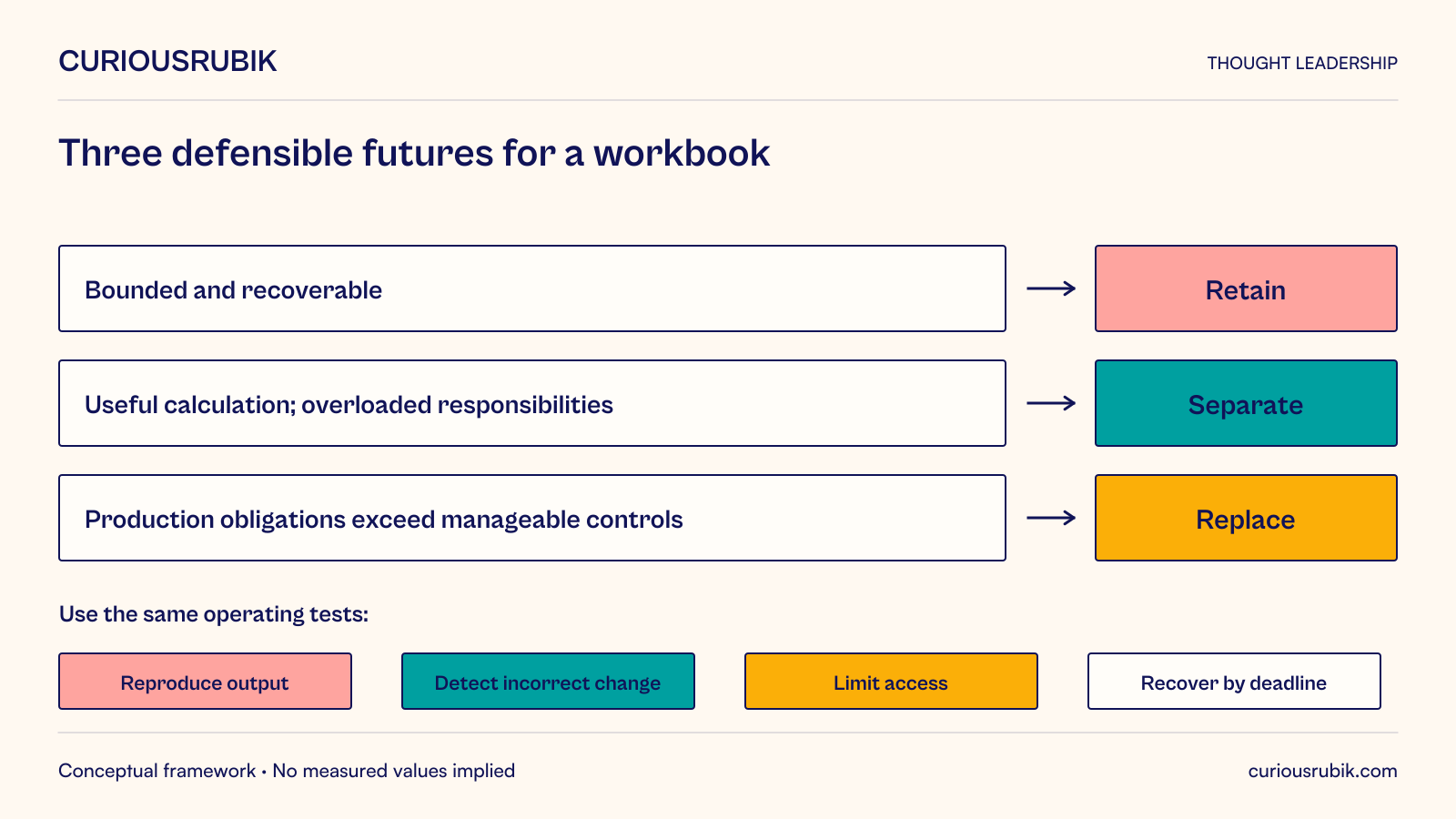
Spreadsheets remain useful wherever a knowledgeable person needs to inspect a calculation, test alternatives, or explain an unfamiliar relationship. Dependence becomes dangerous when the organization treats a personal calculation tool as a shared production service without giving it equivalent ownership, controls, or support. The appropriate response may be to strengthen the workbook, separate its responsibilities, or replace it. A blanket prohibition can hide the problem as people create unofficial copies to get their work done.
The practical objective is to know which spreadsheets carry business obligations and give each a defensible future. That requires a portfolio decision followed by a controlled transition, rather than a campaign to eliminate files.
An inventory based on filenames will miss the workbook copied into a presentation, the monthly file attached to an approval email, and the analyst’s local table used to correct system data. Start with important outputs instead: payment proposals, management accounts, forecasts, covenant calculations, and reporting submissions. Follow each output backward until the team can explain every material transformation.
For each workbook, record its purpose, owner, substitute operator, inputs, outputs, downstream users, and frequency. Identify whether the file calculates, stores authoritative data, manages workflow, or provides evidence of approval. Many fragile workbooks do several of these jobs at once.
Then ask an operational question: if this workbook disappeared today, what would stop, how would the team recover, and which decisions would become unreliable? The answer reveals dependence more directly than formula count. A short mapping table can affect every revenue report. A large scenario model may be safely reproducible from controlled inputs and used only for discussion.
Include the unofficial repairs. If a workbook corrects invalid customer identifiers before a report is produced, removing it without fixing the source recreates the error downstream. The repair may be poorly controlled, but it still performs a necessary function. Migration must account for that function explicitly.
Use four questions as a working heuristic. Can another person reproduce the output? Can an incorrect change be detected? Can access be limited to the appropriate responsibilities? Can the process recover before the next business deadline? These are assessment prompts, not a validated spreadsheet risk score.
Reproducibility requires more than retaining the final file. Preserve the input snapshot or a reliable reference to it, the calculation version, key assumptions, and any manual overrides. If a forecast changes because an assumption changed, a reviewer should be able to distinguish that from a formula change or a changed source extract.
Detection requires checks tied to plausible failure modes. A total agreeing to the ledger does not establish that values were allocated to the right customers. A formula copied consistently can still implement the wrong business rule. Test missing rows, duplicate inputs, new categories, reversed signs, and values near any threshold used by the model.
Access controls and version history help, but they do not make an inappropriate process sound. If the same person changes a payment destination, prepares the payment list, and approves the result, protecting the calculation cells leaves the important conflict untouched. Look at responsibilities across the whole workflow.
The Basel Committee’s 2013 risk-data principles explicitly discuss controls around spreadsheets and other desktop applications in banks. This is a sector-specific source, not a rule imposed on every finance team, but it illustrates why the surrounding process matters as much as the tool. BCBS 239, Principle 3, paragraph 36(b)
Retain a workbook when its purpose is bounded, inputs are controlled, review is workable, and its failure can be recovered within the required time. A quarterly sensitivity model with a small informed audience can fit this category. Improving documentation and tests may provide more value than commissioning an application that is harder to change.
Separate responsibilities when the calculation remains valuable but the surrounding workflow has outgrown the file. Store reference data in a managed source. Put approvals in a system that records actor, time, decision, and the approved version. Deliver input extracts through a controlled process. The workbook can then remain an analytical component without acting as the organization’s unofficial database and workflow engine.
Replace when the process requires concurrency, reliable transaction histories, repeated integrations, fine-grained access, or support obligations the workbook cannot economically meet. Replacement does not necessarily mean a large enterprise platform. A narrowly scoped service or a capability already present in an existing application may be sufficient.
Do not choose solely on transaction volume. A small but consequential process can justify stronger controls, while a large, read-only analysis can remain appropriate for a workbook. The issue is the combination of consequence, change frequency, interdependence, and the cost of managing those conditions.
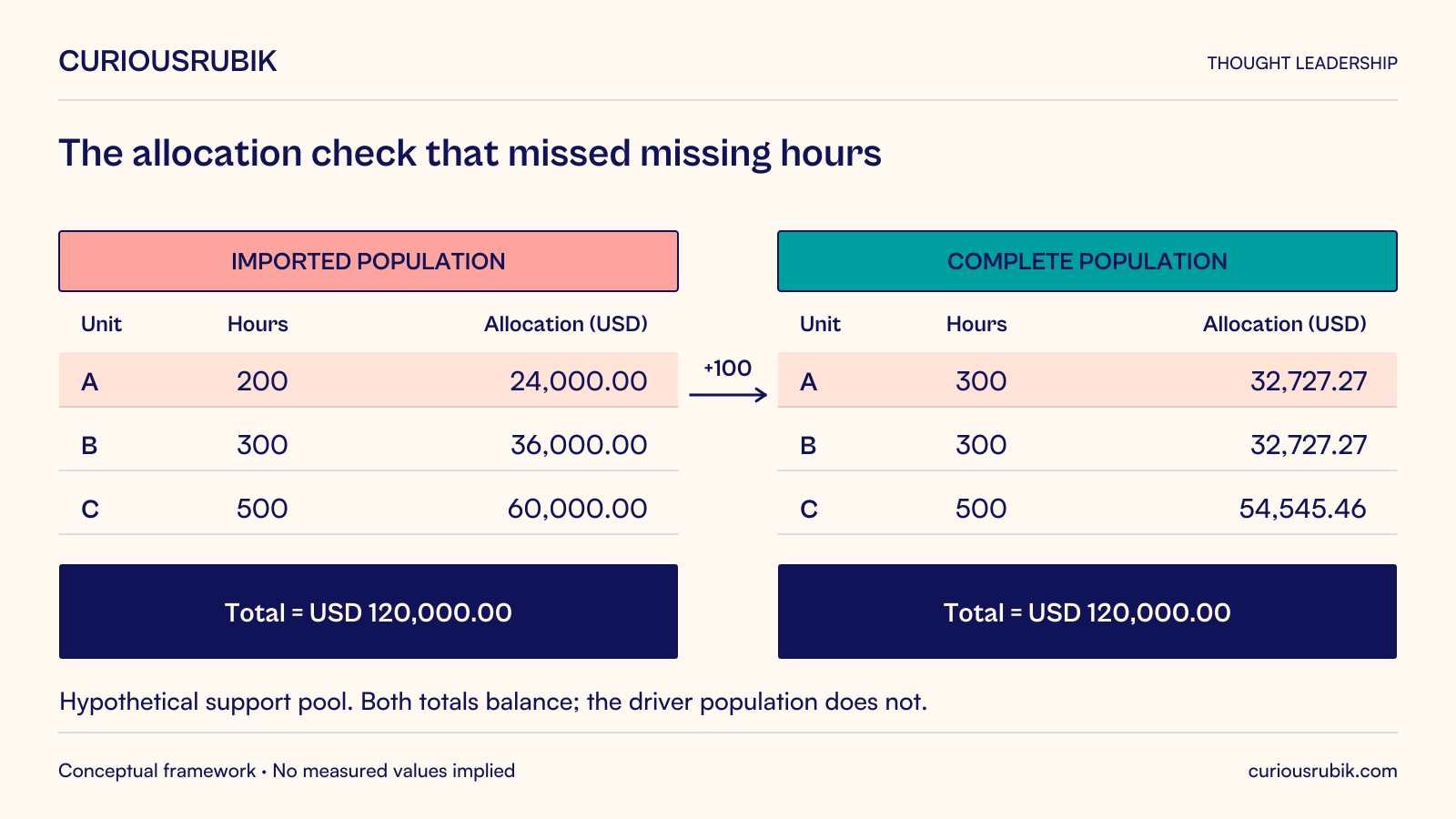
Suppose a services company allocates a monthly USD 120,000 shared-support cost to three business units using approved support hours. In this hypothetical example, the units record 200, 300, and 500 hours. The allocation is USD 24,000, USD 36,000, and USD 60,000. These figures illustrate an internal management allocation, not a prescribed accounting treatment.
The workbook also contains employee mappings, imports time records, emails managers for approval, and produces journal-upload files. During a month, a new team is created. Its 100 hours are omitted because a lookup accepts only the three existing unit codes. The remaining 1,000 hours still allocate the full USD 120,000, so the control checking that allocated cost equals total cost passes.
If the new team’s hours belong to the first unit, the correct input totals for this example are 300, 300, and 500 hours. The revised allocations, rounded to cents, are USD 32,727.27, USD 32,727.27, and USD 54,545.46, with the final cent assigned by a documented rounding rule. The original control could not detect a missing population because it tested conservation of the cost pool, not completeness of the driver.
A proportionate redesign might retain the transparent allocation calculation while moving team mappings to an owned reference-data source. The import rejects unknown codes into an exception queue instead of silently dropping them. The controller reconciles imported hours to the approved source population before allocation. Approval records identify the exact output version, and the journal export carries a unique batch identifier to prevent accidental repeat submission.
This design addresses the actual failure mechanism. Rebuilding the same lookup and weak check inside an expensive application would preserve it.
For every replacement candidate, extract a short rulebook. Record how inputs are selected, how assumptions are approved, how values are calculated, how exceptions are resolved, and how outputs are authorized. Include the manual interventions that make the workbook appear reliable. An undocumented adjustment performed by an experienced accountant is part of the current process, even if it should be redesigned.
Create test cases from the rulebook. Use normal periods and challenging ones: new units, missing inputs, reversals, unusual currencies, changed assumptions, and prior-period corrections where relevant. Expected results should be independently derived, not copied uncritically from the old workbook. Otherwise, the new system is tested for agreement with an unknown error.
Run the old and new processes in parallel for a period chosen around the process’s significant variations. A monthly process with meaningful quarter-end adjustments needs evidence beyond an ordinary month. Investigate differences individually. A smaller difference is not necessarily better if two large errors offset.
Maintain a controlled cutover record showing the last authoritative workbook output, the first authoritative replacement output, unresolved differences, and the person accepting the transition. Prevent both systems from issuing conflicting instructions. Where rollback is necessary, specify how transactions created after cutover will be reconciled; restoring an old file alone cannot reverse activity elsewhere.
Success is more than a reduced workbook count. Track how many important processes have a trained alternate owner, reproducible outputs, tested change procedures, and explicit recovery steps. Count unexplained reconciliations and manual repairs, not just manual cells. A replacement that creates a new shadow workbook has not removed the underlying need.
COSO’s 2013 framework includes quality information and technology controls within the wider control system. It supports assessing the end-to-end arrangement rather than treating a software purchase as proof that a control objective has been met. COSO Executive Summary, Principles 11 and 13
There are limits to standardization. Analysts need room to investigate unfamiliar questions, and a centrally governed system can make exploratory work cumbersome. Preserve an explicit route from an experimental model to a controlled recurring process. The point at which other people rely on its output should trigger a review of ownership and controls, not an automatic ban.
Begin with the three spreadsheet outputs that would cause the most disruption if their owner were unavailable. Trace each input, reproduce each result, and test a realistic failure. Those exercises will tell the controller whether to retain, separate, or replace far more clearly than an organization-wide promise to become spreadsheet-free.