A homewares exporter is considering a long-term distribution arrangement. One proposal offers a simple global operating model with attractive scale economics. Another preserves more regional flexibility at a visible cost. Which is the better preparation for 2030 depends partly on conditions the company cannot know in advance.
The useful response is to test the decision against several plausible futures. Treat 2030 as a planning horizon, not a deadline by which a particular technology or business model will inevitably prevail. A confident forecast about the enterprise of that year can distract from the commitments leaders are making now.
For the exporter, preparation means understanding which assumptions support its distribution choice, which capabilities remain useful across different conditions, and what evidence would justify changing direction. The scenario exercise below is hypothetical. It does not predict trade policy, supply conditions, AI capabilities, or the performance of any vendor.
Select a real decision with a long life: a distribution agreement, operating platform, facility, service model, or dependency on a critical partner. The horizon matters because the consequences extend beyond the next annual plan.
Describe the decision’s assumptions. A global distribution arrangement may rely on reasonably consistent market access, usable cross-border information, dependable transport, and sufficient commonality in customer needs. The analysis should identify those dependencies explicitly rather than hide them inside a financial forecast.
Separate what management controls from what it does not. The company can decide how it structures information, contracts, capabilities, and contingency. It cannot guarantee the external environment. A good preparation strategy uses the controllable choices to remain viable under uncertainty.
Define the consequence of being wrong. Some assumptions can be corrected through a small operating adjustment. Others may leave the business with an inflexible commitment or a service promise it cannot meet. Focus the scenario work on those material exposures.
An uncertainty is useful for this exercise when different plausible outcomes would change the preferred option. Avoid a long list of trends that sound important but do not alter the commitment being assessed.
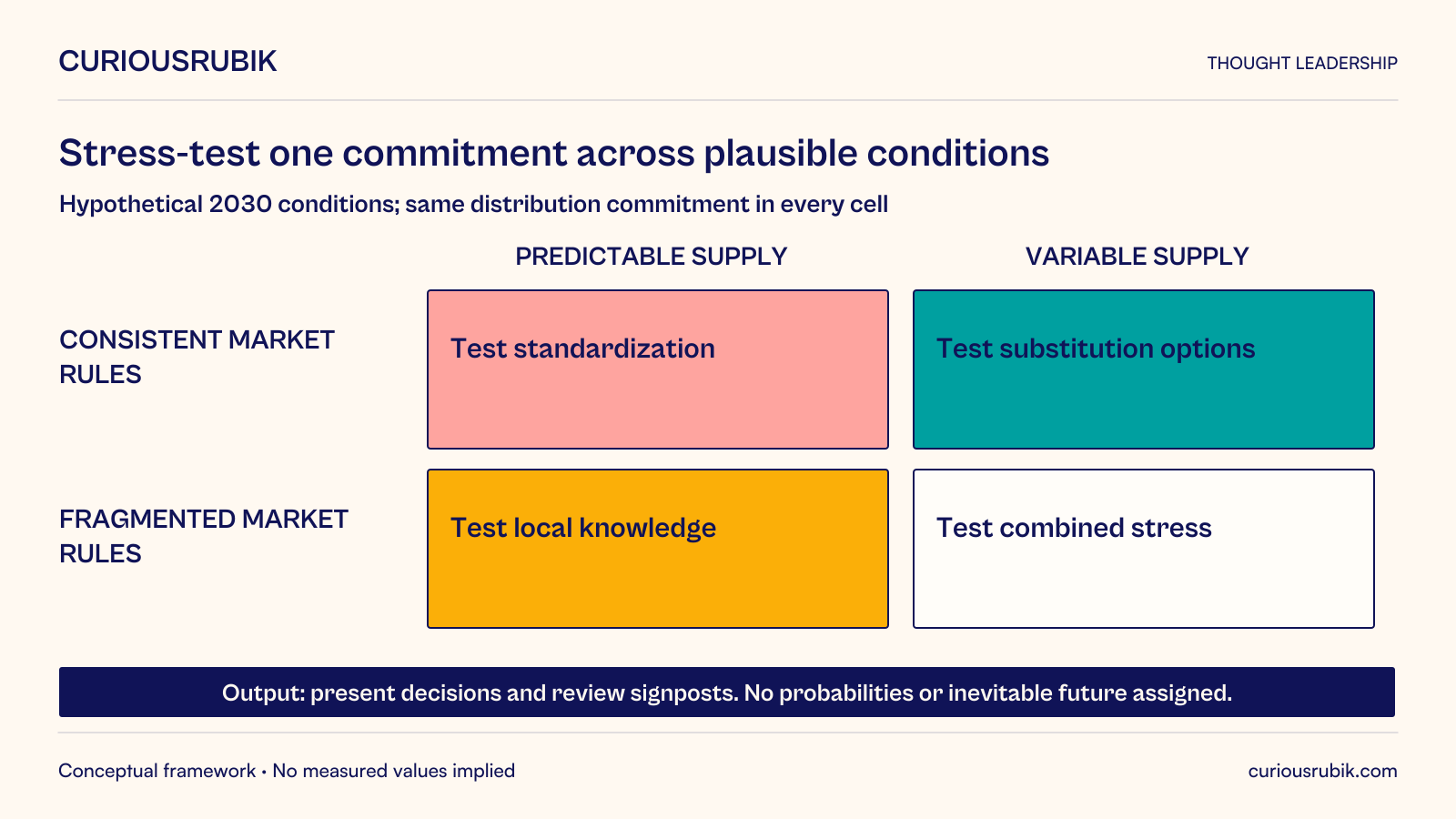
For the hypothetical exporter, consider two dimensions: the degree of consistency in market rules and the variability of supply and transport conditions. The exercise can contrast relatively consistent versus fragmented requirements, and relatively predictable versus variable supply. These are deliberately simplified assumptions, not a complete model of the world.
Keep the scenarios plausible and internally coherent. Explain how customers, partners, costs, information, and operating choices might behave together. Do not attach invented probabilities or use dramatic labels to make a scenario appear more authoritative.
HM Treasury’s May 2023 Orange Book recommends collaborative horizon scanning and scenario planning to consider emerging risks and trends in government strategy. That supports the method of testing assumptions; it does not establish any particular corporate future. The Orange Book, Section B4
In a scenario with relatively consistent market rules and predictable supply, the global arrangement may exploit standard processes and consolidated volume. Regional flexibility may still be useful, but its additional cost needs a clear rationale.
With consistent rules but variable supply, the important questions change. Can the business substitute a route or partner, establish current availability, and revise customer promises through an authorized process? A highly efficient normal path may prove expensive to change during repeated disruption.
With fragmented requirements but predictable supply, local interpretation and maintained market-specific information become more important. The company needs to know which requirements apply to each transaction and who is responsible for validating them. A single global template may need controlled variation rather than informal workarounds.
With both fragmented requirements and variable supply, several dependencies can be stressed at once. The company may need more regional operating knowledge, stronger partner coordination, and a narrower service promise. It should examine whether the proposed arrangement can support those conditions without assuming unlimited fallback capacity.
The exercise does not automatically select the more flexible option. Flexibility has a cost, and some alternatives may be impractical. The board compares the consequences across the scenarios, identifies where each proposal is exposed, and decides which risk and option costs it is prepared to accept.
A useful output is a set of present decisions: preserve a defined exit or transition path, improve product and destination data, test an alternative fulfillment route, or limit the initial scope of a long commitment. These actions should have an owner, a purpose, and evidence that their cost is justified.
Reliable business identity and information are valuable in several scenarios. The exporter needs to know what it is selling, where it is committed, which conditions apply, and which partner owns the next action. Those facts support both efficient routine work and adaptation.
Clear interfaces and operating agreements can also preserve options. If a partner relationship changes, the company should understand the records, responsibilities, and transitions required. Technical portability alone is insufficient if the business cannot transfer knowledge or continue service.
Develop people who can interpret exceptions and update the operating model. A future with better automation may still require qualified judgment about unfamiliar conditions. Preparation should include learning and decision capacity, not only replacement technology.
Avoid describing every foundation as a no-regret investment. Even broadly useful capabilities have opportunity costs and can be overbuilt. Fund a proportionate version tied to actual decisions and service needs, then expand when evidence supports it.
Some investments depend heavily on one future. A specialized automated facility, exclusive partner arrangement, or proprietary orchestration layer may be valuable under specific conditions and less useful under others. State that dependency rather than presenting the proposal as universally future-proof.
Use experiments to resolve a material uncertainty before a larger commitment where practical. A bounded regional trial can test whether the alternative operating model works. The experiment should have a decision at its end, not simply generate more demonstrations.
Preserve the ability to change course when it is worth the cost. That may involve staged capacity, modular commercial scope, documented transitions, or a supported alternative process. Evaluate those options with appropriate commercial and legal advice for the actual agreement.
Do not confuse flexibility with avoiding commitment. A business eventually has to choose customers, capabilities, and operating arrangements. The aim is to make those choices with visible assumptions and a credible response if the important conditions change.
Define observations that would challenge the current assumptions. For the exporter, these might include sustained changes in delivery variability, the effort required to meet market-specific conditions, or concentration in a critical partner. Select indicators the company can observe and interpret.
A signpost should connect to a review decision. State who examines it, what additional evidence is needed, and which option may be reconsidered. Otherwise, horizon scanning becomes a collection of interesting news with no effect on the business.
Distinguish a temporary disturbance from a structural change cautiously. One late shipment should not automatically trigger a major reorganization. Equally, repeated exceptions should not be dismissed indefinitely because the original plan remains attractive on paper.
Review the scenarios themselves. New evidence may reveal an uncertainty the exercise omitted or show that two assumptions are more closely linked than expected. Scenario planning should remain open to revision rather than become another fixed forecast.
AI, integration, and analytical tools may make some work easier or more adaptive over the planning horizon. Evaluate those possibilities through the task they would support and the evidence they would need. Do not assign them unverified capabilities to make the 2030 plan balance.
Keep business authority explicit as assistance expands. A tool that prepares a routing recommendation does not automatically have permission to change a customer commitment or a partner relationship. Better capability should lead to a new evidence-based delegation decision where appropriate.
Plan for changes in suppliers, data, and skills. The enterprise should retain enough knowledge to understand its own service and assess a replacement approach. Dependence on one product or expert may be acceptable, but it should be a conscious choice with known consequences.
The same discipline applies to workforce planning. Describe the work that may change and the skills the operating model would require under different scenarios. Avoid presenting speculative job reductions or universal productivity gains as established facts.
The exporter does not need to know which scenario will occur to improve its present choice. It can identify the assumptions that matter, compare exposure, test a costly unknown, and assign owners to monitor the conditions that would change the decision.
A practical board paper should show the commitment being considered, the scenarios used, the main vulnerabilities, the proposed preparations, and the next review trigger. Keep the limitations visible. The exercise is a structured way to challenge judgment, not an instrument that removes uncertainty.
The enterprise of 2030 will reflect choices made before every relevant fact is known. Leaders can prepare by building the ability to understand and revise those choices responsibly. The strongest plan is one the organization can explain, operate, and adapt when the future differs from the story that originally persuaded it to invest.