An enterprise portal can become more useful by helping a person identify the next relevant task rather than asking them to search a large menu. Personalization can focus the view. Intelligence can help interpret information. Proactive communication can draw attention to something that needs action.
Those capabilities also create new ways to mislead users. A recommendation may rely on stale information, a personalized view may hide an important exception and a confident message may imply that the system has verified something it has only inferred.
For a portal owner, the strategic question is how to make assistance useful while keeping its evidence, permissions and authority understandable. The future opportunity is not a portal that guesses more aggressively. It is a service that helps users act with less effort and a clearer view of what is known.
Start with information that has a legitimate role in the service: the organization the user represents, their permitted responsibilities, open requests and relevant milestones. Use that context to reduce unnecessary navigation.
A supplier representative managing one buyer relationship may need outstanding confirmations and unresolved questions. A customer administrator may need access requests and service issues. Those views can differ without requiring the portal to build a broad behavioral profile of each person.
Make the context visible. Users who represent several organizations should know which one is active and be able to switch deliberately. A personalized recommendation should not accidentally combine tasks or information from separate relationships.
Provide a way to find information beyond the default view where the user is authorized to do so. Personalization should prioritize useful work, not make the system’s guess the only available path.
The design should also allow users to correct mistaken preferences or context through an appropriate process. A portal that repeatedly makes the same wrong assumption can become harder to use than a simple, predictable menu.
A fact might be that a required document has not been recorded for a particular task. An inference might be that the user is likely to need help preparing it. A proposed action might be to draft a message or open the relevant submission form.
Show those distinctions in the experience. Do not describe a predicted need as an established obligation or a draft action as something already completed.
Identify the evidence supporting a consequential suggestion. The user may need the relevant record, date, rule or unresolved condition to judge whether the recommendation applies. A generic confidence label is less useful than an explanation of the actual basis and its limits.
Keep uncertainty actionable. If the portal cannot determine whether a requirement has been satisfied, it can ask for clarification or direct the user to a responsible person. Inventing a complete answer to avoid an empty state undermines trust.
Consider a hypothetical trade-show organizer whose exhibitors use a portal to manage their participation. Each exhibitor has an assigned booth, a set of applicable tasks and event-specific deadlines established by the organizer.
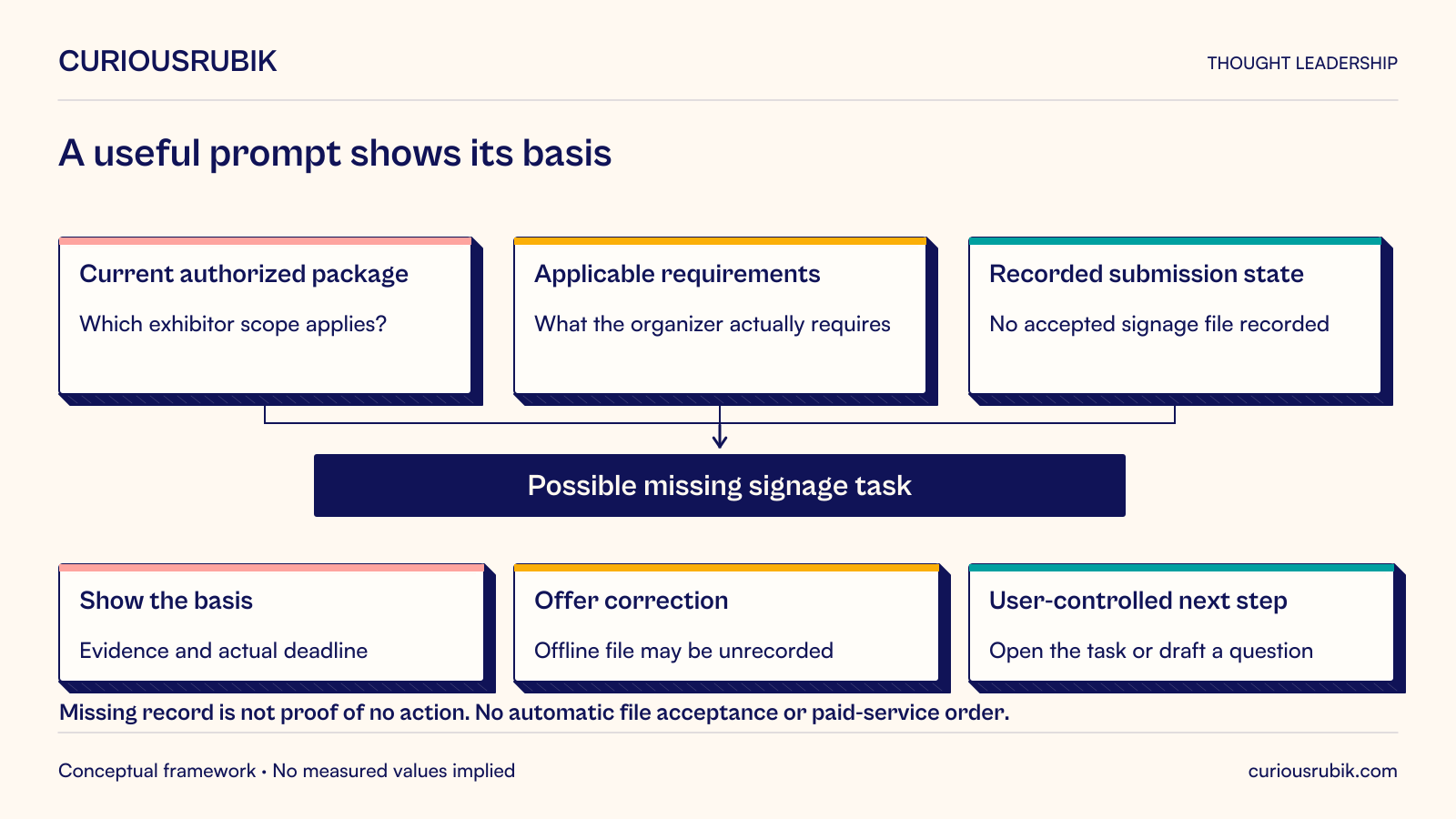
Suppose the portal can see that a signage file is required for the exhibitor’s selected package but no accepted submission is recorded. A useful prompt could identify the missing item, show the relevant deadline and open the correct submission task.
That is different from assuming the exhibitor has not sent anything. The file might have arrived through an assisted channel and not yet been associated with the portal record. The message should describe the recorded state accurately and offer a way to resolve the discrepancy.
If the exhibitor changes its package, the applicable task list may also change. The portal should update the suggestion from the authorized current configuration rather than continue sending reminders based on the previous package.
An AI assistant might help summarize the requirements or draft a question to the organizer. Those outputs still need to reflect the actual event rules and the user’s authorized context. The assistant should not invent a deadline, mark a file accepted or order an additional paid service merely because doing so appears helpful.
The opportunity is a more intelligible service, with fewer searches and fewer missed handoffs. The example does not predict a particular product capability or guarantee an adoption benefit.
Personalized assistance depends on accurate identity, permissions, relationships and workflow state. If those foundations are inconsistent, an intelligent interface can make the inconsistency more persuasive.
Establish which sources determine task requirements and completion. Record how changes propagate and what happens when information conflicts. A recommendation should be able to identify the version or state on which it relied.
Distinguish absence of evidence from evidence of absence. A missing submission record can justify a request to check the status; it may not justify a definitive claim that the user failed to act. The wording and next step should reflect that difference.
Permission checks must occur before protected information is retrieved or exposed through a response. Filtering an answer after unrestricted retrieval is not a substitute for a properly scoped information path.
Include derived information, search results and summaries in the access model. A personalized assistant can disclose sensitive facts without displaying the original document if the underlying boundary is weak.
If the portal uses generative AI, define which questions it may answer and which sources it may use. Establish what happens when the evidence is missing, contradictory or outside the approved scope.
Evaluate outputs against representative tasks, including difficult cases. Check whether the answer refers to the correct organization, current rule and relevant transaction. A fluent explanation of the wrong account’s policy is still wrong.
Use independently established expected outcomes for important tests. Do not rely on the same system to generate both the answer and the only judgment that it is correct.
NIST’s AI Risk Management Framework 1.0 emphasizes context, measurement and management of risks across the AI lifecycle. Applying those ideas to portal assistance means evaluating the actual service and its consequences, rather than treating a convincing demonstration as sufficient assurance. NIST, AI RMF 1.0, January 2023.
Make escalation available when the portal cannot provide a dependable answer. The receiving person should see the relevant question and permitted context, with a clear indication of what the assistant did and did not establish.
A proactive portal should distinguish important new information from routine noise. Define which events justify a message, who should receive it and what useful action the recipient can take.
Avoid repeating the same reminder when nothing has changed, especially after the user has already responded through another channel. Connect notifications to current task state and suppress obsolete messages when the underlying condition is resolved or replaced.
Respect the service’s communication preferences and applicable requirements. A business relationship does not make every possible message useful or appropriate. Keep the content relevant and avoid exposing confidential details in channels that do not need them.
Measure the burden as well as the response. High message-open rates do not establish that the communication helped. Look for correct task completion, reduced uncertainty, unnecessary follow-up and complaints about irrelevant prompts.
Allow users to understand why they received a suggestion and to correct the condition where appropriate. That feedback can improve the service without turning the user into an unpaid debugger for an unexplained prediction.
A portal can recommend, prepare, submit or execute, but those are different levels of authority. Define the permitted level for each capability.
Drafting a response for review is different from sending it. Suggesting a service option is different from placing an order. Identifying an apparent missing document is different from rejecting a submission or changing a customer’s status.
Keep consequential actions behind the relevant business permissions and approval conditions. Recheck current state when the action is committed, rather than relying solely on the information used to generate the suggestion.
Record what the user approved and what the system executed. If execution fails or produces an uncertain result, provide a recovery path that determines the actual outcome before attempting another consequential action.
The appropriate boundary depends on the task’s consequence, reversibility and ability to verify success. It should be an explicit service decision rather than a capability enabled by default because the technology supports it.
A pilot should test whether assistance improves an actual user outcome. Define the task, intended audience, comparison and acceptable error conditions before measuring engagement.
For the exhibitor example, relevant evidence might include whether users find the correct outstanding task, submit the required material and understand whether it is accepted or still under review. The number of generated suggestions is not the outcome.
Include people with different levels of familiarity and access needs. A personalized design that works for a frequent administrator may confuse an occasional participant. Retain predictable navigation and accessible alternatives to conversational interaction.
Measure the service team’s workload too. Assistance that reduces searching but creates more incorrect submissions can move rather than remove effort. Review correction work, escalations and maintenance of the underlying rules and content.
Expand only when the evidence supports the next use case. A successful reminder capability does not establish readiness for autonomous commercial decisions.
The pace of future AI capability is uncertain, so a durable portal roadmap should emphasize foundations that remain valuable: clean context, reliable permissions, explicit workflow state, usable design and observable outcomes.
Add intelligence where it can solve a demonstrated problem and where the organization can verify the result. Keep alternatives available when the model or its supporting service is unavailable. Preserve the ability to change tools without losing the business’s core records and operating responsibilities.
Personalized, intelligent and proactive portals can make enterprise relationships easier to navigate. Their value will depend on how well they connect relevant evidence to an authorized next step, while leaving users able to understand, question and control what happens.