An equipment manufacturer considers selling an ongoing service commitment alongside its products. The commercial team can describe the offer, and the technology team can build a monitoring dashboard. The harder questions concern what the company is prepared to promise, which evidence will establish performance, and how it will respond when a supplier or data source fails.
That hypothetical business shift illustrates the leadership challenge ahead. As digital capabilities become more deeply embedded in products and services, transformation decisions continue after the initial implementation. Leaders need to connect commercial ambition with technical evidence, operating capacity, and the consequences for people who must deliver the promise.
The future described here is a direction for building leadership capability, not a prediction that every enterprise will adopt one organizational model. A useful test for an executive team is whether it can keep making informed decisions as technology, partners, and operating conditions change. Personal sponsorship matters, but the organization also needs expertise and decision continuity that persist beyond a single program.
Start with the promise the business wants to make and the conditions needed to keep it. A product sale, a managed service, and a performance-based agreement create different responsibilities. Technology can support those models, but leadership must decide which model the organization can sustain.
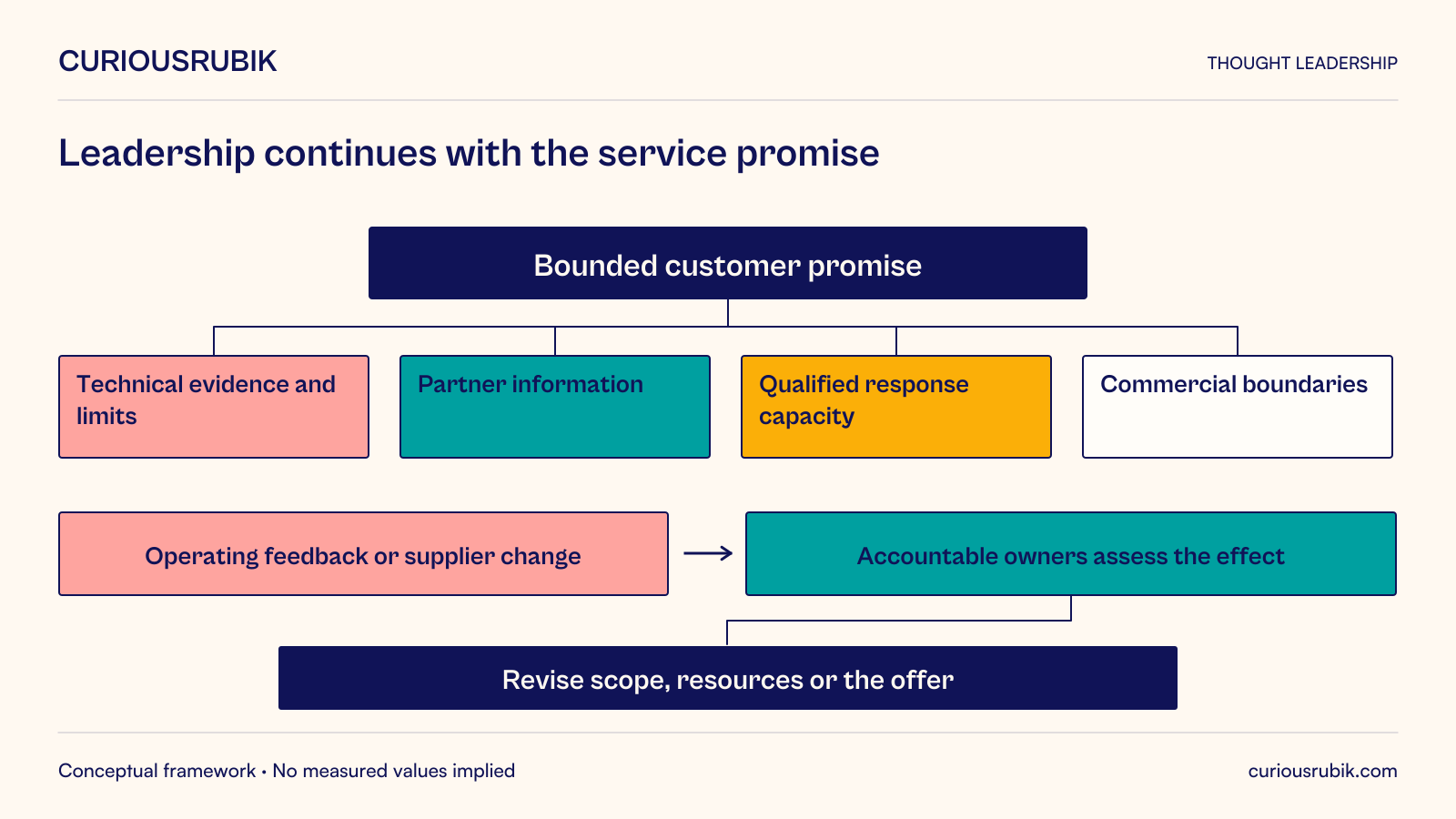
Translate the ambition into questions specialists can answer. What information is required? How reliable must it be? Which actions can the organization take when performance deteriorates? What depends on the customer or another supplier? Which commitments need qualified commercial, legal, or technical review?
Resist the temptation to resolve uncertainty through optimistic language. A dashboard that shows equipment status does not establish the capacity to restore service. An analytical model that forecasts a problem does not establish that every forecast is actionable. The leadership task is to connect the capability to a workable operating response.
A transformation portfolio should reflect those dependencies. It may need service design, data quality, contractual clarity, skills, and support capacity as well as software. Funding only the visible digital component can leave the business with a promise it cannot reliably deliver.
Imagine a hypothetical industrial equipment manufacturer exploring an ongoing support offer for a limited product family. It wants customers to receive earlier notice of potential service issues and a coordinated response through an approved support process. The example does not prescribe equipment maintenance or define real contractual terms.
The first demonstration combines equipment observations with a dashboard. Executives can see a possible customer benefit, but the demonstration leaves important uncertainties. Some customer sites provide delayed data. A specialist component supplier controls part of the technical knowledge. Field response capacity varies by region.
The leadership team chooses a bounded commercial and operational trial. It defines which customers and equipment are eligible, what the service can state when data is incomplete, and which responses require qualified assessment. Commercial promises remain subject to the company’s approved professional review.
The trial also changes internal work. Product engineering must maintain usable knowledge for service teams. Customer-facing staff must explain the limits accurately. Operations must distinguish a detected condition from a confirmed service need. Finance must evaluate the economics of the continuing obligation rather than only the initial equipment sale.
Now suppose a supplier changes the data available through an interface. The original project may already be closed, but the customer service still depends on that source. Leadership needs an owner who can assess the effect, narrow the service if necessary, and coordinate the technical and commercial response.
The important result is a demonstrated capacity to revise the business promise responsibly as evidence changes. The organization has not completed transformation merely because the dashboard launched. It has begun operating a capability whose obligations and dependencies need continued leadership attention.
Executives do not need to become specialists in every technology. They do need to understand the distinctions that affect their decisions: a demonstration versus operating evidence, a forecast versus a commitment, a local improvement versus an enterprise result, and a technical rollback versus reversal of a business consequence.
Use difficult scenarios to develop that fluency. Ask the team to show what happens when data is stale, a supplier is unavailable, a user lacks authority, or the recommended action cannot be completed. The resulting discussion reveals dependencies that a successful demonstration can hide.
The National Audit Office’s March 2023 review of government digital transformation identified leadership expertise and capacity among the barriers requiring attention. Those findings concern government, not a universal private-sector failure rate. They support taking executive digital understanding seriously as part of the capability needed to govern change. NAO, Digital transformation in government, 2023
Make learning part of normal decision work. Short specialist briefings tied to an upcoming choice can be more useful than a broad tour of technology trends. The executive should leave able to explain the relevant uncertainty, alternatives, and consequence, rather than merely repeat new terminology.
Be willing to distinguish what is known from what is plausible. Future capabilities may create valuable options, but they should not become present commitments without evidence. A leader can support experimentation while declining to make a customer promise that the current operating model cannot sustain.
Transformation leadership increasingly requires several kinds of judgment at once. Commercial owners understand the promise, technical specialists understand constraints, operational leaders understand capacity, and people leaders understand the effect on work. No single perspective is sufficient for every decision.
Create a practical way for those perspectives to meet around material choices. The goal is not consensus on every detail. It is a clear account of who decides, whose evidence is required, and how disagreement is resolved when the choice crosses responsibilities.
Develop more than one person who can interpret critical dependencies. If the service model can be explained only by its original program director or an external supplier, leadership continuity is weak. Preserve the rationale, limitations, and operating evidence in forms successors can use.
Keep accountability attached to ongoing outcomes. A delivery leader may own implementation, while a business owner accepts the live service and its continuing obligations. Make that transition explicit, including funding, decision rights, and the conditions that return an issue to executive attention.
A digital service can depend on capabilities outside the enterprise’s direct control. Suppliers may provide data, infrastructure, specialist knowledge, or customer-facing operations. Leadership should understand which dependencies are replaceable, which are concentrated, and what happens when they change.
Do not assume a contract transfers all responsibility for the customer outcome. The enterprise still needs to know what evidence the supplier provides, how incidents are handled, and which commitments remain its own. Qualified advisers should assess the actual contractual and regulatory obligations.
Include dependency changes in the service review. A provider update, changed data coverage, or loss of specialist support may alter the original business case. The organization needs a route to reassess scope and resources before the impact becomes a customer surprise.
Preserve useful options. That can mean documented interfaces, retained operating knowledge, a supported manual process, or a narrower service that remains viable if an advanced component is unavailable. Optionality should be evaluated against its cost rather than treated as free redundancy.
New capabilities can change expertise, workload, discretion, and career paths. Leaders should explain those effects honestly and involve the people who understand the work. Avoid promising that technology will remove only undesirable tasks when the actual implications remain uncertain.
Plan for the skills required by the future service. In the manufacturer example, interpreting incomplete evidence and coordinating a response may become more important than producing another dashboard. Training should follow those responsibilities rather than concentrate only on tool operation.
Protect capacity during the transition. Employees may be asked to operate the existing business while defining and learning the new one. Leadership must decide what work pauses, what support is added, and which commitments are realistic. An attractive future model does not eliminate the cost of getting there.
Listen for evidence that the design is unworkable. Employees can identify missing authority, unrealistic response assumptions, or customer conditions that the proposal overlooks. Treating those observations as obstacles to enthusiasm wastes information the leadership team needs.
The executive team can test its capability with a short operating rehearsal. Present a plausible change: an important data source becomes unavailable, demand exceeds support capacity, or an evaluation reveals that one customer group is outside the demonstrated scope. Ask who identifies the issue, who decides, and what evidence reaches the customer-facing response.
A strong rehearsal produces an actionable decision path rather than a list of people who should have another meeting. It also exposes missing ownership, fragile knowledge, and assumptions that need testing before the business expands its promise.
Review leadership quality through those decisions over time. Can the organization stop a weak initiative, maintain a useful service after the project team leaves, and adapt without losing its obligations? Does it retain enough understanding to challenge a supplier and enough candor to change a plan?
The manufacturer’s future does not depend on calling every executive a technologist. It depends on a leadership system that can connect ambition to evidence and remain accountable as the service evolves. Building that capability now prepares the enterprise for better tools without making its judgment dependent on any particular forecast of technological progress.