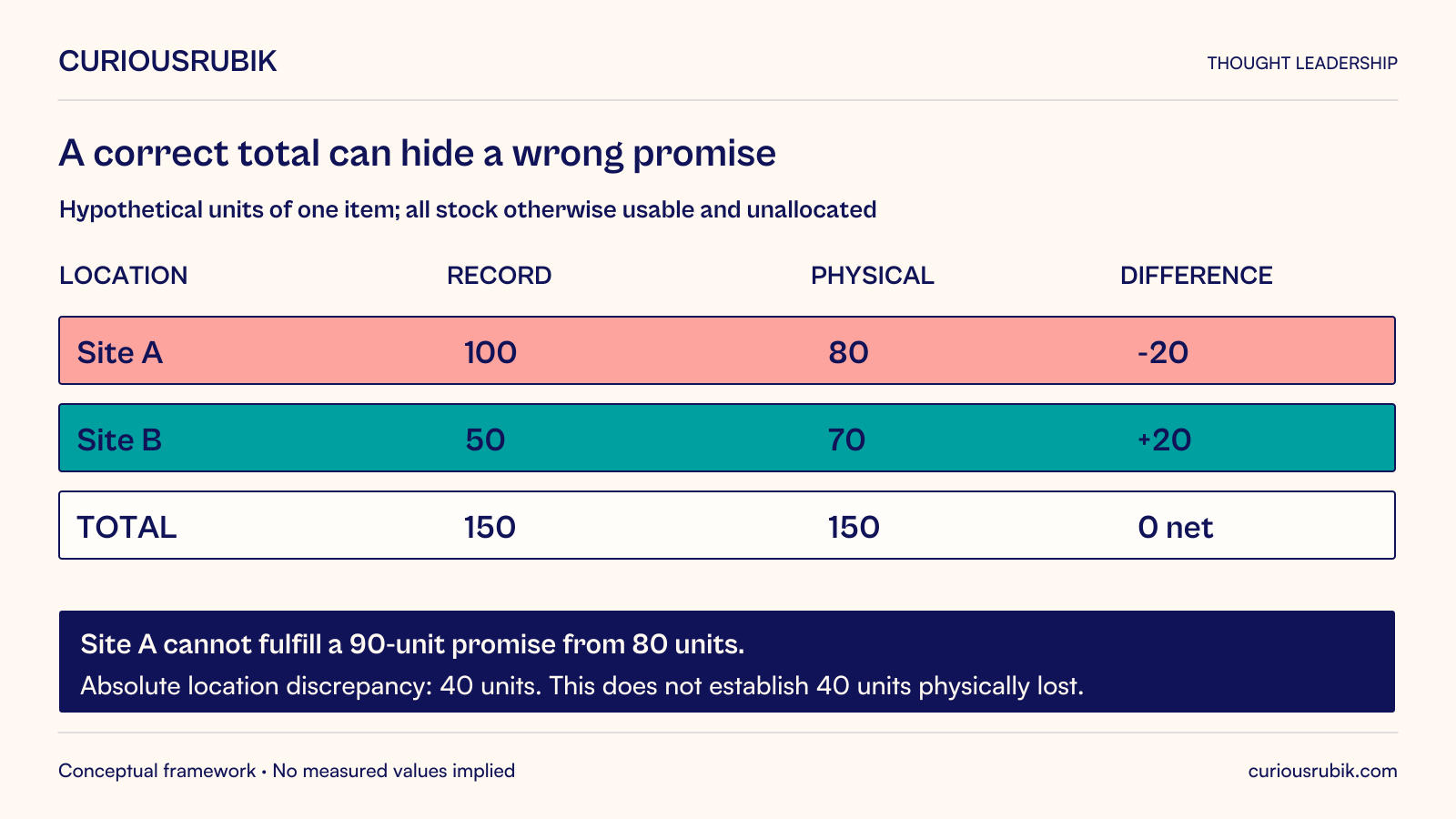
The company-wide quantity is correct. The customer promise is still wrong.
In this hypothetical warehouse example, the system shows 100 units of an item at Site A and 50 at Site B. A verified physical count finds 80 at A and 70 at B. Both the records and the physical count total 150 units, yet a promise to supply 90 units from A cannot be fulfilled from that site’s stock as represented. To isolate the location issue, assume all units are otherwise usable and unallocated.
The negative 20-unit difference at A and positive 20 at B cancel in the total. They do not cancel in the operation. Nor do they prove that 40 units have been lost: adding the absolute differences produces 40 units of location-record discrepancy, not a physical inventory loss.
This is why inventory accuracy needs to be evaluated at the level where decisions are made. A reassuring total can conceal the extra transfers, searches, missed promises and correction work created by the wrong location, condition or availability state.
Inventory records support several questions: how much exists, where it is, what condition it is in, which commitments already consume it and whether it can be used for a particular purpose. Those questions should not be collapsed into a single on-hand total.
A planner needs a reliable basis for replenishment. A picker needs the right item in the right location. Customer service needs an honest availability promise. Finance needs evidence appropriate to its valuation and reporting responsibilities. A record can satisfy one question while failing another.
Define the important record dimensions and the rules used by each process. A location code can be technically valid but operationally wrong. Stock under review can exist physically without being available to promise. A transfer can have left one location without being received into another.
Do not assume that a discrepancy always means missing goods. It may reflect timing, a misidentified location, an incomplete transaction or a count error. Equally, a plausible timing explanation should not become an excuse to ignore a recurring problem.
The first management decision is therefore the scope of accuracy required for the service. Which dimensions must be correct before the business buys, allocates, picks, ships or reports? Without that definition, an accuracy percentage can be difficult to interpret and easy to improve cosmetically.
Return to the two-site example. The organization may need to investigate the location records, arrange a transfer or revise the customer commitment. Each consequence belongs in a different category.
If the investigation takes two staff-hours, that is internal effort. If a necessary expedited transfer creates an evidenced incremental charge of USD 120, that is a cash cost under the example’s assumptions. If the customer waits an extra day, that is elapsed service delay. Those facts should not be added into one monetary total without a defensible method.
The business might also experience a cancelled order or a complaint, but neither should be invented simply because the discrepancy could have caused it. Record what happened and distinguish it from risk exposure or a scenario used for planning.
Avoid double counting. The same incident can create a warehouse ticket, a customer-service case and a finance adjustment. Those are not automatically three independent losses. Link the activities to the underlying event, identify incremental work and check whether a charge or labor entry is already included elsewhere.
A useful incident record can be compact:
The record should remain usable by the people investigating it. Excessive detail that nobody maintains can be less valuable than a consistent small set of evidence-backed fields.
Do not translate a location discrepancy directly into an accounting write-off. The appropriate treatment depends on what the investigation establishes and the organization’s accounting policies. The example’s total physical quantity is unchanged; its operational problem is still real.
A count can reveal that records and physical inventory differ, but the count itself must be trustworthy. Consider the defined scope, movement during counting, item identification, units and the competence and independence of the people performing the work.
GAO’s 2002 inventory-count guide draws on selected private-sector practices and discusses accountability, written procedures, segregation of duties, blind counts and research into discrepancies. It does not establish one universal counting schedule for every type of inventory. GAO, Best Practices in Achieving Consistent, Accurate Physical Counts.
Where appropriate, counting without showing the expected balance can reduce the risk that the counter simply confirms the system’s number. The overall control design still matters, including supervision, access and review of adjustments. Choose the method for the actual operation rather than applying a label without its supporting controls.
Control the comparison point. If goods move while the count is underway, the team needs a reliable way to identify which movements belong before and after that point. Otherwise, a correct physical observation can be compared with the wrong record state.
Research discrepancies before making unsupported explanations permanent. In the two-site example, an unrecorded transfer of 20 units is one possible cause, but it is not proven by the arithmetic. The investigation should examine the relevant movement evidence and other plausible causes.
Preserve who counted, who reviewed and who authorized the correction. An adjustment that makes the system agree today without explaining the cause may leave tomorrow’s process unchanged.
A signed net variance can be useful for one purpose while concealing offsetting location errors. An absolute variance shows a different property, but should not be presented as the quantity physically lost. Label both measures clearly.
Define the population and matching rule behind any record-accuracy rate. Is a record considered correct only when quantity, location and condition all match? Is a stated tolerance permitted for a particular measure? Which records were eligible for review, and which were actually counted?
Do not silently exclude difficult locations or items with unresolved differences. A reported improvement can otherwise reflect a changed sample rather than more dependable inventory.
Segment the evidence where the operating consequences differ. High-movement items, slow-moving stock, transfers and restricted-condition inventory may exhibit different failure patterns. A single overall percentage can conceal the group that drives repeated service failures.
Use counting results alongside operational evidence. Picking failures, repeated location searches, emergency purchases and unexpected substitutions can identify problems that a periodic count has not yet exposed. These indicators need investigation; they are not automatic proof of a particular record defect.
Be cautious with financial weighting. An expensive item can dominate a value-based measure, while an inexpensive missing component can stop a valuable job. Consider the decision consequence as well as the item’s unit value.
The purpose of measurement is to reveal where the records cannot support the business, not to produce the most flattering aggregate.
Recurring inaccuracies often point to a process that fails to capture a real event reliably. Examine receiving, put-away, internal movement, picking, returns, consumption and adjustments according to the evidence.
At each suspected point, ask whether the user can identify the correct item and location, whether the transaction is recorded at the right time and whether failed submissions are visible. A scan that never reaches the authoritative system can create confidence without a valid update.
Look for incentives and practical constraints. Staff may move goods before completing a transaction because a device is unavailable or because the process requires an impractical sequence. Training may help, but a workflow that conflicts with the physical work often needs redesign.
Use a bounded correction and verify the result. If the problem concerns transfers, test the movement record, in-transit state, destination receipt and exception path. Confirm that the change does not create duplicate updates or conceal unfinished transfers.
Do not assume that adding automation eliminates the need for control. Automated movements can propagate an incorrect identifier or rule quickly. The system still needs validation, clear ownership and a way to reconcile physical evidence with recorded state.
The best prevention investment addresses the demonstrated mechanism. Buying another dashboard may make the discrepancy more visible without reducing its recurrence.
After correcting the record, decide what the incident teaches the organization. Is the cause isolated, recurring or still unknown? Does it affect other items or locations? What evidence will show that the proposed fix works?
Assign an owner for the corrective action and a review point tied to relevant activity. A procedure update should be tested in use; a system change should be checked against representative transactions; a data correction should preserve the history needed to explain it.
Evaluate prevention cost against the continuing burden, while keeping risk and service consequences visible. Not every discrepancy justifies a major project, but repeated small errors can create a substantial operating obligation. The evidence should support the scale of the response.
Inventory accuracy is valuable because it lets the business make dependable commitments. A count that balances at the top of the organization is not enough if employees still search, expedite and apologize at the point of service. The management task is to connect the physical facts, the record dimensions and the decisions they support, then remove the conditions that keep pulling them apart.