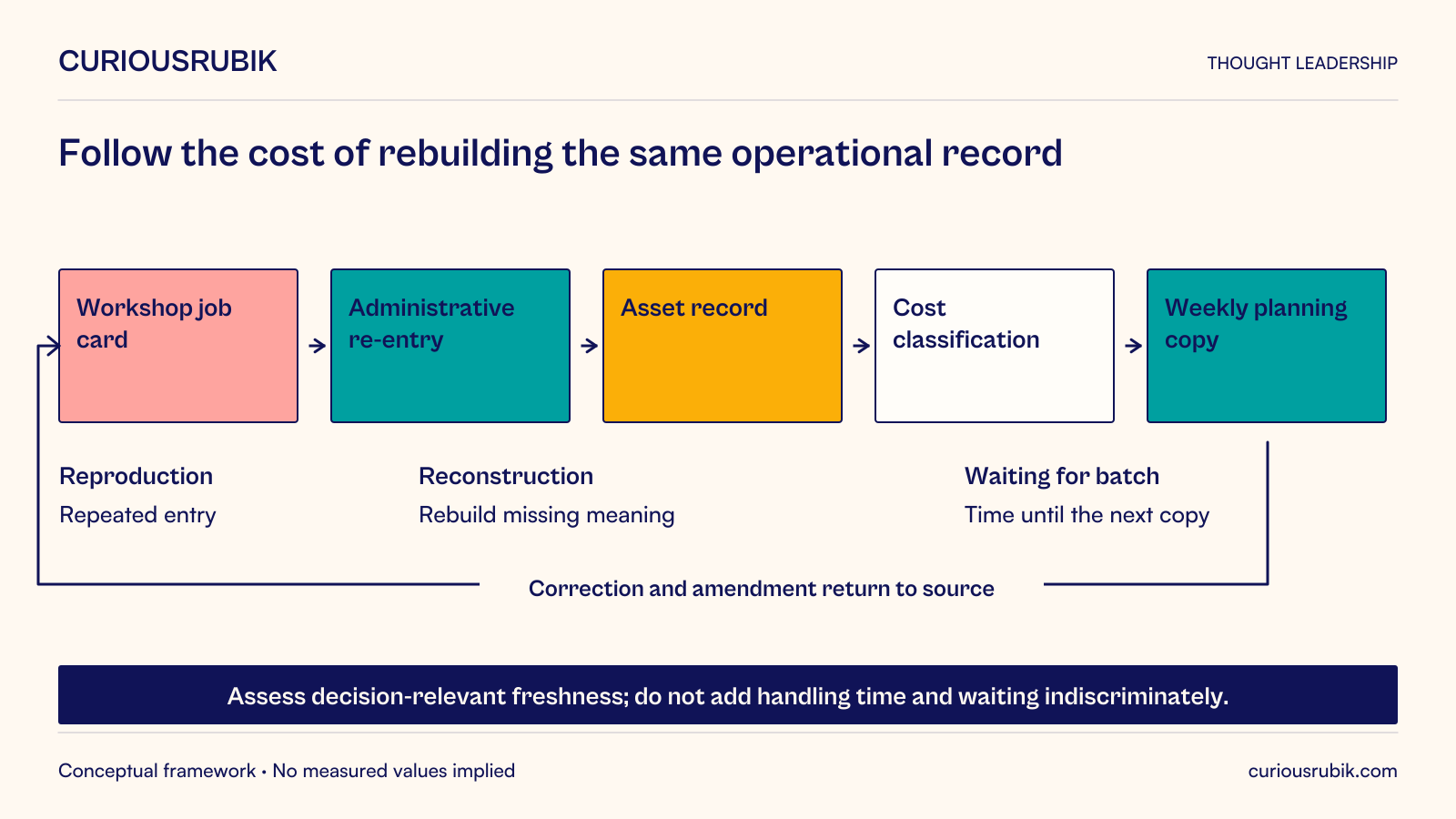
A maintenance job is finished, but the fleet planner cannot see it. The workshop has completed a job card. An administrator will rekey the details into the asset register tomorrow, and a cost analyst will translate the same work into a separate reporting file later in the week.
No formal handoff has failed. The records move eventually. The cost sits in repeated interpretation, waiting for batches, checking identifiers, and reconstructing which version is current.
This recurring operational work deserves its own analysis. It differs from a one-time transfer of responsibility at the end of a sale or project. The problem is the daily conversion of one team’s record into another team’s usable information. Leaders should examine the whole information journey before assuming that connecting two applications will remove the cost.
Choose a recurring record that several teams use: a completed maintenance job, a goods receipt, a production result, or an inspection finding. Trace it from creation through every transformation and decision it supports.
Record where information is re-entered, translated, summarized, checked, or delayed. Include unofficial spreadsheets and messages when they perform a real operating function. The official architecture may show three applications while the actual information path contains several human conversion steps.
Ask what changes at each handoff. Sometimes only the format changes. Sometimes a department adds a necessary judgment, such as assigning a cost category. Sometimes it corrects a defect that should have been prevented upstream.
These differences determine the remedy. Moving data automatically can remove rekeying. It cannot safely replace an undefined classification decision, and it may spread an upstream error to more places before anyone notices.
A useful working heuristic distinguishes reproduction, reconstruction, waiting, and correction. This is a proposed diagnostic structure, not an accounting standard.
Reproduction is the effort of copying or reformatting information that already exists. It includes entering the same identifier into multiple systems and preparing different versions of the same report.
Reconstruction is the effort required to understand what the record means. An employee may search for the original job, call the author, interpret a free-text description, or determine which of several attachments is authoritative.
Waiting occurs when the information is unavailable until a batch, meeting, or individual availability window. The resulting delay may affect planning even when the physical work is complete.
Correction includes detecting and repairing wrong identifiers, omitted records, inconsistent units, or contradictory versions. Distinguish routine handling from additional rework so the same time is not counted twice.
The categories help explain where cost originates. They should remain separate in the business case because waiting time is not equivalent to labor time, and a corrected error does not always create a cash loss.
Consider a hypothetical vehicle fleet operator. A workshop records completed jobs with vehicle identity, work performed, parts used, and relevant follow-up requirements. An administrator enters selected fields into the asset system. A cost analyst maps descriptions into reporting categories and prepares a weekly planning file.
The fleet planner uses the file to identify vehicles needing further attention. Because updates arrive in batches, a vehicle may appear to have unresolved work after the workshop has completed it. Conversely, a follow-up requirement can remain invisible until the next report.
A sample review finds three causes of extra effort: inconsistent vehicle identifiers, free-text part descriptions, and uncertainty about whether a later job-card amendment replaces or supplements the original. Staff have developed personal lookup lists and routinely call the workshop to clarify them.
For a hypothetical monthly calculation, assume 600 job records require four minutes of administrative re-entry and three minutes of routine classification each. That is 70 hours of recurring handling. If 60 of those records also need an additional 12 minutes of investigation beyond the normal seven minutes, that adds 12 hours. The total modeled workload is 82 hours, not a benchmark or observed client result.
The estimate excludes waiting and any later operational consequence. Those are analyzed separately. It also does not imply that all 82 hours can be removed: some classification judgment and verification may remain necessary.
The proposed change establishes a stable vehicle reference, structured work categories where practical, and explicit amendment links. Routine records can move directly into the asset view; ambiguous classifications enter a targeted review queue. The planning view shows update time and unresolved follow-up status rather than relying on a weekly copied file.
The pilot tests a corrected vehicle identifier, a job split across two visits, a late amendment, and a record with a legitimate category not yet in the shared list. It checks both processing effort and whether the planner receives a more dependable picture.
Batching may be a deliberate tradeoff. Processing a group of similar records together can reduce setup effort. The problem is failing to price the delay or letting the batch cadence become an invisible service rule.
A record completed just after the daily export may wait until the next run. A second weekly consolidation can add another delay even if the first interface is fast. Improving one handoff may leave the dominant wait unchanged.
Map the cutoffs and the downstream decision times. If a planner makes allocation decisions each morning, an overnight update may be sufficient. If a dispatcher needs a current status before releasing a vehicle, the same cadence may be inadequate.
Little’s Law provides a relationship among long-run average work in progress, throughput, and elapsed time under appropriate conditions. It can help reconcile backlog and delay for a defined stable record flow, but it does not identify why a particular record waited or establish the value of real-time processing. Little, A Proof for the Queuing Formula.
Choose freshness according to the decision. Real-time integration introduces its own support and recovery obligations and is not automatically the economical answer.
Two fields with the same name may describe different concepts. “Complete” in a workshop may mean mechanical work finished; in fleet planning it may mean all release conditions satisfied. Copying the status can create a misleading result.
Define shared identifiers, units, categories, and state meanings where records cross boundaries. Identify the authoritative source and the owner of each necessary transformation.
Preserve distinctions rather than forcing a false common value. A maintenance-complete state and an operational-release state can coexist with an explicit relationship. A system should not infer the latter merely because the former is present.
The Government Data Quality Framework treats quality as fitness for a purpose and encourages attention throughout the data lifecycle. For recurring handoffs, this means evaluating whether information remains suitable after each transformation, not only whether the original form was complete. Government Data Quality Framework.
Document mappings and review them when products, assets, or operating practices change. An accurate mapping can become wrong without any technical interface failure.
Measure active work through observation, reliable timestamps, or a defensible sample. Avoid asking employees for one broad estimate of “time wasted,” then treating it as precise evidence.
Separate normal handling from exception work, and count each activity once. If an investigation includes both an administrator and a workshop supervisor, capture each person’s active effort without adding the elapsed waiting interval as labor.
Evaluate downstream consequences case by case. An outdated maintenance status may cause a planning change, but it does not automatically cause lost revenue. Establish what decision changed, whether a feasible alternative existed, and which consequence can be supported by evidence.
Distinguish capacity from savings. Reducing fragmented rekeying across several roles may improve responsiveness without eliminating a position. If the business expects overtime reduction or avoided hiring, identify the actual staffing decision and conditions required.
Include continuing costs of the proposed solution: mapping maintenance, exception review, monitoring, support, and correction across copies. A small interface can be operationally important and must be maintained accordingly.
Some handoffs can be removed because the downstream report no longer supports a decision. Confirm that before investing in its automation.
Others can be consolidated by letting multiple teams use one authoritative record with appropriate views and access. This can reduce copying, but the shared system must support the different decisions without forcing all teams into one unsuitable interface.
Integration is appropriate when separate systems have legitimate roles. Transfer only the information needed, preserve source references, and make failures visible. Provide a way to correct the source and propagate the correction rather than allowing each copy to drift independently.
Where a human judgment remains necessary, support it directly. Present the relevant evidence, suggest a mapping where reliable, and record the decision. Do not disguise the judgment as an automatic transformation simply to claim a higher automation rate.
An interface test that counts successful messages is incomplete. Reconcile source records with downstream records and verify that the intended users can make the relevant decision.
Include late, duplicate, amended, cancelled, and out-of-order records. A repeated completion event should not duplicate work or cost entries. A correction should not erase the history needed to explain an earlier decision.
Test an outage and recovery. Determine which view becomes stale, how users are informed, and how pending records are replayed without creating inconsistent results. The business needs an operating fallback for the information delay, not merely a technical restart procedure.
Compare the pilot with the baseline using the same population and definitions. Track reproduction effort, clarification, correction, and decision-relevant freshness. A reduction in manual touches is useful only if information quality and downstream work remain acceptable.
Ask each team to identify a record it repeatedly recreates and the decision that requires the recreation. Trace a few examples together. The most valuable opportunity may lie in a small semantic mismatch or unnecessary batch rather than a large system replacement.
Ask suppliers to demonstrate amendments and reconciliation, not only initial data transfer. Require a named business owner for meaning and a technical owner for operation.
Manual handoffs become costly when each department must rebuild confidence in information the business already possesses. Reducing that repeated reconstruction requires shared meaning, appropriate freshness, and a reliable correction path. Automation is useful when it preserves those qualities while removing avoidable work.