Disconnected systems rarely announce their cost as a single budget line. The expense appears as an analyst reconciling two exports, a customer-service representative asking finance whether a payment arrived, or a warehouse supervisor checking an order that the sales system still shows as available. Each task can seem reasonable. Together, they form an operating model in which employees continually repair the gaps between applications.
Leaders should resist two premature conclusions. A large application portfolio does not prove that the business is fragmented. Nor does purchasing a single platform guarantee coherence. The economic issue is whether a business event can move across the organization with its identity, meaning, status and accountability intact.
That distinction changes the investment decision. Instead of asking how many applications can be removed, ask which broken handoffs create the greatest avoidable cost and what the least complex credible remedy would be.
Application budgets reveal licenses, support and infrastructure. They usually reveal much less about the operating effort required to make applications agree. A team may spend several hours preparing a report because product identifiers differ. Another may maintain a spreadsheet that connects contracts to invoices. Neither activity appears under integration spending, although both perform integration work.
Start with a business event, such as an accepted order, completed service visit or approved supplier invoice. Follow it from origin to financial consequence. At each handoff, observe who re-enters data, checks completeness, translates a code, confirms status or resolves a disagreement. Include work outside the formal process, particularly private spreadsheets and recurring messages.
The objective is not to label all manual work wasteful. A human review may be an intentional control or a commercially valuable judgment. Distinguish reviewing a genuine exception from repeatedly proving that two systems contain the same transaction. The first can protect value; the second may indicate a repairable structural gap.
Ask employees to show their most recent example. General estimates such as “this takes half my week” are useful signals, but transaction-level observations provide a stronger basis for an investment case. Record handling time and elapsed waiting time separately. A ten-minute correction that delays billing for three days has two different consequences.
A useful fragmentation assessment separates direct operating effort, avoidable external cost, timing effects and risk. These categories should remain visible because they have different evidence requirements and different financial meanings.
Direct effort includes rekeying, reconciliation and searching for missing status. Measure frequency and handling time, then apply a defensible loaded labor rate. Show the result as capacity consumed unless the business has an actual plan to remove expense. Calling every saved hour a cash saving overstates the case.
Avoidable external cost includes duplicate shipping charges, correction fees or expedited freight caused by a specific information failure. Use actual records where available. Check causality: urgent shipping might be caused by supplier unreliability rather than a disconnected inventory system. Technology should not receive credit for an operational problem it cannot solve.
Timing effects include delayed invoicing, late purchasing decisions and cash tied up while transactions wait for resolution. Report the exposure and the duration. If converting a cash-timing improvement to a financing estimate, state the assumed funding rate and distinguish it from additional revenue.
Risk includes duplicate payments, inconsistent access, missed contractual conditions and decisions made from stale information. A risk estimate requires judgment about likelihood and consequence. Where evidence is weak, use scenarios rather than a precise expected-loss figure. Record the assumptions so the uncertainty remains visible to the decision-maker.
NIST’s 2004 study of inadequate interoperability in the US capital facilities industry examined costs associated with exchanging and managing information across participants and lifecycle stages. It demonstrates why interoperability deserves economic analysis. Its historical, industry-specific dollar estimates should not be treated as a benchmark for a different company, sector or year.
The most persuasive-looking business cases can be weakened by overlapping benefits. Suppose a disputed invoice generates employee effort, delays collection and occasionally triggers a credit note. Those are potentially distinct consequences. But the same hour cannot be claimed as both a labor saving and additional revenue without explaining the second causal step.
Likewise, a released working-capital balance is not annual profit. A company that accelerates collection may obtain a one-time reduction in receivables and an ongoing financing benefit. It should not add the full balance to annual recurring savings.
Use a transaction identifier to connect consequences in the cost ledger. For each issue, record the initiating failure, resulting tasks, direct expense, timing effect and any loss. Finance can then identify overlaps before the figures are aggregated. A less impressive total that withstands scrutiny is more useful than an optimistic total that cannot guide a decision.
This is consistent with the discipline emphasized in GAO’s 2020 Cost Estimating and Assessment Guide: estimates need a documented basis, explicit assumptions and treatment of uncertainty. The guide concerns program cost estimation rather than an ERP integration calculator; the application here is a management inference, not a prescribed GAO formula.
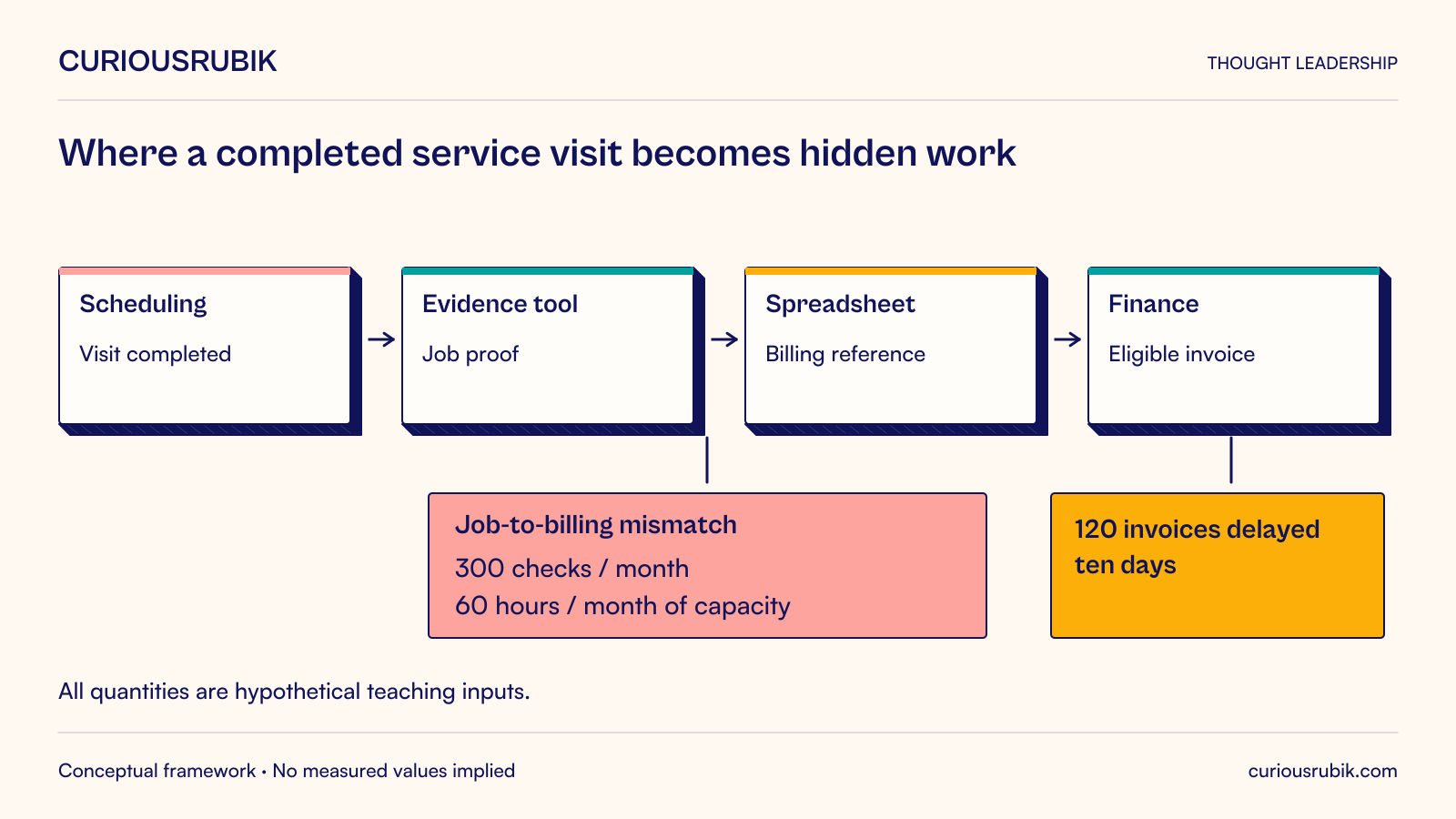
Consider a fictional equipment-maintenance company. Its scheduling application records completed visits, technicians upload job evidence to a separate tool, and finance creates invoices from a weekly spreadsheet. All figures below are illustrative assumptions, not research findings or client results.
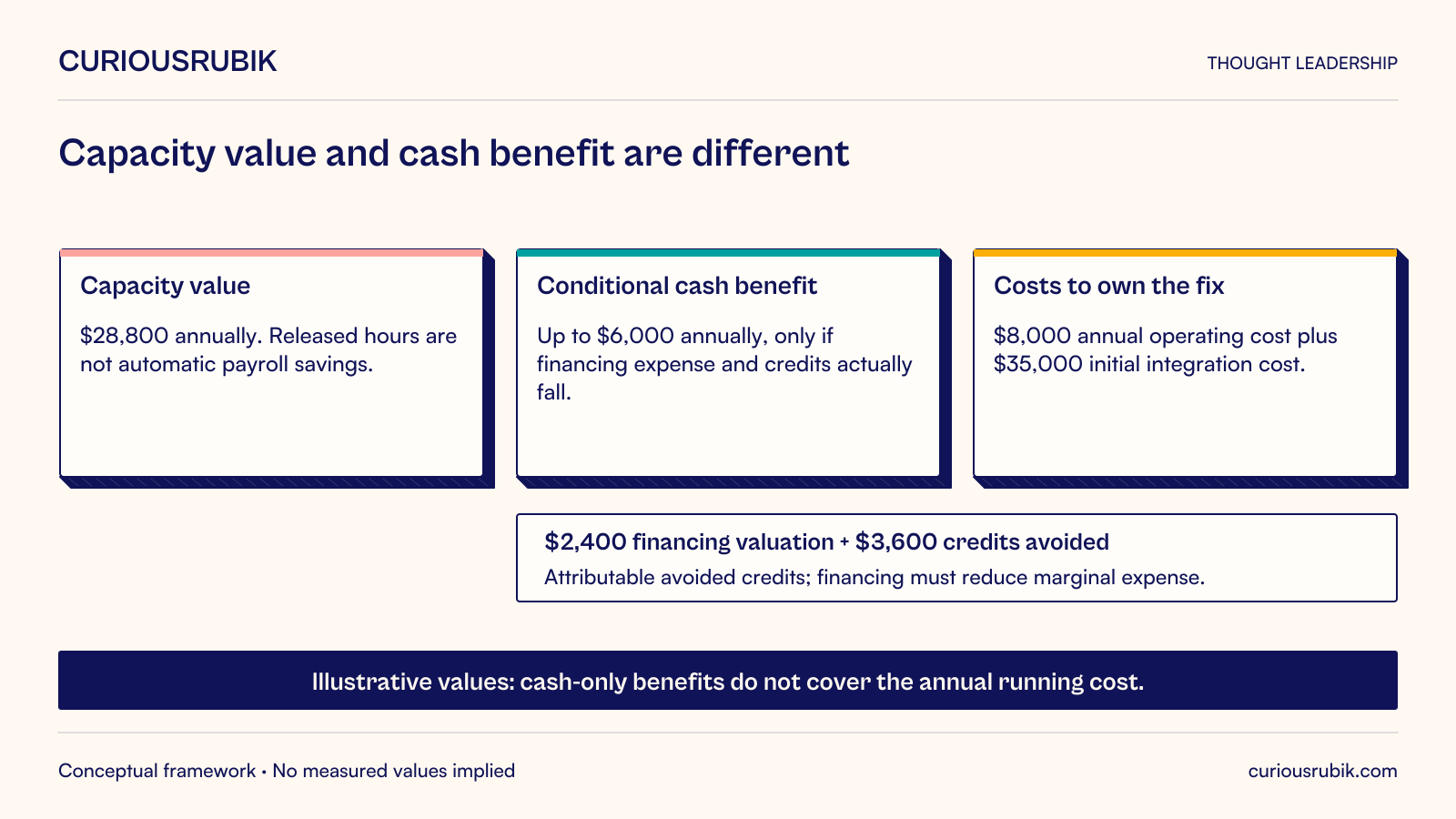
The company completes 2,000 jobs each month. A sample suggests that 300 require an administrative check because the completion record cannot be matched to the billing record. Each check takes 12 minutes. At an assumed loaded labor rate of $40 per hour, the monthly capacity consumed is 60 hours, valued at $2,400. That is $28,800 annually if the volume and exception rate remain constant.
Of the 300 exceptions, 120 delay invoices averaging $500 by ten days. The invoices represent $60,000 of monthly billing. Assume a steady monthly flow and that the ten-day invoicing delay also delays collection by ten days. Using a simplified 30-day month, the average additional cash tied up in the billing-to-collection cycle is approximately $20,000: $60,000 multiplied by ten divided by thirty. Delayed invoicing need not increase recorded receivables; some exposure may remain unbilled. At an illustrative 12% annual funding rate, the financing valuation is about $2,400 per year. It becomes a cash saving only if marginal borrowing or financing expense actually falls at that rate. It is neither $60,000 of lost revenue nor $20,000 of recurring profit.
The company also observes two correction-related customer credits each month, averaging $150. Those credits total $3,600 annually. Before attributing them to system fragmentation, the team checks whether the underlying service was actually satisfactory. Credits caused by poor workmanship remain outside the integration case.
A proposed integration costs $35,000 initially and $8,000 a year to operate. Even assuming all three effects are eliminated, the maximum annual quantified benefit is $34,800, of which $28,800 is capacity value. After operating cost, the annual economic benefit is $26,800. A simple undiscounted payback calculation would be about 1.3 years, but only if the capacity has a valuable use and the assumptions hold.
The cash case is much weaker without a staffing or outsourcing change. Even if financing expense actually falls as assumed and the credits are genuinely avoided, those annual cash benefits total just $6,000, below the integration’s recurring cost. Otherwise, recurring cash benefits are lower. Leadership must decide whether released capacity supports growth, service quality or a real expense reduction. That decision should be explicit rather than concealed inside a single ROI percentage.
The most promising remedy may also be smaller than the initial proposal. If the root cause is inconsistent job identifiers, introducing a controlled identifier and a required completion reference could reduce exceptions before a full integration is built. A pilot should test that cheaper hypothesis.
An interface can move incorrect information efficiently. If one application defines “completed” as technician departure and another defines it as customer acceptance, synchronizing the status field will not settle the disagreement. It may simply make the inconsistency harder to detect.
For each important handoff, define the event that makes the record eligible to move, the source allowed to assert it, the receiving system’s interpretation and the response when the event is reversed. Include identifiers, time conventions, units and permitted state changes. Agree who resolves disputed records and how downstream users learn that a correction occurred.
The UK government’s Data Quality Framework emphasizes fitness for intended use and addressing quality issues at source. That is a useful principle for integration decisions: define the receiving process’s needs before treating successful data transmission as success.
Technical monitoring should therefore include business checks. A message arriving is one measure. A completed job becoming a correct, eligible invoice is another. Reconciliation should reveal missing, duplicate and rejected business events, with owners and resolution times that fit their consequences.
There are three broad remedies, and an organization may need all three in different places.
Repair the process when the main cause is unclear ownership, inconsistent identifiers or avoidable policy variation. Integration can support that repair later, but it should not be used to automate an unresolved definition.
Connect existing systems when they perform their roles well and the boundary between them is stable. Favor a narrow, observable exchange with a documented contract and a recoverable failure path. Price ongoing monitoring, support, testing and changes to both endpoints.
Consolidate when the systems repeatedly duplicate the same capabilities, require extensive reconciliation or obstruct a strategically important process. Include migration, retraining, lost specialist functionality and the risk of concentrating operations on one platform. Removing applications is not a benefit if it forces productive teams into more expensive workarounds.
A working prioritization heuristic is to compare each handoff on business consequence, transaction frequency, ownership clarity and remedy feasibility. Use those dimensions to structure discussion, not to manufacture a mathematically authoritative ranking. A rare safety-critical or financially material failure may deserve attention ahead of a frequent low-value inconvenience.
A sound pilot establishes its baseline before changing the handoff. Select a complete process segment, including exceptions, rather than the easiest transactions. Observe a normal operating period and a peak or month-end period if those conditions materially change behavior.
After the change, compare exception volume, handling time, waiting time and business outcomes. Check whether work moved to a different team. Ask whether employees still maintain their old spreadsheet because they do not trust the new flow. The disappearance of a visible queue can conceal a new queue elsewhere.
There are legitimate limits. A low-volume business may rationally retain manual reconciliation. Separate systems can protect local autonomy, specialist capability or resilience. An integration that requires continual expert support may cost more than the task it replaces. The correct objective is dependable coordination at an acceptable total cost, not architectural tidiness.
The hidden cost becomes manageable when it is made specific: this event, this handoff, this recurring repair, this consequence and this owner. Start there. An enterprise-wide platform decision can follow if the evidence supports it.