A direct integration becomes technical debt when its shortcuts repeatedly increase the cost or risk of changing the business. The number of connections alone does not establish that debt. A small, stable, well-owned connection can be entirely appropriate. A single undocumented connection that contains critical business rules can be a serious liability.
For an integration lead deciding what to refactor, the useful question is which connections carry duplicated meaning, hidden operational obligations, or poorly understood dependencies. Refactoring all direct links into a shared platform may replace one maintenance problem with another. The investment should target an identifiable source of recurring work or exposure.
Start with recent changes and incidents. Find the interfaces that required coordinated releases, manual reconciliation, emergency credentials, repeated fixes to the same mapping, or investigation by a person whose knowledge is not documented. Those are observable symptoms worth examining. An untidy architecture diagram is a prompt to investigate, not a business case by itself.
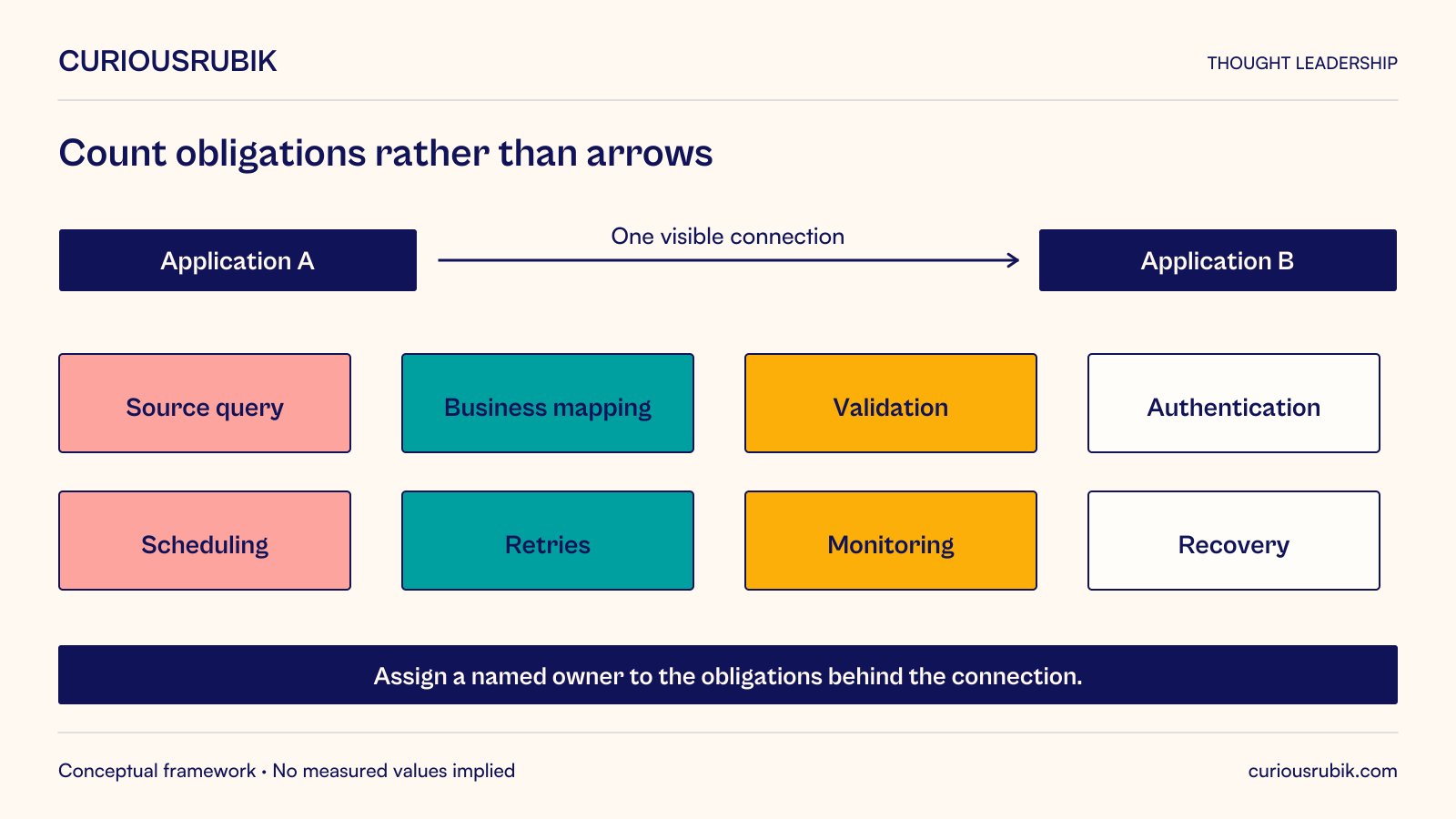
An integration arrow represents more than transport. It may contain source queries, transformation rules, validation, authentication, scheduling, retry behavior, monitoring, deployment configuration, and a recovery procedure. Someone must maintain each of these as applications and business rules change.
Record these obligations per flow. Identify the authoritative source, consumers, data meaning, change owner, support owner, and business consequence of delay or error. Note where code or configuration is copied across connections. A change to customer classification implemented separately in six mappings creates six opportunities for inconsistent interpretation.
Distinguish duplicated implementation from genuinely different requirements. Two consumers may both need a customer record but use different definitions of eligibility. Combining their rules indiscriminately can create an overgeneralized interface that is harder to understand than the original connections. Shared infrastructure should not erase legitimate business distinctions.
Hidden dependencies also include timing. A nightly export might assume another batch finishes first without an explicit completion signal. A script might depend on a file naming convention that no application owner recognizes as a contract. These relationships can fail during an otherwise routine upgrade because they were absent from change planning.
With eight applications, there are twenty-eight possible undirected application pairs: eight multiplied by seven, divided by two. If every application sends to every other through a distinct directed path, there are fifty-six possible directions. These are hypothetical maximum connection counts under specified assumptions, not estimates of a typical enterprise’s integrations.
Real estates are rarely complete graphs. Several applications may communicate only with one central service, and multiple business flows can share a technical connection. Conversely, one visible arrow may conceal several independently maintained jobs. Counting applications and applying a formula can substantially misrepresent the work.
The Canonical Data Model pattern describes using an application-independent message format to reduce format-to-format dependencies. Its benefit depends on the participating interactions and the cost of maintaining the shared model. It is not evidence that every enterprise should build one universal data schema. Enterprise Integration Patterns, Canonical Data Model
Map the actual graph by business flow and change dependency. Highlight where a source meaning is copied, where consumers rely on internal fields, and where a release requires simultaneous changes. This shows which dependencies a proposed shared contract would remove and which would remain.
Semantic debt appears when a transformation’s business meaning is implicit or duplicated. A field called “customer status” may be interpreted differently by billing, service, and sales. The remedy begins with ownership and definitions, not simply moving the mapping to a new tool.
Operational debt appears when successful execution depends on weak monitoring, manual recovery, or undocumented support. A connection may be technically simple but expensive to operate because failures are discovered only when a user complains. The remedy may be observability, reconciliation, and tested recovery rather than architectural replacement.
Change debt appears when implementation details leak across the boundary. Consumers may query private tables, depend on undocumented enumerations, or require a provider and all consumers to deploy together. A stable contract and compatibility tests can reduce this coupling, provided the contract has an owner and realistic evolution policy.
These categories are a working diagnostic aid. They often overlap. Separate them so a refactoring proposal identifies the problem it will actually address. A middleware purchase that improves scheduling may leave semantic duplication intact. A shared schema may reduce mapping effort while doing nothing for lost-message recovery.
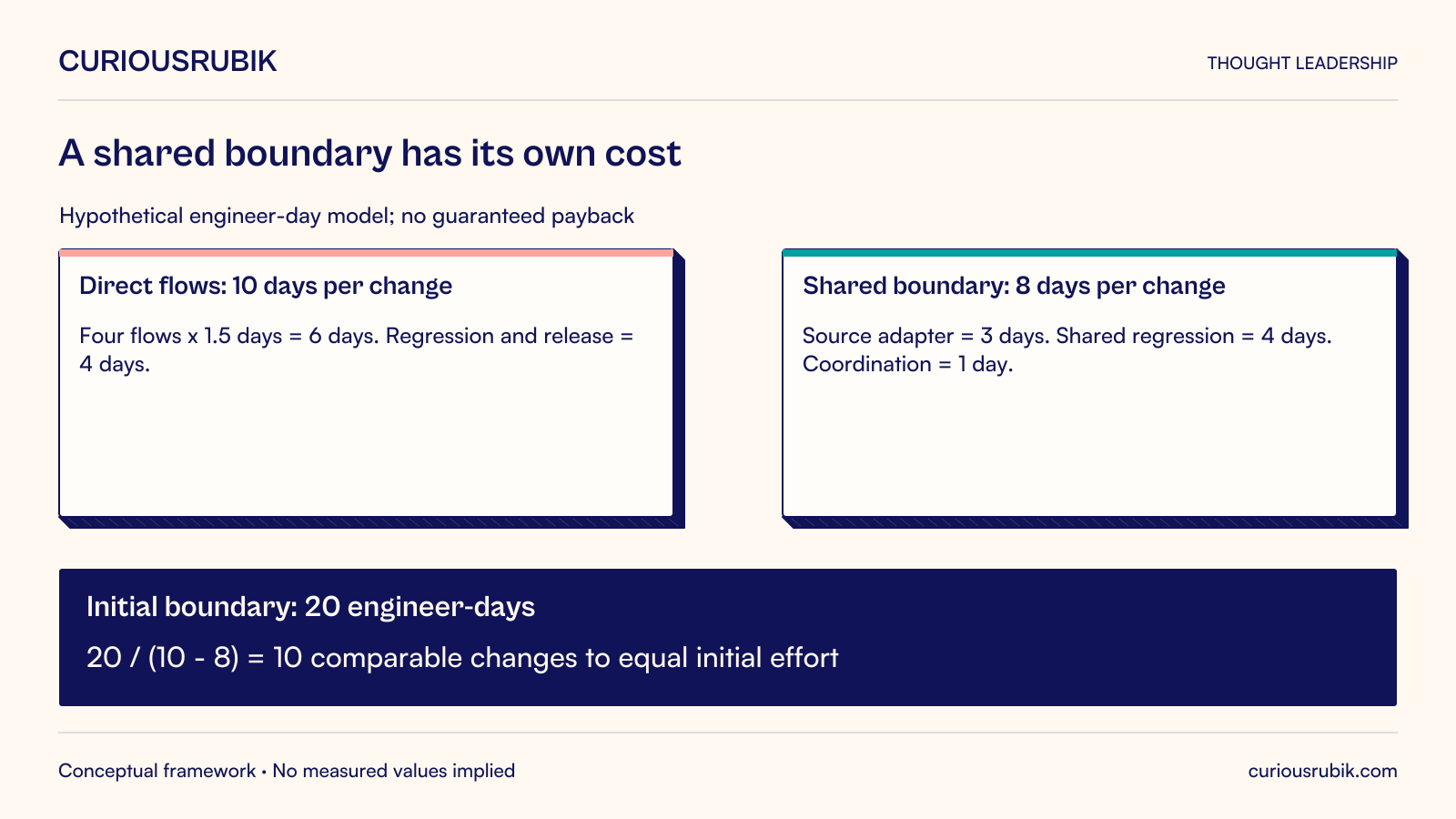
Suppose a hypothetical company has four direct customer-data flows affected by a recurring source change. The team estimates one and a half engineer-days to update each flow and four engineer-days of combined regression and release work. That is ten engineer-days per change, assuming the estimates are representative and do not overlap.
A proposed shared boundary requires twenty engineer-days to establish. For a comparable future change, updating its source adapter is estimated at three days, shared regression at four days, and deployment coordination at one day: eight engineer-days. The modeled reduction is two days per change. Ignoring other costs and benefits, the initial twenty-day effort equals ten such reductions.
This is illustrative arithmetic, not a productivity benchmark or a predicted payback. The proposal might be worthwhile sooner if it removes a serious reliability weakness, or never worthwhile if only one more change is likely. It might also save less if consumers still need their own changes or the shared contract is unstable.
The integration lead should test the largest assumptions. Can the shared representation actually preserve the meaning all four consumers need? Does regression remain four days as more consumers join? Who pays for operating the new boundary? Will the direct flows really be retired, or will the organization maintain both indefinitely?
This case discourages a superficial argument that fewer arrows automatically mean dramatic savings. A defensible proposal shows the specific repeated work removed, the new obligations introduced, and the expected change horizon.
Choose a seam where several flows share a stable business meaning and where repeated changes or incidents provide evidence of cost. Establish a narrow contract with explicit ownership. Build the translation and operational controls around that contract before migrating consumers.
Use a staged transition. Compare the old and new outputs on representative populations, investigate differences, and switch a bounded consumer or business segment. Preserve a clear source of authority during coexistence. If both paths can write to the same destination, define how duplicates and conflicting updates are prevented.
A parallel run should test behavior, not only totals. Include missing records, new values, source corrections, partial failures, and retries. The new route may produce the same aggregate count while assigning records incorrectly. Consumer-level checks should establish that the business result is correct.
Retire the old path deliberately. Confirm that no remaining consumer uses it, disable its schedule through the approved process, remove obsolete credentials and access through the responsible owners, and preserve required evidence. A new integration layered on top of an active old one can increase debt if retirement is never completed.
A shared platform can standardize useful capabilities such as deployment, authentication, monitoring, and connector management. It can also become a central repository for unrelated business rules that no domain team understands. The latter reduces the visible connection count while increasing organizational dependence on a small specialist group.
Keep contract ownership close to the business capability. A platform team can maintain common technical mechanisms; the appropriate domain owner should approve meaning and policy changes. Document where orchestration lives and who can modify it. A long-running business process should not be hidden inside a mapping expression simply because the tool permits it.
Consider failure concentration. If the shared hub is unavailable, which previously independent processes stop? What isolation, capacity management, and recovery does it need? The new design must be evaluated as a production service, including the operational cost of its wider reach.
Direct connections remain reasonable for isolated, stable interactions, temporary migrations with real retirement dates, and cases where a shared abstraction would add more complexity than it removes. The architecture should allow justified exceptions without making them invisible.
Measure the work associated with representative changes: interfaces modified, consumer coordination, regression effort, release waiting, and incidents caused by incompatibility. Track recovery effort and reconciliation defects separately from development speed. A project can reduce one type of debt while increasing another.
Keep a debt record with a concrete trigger for action. For example, reassess a direct connection when a second consumer duplicates its business mapping, when a source upgrade requires coordinated releases, or when recovery exceeds an agreed business tolerance. These triggers are local design choices, not universal thresholds.
The next step is to select one troublesome connection and reconstruct its last significant change. Identify what work was unavoidable and what existed because meaning, ownership, or recovery was missing. Refactor the dependency that caused that extra work. Technical debt becomes manageable when it is described as a specific obligation with evidence, an owner, and a proportionate remedy.