A backup can restore yesterday’s database. It cannot undo a truck that has left, a customer who has entered a venue, or a message that has created an expectation. After a system change, the technical state and the business’s real-world state may no longer move backward together.
Continuity and rollback planning must account for that difference. Continuity protects important activities during disruption. Recovery restores a dependable operating state. Rollback returns selected components to an earlier state where that remains coherent and feasible.
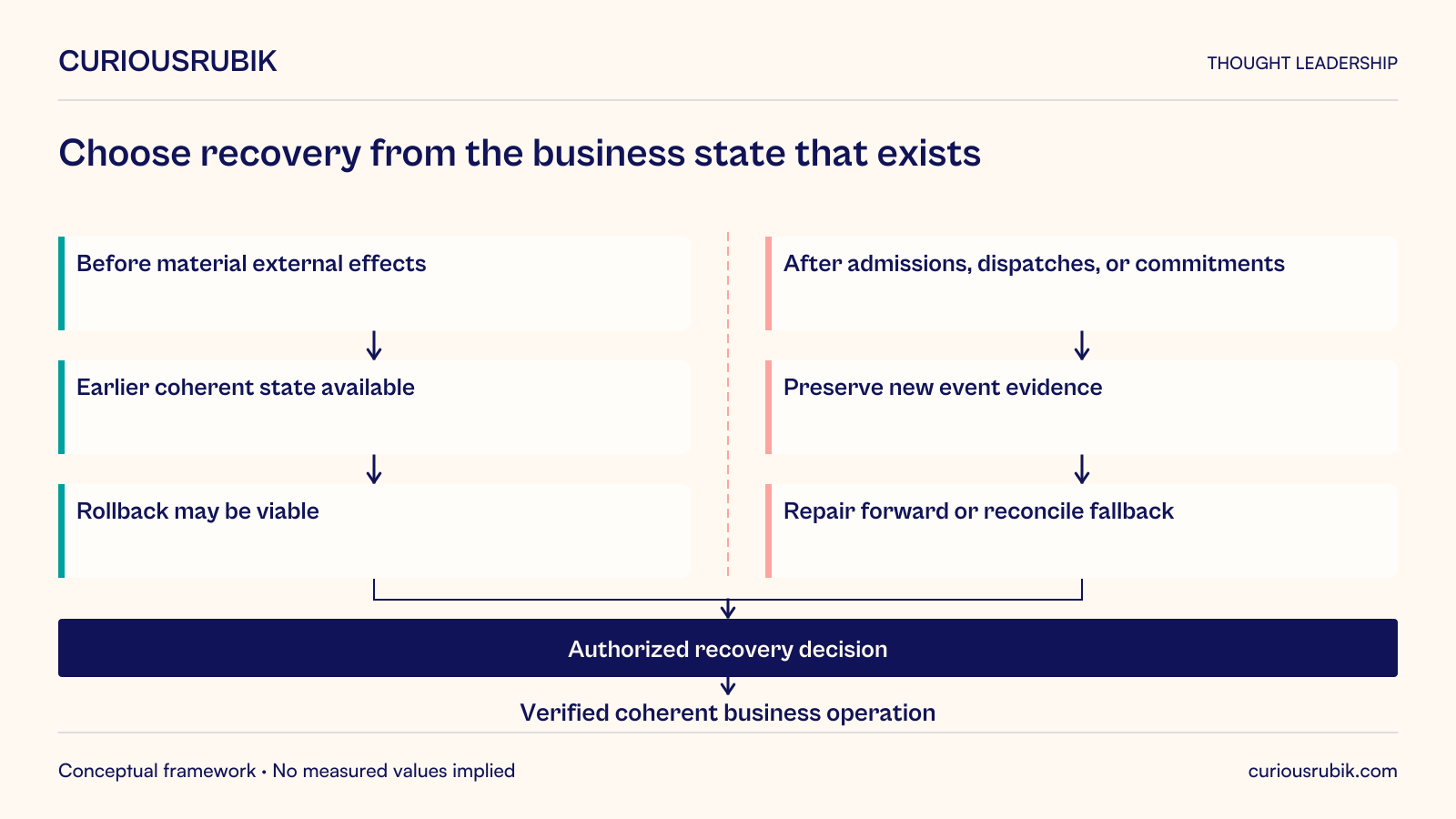
For an executive sponsor, the critical decision is which response remains valid at each stage of a change. A credible plan may use rollback before external activity begins, forward repair after certain commitments occur, and a controlled fallback while evidence is reconciled. “We have a backup” is the start of that discussion, not its conclusion.
Identify the activities that must continue, the consequences of interruption, and how those consequences change over time. A short delay may be manageable for one process and unacceptable for another.
Map dependencies beyond the application: people, identity services, communication channels, supplier systems, facilities, and the information required for decisions. Restoring one platform may not restore the business capability if a critical dependency remains unavailable.
ISO 22301 addresses business continuity management and preparedness for disruption. Its scope reinforces the need to consider the organization and its activities rather than treating continuity as a backup technology alone. The planning approach in this article is not a claim of certification or a substitute for applicable requirements. ISO 22301:2019.
Define the minimum acceptable operating mode and its limits. A fallback may support only selected work, at reduced volume, for a finite period. Make those conditions explicit.
A recovery-time objective expresses the target time for restoring a defined capability after disruption. A recovery-point objective expresses the tolerated age of recoverable data, commonly framed as the maximum acceptable data loss measured in time.
Both require a precise scope. Restoring the application to respond is different from restoring the business process with reconciled transactions and usable access. A backup interval does not by itself prove the achievable recovery point.
Set targets from business needs, then test whether the proposed architecture, procedures, people, and dependencies can meet them. Do not choose attractive numbers first and assume the technology will deliver them.
Record uncertainty and tradeoffs. A shorter target may require additional infrastructure, more frequent replication, stronger operational coverage, or a different process. The appropriate investment depends on the consequence of interruption and loss.
Before users begin new work, returning to the previous application and data state may be relatively straightforward. Once transactions create external effects, the recovery problem becomes more complex.
List those effects: physical movements, customer communications, external postings, accepted bookings, or other commitments. Determine which can be reversed, which require a compensating action, and which must remain part of the business history.
Define a decision checkpoint before crossing a material boundary. The team should know who can authorize continuing, what evidence is required, and what recovery option remains afterward.
The following working heuristic separates three responses: restore an earlier coherent state, repair forward while preserving new events, or operate a bounded fallback while reconciling. It is a planning aid, not a universal recovery standard.
Consider a hypothetical museum replacing its timed-entry booking and admission system. Before opening, the team migrates valid bookings and tests scanning. A technical problem appears after visitors have begun entering.
Restoring the pre-opening database would recover the application but omit admissions already recorded in the new system. If those events are lost, the system may no longer distinguish used tickets from unused ones or accurately represent the current admission history.
The recovery design therefore treats recorded admissions as business events that must be preserved. Before opening, rollback can return to the old system if the agreed checks fail. After admissions begin, the team must retain the new event evidence and choose a recovery route that reconciles it.
A bounded fallback records the necessary admission reference and event through an approved method if the primary system becomes unavailable. Staff have a defined authority and capacity limit. The fallback does not authorize overriding venue safety or operational rules; those remain with the responsible teams.
The rehearsal tests a scanner with delayed synchronization, a duplicate scan record, a booking amended during the window, and an outage after some admissions are confirmed. The team verifies that recovery preserves the relevant events and does not simply make the application appear available again.
The hypothetical example demonstrates the difference between technical restoration and a coherent business record. It does not prescribe an admission-control procedure or claim that one recovery strategy suits every venue.
Recovery depends on knowing what happened before and during the failure. Identify the logs, transaction references, source records, and acknowledgments needed to establish completed effects.
Keep this evidence accessible through the approved recovery route. If the only copy of a runbook or transaction log is inside the unavailable environment, the plan contains a circular dependency.
Protect integrity and access. Recovery records can contain sensitive operational or customer information. Use controlled storage and permissions, and avoid creating unmanaged copies merely for convenience.
NIST’s Guide for Cybersecurity Event Recovery emphasizes planning, playbooks, testing, and improvement of recovery capability. Its cybersecurity focus is narrower than all business interruptions, but it supports treating recovery as a prepared and evaluated capability rather than an improvised technical action. NIST SP 800-184.
A successful backup job proves that a job completed under its own checks. It does not establish that the organization can restore the required service within its target.
Test restoration into an appropriate environment and verify the data, configuration, access, and dependencies needed for the intended process. Include the steps required to interpret and reconcile restored information.
Check for missing components such as attachments, keys under approved custody, integration settings, reference data, or external service dependencies. The exact requirements depend on the architecture.
Exercise the people and procedures. Record actual duration, manual intervention, and unexpected dependencies. A restoration that succeeds only through undocumented expert knowledge remains a fragile recovery capability.
A transaction may have completed in one system before another system lost confirmation. Repeating it can create a duplicate; ignoring it can leave missing work.
Define how the team establishes the result. Use authoritative evidence and stable identifiers, and distinguish confirmed success, confirmed failure, and unknown state.
Create reconciliation procedures for the interfaces and business objects affected by the change. A blanket rollback can overwrite valid new work, while a blanket replay can duplicate external effects. Recovery should be based on the actual state of each relevant category.
Do not assume every operation has a clean inverse. A correction may require a new record that preserves history rather than deletion of the original event. Business and control owners should define the appropriate treatment.
Recovery plans often become less useful when teams spend too long attempting an uncertain repair. Define the information and timing needed to choose among continued diagnosis, fallback, rollback, and forward recovery.
Avoid a rigid deadline that ignores new evidence. A nearly completed verified repair may be preferable to a risky rollback, while an unbounded series of optimistic estimates can consume the available recovery window.
Name the decision authority and the people who advise it. The technical lead explains system state and options; business owners explain operating consequences; the authorized decision maker accepts the chosen tradeoff.
Record the decision and assumptions. This supports coordination during recovery and learning afterward without requiring a detailed narrative while the incident is still unfolding.
Restoration can leave a backlog of temporary records, delayed messages, corrections, and user work performed outside the system. Plan the return to normal operation as a controlled phase.
Establish which source is authoritative during reconciliation. Prevent new conflicting updates while differences are resolved. Prioritize cases by consequence and age.
Verify that users can perform the important tasks and that downstream records agree. Technical health checks should support, not replace, this business verification.
Close temporary channels and revoke temporary access when their approved purpose ends. A fallback that remains in informal use can create the next integrity problem after the original outage is resolved.
A recovery plan becomes stale when applications, interfaces, data structures, suppliers, or responsibilities change. Include recovery impact in release and architecture decisions.
Test representative scenarios at a cadence appropriate to the risk and rate of change. A document review can identify obsolete names; only an exercise can reveal that a restore takes longer than expected or a dependency cannot be reached.
Capture lessons from real incidents and tests. Assign improvements and verify completion. Repeatedly discovering the same recovery gap is evidence that the management loop is incomplete.
Consider the cost of maintaining the plan when comparing architectures or vendors. A design that is inexpensive to run normally may require difficult manual recovery. That obligation belongs in the decision.
Ask what state the business can safely return to, which events make that state obsolete, and how new work will be preserved. Ask whether recovery targets have been demonstrated with the relevant people and dependencies.
Require a clear account of fallback capacity, decision authority, and reconciliation before ordinary operation resumes. Ask suppliers to show recovery evidence rather than only a backup configuration screen.
Continuity and rollback planning are valuable because they preserve choices under pressure. The strongest plan recognizes that business history continues while systems fail or change, and it restores a coherent service without pretending that real-world events can simply be erased.