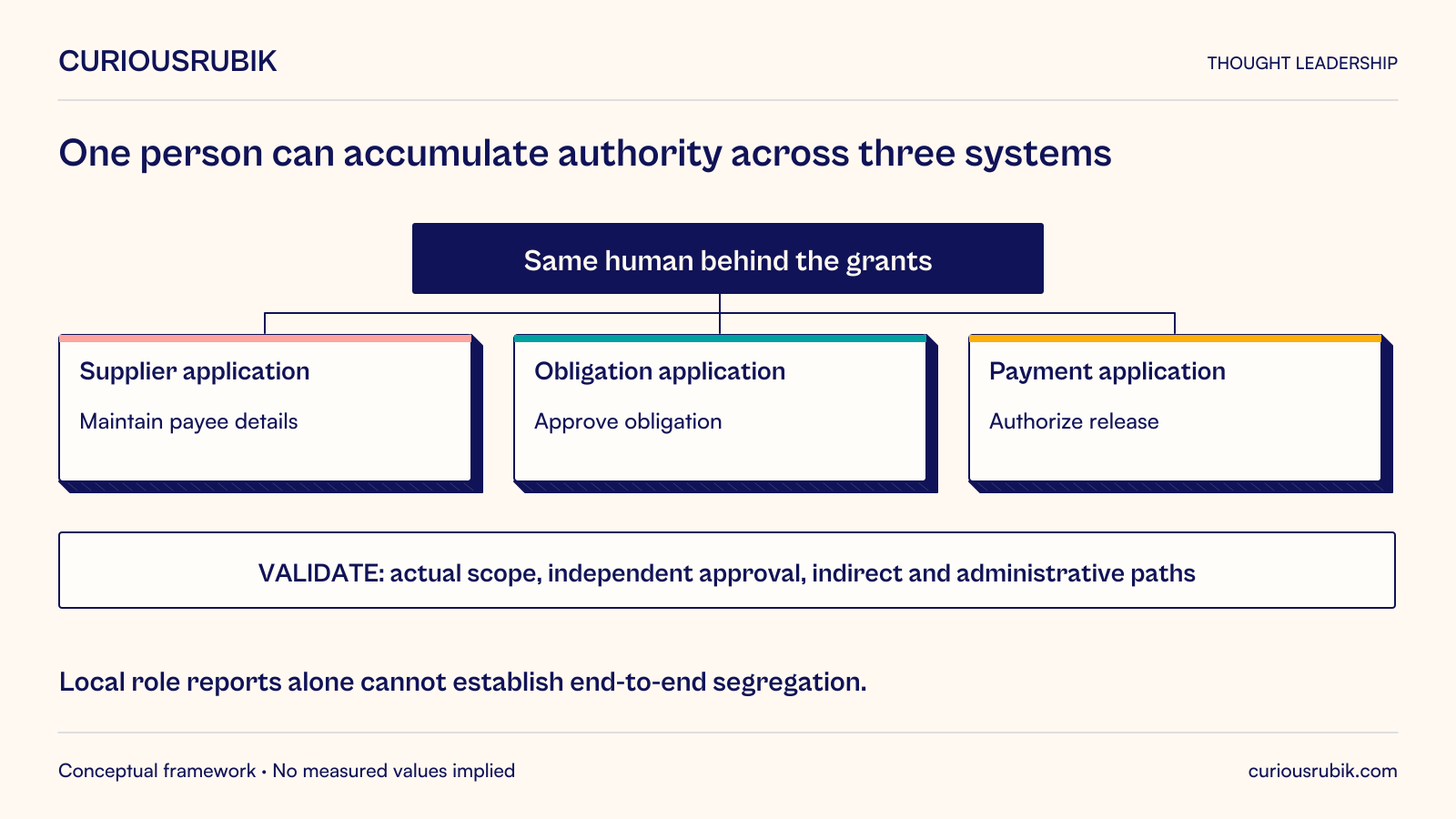
Three clean access reports can conceal one consequential conflict. In a hypothetical company, Leah can maintain supplier details in one application, approve obligations in another, and authorize payment release in a third. Each local report shows only one functional role. Taken together, the grants allow one person to influence the full path from payee information to an outgoing payment.
The problem is effective authority across the process, not the number of role names inside an application. A controller assessing segregation of duties needs to identify which combinations could create or conceal an inappropriate outcome, then determine how those combinations are prevented or independently challenged.
This is an operating-control discussion, not a universal financial-system configuration or accounting rule. The appropriate conflicts, approval conditions, and alternative controls depend on the organization’s transactions, staffing, systems, and applicable obligations. Qualified control and assurance owners should evaluate the resulting design.
Start with the outcome at risk. In a supplier-payment process, relevant duties may include maintaining payee information, establishing or approving an obligation, preparing a payment instruction, authorizing release, and reconciling the result. These duties can be distributed across several applications and manual steps.
A conflict rule should explain how a combination could affect that outcome. “Role X conflicts with Role Y” is useful only when the underlying capabilities are understood. Two role names can appear incompatible while the scopes never overlap; two harmless-looking roles can combine into broad end-to-end authority.
Include data scope and transaction context. The ability to maintain suppliers for Entity A and approve unrelated transactions for Entity B may have a different consequence from exercising both capabilities over the same supplier and obligation. The assessment must preserve those relationships rather than treating all grants as interchangeable.
NIST SP 800-53 Revision 5 explicitly recognizes that separation-of-duty violations can span systems and application domains. AC-5 calls for identifying the duties requiring separation and defining supporting access authorizations. It provides a control-design reference, not a universal list of financial conflicts. NIST SP 800-53 Revision 5, AC-5
Return to Leah’s three grants. The controller first verifies what each permission actually permits. Does supplier maintenance include changing payment details or only a display name? Does obligation approval apply to all entities or a narrow category? Does payment release require an independent second authorization that Leah cannot satisfy herself?
Those details can change the assessment. If a separate, informed authorization is enforced before release, the process differs from one in which Leah can complete every consequential step alone. A role report should not be accepted as evidence of either condition without checking the actual workflow.
The review then examines indirect capabilities. Leah may have an administrative account that can change approval rules, a delegated account used during absences, or access to a service credential. These paths can recreate a conflict even if ordinary business-role assignments are separated.
A defensible remediation might remove one incompatible capability, narrow its scope, or redesign the approval route so an independent authorized person examines the relevant evidence before the consequential action. The exact choice depends on the risk and available operating model; simply adding another checkbox is insufficient.
The controller documents the retained duties, the control that addresses the conflict, the person responsible for performing it, and the evidence showing it operated. The hypothetical case is resolved only when effective authority has changed or an appropriate alternative control has been established and tested, not when the access spreadsheet turns green.
Some combinations should be prevented at assignment time because the same person should not hold both capabilities within the relevant scope. Other policies may permit several roles but prevent the person from performing incompatible steps on the same transaction.
For example, an employee might be eligible to prepare and review different items while being prohibited from reviewing an item they prepared. That requires transaction-level enforcement and reliable attribution, not merely a role-membership rule. Whether this arrangement is appropriate depends on the process and control objective.
The system must identify the actual actor behind each step. Separate usernames do not create independence if one person controls both. Shared accounts and untracked delegation can make the transaction history unable to establish who performed the required challenge.
Consider timing. A person could prepare a transaction, temporarily receive approval authority, and then approve the same item after the role change. A design that checks only simultaneous role membership may miss the conflict. Historical participation can matter to the transaction rule.
Keep the policy understandable. Complex conflict logic that nobody can explain is difficult to review and can create unexpected blocks. Define the business reason, scope, and examples of allowed and denied combinations before implementing the rule.
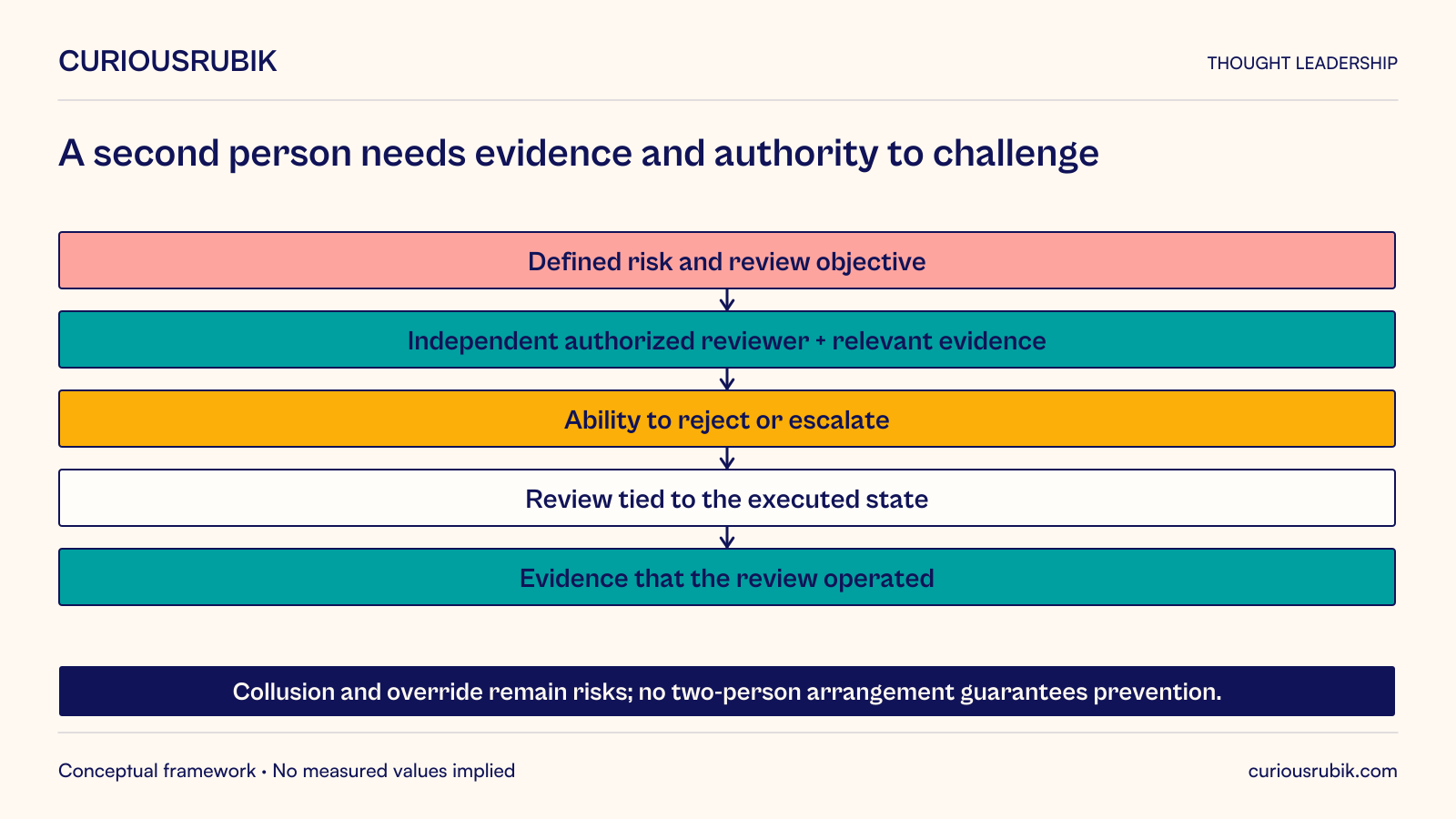
Independence is necessary for some controls, but a second person must also have the evidence, competence, time, and authority to challenge the action. A reviewer who sees only an aggregate total may be unable to identify an inappropriate payee change hidden within it.
Specify the review objective. Is the person confirming that the obligation is supported, that the payment destination is verified, that the instruction matches approved records, or that the result reconciles? These questions may require different evidence and owners.
Preserve the relationship between the review and the actual transaction state. If material details change afterward, determine whether the prior review remains valid or must be repeated. The workflow should not allow a meaningful check to be detached from the information that will be executed.
Avoid assuming that two-person control eliminates all risk. Collusion, management override, compromised accounts, or an ineffective review can still defeat the arrangement. NIST’s AC-5 discussion describes reducing certain abuse risks without collusion; it does not promise absolute prevention. NIST SP 800-53 Revision 5, AC-5 discussion
Review the quality of the challenge through appropriate assurance activity. Repeated unsupported approvals, missing evidence, or identical rapid sign-offs can justify investigation of whether the control is operating as designed. They are signals for assessment, not automatic proof of misconduct.
A small finance team may not be able to allocate every preferred duty to a different person. That constraint should be visible in the control design rather than hidden behind duplicate accounts or nominal role separation.
The historical 2014 GAO Green Book discusses alternative controls where segregation is impractical. It is a federal framework, cited here only for this established design consideration rather than as a universal enterprise mandate. GAO-14-704G, paragraphs 10.12–10.14
An alternative might involve an appropriately independent review with access to reliable evidence, a narrower permitted transaction scope, or a different operating arrangement. Its adequacy depends on the specific risk and the time available to detect and correct an issue. A retrospective review cannot be assumed equivalent to prevention when the consequence is difficult to reverse.
Temporary coverage needs a defined purpose, scope, duration, approval, and termination mechanism. Assess what the temporary grant combines with the person’s existing authority, including other systems. A narrow new permission can create a broad conflict when added to accumulated access.
Emergency access should preserve accountability and trigger the agreed review. The process should be usable during a genuine disruption without becoming a permanent workaround. After the event, confirm that the grant ended and that consequential actions received the required examination.
Use a small set of realistic scenarios rather than relying only on a role-conflict report. The test plan should include:
Run these tests only in an authorized environment with appropriate data. Verify persistent state and evidence as well as the visible response. A blocked screen is not sufficient if another supported path can complete the same action.
Review the users who can change the controls themselves. Access administrators, workflow configurators, and audit administrators can affect the independence or visibility of the process. Their responsibilities need an appropriate separation and oversight model too.
NIST links separation of duties with account management, access enforcement, identity, and audit protection. That relationship explains why segregation cannot be maintained solely inside a finance role catalogue. NIST SP 800-53 Revision 5, AC-5 related controls
Reassess conflicts when applications are connected, responsibilities move, approval limits change, or a service account gains new capabilities. Periodic review helps, but important operating changes may require a more immediate assessment.
Measure unresolved consequential conflicts, temporary grants past their intended end, failed control tests, and the quality of alternative-control evidence. A low total conflict count is not useful if one remaining combination can affect a critical process without independent challenge.
There are costs to separation: additional handoffs, staffing requirements, and occasional delay. Reduce unnecessary duplication, but preserve the distinct review or authorization that addresses the risk. The objective is an operable control system, not the maximum number of approvers.
A useful first exercise is to select one payment-related process and follow one person’s effective authority across every system involved. Add administrative and delegated paths, then test the point where independent challenge is supposed to occur. That view reveals whether the organization has genuine segregation of duties or merely separate role names.