The most useful next generation of enterprise mobile applications will help people interpret evidence and prepare decisions at the point of work. That may involve reading a label, suggesting a defect category, retrieving an approved procedure, or drafting a structured report. The investment case depends on whether the assistance improves the complete task under real mobile conditions, not on whether the interface includes a conversational feature.
For a product leader considering AI in an inspection app, the immediate decision is which bounded assistance is worth piloting and what authority must remain outside the model. A model-generated description can be treated as a draft. A decision to release a product, change a customer commitment, or bypass a control requires a different level of evidence and governance.
This article explores design directions rather than promising a dated product roadmap or a particular vendor capability. Its hypothetical textile-inspection example shows how to evaluate assistance, deployment location, human review, and failure recovery without assuming that an impressive demonstration establishes operational readiness.
Start with one part of the workflow that is difficult or repetitive and has a reviewable output. Candidates might include extracting an identifier from an image, proposing a category from an approved list, or assembling a draft report from observations the employee has already recorded.
Specify the input and the permitted output. An image-based identifier suggestion should point to the relevant image region and remain editable. A category suggestion should use the organization’s actual taxonomy and allow “unable to determine.” A report draft should preserve the distinction between observed facts, employee statements, and model-generated wording.
Avoid beginning with an unconstrained assistant that can answer any question and invoke any business action. The broader the scope, the harder it becomes to establish representative evaluation, useful refusal behavior, and clear accountability. A narrow tool can provide valuable assistance while leaving the surrounding process understandable.
Choose a task where the business can recognize a correct result. If reviewers disagree about defect definitions or acceptable evidence, resolve that ambiguity before treating their judgments as model ground truth. AI can reproduce inconsistent labels as easily as it can help organize well-defined ones.
Imagine a hypothetical textile producer evaluating a mobile assistant for recording visible fabric defects. An inspector photographs a selected area, records the roll identifier, and asks the application to suggest a defect category and draft a description. The inspector reviews the suggestion before saving the observation.
The proposed scope is deliberately limited. A photograph of one area does not establish the condition of the entire roll. The model does not decide whether the roll passes, approve a customer concession, or change the inspection plan. Those decisions remain with the approved quality process and authorized personnel.
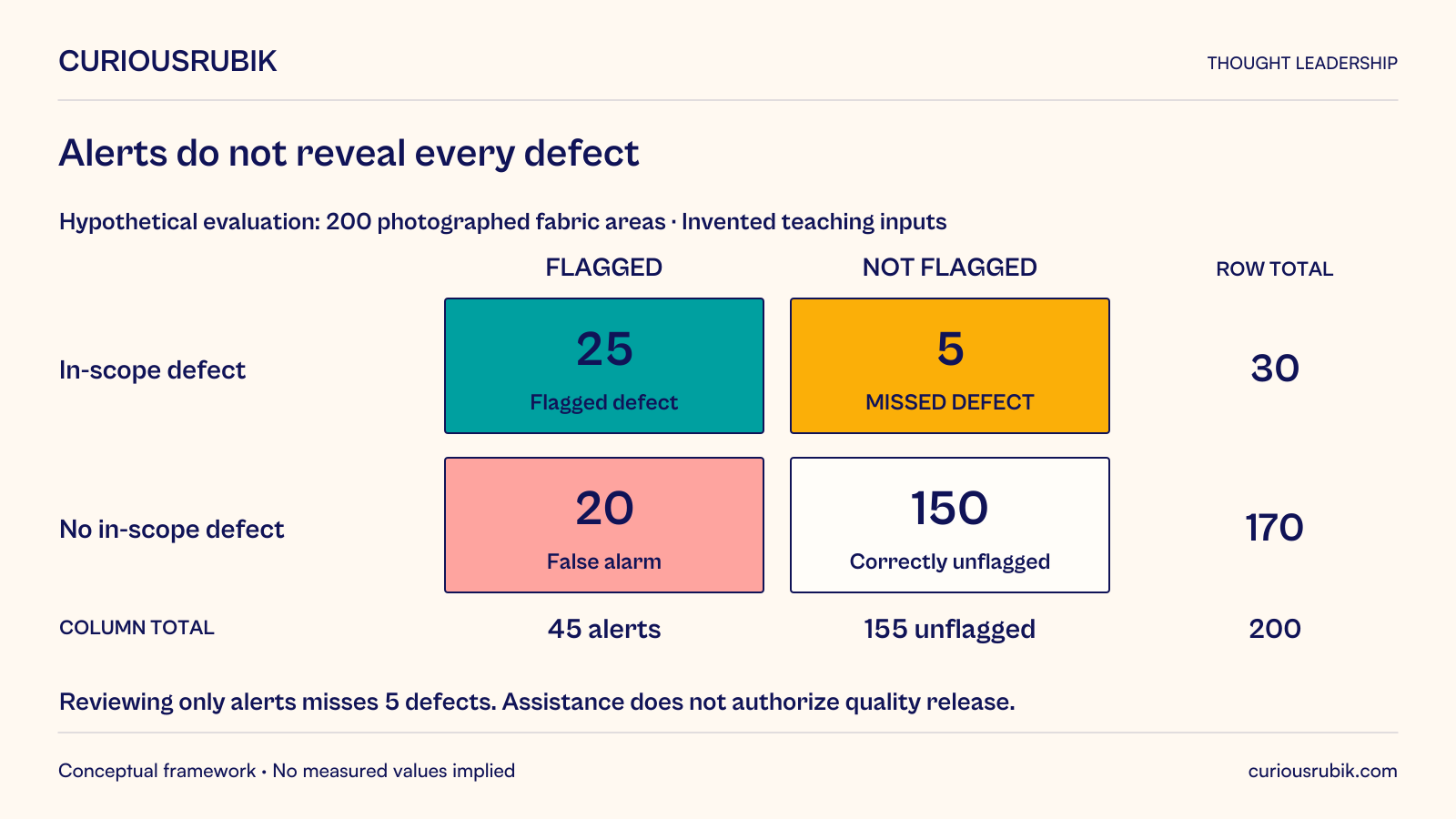
In an illustrative evaluation set of 200 photographed areas, qualified reviewers identify 30 areas containing an in-scope defect. The candidate model flags 25 of those and misses five. It also flags 20 of the 170 areas without an in-scope defect. These are invented teaching inputs, not product performance claims.
The 45 flagged areas therefore include both useful detections and false alarms. Reviewing only flagged images would leave the five missed defects outside that review path. A human-in-the-loop label does not solve that problem if the human never sees the omitted cases. The test plan must examine unflagged inputs and preserve the independent inspection requirements.
Now change the conditions. Photograph glossy fabric under different lighting, use an older approved device, or introduce a defect type absent from the test set. The model may behave differently. The evaluation should identify these conditions and the appropriate fallback rather than present one aggregate score as a universal guarantee.
The assistance may still be valuable if it reduces description effort or improves category consistency while inspectors retain the necessary checks. That narrower outcome should be measured directly. It is a stronger basis for a pilot than claiming the system has automated quality assurance.
On-device processing can be a candidate when connectivity, responsiveness, or limiting data transfer matters. Remote processing can be a candidate when the task needs resources or managed capabilities that the supported device cannot provide. A split design may perform a narrow local step and use a remote service only when appropriate.
These are architectural possibilities, not guarantees. Evaluate the actual model, device, runtime, and task. A local implementation still needs secure storage, updates, and support. A remote implementation still needs a reliable response contract, appropriate data controls, and a plan for unavailable connectivity.
Measure latency at the user interaction, including image preparation, transfer, inference, and result rendering. Also test battery use, memory pressure, thermal conditions, and interruptions on supported devices. A fast isolated model run does not prove that a worker can complete the full task comfortably during a shift.
Define degraded behavior. The inspection app might allow manual capture and defer suggestions when inference is unavailable. It should preserve the employee’s observations and explain that assistance was not obtained. Failure of an optional AI feature should not silently erase ordinary work or fabricate a completed analysis.
Specify what the reviewer must inspect, which evidence is available, and what decision they are responsible for. A generic Confirm button can encourage acceptance without examination. The interface should make the model’s proposed changes and uncertainty visible enough for meaningful review.
Let the employee disagree without fighting the application. They should be able to replace a category, edit a description, decline a suggestion, or indicate that the evidence is insufficient. Capture correction reasons where they are useful and proportionate, without turning every disagreement into a burdensome annotation task.
NIST’s AI Risk Management Framework describes governance, context, measurement, and management activities, and its human-AI interaction discussion emphasizes clearly differentiated roles. The framework is voluntary guidance, not certification that a particular review arrangement is effective. NIST AI RMF 1.0, Part 2 and Appendix C
Test review behavior as well as model output. Can an inspector identify an incorrect suggestion under realistic time pressure? Does the wording make a tentative inference sound like an observed fact? Does the app preselect acceptance? These are product-design questions that a model benchmark alone cannot answer.
Use a representative evaluation set with documented labels and conditions. Keep an independent test portion that is not repeatedly used to tune the system. Record device, lighting, material, input quality, and relevant task variation so weak conditions can be found rather than averaged away.
Measure false positives and false negatives separately when the task has detection behavior. Their consequences differ. An unnecessary review consumes time; an overlooked defect may affect later production or a customer. The accountable quality owner should define acceptable use and escalation based on those consequences.
Measure effort after including review and correction. A draft generated instantly may take longer to verify than a short structured manual entry. Compare complete task time and accepted record quality, and include the work needed to investigate errors. Do not count generated text or suggestion volume as business value by itself.
Track changes in the model and surrounding system. A new model version, image-processing step, taxonomy, or instruction can change behavior. Keep enough version information to connect an output to the tested configuration. Establish the evidence required before expanding scope or replacing a previously accepted configuration.
Treat model output as untrusted input to business actions. Validate identifiers, permitted values, and authorization through deterministic controls where appropriate. A plausible description should not be able to change an order, release an item, or access another customer’s records merely because it appears in a model response.
Separate retrieved material from instructions that control the application. A photographed label, document, or external text may contain content unrelated to the employee’s intended task. The architecture should constrain what the model can influence and avoid giving retrieved content authority over tools or permissions.
Minimize information supplied for inference. Determine which images, identifiers, and contextual records are genuinely needed. Review provider handling, retention, access, and any proposed reuse of data before sending it to an external service. On-device inference can reduce some transmissions, but it does not remove all privacy or security responsibilities.
Design logs for diagnosis without indiscriminate capture. The organization needs enough evidence to understand errors, yet unrestricted storage of photographs and full prompts can create a separate exposure. Define access and retention around the actual evaluation and support needs.
Assign a business owner, a technical owner, and an evaluation owner. Agree on the task boundary, prohibited actions, supported conditions, fallback, and stop criteria. These responsibilities should remain clear after the initial enthusiasm of the pilot.
Begin with assistance that does not silently remove an existing required check. Review errors and employee corrections, including the cases where the model abstains or the worker chooses manual entry. Expand only when the evidence supports the new scope; success at describing one defect category does not establish readiness to authorize product release.
Prepare a reversible deployment path. The ordinary capture workflow should continue if the AI feature is disabled, the provider is unavailable, or a version fails evaluation. Keep accepted records interpretable without requiring the same model to run again later.
The next useful investment is a bounded experiment with an explicit decision at the end. Select one assistance task, define the complete outcome and failure costs, collect representative test cases, and compare the assisted workflow with the existing method. The next generation of mobile applications earns its place when it improves that work reliably while keeping evidence, authority, and recovery clear.