A line manager receives a resignation on Monday. HR updates the employee record on Wednesday. Payroll learns on Friday, after a payment has been released. If tax clearance was required, the operational delay may already have affected the money the employer needed to withhold.
The handoff should begin when the relevant information becomes known, with a prompt assessment of the employee's circumstances. That does not mean holding every departing employee's pay. It means giving the authorised payroll or tax-clearance owner enough information to decide the lawful route before money leaves through any channel.
Keep the date the business became aware of the impending cessation or departure, the expected last day, the proposed departure from Singapore where relevant and the date HR processed the record. These dates describe different events.
A workflow that starts only when an HR form is complete can conceal an earlier awareness date. Ask managers to send the relevant notice promptly through the agreed secure route, even if some administrative details remain unresolved. HR can complete the record while the tax-clearance owner begins the assessment.
Collect the facts required for that assessment, with access limited to the people who need them. The wider handover team may need the employee's availability and replacement owner; it does not need the employee's tax details or complete payment inventory.
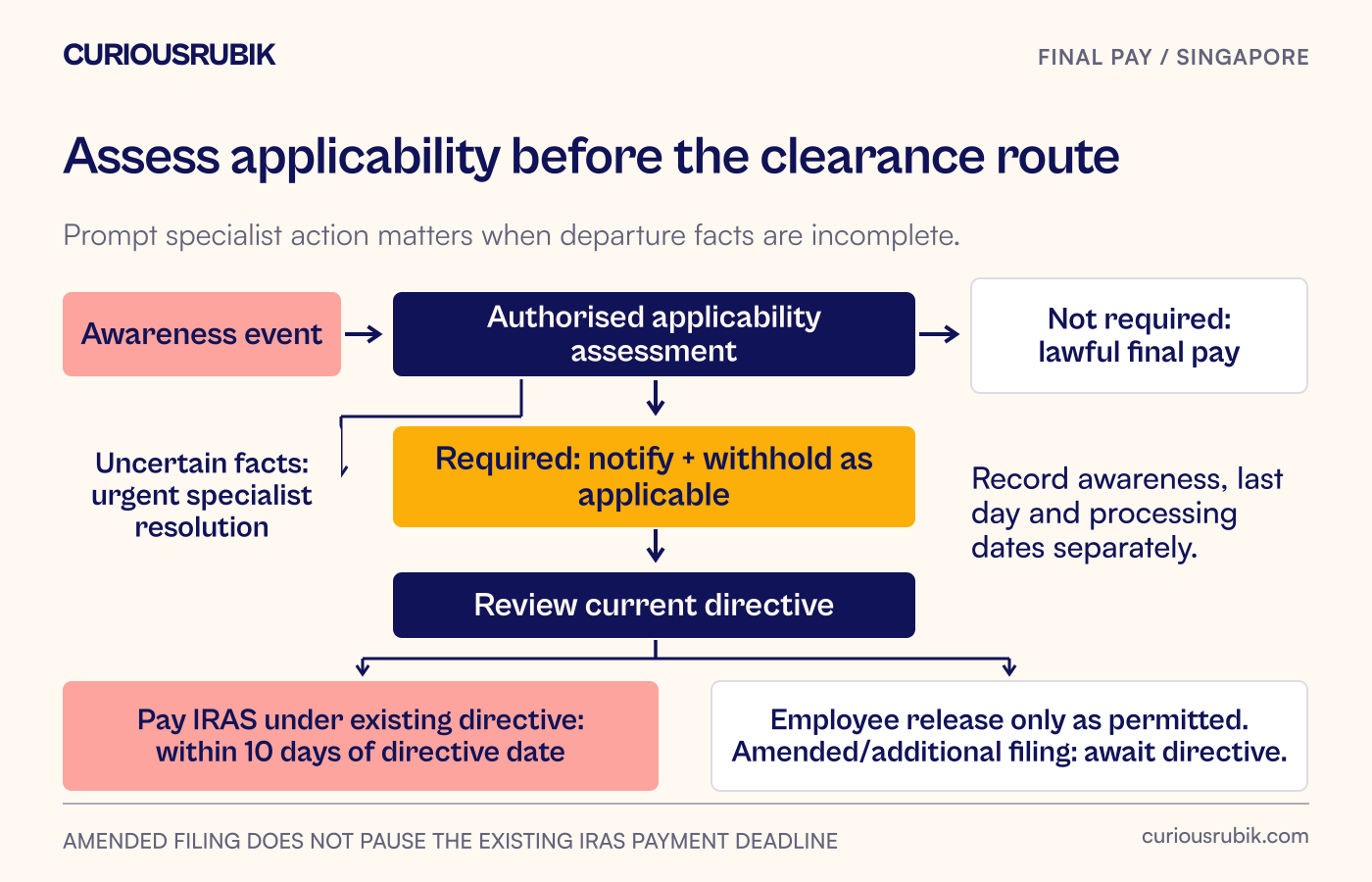
IRAS instructs employers to determine whether tax clearance is required before filing Form IR21 and withholding monies. For relevant non-Singapore-citizen cessation, overseas-posting or departure cases, its general guidance requires at least one month's advance notification and withholding from awareness, subject to exceptions.
The authorised owner should check the actual circumstances against current IRAS requirements. Citizenship or permanent-resident status, the nature of the departure and applicable exception conditions may matter. Do not reduce the assessment to a single “foreign employee” checkbox.
Record the conclusion, evidence and reviewer. If clearance is not required, payroll still needs to apply the relevant final-pay obligations and normal controls. If it is required, the owner coordinates the notification, withholding and eventual release or remittance instructions.
Where notice is short, escalate promptly and follow the applicable reporting route. An immediate resignation does not justify silently using an inaccurate future awareness date to make the process appear on time.
CURIOUSRUBIK FINAL PAY / SINGAPORE Assess applicability before the clearance route Prompt specialist action matters when departure facts are incomplete. Awareness event Authorised applicability assessment Not required: lawful final pay Uncertain facts: urgent specialist resolution Required: notify + withhold as applicable Review current directive Record awareness, last day and processing dates separately. Pay IRAS under existing directive: within 10 days of directive date Employee release only as permitted. Amended/additional filing: await directive. AMENDED FILING DOES NOT PAUSE THE EXISTING IRAS PAYMENT DEADLINE curiousrubik.com
A final-pay checklist can miss amounts processed elsewhere. Build an outstanding-money inventory by asking every relevant owner what may still become payable.
Include salary and leave-related amounts, overtime, allowances, approved expenses, variable incentives and any later payments requiring assessment. IRAS's withholding guidance, where clearance applies, covers monies beyond salary, including reimbursements. The precise treatment and reporting should be confirmed by the responsible specialist.
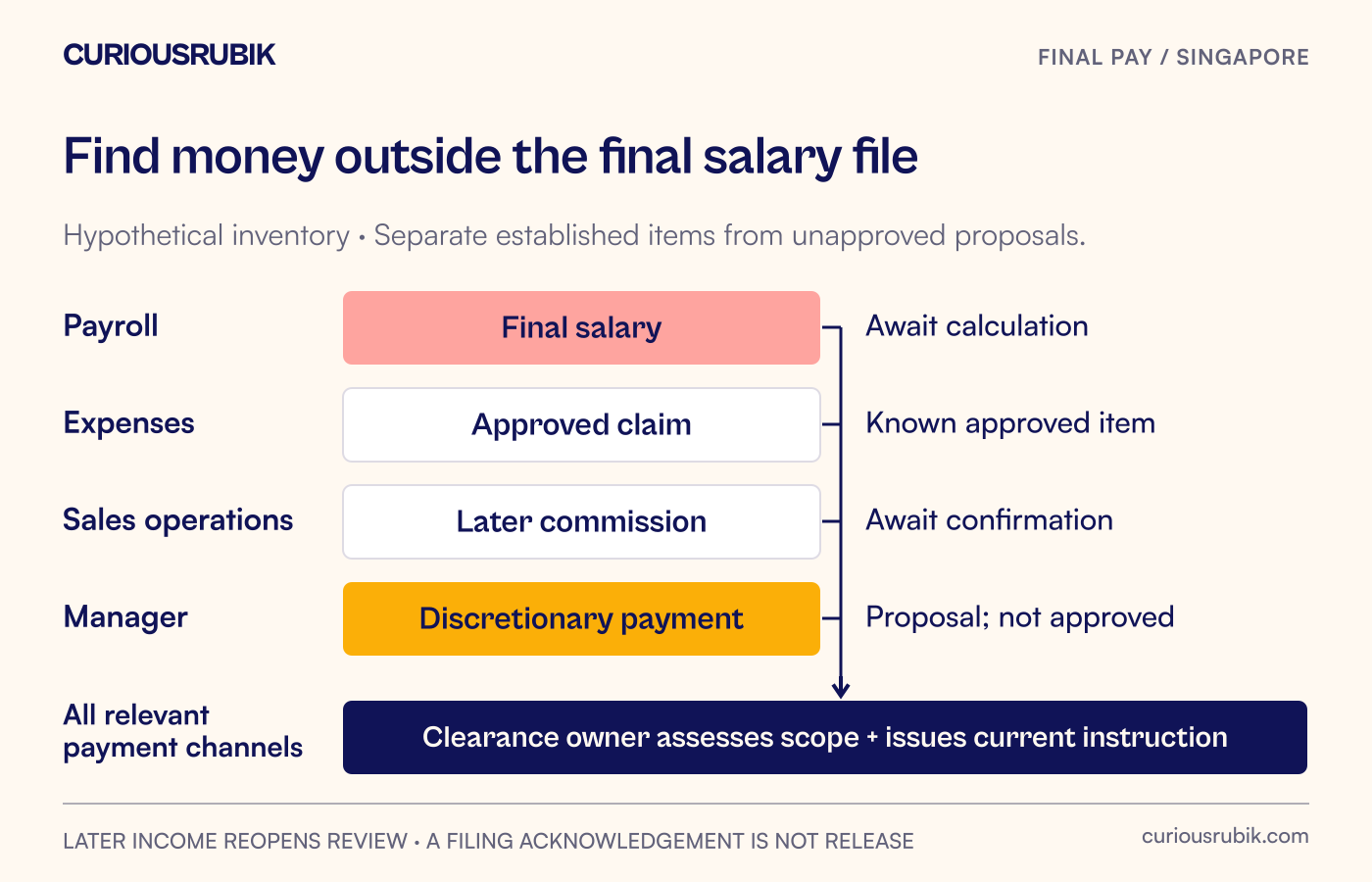
For each item record the owner, amount or calculation status, expected payment date, paying entity, payment channel and current release instruction. Distinguish a known payable from a possible future amount that still needs approval. Both can require attention, but they should not be presented as equally certain.
The following hypothetical inventory illustrates the coordination problem:
The clearance owner needs visibility of these routes. A hold applied only in payroll may leave the expense payment untouched. Conversely, an uninformed team may keep money held after the relevant release instruction has been received.
CURIOUSRUBIK FINAL PAY / SINGAPORE Find money outside the final salary file Hypothetical inventory · Separate established items from unapproved proposals. Payroll Final salary Await calculation Expenses Approved claim Known approved item Sales operations Later commission Await confirmation Manager Discretionary payment Proposal; not approved Clearance owner assesses scope + issues current instruction All relevant payment channels LATER INCOME REOPENS REVIEW · A FILING ACKNOWLEDGEMENT IS NOT RELEASE curiousrubik.com
HR or payroll should explain the applicable process and the current status accurately. Avoid saying that a delay is “company policy” when it follows a specific tax-clearance requirement, or implying that every non-citizen employee must undergo the same hold.
The employee should know who can answer questions and which information is still needed. Keep tax details in the appropriate private channel. The manager coordinating operational handover can communicate availability without sharing the employee's financial circumstances.
An unresolved return of equipment is a separate issue. Do not let an operational handover checklist become an automatic instruction to withhold final salary. The payroll or employment specialist should assess lawful payment obligations and any permitted deductions on their own basis.
When clearance applies, receiving a filing acknowledgement is not the same as receiving the instruction governing the money. IRAS describes a Directive to Pay Tax or a Notification to Release Monies. The owner should verify the relevant directive, its scope and any subsequent amendment before instructing the payment teams.
Additional or changed income can reopen the reporting question. IRAS warns that where an amended or additional Form IR21 has been submitted, withheld monies should not be released until the corresponding further clearance directive is received. That does not suspend payment required by an existing Directive to Pay Tax. IRAS says to pay the first directive while an amended or additional filing is being processed; payment is due within 10 days from the directive date. Keep this remittance deadline separate from permission to release money to the employee. The process also needs to notice a later bonus or correction rather than treating the first filing as permanent closure.
Keep the directive reference and authorised payment decision connected to the inventory. Reconcile what was withheld, what was remitted or released and what remains unresolved. Each paying team confirms execution through its normal controls. A case status marked “cleared” should reflect completed checks, not just a document arriving in an inbox.
In the improved hypothetical sequence, the manager notifies HR and the clearance owner on Monday using the agreed route. The owner promptly assesses applicability and any urgent action needed. HR confirms the dates and facts. Payroll, expenses and other payment owners receive the appropriate scoped instructions.
If clearance is required, the process follows that route and tracks all relevant amounts. If it is not required, the final-pay process continues under the applicable obligations. Uncertain cases receive specialist attention early enough to make a lawful decision; the system does not invent one.
By Friday, payroll can show what it knows, what was assessed and which instructions control the pending amounts. The improvement is the earlier decision, not simply a faster HR status update.
Automation can alert the named owners when a resignation or relevant departure is recorded, gather outstanding-payment information and flag a payment proposal inconsistent with the current instruction. It should also identify a failed notification or an unacknowledged instruction.
A human specialist retains the applicability and release decisions. A date change, revised departure plan or later income item should trigger reassessment where needed. Do not make the employee's tax position depend on an unreviewed rule inferred from nationality.
Review recent departures for the gap between awareness and payroll notification, payments released before assessment, forgotten payment channels and money held after a valid release decision. Use those findings to improve the handoff rather than collecting more personal data by default.
The essential test is simple: can the clearance owner identify every team that might still pay this employee, and can each team show the current authorised instruction? If either answer is missing, the offboarding payment process remains unfinished.