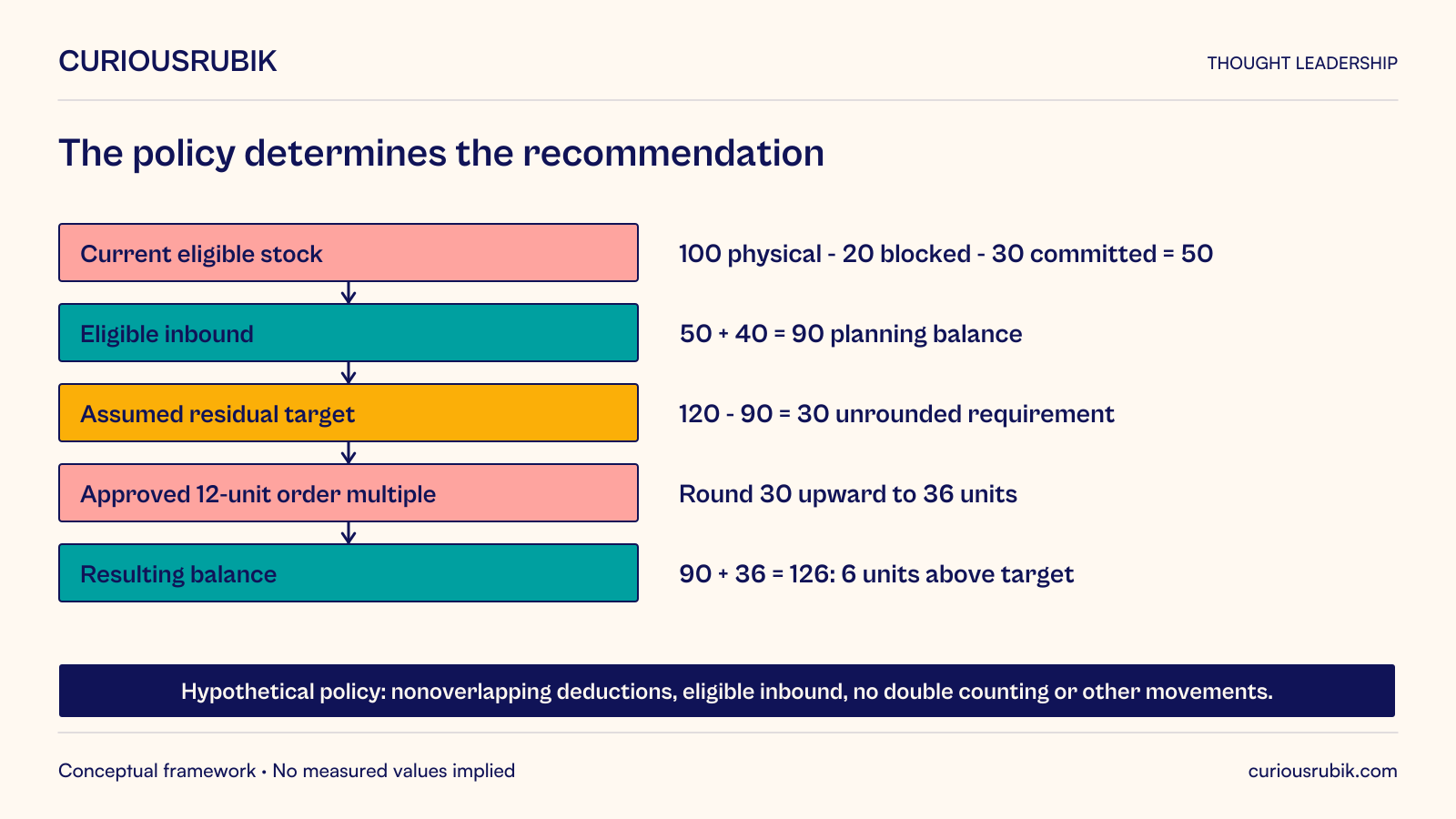
A replenishment system recommends thirty units. The supplier ships only in multiples of twelve. Rounding the recommendation to thirty-six is easy; deciding whether those six additional units are acceptable requires a policy.
That small example captures the role of automation. Software can apply a replenishment policy consistently across many item-location combinations, but it cannot make undefined assumptions about usable stock, incoming supply, demand or supplier constraints disappear. A faster calculation can simply repeat those assumptions more often.
The important design work is to make the policy explicit, maintain the inputs it depends on and identify the conditions under which its result needs investigation. The purchasing action is the end of that reasoning, not the whole replenishment problem.
Physical on-hand quantity is only one input. Replenishment may also depend on stock restrictions, commitments, backorders, open supply and the dates on which that supply becomes usable.
Define these categories so that the same demand or supply is not counted twice. An order allocated to a customer should not appear again as an unrelated uncovered demand if the model has already deducted it. An incoming purchase should not be counted both as an open order and as a receipt after the goods arrive.
MIT’s 2006 Logistics Systems lecture on inventory management in practice distinguishes review frequency, the decision to order and order quantity. It also highlights inventory-position inputs and practical questions about when an order counts as incoming supply. The teaching material supports examining these assumptions; it does not prescribe one model for every business. MIT OpenCourseWare, Inventory Management and Optimization in Practice.
Document which system owns each input and how quickly relevant changes reach the calculation. A stock hold, cancelled customer commitment or delayed supplier delivery can alter the answer without changing the headline on-hand balance.
Treat uncertain open orders carefully. If a purchase was transmitted but its outcome is unclear, removing it from the calculation and immediately ordering again can create duplication. Resolve or explicitly represent the uncertainty instead of forcing it into either confirmed supply or zero supply without evidence.
Consider a hypothetical, deliberately simplified order-up-to policy for one item at one location. There are 100 units physically on hand, of which 20 are blocked and 30 are already committed. That leaves 50 usable, uncommitted units. Assume these categories do not overlap.
A further 40 units of confirmed incoming supply are due within the policy’s relevant window, producing 90 units in this simplified planning view. The assumed policy calls for 120 units of coverage after honoring the existing commitments. Those commitments are not counted again in the residual demand represented by the target.
The unrounded replenishment recommendation is therefore 30 units: 120 minus 90. If the approved policy allows rounding upward to a supplier pack multiple of twelve, the order quantity becomes 36. The resulting planning balance is 126, six above the target.
The example does not establish that 120 is an optimal target or that upward rounding is always correct. The target is an input assumed to have been set through the organization’s demand, review-period, lead-time and uncertainty analysis. No other movements are included, and the example is not a general inventory-position formula.
The six extra units may be acceptable, or they may breach storage, shelf-life, cash or other constraints. The system should expose the effect and apply the organization’s rule rather than hide it inside a rounding function.
A daily calculation and a weekly calculation can require different coverage assumptions. The business needs to account for the time until it can next review and act, as well as the time required for replenishment to become usable.
Supplier calendars matter. A request submitted just after a weekly dispatch cutoff can face a longer effective wait than the same request submitted before it. Receiving hours and inspection or acceptance steps can also affect when the stock is available to the operation.
Do not use one static lead-time field without understanding what it measures. Order preparation, supplier confirmation, production, transport and receiving can contribute differently to elapsed time. Historical averages may conceal variability that matters for the service commitment.
Choose review frequency according to the item and process. A rapidly changing critical item may justify closer attention than a slow-moving item with a stable supply path. More frequent calculation has limited value if source transactions arrive only in a delayed batch or nobody can act on the result.
When the calendar or lead-time assumptions change, revisit the policy. Otherwise, the system can apply yesterday’s correct calculation to a different operating environment.
Pack multiples are only one constraint. Minimum order quantities, combined-order requirements, supplier capacity, storage limits and product life can all affect the proposed replenishment.
Make the order of rules explicit. A minimum quantity followed by rounding can produce a different result from a rule that evaluates the constraints together. The intended method should be understandable to the policy owner and covered by test examples.
Avoid treating a mathematically feasible quantity as commercially or operationally available. The supplier may not be able to confirm the required date, or the receiving location may lack capacity during the proposed window.
Some situations call for a different response: a transfer from another location, a reviewed substitute, a changed customer commitment or an exception for human planning. Those options need their own authority and evidence; the replenishment engine should not invent them from a generic stock shortage.
Consider interactions across items and locations. Optimizing each item independently may ignore shared transport, storage or production constraints. The scope of the model should match the decision it is expected to support.
A clear exception is often more useful than a confident order recommendation produced by silently ignoring a constraint.
The target and trigger depend on assumptions about demand and supply. Assign owners who can review those assumptions and explain why the current policy remains appropriate.
Distinguish observed sales from unconstrained demand. Stockouts, substitutions and lost opportunities can affect what the history shows. A model trained only on completed sales may learn a low-demand pattern caused partly by unavailable stock.
Treat promotions, product introductions and end-of-life conditions explicitly where they matter. A stable replenishment rule may be unsuitable for a short selling window or a product being withdrawn.
Record policy versions and the evidence used to change them. A planner reviewing an unusual order should be able to see the relevant target, input state and constraint adjustments, not merely the final quantity.
Do not let frequent manual overrides become an invisible second policy. Capture their reasons and review recurring patterns. Some overrides reveal poor data or unsuitable parameters; others reflect legitimate information that the formal model does not yet represent.
The response should improve the policy or its exception process rather than simply instruct planners to trust the automation more.
Before allowing routine recommendations to drive purchasing, evaluate representative historical and constructed cases in an authorized test environment. Include ordinary demand and the exceptions the operation actually encounters.
Useful tests include a stock hold, a partially received purchase, an overdue order with uncertain status, a cancelled customer commitment, a changed pack multiple and a missed supplier cutoff. The expected outcome should come from the agreed policy and independently checked inputs.
Compare the full result, not only whether an order was generated. Did the recommendation duplicate an existing commitment? Did it account for incoming stock at the right time? Did rounding create an unacceptable excess? Did the system identify an infeasible case rather than suppress the problem?
Use a bounded pilot and retain visibility into adjustments. A recommendation-only phase can help expose policy issues, but reviewers need enough time and information to evaluate the outputs meaningfully.
Do not infer success from a quiet exception queue alone. The queue may be quiet because the policy handles the work well, or because failures are not being detected. Check outcomes and representative records independently.
A replenishment system can reduce planner effort while increasing excess stock, or reduce stock while increasing shortages. Evaluate the tradeoff against the service objective the business actually chose.
Track relevant outcomes such as availability, unresolved demand, inventory exposure, emergency actions and planner intervention. Define each measure and its population consistently. Different service measures answer different questions and should not be exchanged casually.
Review performance by meaningful item and supply segments. An overall average can conceal a group whose demand or lead-time pattern does not fit the policy. Changes in the product mix can also make before-and-after comparisons misleading.
Keep the operating cost of the automation visible: data maintenance, parameter review, exception handling and integration support. Removing a manual spreadsheet does not eliminate the responsibility to maintain the replenishment decision.
Automation earns its place when it applies a sound policy reliably and makes exceptions easier to understand. The organization still owns the target, the meaning of the stock position and the consequences of ordering. Making those choices explicit is what turns a fast recommendation into a dependable replenishment process.