The invoice can travel electronically, but the customer still cannot approve it. The purchase-order reference is missing, the service location is unclear and the salesperson has to reconstruct the details after month end. A faster delivery route has brought the same incomplete request to the buyer sooner.
InvoiceNow preparation is an opportunity to fix one of these operating problems. The useful starting point is a specific buyer-supplier flow and the reason invoices get stuck there. Choose a pilot that can demonstrate a better commercial handoff, while the responsible specialists separately establish the business's actual compliance obligations.
The GST InvoiceNow Requirement is phased. IRAS states that businesses applying for voluntary GST registration on or after 1 April 2026 are in scope, while remaining existing GST-registered businesses that are not already in scope enter later phases under specified total-supplies bands. Those bands use the prescribed accounting periods ending in calendar year 2025, not simply today's revenue. Exclusions include overseas entities and businesses liable to register wholly because of reverse charge.
Have the tax owner confirm the applicable phase, exclusions and requirements for the actual entity using current guidance and any relevant IRAS notification. Do not borrow another company's date. A voluntary process pilot must not delay an obligation already applying to the business.
Keep the two questions distinct: “What must we do and by when?” and “Which business problem should we improve first?” The compliance workstream needs its full required scope. The operating pilot can be deliberately narrow so that its result is understandable.
Ask the billing team and the buyer's receiving team to describe the last few invoices that needed clarification. Where did the work stop? What fact was missing? Who eventually supplied it?
The bottleneck might be a customer reference, an agreed billing milestone, an incorrect legal entity or evidence of service completion. Some delays concern a real commercial disagreement rather than missing data. Sending the same invoice through a different channel will not resolve that disagreement.
Draw a short sequence from the event that permits billing to the buyer's ability to assess the invoice. Avoid beginning the map at “invoice created” if the missing information should have been established when the order was accepted.
For each pause, record the cause and its owner. “Customer delay” is too broad if your own team omitted the purchase-order reference. Equally, do not promise that improving invoice information will remove the customer's internal approval cycle or change contractual payment terms.
Imagine a hypothetical Singapore service business considering three pilots.
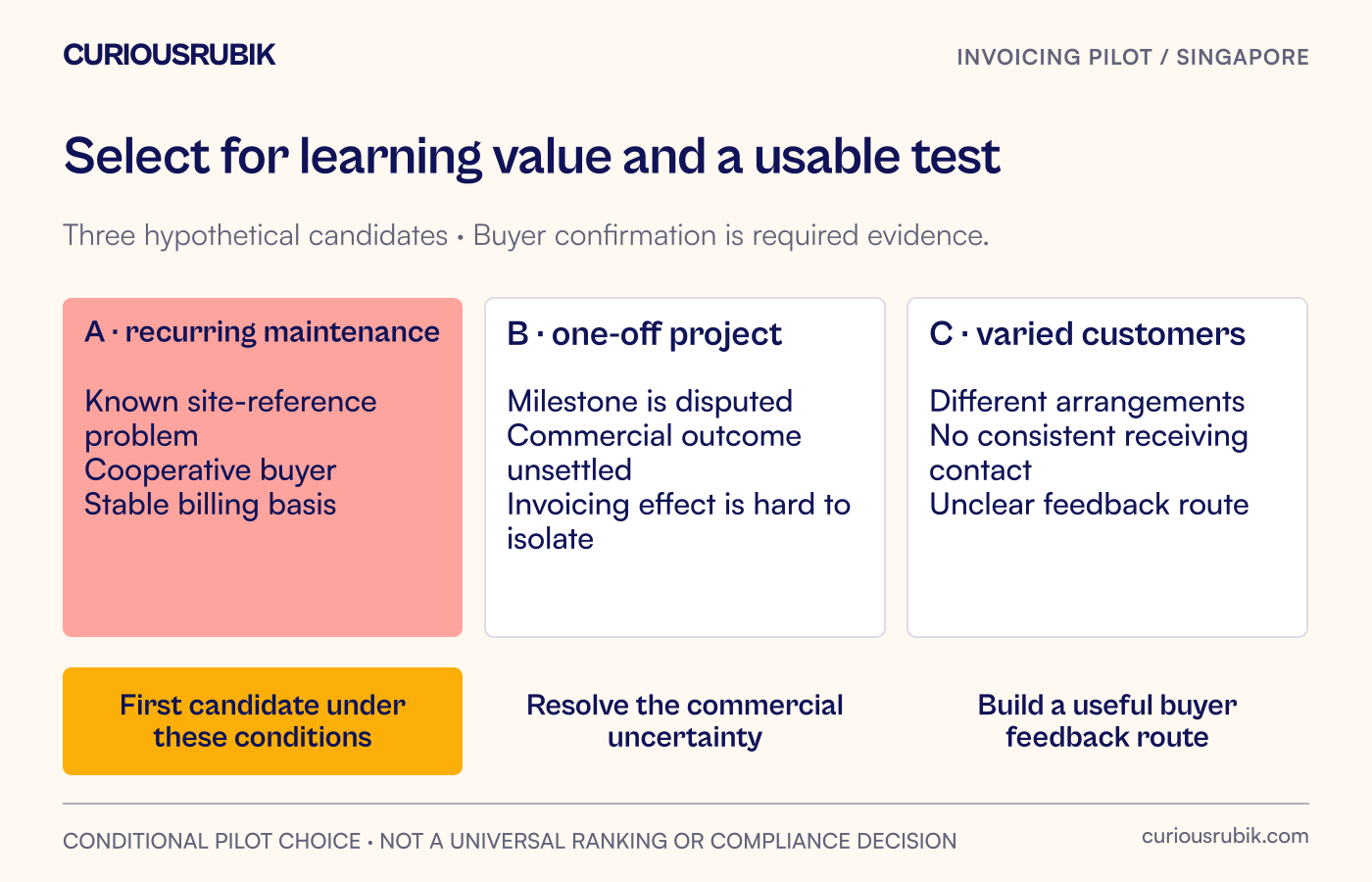
Flow A: recurring maintenance for one cooperative buyer. Invoices are frequent enough to observe, the billing basis is stable and the buyer can identify the reference it needs. Several recent queries concern service-location codes that the seller already knows but does not pass reliably to billing.
Flow B: a large, one-off project. The invoice value is high, but the parties are still negotiating whether a milestone has been achieved. There may be a valuable process review to do, but the pilot would struggle to separate improved invoicing from resolution of the commercial dispute.
Flow C: many low-value customers with varied arrangements. The volume looks attractive, but the business has no consistent receiving contact or agreed way to learn why invoices are queried. A broad launch could create many different problems without a useful comparison.
Flow A is a reasonable first candidate under these invented conditions. Its advantage is the ability to test a specific hypothesis: capturing the correct site reference before billing should reduce avoidable clarification in that flow. It is not selected merely because it is easy or because its invoices are the largest.
CURIOUSRUBIK INVOICING PILOT / SINGAPORE Select for learning value and a usable test Three hypothetical candidates · Buyer confirmation is required evidence. A · recurring maintenance Known site-reference problem Cooperative buyer Stable billing basis First candidate under these conditions B · one-off project Milestone is disputed Commercial outcome unsettled Invoicing effect is hard to isolate Resolve the commercial uncertainty C · varied customers Different arrangements No consistent receiving contact Unclear feedback route Build a useful buyer feedback route CONDITIONAL PILOT CHOICE · NOT A UNIVERSAL RANKING OR COMPLIANCE DECISION curiousrubik.com
The pilot card should be short enough to use in a meeting. It identifies the selected entity and invoice family, buyer contact, current problem, proposed change, baseline, owners and the decision the pilot will support.
For Flow A, the proposed change is to capture and verify the buyer's site reference at the order or service-agreement handoff, carry it into billing and let the buyer confirm that it is usable. The account owner obtains the reference; operations confirms its connection to the completed service; billing checks the agreed information before issuing the invoice.
Define what would show the hypothesis is wrong. If complete site references reach the buyer but the same queries continue because the service evidence is missing, the pilot has found a different constraint. That is useful learning. It should not be hidden by reporting only successful electronic delivery.
Agree how exceptions are handled. A new site without a confirmed reference needs a named commercial owner and a timely decision about billing. A mandatory field filled with “TBC” creates the appearance of readiness while preserving the original problem.
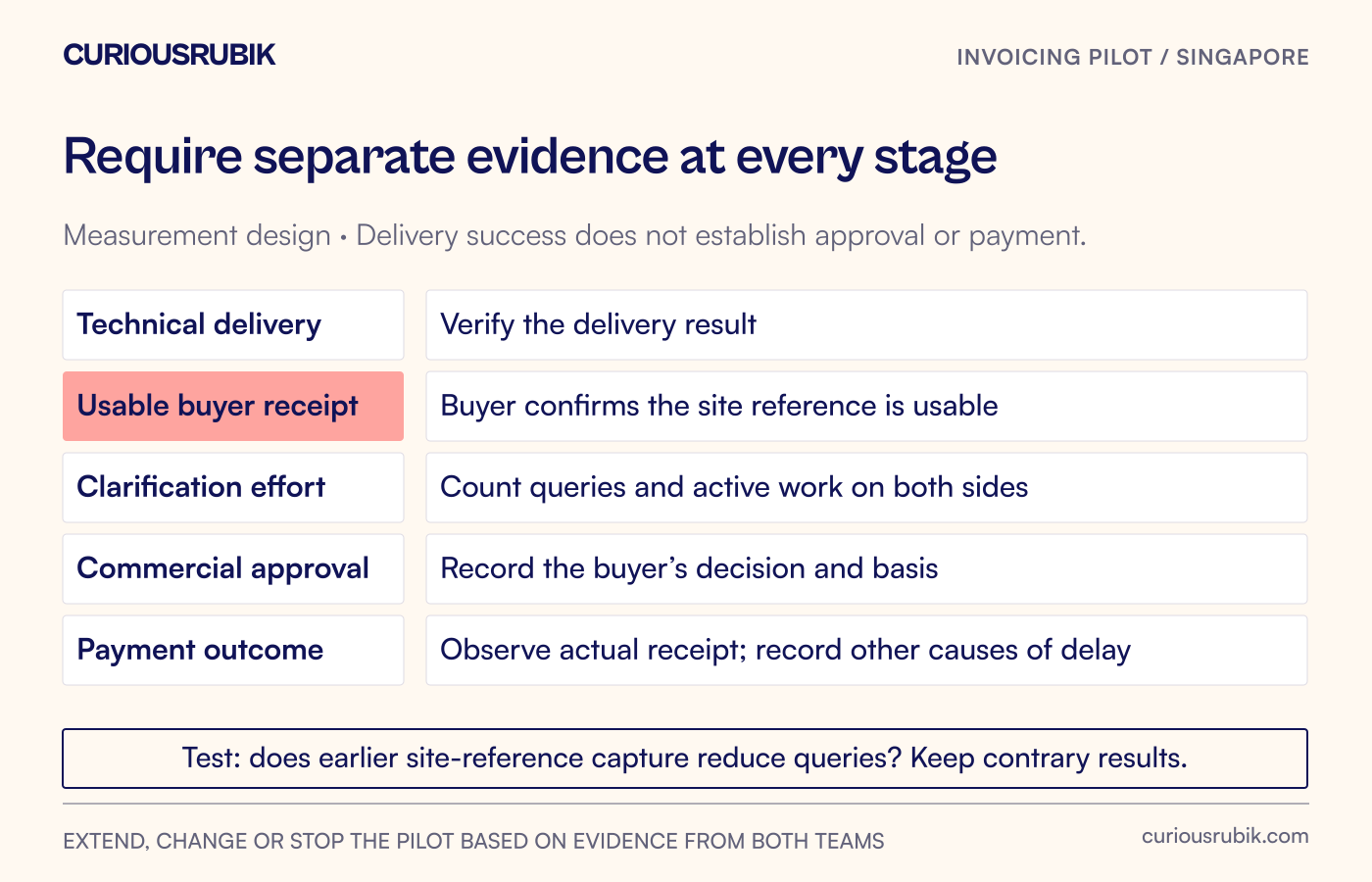
Network delivery, invoice-data transmission to IRAS, commercial acceptance and payment are different outcomes. Track the ones relevant to the pilot separately. The technology team can verify the delivery route; the business owner must establish whether the buyer can use the invoice for its intended process.
A useful small baseline records invoices needing clarification, the reason, elapsed time until the missing information is supplied and active work by both teams. Keep unpaid invoices visible rather than measuring only the easy cases that finish quickly.
After the change, compare similar invoices and explain differences in mix. A quieter month or a different buyer approver can affect the result. If the sample is small, describe what happened without presenting it as a reliable forecast for every customer.
Payment timing may improve, remain unchanged or worsen for unrelated reasons. Do not claim a cash benefit simply because a reference field is complete. Show whether the identified source of delay actually changed, then assess any wider effect with appropriate evidence.
CURIOUSRUBIK INVOICING PILOT / SINGAPORE Require separate evidence at every stage Measurement design · Delivery success does not establish approval or payment. Technical delivery Verify the delivery result Usable buyer receipt Buyer confirms the site reference is usable Clarification effort Count queries and active work on both sides Commercial approval Record the buyer’s decision and basis Payment outcome Observe actual receipt; record other causes of delay Test: does earlier site-reference capture reduce queries? Keep contrary results. EXTEND, CHANGE OR STOP THE PILOT BASED ON EVIDENCE FROM BOTH TEAMS curiousrubik.com
At the end of the pilot, ask the buyer contact to explain whether the revised information helped and what still caused work. The sender's internal report alone cannot answer this.
The process owner should choose among extending the same design, changing it or stopping that pilot approach. Extension requires evidence that the next customer or invoice family shares the relevant conditions. A different reference convention or acceptance requirement may need a different handoff.
Document the work that remains. A pilot can demonstrate the site-reference improvement while technical, tax or broader rollout tasks are still open. Calling the business experiment successful must not automatically mark the entire compliance programme complete.
Assign ownership for maintaining the agreed references and handling changes after the pilot team moves on. A clean first month can decay if new sites are added through an informal email route that bypasses the improved handoff.
A useful first meeting needs billing, the commercial owner, operations and someone who understands the buyer's receiving process. Bring several actual delayed cases through an authorised, appropriately protected review. Ask which missing fact could have been established earlier and who had the ability to establish it.
Select one flow, state the change and agree how a result will be judged. That turns InvoiceNow preparation into an operating improvement with evidence, rather than a promise that electronic transmission alone will make every invoice easier to approve or pay.