A system can pass technical tests and still be unsuitable for the work people must perform. The screens respond, the interfaces return valid messages and the configured rules behave as specified, but a user cannot complete a realistic task without extra access, missing information or an undocumented workaround.
User acceptance testing asks whether the implemented process is acceptable for its intended business use. Technical specialists help create environments, diagnose defects and verify corrections. Business owners must define the operating conditions, evaluate the consequences and decide whether the evidence supports acceptance within their authority.
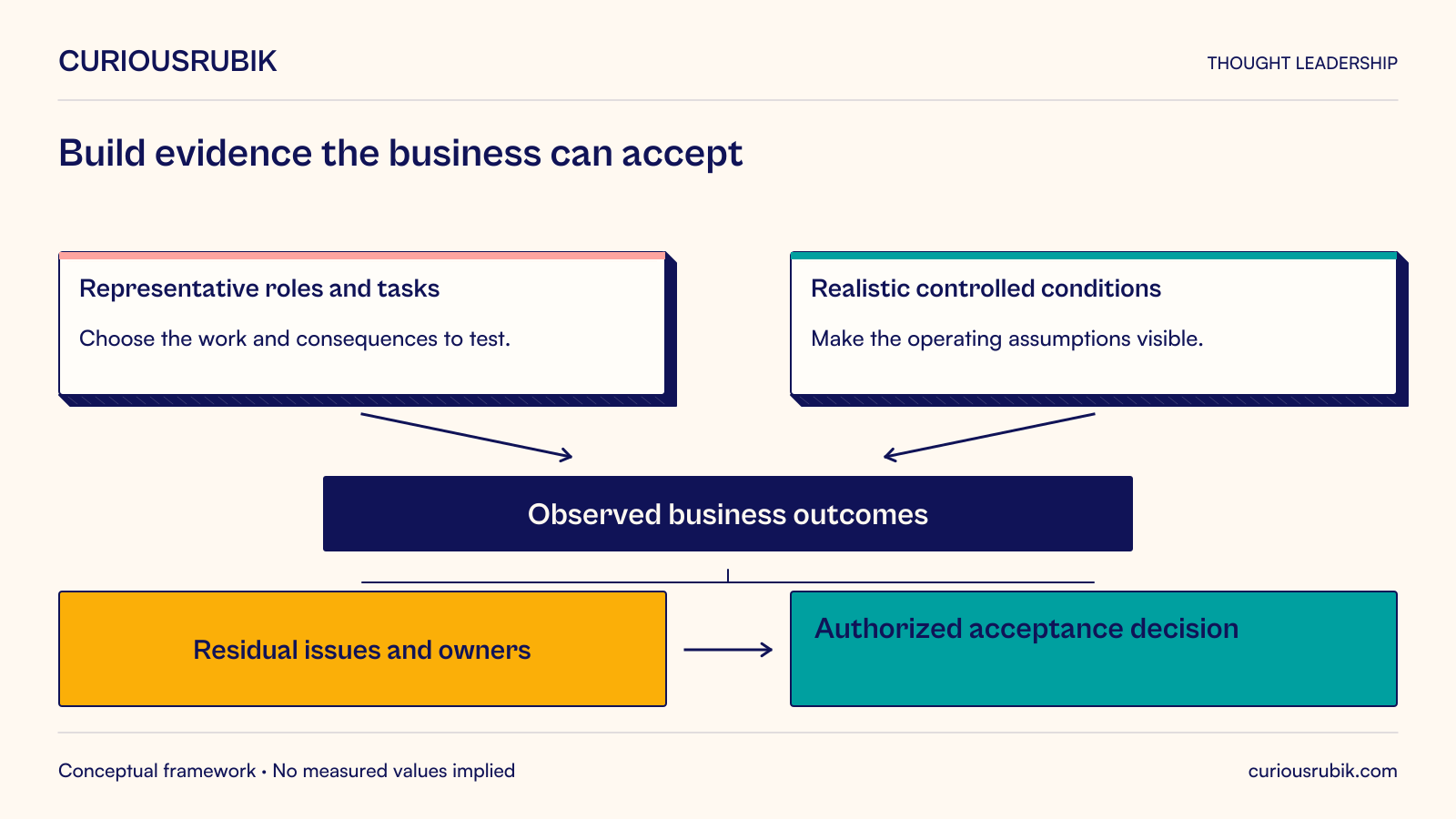
For a sponsor, the important distinction is between asking users to execute a script and giving the business a credible basis for a release decision. The latter requires representative tasks, appropriate participants, realistic conditions and an explicit treatment of unresolved issues.
Start with the business outcomes and critical scenarios the release must support. Identify the users, permissions, data, dependencies and conditions involved. Include work that crosses departments rather than testing each screen in isolation.
Agree what evidence would establish success. A task may need a correct operational result, an appropriate approval record, a reconciled downstream state and a usable recovery route. A screenshot of a completed form may prove only one part of that outcome.
Distinguish acceptance from training. A trained user may learn to follow the intended route, while acceptance testing should also expose whether the route works under representative conditions and whether the system handles predictable mistakes or exceptions. Training feedback is valuable, but attendance and confidence are not substitutes for observed results.
NASA’s 2016 Systems Engineering Handbook distinguishes product verification against specified requirements from validation in relation to intended use and stakeholder expectations. Its systems-engineering context differs from enterprise software, but the distinction explains why technical conformance alone cannot establish business acceptance. NASA Systems Engineering Handbook, sections 5.3–5.4.
Include users with different relevant roles and levels of experience. Expert champions can provide valuable insight, but may navigate around problems that ordinary or occasional users will encounter. Supervisors, downstream recipients and support staff may see consequences that the initiating user does not.
Give participants time to prepare and test without pretending their normal workload disappears. Business capacity is part of the test plan. A short window staffed by distracted volunteers can produce a signed document without meaningful coverage.
Use appropriate accounts and permissions. Testing every scenario with an administrator account can conceal missing permissions, excessive access or duties that should be separated under the organization’s policy. Verify both allowed and prohibited actions for the relevant roles.
Make decision authority explicit. A tester can report what happened; the accountable business owner decides whether a deviation is acceptable, requires correction or changes the release decision. Specialist obligations remain with the relevant finance, security, legal or operational authorities.
Use representative task narratives rather than instructions that simply reproduce the configuration team’s assumptions. State the starting condition, user objective, relevant data and expected business result. Let the test reveal whether the user can achieve that result through the intended process.
Include normal cases, boundary cases and recovery. Examples include a changed request, an unavailable dependency, a rejected approval, a duplicate submission or a record requiring correction. Select them because they matter to the operation, not because a generic test template includes them.
Preserve traceability to requirements and business decisions. When a test fails, the team should know whether the implementation violated an agreed rule, the rule was ambiguous or the scenario exposes a missing need. Those findings lead to different actions.
Avoid treating a long script count as coverage. Several similar happy-path tests may provide less assurance than one carefully designed cross-functional scenario with meaningful exceptions.
Build a small coverage map linking roles, task types and important data states. For the picking process, distinguish an ordinary order, a partially completed task, an interrupted connection and a correction requiring supervisor involvement. The map helps reveal combinations the test plan has overlooked. It does not require testing every mathematically possible combination; prioritize by consequence, frequency and uncertainty, and explain the limits.
Record why a scenario was included or deferred. When time is constrained, the business owner can then see which evidence is being sacrificed rather than approving an unexplained reduction in test count. Revisit that choice when a defect suggests that an apparently ordinary variation has broader consequences.
Consider a hypothetical wholesaler introducing a handheld picking application. The example is illustrative and assumes a controlled test environment, not experimentation on live customer orders. The configuration team demonstrates a clean sequence on a desk with a stable network and an administrator account.
Business testers then run representative picking tasks in a safe staging area using the intended devices and ordinary warehouse permissions. They include realistic label positions, interruptions and the network conditions the operating team expects to encounter. Any physical conditions used in testing must follow the site’s safety procedures.
The users find that a scan can appear unconfirmed during a connection interruption. Some naturally scan again. After connectivity returns, the system’s displayed task state is difficult to interpret, and the worker cannot tell whether the action was recorded once or remains pending. The demonstration had shown that the scan function worked; the acceptance test reveals uncertainty in the operating workflow.
The business owner does not need to prescribe the technical duplicate-handling design. They define the required operational result: the worker must be able to understand the confirmed quantity and pending state, avoid unintended repeat effects and obtain help for an unresolved exception. Technical staff propose and test the appropriate implementation.
The corrected scenario is rerun with representative users and permissions, including the interruption and recovery. The test also checks the downstream stock and task records, rather than relying solely on the handheld message. Acceptance evidence now addresses how the process behaves under the conditions that caused confusion.
The finding does not prove that every warehouse or device condition has been covered. The team records remaining limits and decides whether further testing is needed before release.
A test result is only as relevant as the conditions under which it was obtained. Record the application version, configuration, interfaces, permissions and data population used. Identify differences from the planned production environment.
Use data that exercises the important rules and relationships. Artificially clean records can conceal the variations migration and operations will introduce. Where real data would create privacy or access concerns, use appropriately protected or representative test data under the organization’s controls.
Make external dependencies visible. If an interface is simulated, state what the simulation demonstrates and what remains unverified against the real service. A mock that always returns success cannot establish recovery behavior when the actual dependency rejects or delays a request.
Control changes during the test window. If configuration changes after a scenario passes, identify which evidence may no longer apply. Retest affected behavior rather than assuming the earlier pass remains valid for a different version.
Describe the observed result, expected result, evidence and conditions needed to reproduce the issue. Include the affected business outcome and the consequence of leaving it unresolved. A technical severity label alone may not capture an operationally important failure.
Separate defects from usability concerns, missing requirements and training needs without using the categories to dismiss them. A problem classified as training can still prevent safe operation if the planned training is inadequate. A low-frequency exception can be material if recovery is costly or the outcome is consequential.
Agree who can accept residual issues and under what conditions. A temporary workaround needs an owner, instructions, capacity and a review or retirement date. It should not rely on an unavailable expert or a control that exists only in an informal conversation.
Do not let a deadline turn unresolved evidence into an automatic pass. If the release cannot meet a required obligation, the appropriate decision may be to correct, narrow or postpone it. The business owner should understand the remaining exposure rather than receiving a report that averages serious failures into an overall success percentage.
The acceptance record should identify the tested scope and version, scenario coverage, results, unresolved issues, approved limitations and responsible owners. It should distinguish what was observed from what remains assumed.
A signoff is not a claim that no defect can ever occur. It is an authorized decision that the available evidence supports the defined use under stated conditions. The authority making that decision must be appropriate to the consequences involved.
Connect acceptance to operational readiness. Users need the correct access, support route, instructions and ownership after the test team disbands. A process that works only because project specialists are standing beside every user is not yet a dependable operating model.
User acceptance testing becomes valuable when it gives the business a truthful view of the release it is about to own. Start with a few consequential tasks, the people who perform them and the conditions most likely to expose a gap. The resulting evidence will support a better decision than a large collection of scripts marked complete without understanding what the users actually proved.