AI can create measurable value in finance when it reduces the effort of interpreting unstructured information, preparing reviewable work, or identifying cases that deserve investigation. The benefit must survive verification, correction, control, and ongoing maintenance. Faster generation of a financial narrative is useful only if the final analysis remains accurate and supported.
For a controller evaluating AI-assisted variance analysis, the investment decision is whether language assistance improves the review process beyond what dependable calculations, better data access, and clearer templates already provide. The model should not become the authoritative calculator or invent a business cause because a variance requires an explanation.
This article develops a measurement approach using a hypothetical departmental expense review. It concerns internal operating analysis, not investment advice or a determination of accounting treatment. Accounting policy, materiality, required review, and any resulting entries remain with the organization’s qualified finance owners.
Break the process into data retrieval, calculation, prioritization, evidence collection, interpretation, drafting, review, and authorized action. Different steps benefit from different tools. Exact arithmetic and reconciliation against a defined ledger population usually call for controlled calculations rather than free-form model generation.
AI may be useful where the work includes varied descriptions or documents. It might summarize an approved manager explanation, identify a relevant purchase-order note, or prepare a draft that distinguishes known facts from questions still requiring investigation. Each proposed use needs a testable output.
Compare with a credible simpler alternative. A standard variance report with direct links to transactions may solve much of the problem. The incremental AI case begins after that baseline, rather than claiming all benefit from improvements that do not require a model.
Keep the action boundary visible. Preparing a variance explanation does not authorize a journal entry, a forecast change, or a message to an external party. If the project later proposes those capabilities, evaluate them separately with the necessary professional review and controls.
A useful variance packet identifies the account or cost center, period, comparison basis, amount, relevant source records, supported explanation, and unresolved questions. It should say whether the explanation describes a confirmed cause, a plausible hypothesis, or a manager’s statement that still needs corroboration.
Agree on the comparison basis before measuring performance. Actual versus budget, actual versus prior year, and actual versus latest forecast answer different questions. Changes in organizational structure, account mapping, or period boundaries can alter the population even when the displayed labels look similar.
Use versioned source data. A packet prepared before late adjustments may no longer match the final period. The workflow should show its data version and determine whether material changes require a refresh. A polished narrative attached to outdated totals is not an accepted outcome.
Define who can accept the packet and what they check. Review may require validating the arithmetic, inspecting supporting transactions, challenging causal claims, and identifying any separate follow-up. Measuring only whether the draft follows a template misses the finance judgment involved.
Imagine a hypothetical distributor reviewing departmental expenses. A maintenance cost center shows actual expense of USD 18,000 against a budget of USD 12,000 for the month. Under the stated comparison, the unfavorable difference is USD 6,000. These amounts are teaching inputs, not a real company’s records.
A language assistant sees descriptions containing “service” and drafts an explanation attributing the increase to higher supplier prices. The wording is plausible, but the transaction evidence shows a different story: two service periods were posted in the current month, and the underlying unit prices did not change in the selected records.
The useful assistant would present the timing pattern as supported evidence and avoid asserting a general price increase. If the available documents cannot establish whether the posting is appropriate, the packet should raise that question for the controller. It should not invent an adjustment or silently recalculate the period under an assumed accounting policy.
Now suppose a department manager adds that equipment usage increased. That statement may explain part of the underlying activity, but it does not by itself explain why two periods appear in one month. The packet should retain both the transaction evidence and the manager’s explanation, with their distinct status.
The controller’s decision is whether the packet accurately explains the variance and identifies the necessary next investigation. The AI’s contribution is organizing relevant evidence and drafting a reviewable account. Its fluency is not evidence that the causal explanation is true.
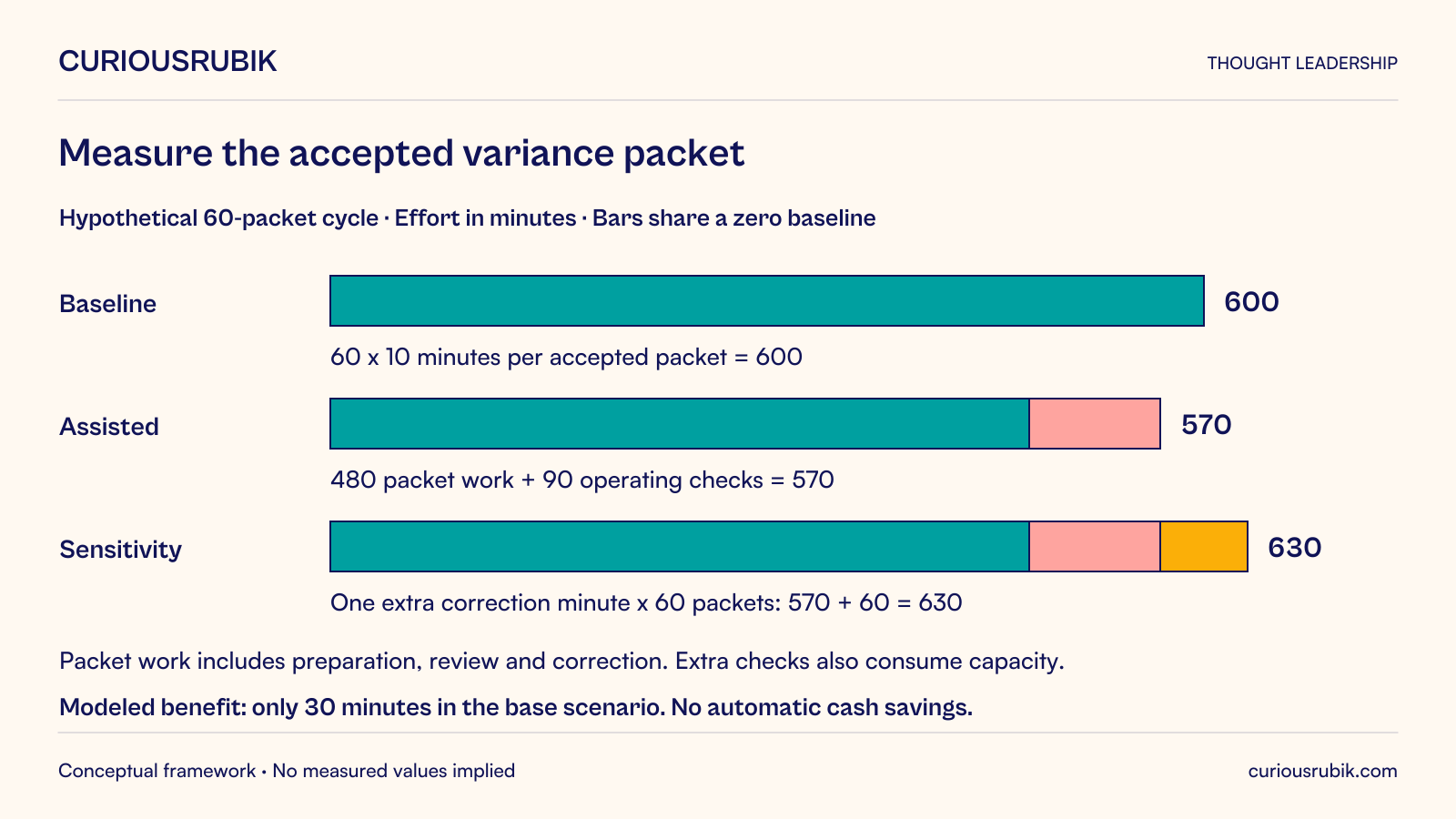
Suppose a hypothetical review cycle contains 60 comparable variance packets. The current process takes ten minutes per accepted packet, for 600 minutes or ten hours. The proposed assisted process uses three minutes of preparation, four minutes of review, and one minute of correction per packet: eight minutes each, or 480 minutes.
The apparent difference is two hours. But the proposed process also requires 90 minutes per cycle for evaluation, source maintenance, and operational checks. Total modeled effort is therefore 570 minutes, or nine and a half hours. The net modeled capacity improvement is 30 minutes per cycle.
These figures are illustrative assumptions. They are not a benchmark or a prediction. The example shows why a drafting-time reduction can translate into a much smaller complete-process benefit. If correction takes two minutes rather than one, the assisted total becomes 630 minutes and exceeds the baseline.
Capacity is also not automatically cash. A half-hour freed across several reviewers may improve responsiveness without changing expenditure. A cash-saving claim needs an identifiable change such as avoidable overtime or a service cost that can actually be removed, together with its own evidence.
Assess whether each material statement is supported by the cited record. A source link can be correct while the interpretation is wrong. In the example, an invoice description supports the existence of a service charge but does not prove a supplier-wide price increase.
Track unsupported explanations, omitted material drivers, incorrect period references, and unresolved questions presented as facts. These measures should use agreed review definitions. A simple approval rate can conceal weak review or pressure to finish the close process quickly.
NIST’s explainable-AI principles distinguish explanation accuracy from an explanation merely being understandable. Applied to variance analysis, a readable narrative must still faithfully represent the evidence and its limits. NISTIR 8312, Section 2
Evaluate the full packet rather than isolated sentences. The narrative may be individually plausible but omit the one transaction that changes the conclusion. Include difficult cases such as mixed causes, reclassifications, missing documents, changed mappings, and comparative periods with different activity.
Select a representative set of review tasks and establish the accepted outcomes independently. Compare assisted and unassisted work under similar conditions, including comparable source access and reviewer experience. Otherwise, an apparent benefit may come from better data preparation rather than AI assistance.
Avoid testing only clean, well-documented variances. The costly work may be concentrated in ambiguous cases. Report performance by relevant complexity group and show which cases remain outside the intended use. A narrow successful scope can be worthwhile without supporting an enterprise-wide productivity claim.
Record time consistently. Include time spent opening sources, correcting unsupported statements, escalating questions, and repairing failed runs. If reviewers perform hidden verification outside the measured tool, the resulting estimate understates effort.
Use multiple cycles when the process varies materially over time. A routine month may differ from a year-end period or a major organizational change. The pilot should state its observation limits and avoid extrapolating a short test to every finance condition.
Use the minimum financial and personal information needed for the task. Review access, provider handling, retention, and approved processing arrangements before exposing sensitive records. A tool being convenient does not establish permission to use it with every ledger attachment or manager note.
Carry source identity and access controls into retrieval. A reviewer should see only records they are authorized to inspect. The assistant should not combine confidential information from another entity or department merely because it would make a narrative more complete.
Protect the approved calculation path. The model can describe or question a result, but changes to source data, formulas, mappings, and accounting treatment should follow the responsible owners’ procedures. Keep generated text distinct from authoritative amounts and decisions.
Plan correction after release. If a packet’s source data changes or an explanation proves unsupported, the organization needs to identify affected outputs and revise them through the accepted process. Retain enough version information to do that without keeping unnecessary sensitive prompt history.
Choose a bounded finance activity where language work is material, sources can be checked, and the accepted outcome is clear. Do not choose the highest-consequence decision simply because it attracts executive attention. A useful first scope may prepare evidence while leaving judgment and action with finance professionals.
Agree on the minimum quality conditions before reviewing time savings. A faster process that produces materially unsupported explanations is not an improvement. Once quality is acceptable, evaluate complete effort, capacity use, and any separately evidenced cash effect.
The controller’s next step is to time and inspect a sample of current variance packets, identify the language-heavy work, and compare assistance against a well-organized non-AI baseline. Invest where the accepted work becomes better or less costly after verification. That is a measurable finance case, rather than a promise based on how quickly a model fills a page.