The accounting provider has delivered the monthly pack. The bank reconciliation is attached, the schedules are neatly labelled and the profit figure is available for management's meeting. One balance still has no explanation, and two estimates rely on information the business never supplied.
Has the work been completed? That depends on what the company and provider agreed “completed” means. Outsourcing works better when preparation, review and approval have separate meanings, and unresolved questions stay attached to the pack until an accountable person decides what to do.
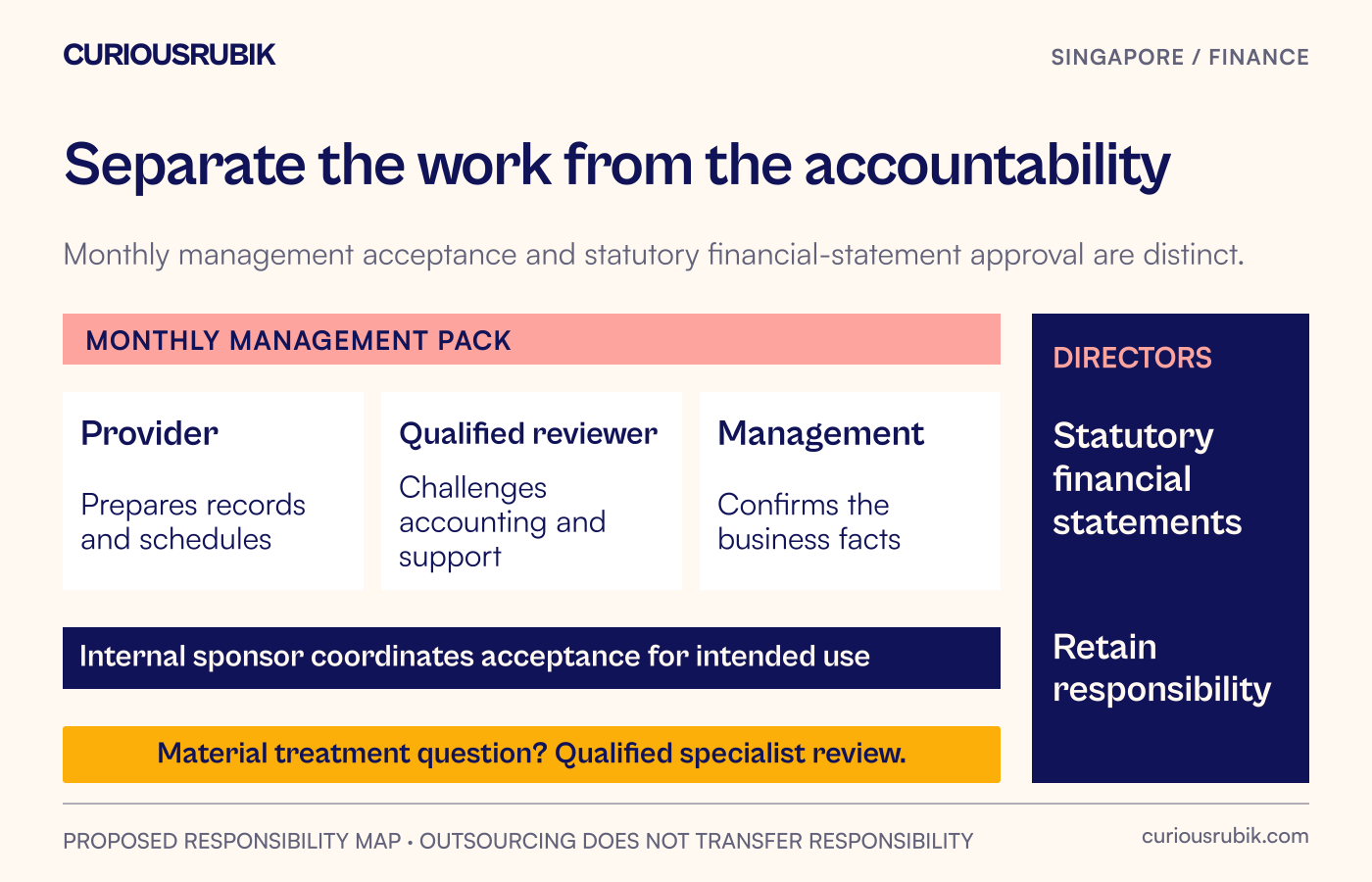
A monthly management pack, a set of bookkeeping records and statutory financial statements serve different purposes. Do not let one generic sign-off cover all three.
The monthly pack may support pricing, hiring or cash decisions. Its acceptance criteria should describe the information management needs, the basis of preparation and which unresolved items would make those decisions unreliable. Statutory financial statements require their own preparation and approval process under the applicable obligations and reporting framework.
In Singapore, ACRA makes clear that directors remain legally responsible for financial statements even when external help is used. Its small-company audit-exemption guidance also states that the exemption does not change financial-statement filing requirements. Neither outsourcing nor an audit exemption means that a complete-looking monthly pack can be accepted without an appropriate internal review.
These points establish the accountability boundary. The handoff method in this article is a recommended operating design, not a prescribed statutory checklist. A qualified accountant should determine the entity's reporting requirements and any material accounting treatment.
Prepare means compiling the agreed records, reconciliations and schedules, identifying assumptions and showing exceptions. It should not mean silently choosing an answer whenever management information is absent.
Review means checking the support and challenging the significant judgments within the reviewer's competence. A review of arithmetic and completeness is useful, but it is narrower than a review of estimates or accounting policy.
Decide means resolving a question that requires authority or business knowledge. Management may need to confirm whether a project is complete, whether a balance is recoverable or whether a commitment has changed. The provider can ask and advise; it cannot manufacture the missing fact.
Accept means that the named internal owner acknowledges the pack's agreed purpose, the completed checks and any remaining limitations. If the pack is accepted with an open item, record why that limitation is tolerable for its intended use, who must resolve it and by when.
Avoid asking the provider to tick “management approved” on management's behalf. Also avoid asking a director with no relevant technical support to make a complex accounting judgment merely to complete the workflow. The responsibility map should show where a qualified reviewer or specialist is required.
CURIOUSRUBIK SINGAPORE / FINANCE Separate the work from the accountability Monthly management acceptance and statutory financial-statement approval are distinct. MONTHLY MANAGEMENT PACK Provider Prepares records and schedules Qualified reviewer Challenges accounting and support Management Confirms the business facts Internal sponsor coordinates acceptance for intended use Material treatment question? Qualified specialist review. DIRECTORS Statutory financial statements Retain responsibility PROPOSED RESPONSIBILITY MAP · OUTSOURCING DOES NOT TRANSFER RESPONSIBILITY curiousrubik.com
A practical handoff can consist of the pack, an evidence index and a short unresolved-item list. Agree these deliverables before the reporting cycle begins.
For each major schedule, define the period, company entity, source records, reconciliation status and reviewer. A schedule labelled “bank reconciled” should identify the statement date and explain reconciling items, rather than merely showing that the opening and closing balances add up.
For each unresolved item, capture:
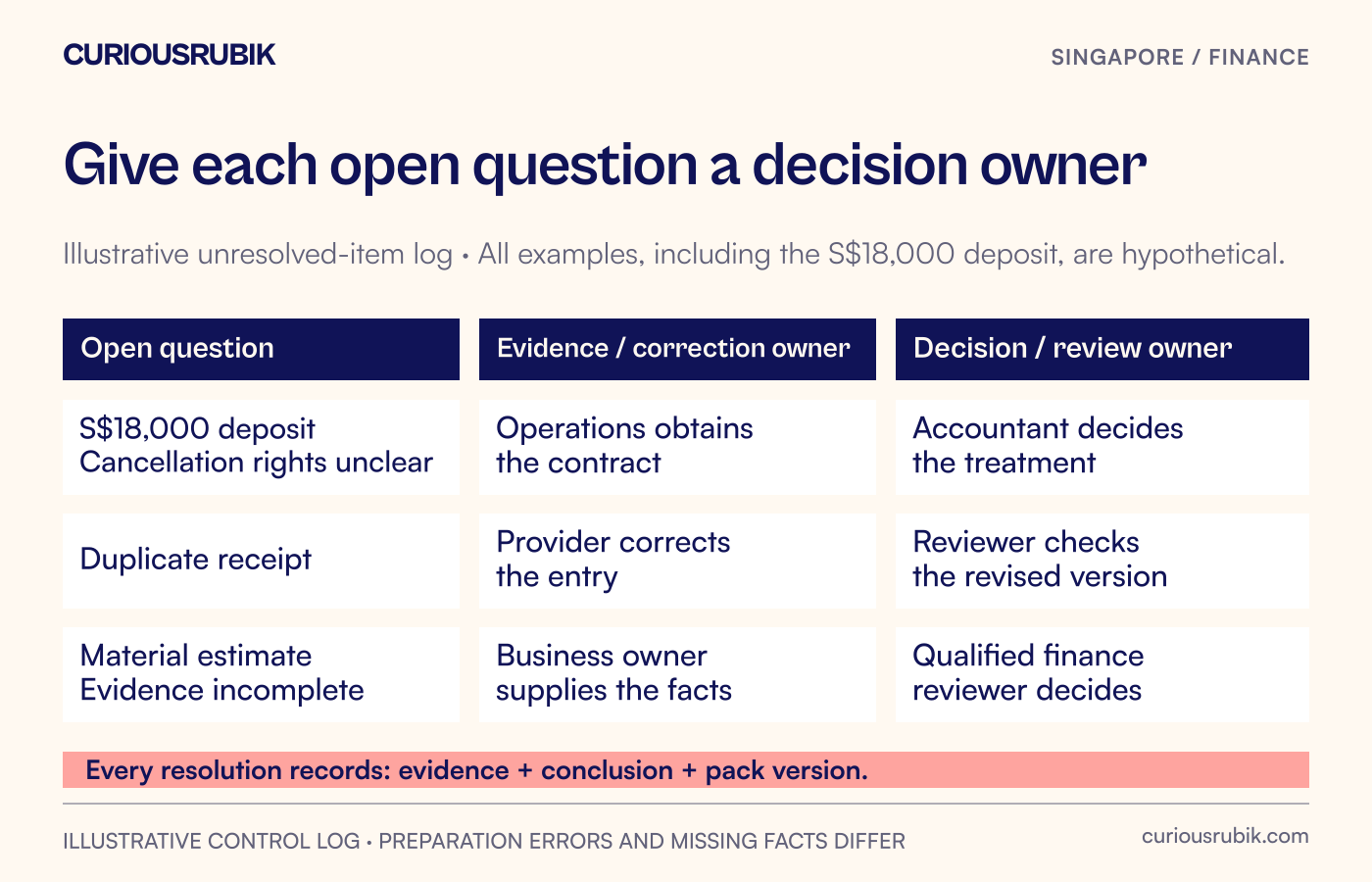
Separate preparation errors from missing company inputs. If the provider posted a receipt twice, the provider owns the correction. If the company has not explained whether a deposit is refundable, the internal owner supplies the commercial facts and finance assesses the accounting consequence. Blurring those categories often creates an unproductive argument about whose delay caused the close.
Consider a hypothetical S$18,000 balance recorded as a supplier deposit. The provider has the payment record but no current contract. Operations thinks the order was cancelled. The pack currently carries the deposit unchanged.
The unresolved-item list should ask a concrete question: what rights does the company retain following cancellation, and what evidence supports recovery or another treatment? The operations owner obtains the agreement and relevant correspondence. The accountant assesses the balance using the applicable policy and facts. Management then understands the effect before relying on the pack.
Now suppose the evidence arrives after the first pack is circulated. The provider should issue a controlled revision with a change summary. The internal sponsor confirms that the replacement reached the people who will use it. Leaving two equally named versions in circulation can undo an otherwise sound review.
A different issue may be a small reconciliation difference caused by a known timing item. The internal reviewer can decide whether the pack remains usable with a documented limitation, according to policy and materiality. The decision should identify the expected clearing event and review date. “Small amount” is not a sufficient explanation if the same issue keeps recurring or suggests a wider control failure.
CURIOUSRUBIK SINGAPORE / FINANCE Give each open question a decision owner Illustrative unresolved-item log · All examples, including the S$18,000 deposit, are hypothetical. Open question Evidence / correction owner Decision / review owner S$18,000 deposit Cancellation rights unclear Operations obtains the contract Accountant decides the treatment Duplicate receipt Provider corrects the entry Reviewer checks the revised version Material estimate Evidence incomplete Business owner supplies the facts Qualified finance reviewer decides Every resolution records: evidence + conclusion + pack version. ILLUSTRATIVE CONTROL LOG · PREPARATION ERRORS AND MISSING FACTS DIFFER curiousrubik.com
A small company cannot always build a large internal finance team around an outsourced provider. It can still make the review useful.
Start with balances and judgments that could change the decisions management is about to make. Compare material movements with the underlying business events. Ask why a balance has not moved when the related operation has changed. Examine repeated reconciling items and manual adjustments rather than only large absolute values.
The internal sponsor should be capable of understanding the pack and coordinating answers. They do not need to perform every technical calculation personally. Where the company lacks the necessary accounting expertise, arrange qualified review of the relevant areas instead of treating the provider's preparation as its own independent challenge.
Agree what happens during absence. An internal owner on leave should have a named delegate with access to the evidence and appropriate authority. An unread message should not trigger automatic acceptance because the contractual delivery date has passed.
Automation can compare the delivered pack with the agreed list of schedules, identify missing periods, check whether reconciliations have evidence links and route questions to their owners. It can remind the internal sponsor when an item is ageing or when a revised pack awaits acceptance.
Those checks establish readiness for review. They do not establish that the balances are correct. A fully populated schedule may still rest on an unsupported estimate or inappropriate classification.
Make the exception route specific. A missing sales report goes to the source owner. An unexplained journal goes to the preparer. A material policy question goes to the qualified reviewer. Escalate overdue items to the internal sponsor, who can decide whether more information, a revised timetable or specialist help is needed.
Retain the review evidence. A final status should show what was reviewed, the conclusion, the reviewer and the relevant version. An approval timestamp without a scope tells the next person very little.
Test the approach over a reporting cycle. Measure the elapsed time from provider delivery to usable management information, unresolved items carried forward, corrections after acceptance and repeated questions caused by missing company inputs.
Interpret the results with both sides. A provider may meet its preparation date consistently while the company takes too long to supply decisions. Alternatively, company inputs may arrive on time but the pack may need repeated correction. The point is to identify the actual handoff problem, not to assign all delay to the party holding the file last.
Before next month, take the current pack and write three short lists: evidence the provider must deliver, facts the company must confirm and judgments requiring a qualified reviewer. Name the person who will accept the completed pack for its intended purpose. That conversation makes the service easier to manage and the resulting numbers easier to rely on.