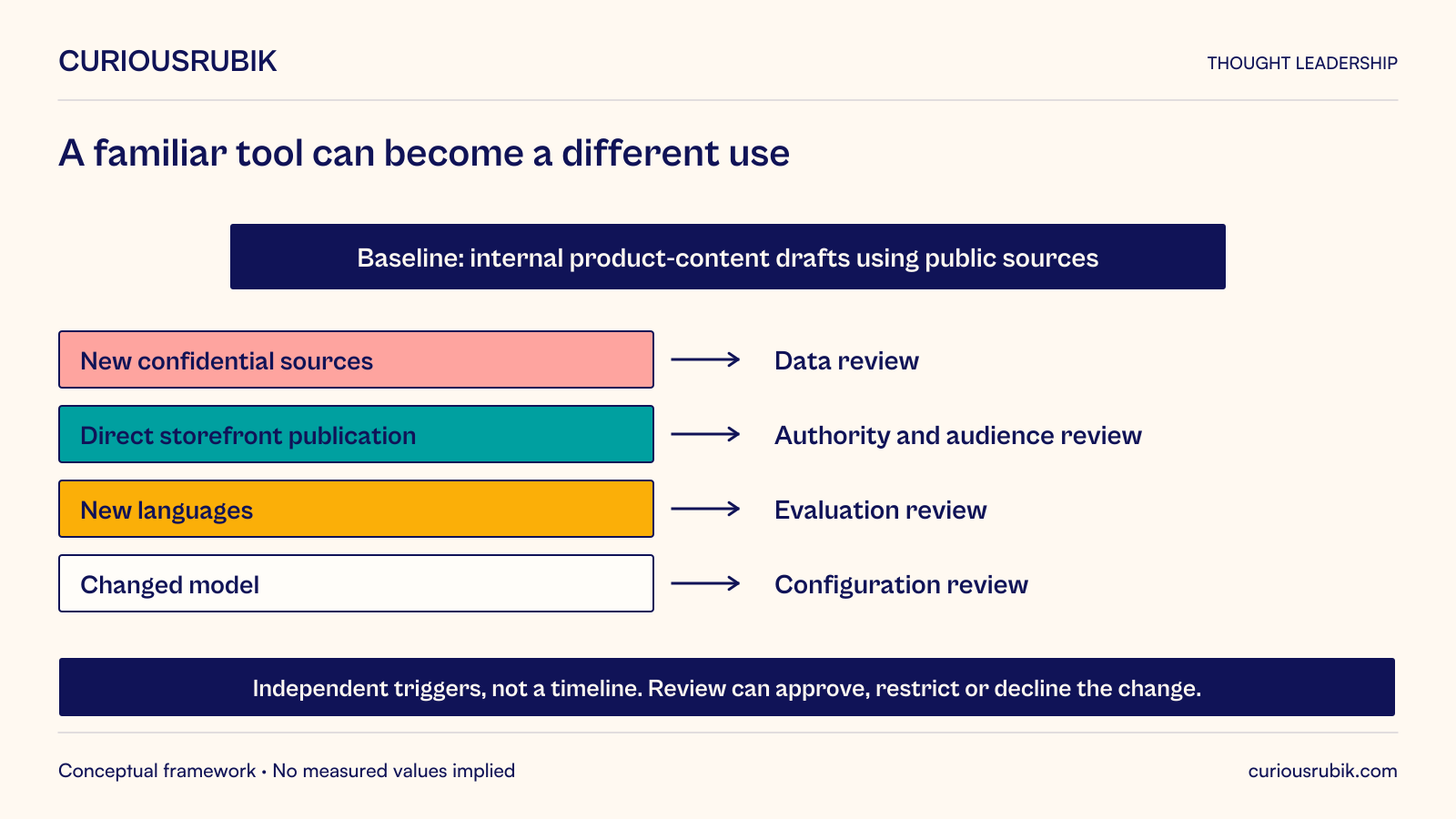
AI governance must evolve because the risk of a system changes when its data, audience, decisions, or actions change. An assistant approved to prepare internal drafts may later receive confidential information, publish externally, or operate in a new language. Keeping the same product name does not make those expansions equivalent to the original use.
For a technology-risk leader overseeing a growing AI portfolio, the key decision is how to detect material changes and route them to proportionate review without sending every minor edit through a central committee. A static list of approved tools cannot answer whether the current use remains within the conditions that were assessed.
The practical design is a maintained use record connected to release and operating processes. It should describe what the application does, what authority it has, which information it uses, who is affected, and what changes require reassessment. The hypothetical product-content example below shows why governance must follow the use rather than the brand of the model.
Inventory applications at a level that reveals their consequences. “Marketing uses AI” is too broad. “The content team drafts product descriptions from approved public specifications, with editorial review before publication” describes a task and a control boundary that can be assessed.
Record the owner, users, affected audience, input sources, output destination, tools, permitted actions, and operating limits. Include relevant dependencies and the fallback if the application is unavailable or suspended. The record should support a decision, not become a catalog of technical details nobody maintains.
Distinguish a supplier capability from the organization’s use. The same model can support internal brainstorming, customer advice, or an action that changes a system of record. Those contexts can require different controls even when the underlying service contract is unchanged.
NIST’s AI Risk Management Framework treats governance as a cross-cutting function across the lifecycle, with defined responsibilities. That supports maintaining the assessed use as it changes rather than treating procurement approval as the end of oversight. NIST AI RMF 1.0, GOVERN
Use explicit review triggers. Examples include a new sensitive data source, a broader audience, a new external destination, additional action authority, a materially changed model or retrieval process, and a new operating population that existing evaluation does not cover.
A change can be material without a code release. A team may connect a restricted folder, alter an instruction, enable a supplier feature, or start using drafts as final answers. Governance needs a way to notice these operating changes through responsible owners and deployment controls.
Avoid treating every wording edit as equivalent to a new use. A proportionate process distinguishes changes that preserve the assessed boundary from those that alter it. Define who can make that determination, what evidence they inspect, and how uncertain cases are escalated.
Record the reason for a decision. If a change does not require a new review, explain why the existing evidence and controls still apply. This makes the process more consistent and helps future reviewers understand whether a seemingly small change accumulated into a larger expansion.
Imagine a hypothetical office-accessories manufacturer using an assistant to draft product descriptions. The initial scope uses approved public specifications, produces internal drafts, and requires an editor to verify claims before publication. It cannot change the product catalog directly.
The content team later wants to include confidential launch documents. That changes the data boundary and requires review of permitted processing, access, retention, and source handling. The earlier approval for public information does not automatically cover the new material.
Next, the team proposes publishing routine descriptions directly to the storefront. That changes action authority and audience. Governance must examine claim validation, publication permissions, error detection, correction, and the consequences of an inaccurate customer-facing statement. Better drafting quality alone does not settle those questions.
A third expansion adds languages that the original reviewers cannot evaluate. The model may produce fluent text, but the organization lacks evidence that important qualifications and product terms remain accurate. The release decision needs appropriate linguistic and subject-matter review rather than an assumption that performance transfers unchanged.
Finally, a supplier changes the model configuration used by the service. The effect may be small or material, but the owner needs an agreed process to assess it against representative outputs and existing limits. A supplier’s release note is relevant evidence, not a substitute for the enterprise’s acceptance decision.
The appropriate governance response may differ for each change: approve with existing controls, require additional evidence, narrow the proposed scope, or decline it. The purpose is to make the expansion explicit before the new exposure becomes routine.
The business owner should be accountable for the intended outcome and acceptable operating consequences. Technical owners maintain implementation and reliability. Security, privacy, legal, compliance, and other specialists provide the decisions or advice required by the actual use. Their involvement should follow the risk, not a generic rule that every team reviews every change.
Define who can accept residual risk within the organization’s policy. A supplier assurance or a project manager’s confidence should not silently replace that authority. Some uses may be inappropriate regardless of commercial enthusiasm or require constraints that the proposed product cannot meet.
Give owners a usable decision packet: proposed change, affected boundaries, relevant evidence, unresolved concerns, controls, and fallback. A large collection of model documentation is not a substitute for explaining what the application will do differently next week.
Preserve accountability after approval. Assign operating indicators, incident responsibilities, and review triggers to named roles or maintained functions. Governance that depends on one person’s memory will weaken as teams and suppliers change.
Use the same evaluated configuration in the release decision and deployment record. Identify material model, instruction, tool, source, and policy versions. The exact level of detail should support investigation and change assessment without collecting unnecessary sensitive content.
Require evidence appropriate to the use. A drafting assistant needs tests for claim support, omissions, and correction effort. Direct publication additionally needs tested action permissions, content-version linkage, containment, and correction. A new language requires evidence for that language and its intended audience.
Model Cards for Model Reporting proposes documenting intended use, evaluation conditions, and limitations. Those reports can inform review, but they do not replace evidence about the enterprise’s combined application and operating process. Mitchell et al., Model Cards, 2019 version
Keep exceptions time-bounded or condition-bounded where appropriate. An interim approval should state what remains unresolved, who owns remediation, and what happens if the condition is not met. Otherwise, temporary accommodations can become permanent unexamined exposure.
Compare the approved use with operating behavior. Are employees pasting information from unapproved sources? Are reviewed drafts being reused as standard claims? Has a team begun sending outputs to customers through an informal process? These patterns may indicate an unmet need or an unsuitable control, as well as a boundary violation.
Provide a practical route for reporting errors and near misses. Employees should be able to identify unsupported claims, inappropriate access, or unexpected actions without needing to diagnose the model. The report should reach an owner who can contain the issue and investigate affected work.
Track the distribution of outcomes, not only averages. Problems may concentrate in a language, product category, document type, or unusual task. An overall acceptance rate can hide a scope that should be narrowed even while most of the application remains useful.
Use operating evidence to update policy and evaluation. A recurring failure may require better sources, a changed interface, a tighter permission, or suspension of one capability. Do not assume every incident calls for a model change, and do not assume retraining alone addresses the cause.
Understand the supplier dependencies that affect the assessed use. These may include model changes, data handling, subcontracted services, retention settings, tool capabilities, and availability. Record which changes the organization expects to be notified about and how it will respond under the actual agreement.
Review new contractual or regulatory obligations with qualified advisers for the relevant jurisdiction and activity. A general AI governance framework is not a legal-compliance certificate. Keep legal conclusions tied to the applicable facts and current requirements rather than treating a policy checklist as universal assurance.
Retirement also needs ownership. Disable unneeded access, stop scheduled work, preserve required records, and handle data retention or deletion through approved processes. An unused assistant with persistent connections can remain an exposure after its business value has disappeared.
Plan substitution or fallback before a critical dependency fails. The organization should retain enough source, evaluation, and operating knowledge to assess another approach or continue manually where feasible. Governance should make responsible change possible, not lock the enterprise into one supplier indefinitely.
Select an existing AI application and compare its actual use with its last assessed scope. Identify changes in data, audience, decisions, tools, and operating conditions. Ask which changes were deliberate, which evidence still applies, and which owner can resolve the gaps.
Then connect those review triggers to the normal release and operating processes. A maintained use record, clear decision authority, and evidence-based change review can support adoption without pretending risk is static. Governance succeeds when the enterprise can recognize that a familiar application has become a different proposition and make an informed decision before the expanded use becomes a costly surprise.