A sales representative can understand the CRM, acknowledge its importance, and still postpone updating it until Friday afternoon. That behavior is often described as resistance. It may also be a rational response to a system that asks for effort now and returns little help when the representative needs to act.
CRM adoption depends on the daily exchange between the employee and the organization: what information the employee supplies, what useful work the system enables, and how managers use the result. Excellent software cannot repair an exchange that feels one-sided.
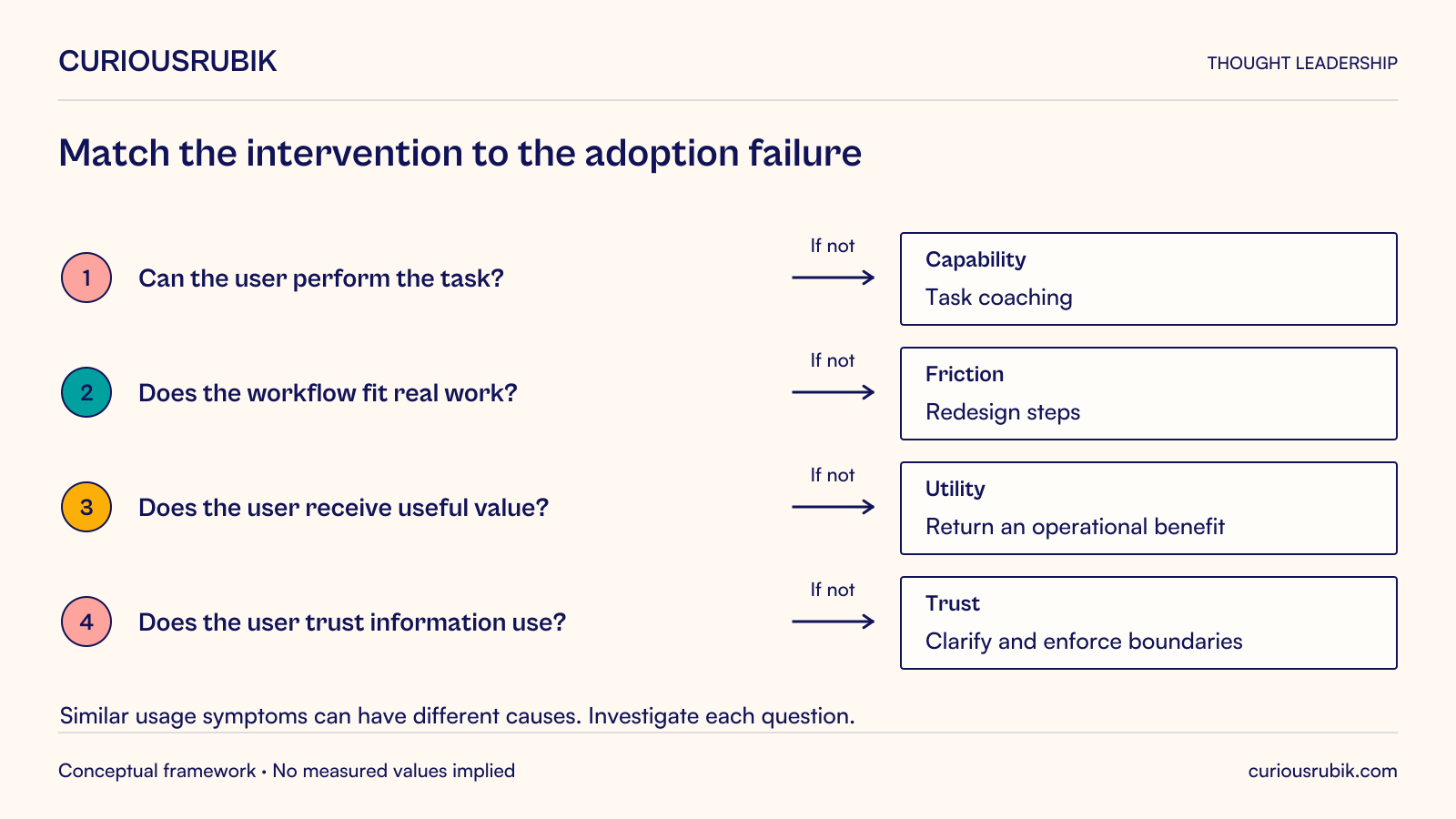
For sales leaders, the first decision is therefore diagnostic. Before buying more training or replacing the platform, determine whether people cannot use it, cannot fit it into their work, do not trust it, or see no operational value in maintaining it. These problems require different interventions. Treating them all as a compliance issue creates more activity without necessarily creating a more reliable customer record.
A person who opens the CRM every morning may still run every important customer decision from private notes. Conversely, a field representative may interact with the system briefly but leave a precise next action and a usable handoff after every visit.
Define adoption at the level of a useful behavior. Can a colleague continue an opportunity without asking the owner to reconstruct it? Can a manager identify the evidence behind a forecast change? Can a service team see the commitments made during the sale? These are stronger tests than time spent inside the application.
Activity counts remain useful for detecting access failures or identifying where to investigate. They become misleading when treated as proof that the operating process works. Mandatory fields can improve completeness while reducing accuracy if staff enter placeholders to proceed. A high volume of notes can conceal the absence of a clear decision or obligation.
The UK government’s Service Standard recommends combining performance measures with user research to determine whether a service solves its intended problem. That principle is relevant to an internal CRM even though the standard addresses public services. Observe the work as well as the dashboard. GOV.UK, Define what success looks like.
Start with capability. Does the employee know how to complete the task? A user who understands opportunity stages but cannot find a renewal contract needs navigation or workflow help. A user who cannot distinguish a customer commitment from a seller’s assumption needs coaching in the business process. A generic product tutorial addresses neither particularly well.
Next examine friction. Count the context switches, repeated entries, unclear labels, and steps required to finish a real activity. Test poor connectivity, a short gap between meetings, and use on the devices people actually carry. A workflow that works in a training room may be impractical outside it.
Then examine utility. Which decisions become easier for the person maintaining the record? Useful returns may include a prepared meeting brief, less duplicate reporting, a dependable follow-up queue, or fewer interruptions from colleagues asking for status. If the system mainly supplies management reports, leaders must acknowledge the imbalance and redesign it where possible.
Finally examine trust. Employees may worry that uncertain information will be treated as a promise, that an honest early warning will be punished, or that automatic activity capture will expose irrelevant communications. Explain what is recorded, who can see it, and how it will be used. Do not promise confidentiality or limits that the organization cannot enforce.
These four categories form a working diagnostic heuristic, not a validated adoption model. Their value is that they connect observable problems to different remedies rather than producing a single maturity score.
Interviewing users is useful, but asking whether the CRM is “easy to use” produces vague answers. Observe a specific task from beginning to end: preparing for an account call, recording a changed requirement, requesting a technical estimate, or handing an agreement to delivery.
Ask the user to explain what they need to know, what they decide, and what happens if the information is wrong. Note the tools used before and after the CRM. Include staff who are struggling and those who have developed effective workarounds; the latter can reveal missing functionality more clearly than a list of complaints.
Avoid turning observation into an individual performance inspection. Explain the purpose and handle customer and employee information appropriately. Capture patterns and process defects rather than collecting unnecessary personal detail.
The Service Standard’s guidance on understanding users emphasizes learning about their needs and testing assumptions. For CRM design, that means treating front-line work as evidence rather than assuming that a centrally designed process already describes reality. GOV.UK, Understand users and their needs.
Consider a hypothetical facilities-services business whose account managers sell maintenance contracts. After a site visit, they must record the opportunity stage, expected value, estimated start date, building details, asset information, and a long qualification checklist. They also send a separate email to the estimating team because the CRM request does not contain the operational detail estimators need.
Managers see incomplete records and propose more mandatory fields. Observation reveals a different problem. The system asks account managers for precise values before an estimator has assessed the site. Staff therefore enter provisional figures that later appear in management reports as if they were confirmed.
The redesign separates known facts from estimates and changes the point of capture. After a visit, the account manager records the customer objective, site identifier, access constraints, promised next step, and information needed for estimating. A structured request sends those details to the estimating queue. The estimator adds the estimate with its assumptions and validity date. The sales owner confirms the commercial proposal later.
The system now returns something useful: account managers can see whether estimating has accepted the request and what information is missing. The separate status-chasing email becomes unnecessary when the new queue proves dependable.
The pilot deliberately includes repeat customers, incomplete asset lists, and urgent requests. The team measures rejected estimating requests, time spent chasing status, overdue customer commitments, and use of placeholder values. It also interviews estimators, since removing effort from sales while adding ambiguity downstream would not be a successful redesign.
No result is claimed for this hypothetical business. The decision rule is explicit: expand only if the combined workflow becomes more reliable without unacceptable loss of qualification evidence. If estimating capacity is the actual constraint, adding better CRM routing will make that constraint visible but will not remove it.
A CRM cannot become the working record while leadership continues to request a different version of the truth in slides, spreadsheets, and private messages. Staff learn that the official system is an administrative prerequisite and the unofficial channel is where decisions happen.
Choose the management meetings that will rely on the CRM record. For an opportunity review, define the evidence required, who updates it, and the questions the manager will ask. Allow uncertainty to be recorded explicitly. Discuss the next action and its rationale instead of rewarding polished descriptions of unsupported confidence.
Retire duplicate reports only after the replacement is adequate. Abruptly removing a spreadsheet without recreating an essential planning view shifts work rather than eliminating it. Map each existing report to a real decision; rebuild what is necessary and stop collecting what nobody uses.
Managers also need to model the expected behavior. If a manager approves a commercial exception by message, the approval needs a reliable route into the relevant record. It is unreasonable to demand system discipline from the team while key decisions remain outside the process.
The right information at one stage can be the wrong requirement at another. A first conversation may establish a business problem and a next meeting. It may not establish a validated budget, procurement route, or delivery date.
Design stage transitions around evidence that can reasonably exist at that point. Distinguish missing information from information that has not yet become knowable. Give users a way to record uncertainty without inventing an answer or bypassing a control.
Use mandatory fields selectively. Require them when an omission creates a material downstream risk and the person entering the information can obtain it. For other fields, use prompts, later enrichment, or a review queue. Every required field should have a named consumer and a reason for being needed now.
Revisit inherited fields. A request from a former executive can remain embedded in the system long after the report has disappeared. Maintain a lightweight field inventory with purpose, owner, source, and review date. This is particularly useful before adding automation, which can amplify the burden of obsolete requirements.
An adoption pilot should run long enough to observe the actual task cycle. A week may capture daily follow-up but miss monthly forecasting or a handoff that occurs only when a deal closes. Set the observation window around the process rather than a convenient project milestone.
Use a small group of complementary measures. Record whether the critical behavior happens, whether the information is usable, whether the user receives a benefit, and whether downstream work improves. For the facilities example, a completed visit record matters less than an accepted estimating request with a traceable customer commitment.
Compare like with like where possible. A pilot team receiving exceptional support may outperform a wider rollout for reasons unrelated to design. Note differences in territory, deal complexity, management attention, and workload. Treat early improvement as evidence to investigate, not as a guaranteed enterprise-wide result.
Review failures with users promptly. Fix small workflow defects while the experience is fresh. Publish the decisions that follow from feedback so participation has a visible consequence. Otherwise, repeated surveys can become another task that asks for effort and gives little back.
Some information is mandatory for legitimate operational, contractual, or regulatory reasons. The organization may need to require its capture even when the immediate benefit to the salesperson is limited. Explain the purpose and reduce the effort without pretending every requirement will be personally attractive.
Performance accountability also remains appropriate after the process is usable, expectations are clear, and support is available. Diagnose before enforcing; do not use diagnosis as an indefinite excuse for ignoring agreed responsibilities.
Buyers should ask prospective partners to demonstrate real role-based tasks, including incomplete information and interrupted work. Request a plan for manager adoption, report retirement, data ownership, and post-launch improvement. A training calendar alone is not an adoption strategy.
The most revealing question is simple: after using the CRM properly, can an employee complete an important piece of work more reliably? When the answer is yes, the system has a basis for becoming an operating habit. When the answer is no, another reminder to update it is unlikely to solve the underlying problem.