A customer agrees to a service, completes onboarding, receives an invoice, and asks for help. Inside the company, those events may belong to four departments. To the customer, they are parts of one commitment.
A CRM designed around departmental boundaries can make each team efficient while forcing the customer to coordinate the overall experience. Sales marks a deal complete before onboarding has accepted it. Service closes a case while a billing correction remains unresolved. Every internal dashboard can look healthy while the customer still waits.
Journey-led design addresses this problem by organizing information and responsibility around the customer’s progress toward an outcome. It does not abolish departments or require one system to perform every activity. It makes the transitions between specialized teams explicit and gives somebody responsibility for whether the whole commitment is fulfilled.
A touchpoint records an interaction: a call, form, meeting, or message. A journey describes what the customer is trying to accomplish, the states they pass through, and the obstacles that prevent progress.
“Contact sales, receive proposal, sign contract” describes the seller’s activity. “Understand whether the service fits, agree a workable scope, become ready to use it” describes customer progress. Both views matter, but only the latter reveals whether an internally completed activity has actually moved the customer forward.
Avoid assuming every customer follows the same path. An existing customer adding a location may not need full onboarding. A complex deployment may require technical validation before a commercial agreement. A complaint can reopen an earlier decision. Represent legitimate variation rather than forcing exceptions into a linear funnel.
The UK Service Standard calls for solving a whole user problem across organizational boundaries while avoiding an overlarge service that tries to do everything. That balance is useful for CRM: join the necessary work without turning the journey into an unmanageable transformation program. GOV.UK, Solve a whole problem for users.
Begin with a journey that has visible friction, such as starting a new service or resolving a disputed invoice. Review actual cases with customer-facing staff, operational teams, and, where appropriate, customers themselves.
For each transition, ask what the sending team considers complete, what the receiving team needs before accepting responsibility, and what the customer believes will happen next. Differences among those answers expose the most useful design work.
A sales handoff may be “complete” when a contract is signed. Delivery may require a confirmed site date and named customer contact. The customer may believe work starts immediately. The gap is a promise problem before it is a workflow problem.
Record waiting states explicitly. “Pending” is too broad if it can mean awaiting customer information, internal approval, supplier capacity, or a system repair. Each state needs a reason, owner, next action, and a way to explain the delay to the customer.
The following is a working heuristic for journey design: define outcome states, transition evidence, accepting owners, and recovery routes. It is not a formal industry standard.
An outcome state should describe something materially true for the customer. “Ready for service” is useful only if its conditions are defined, such as an accepted scope, verified prerequisites, and a confirmed start arrangement.
Transition evidence establishes why the state changed. A seller checking a box may be enough for a low-risk internal task; a consequential commitment may require a confirmed document, validation result, or customer acknowledgment. Match evidence to consequence.
An accepting owner takes responsibility for the next part of the journey. Sending a notification is not the same as acceptance. The process needs a defined response if the receiving team rejects the handoff or cannot accept it within the required period.
A recovery route describes how the journey proceeds when normal conditions fail. It may return to a previous state, create an exception, or require a revised agreement. Avoid quietly advancing the record to preserve a favorable performance measure.
This model creates a common operating language while allowing each team to retain its specialized tools and methods.
Consider a hypothetical managed IT service provider. Sales closes an agreement and creates an onboarding ticket. The onboarding team discovers that the customer’s equipment list is incomplete. Finance starts billing from the contract date, while the customer expects billing to begin after service readiness.
The immediate reaction might be to add more fields to the sales opportunity. The journey review finds a deeper issue: the commercial agreement, operational acceptance, and billing trigger are being interpreted separately.
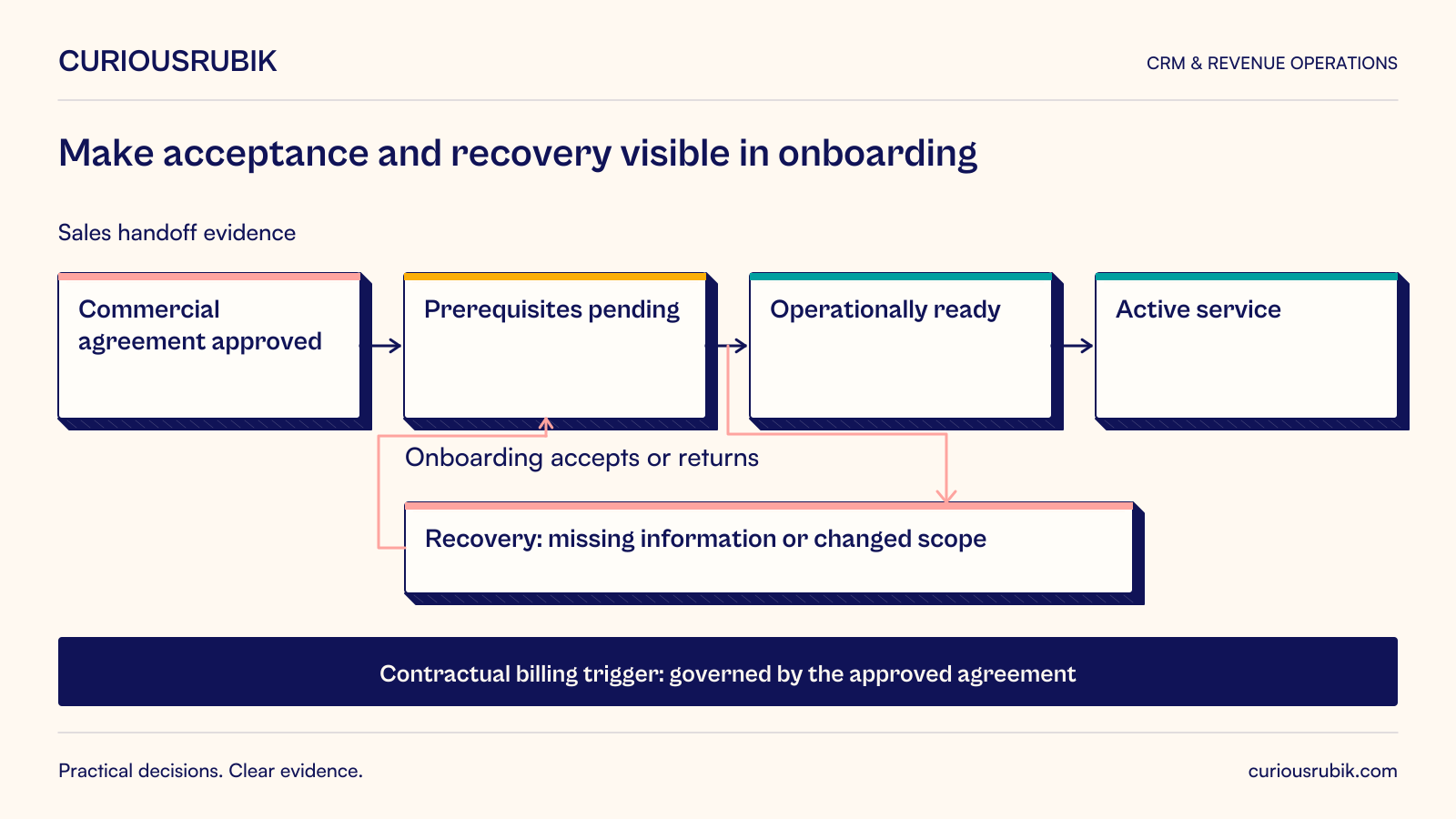
The redesigned journey defines an agreed commercial state, a prerequisites-pending state, an operationally-ready state, and an active-service state. The contract remains authoritative for billing obligations. Where the intended commercial model requires a readiness condition, that condition must be correctly reflected in the approved agreement, not invented by the CRM workflow.
Sales supplies the agreed scope, authorized customer contact, and known prerequisites. Onboarding accepts the handoff or returns a specific missing-information request. A named owner coordinates any delay that affects the customer’s expected start. Finance receives the relevant contractual trigger and evidence rather than inferring billability from an internal ticket closure.
The customer sees one clear readiness checklist and one coordination contact. They do not need to understand which team owns each backend task. Internal specialists can still communicate directly where useful, but their actions update the shared commitment.
The team tests a straightforward customer, an incomplete equipment list, a scope change after signature, and a customer-requested delay. It measures time to readiness, rejected handoffs, customer repetition, billing disputes, and work reopened after apparent completion. This is a hypothetical design exercise; no improvement percentage is assumed.
Journey ownership often fails when it is merely an additional title. The owner needs authority to convene teams, resolve conflicting definitions, propose changes, and escalate resource or policy disputes.
Department leaders remain responsible for their teams’ skills, capacity, and controls. The journey owner focuses on the integrity of the overall commitment. Define which decisions can be made directly and which require executive arbitration.
For example, a journey owner may standardize handoff evidence but cannot unilaterally change contract terms or financial controls. Those decisions belong to the relevant authorized owners. Clear boundaries prevent journey governance from becoming a competing management structure.
Use a short regular review of exceptions that cross departments. Discuss the oldest unresolved commitments and repeated causes of rework. Do not turn the meeting into a recital of every team’s status. Its purpose is to resolve the gaps no single team can fix alone.
Customers may begin online, continue by phone, and resolve a problem through an account manager. A journey design should preserve relevant context across those channels while recognizing their different strengths.
The UK Service Standard explicitly addresses joined-up experiences across online and offline channels. For a commercial CRM, the practical implication is to avoid making customers restart the same explanation simply because they changed channel. GOV.UK, Provide a joined up experience across all channels.
That does not require identical interfaces. A specialist conversation can capture nuance that a self-service form cannot. The shared requirement is a reliable account of the customer’s objective, current state, outstanding commitment, and next step.
Respect identity and access boundaries when sharing context. A public form submission should not automatically grant access to an existing account. A contact representing one subsidiary may not be authorized to see another subsidiary’s cases. Journey continuity must preserve these distinctions.
Departmental metrics remain necessary, but they need companions that reveal end-to-end performance. An efficient handoff that repeatedly fails acceptance is not effective. A fast case closure that produces repeated contacts may be premature.
Measure elapsed time between meaningful outcome states, repeated requests for the same information, rejected handoffs, reopened work, and unresolved commitments. Segment by journey type and complexity. Comparing a standard renewal with a complex new deployment can conceal useful differences.
Pair speed with quality and control. Faster onboarding is valuable only if service starts correctly and obligations are understood. A reduction in recorded exceptions may mean better work, or it may mean staff have stopped reporting them. Sample completed cases to verify the interpretation.
Use customer feedback at the point of uncertainty rather than relying only on a broad satisfaction survey after completion. Ask whether the next step was clear and whether the organization did what it said it would do. Treat feedback as one source of evidence alongside operational records.
A detailed journey map is useful only if it changes decisions. Start with one consequential transition and test the new acceptance rule, information set, or recovery path. Expand when the evidence shows the improvement is workable.
Some boundaries should remain. Legal entities, regulated services, contractual separation, and professional confidentiality can require distinct processes. The goal is an understandable experience across those boundaries, not their removal.
Small businesses may need only a shared checklist and an explicit handoff owner. Larger organizations may need versioned state definitions and system integration. Complexity should follow the operational requirement, not the visual sophistication of the journey map.
Buyers should ask a CRM partner to demonstrate an incomplete handoff, a customer changing channels, and a journey moving backward after a new issue. Ask who owns the exception and how the customer is informed. A polished happy-path demo tells little about those situations.
Journey-led CRM works when it makes the company’s promises easier to keep. Departments still perform specialized work, but customers no longer carry the burden of joining that work together. That is the design test worth applying before adding another departmental dashboard.