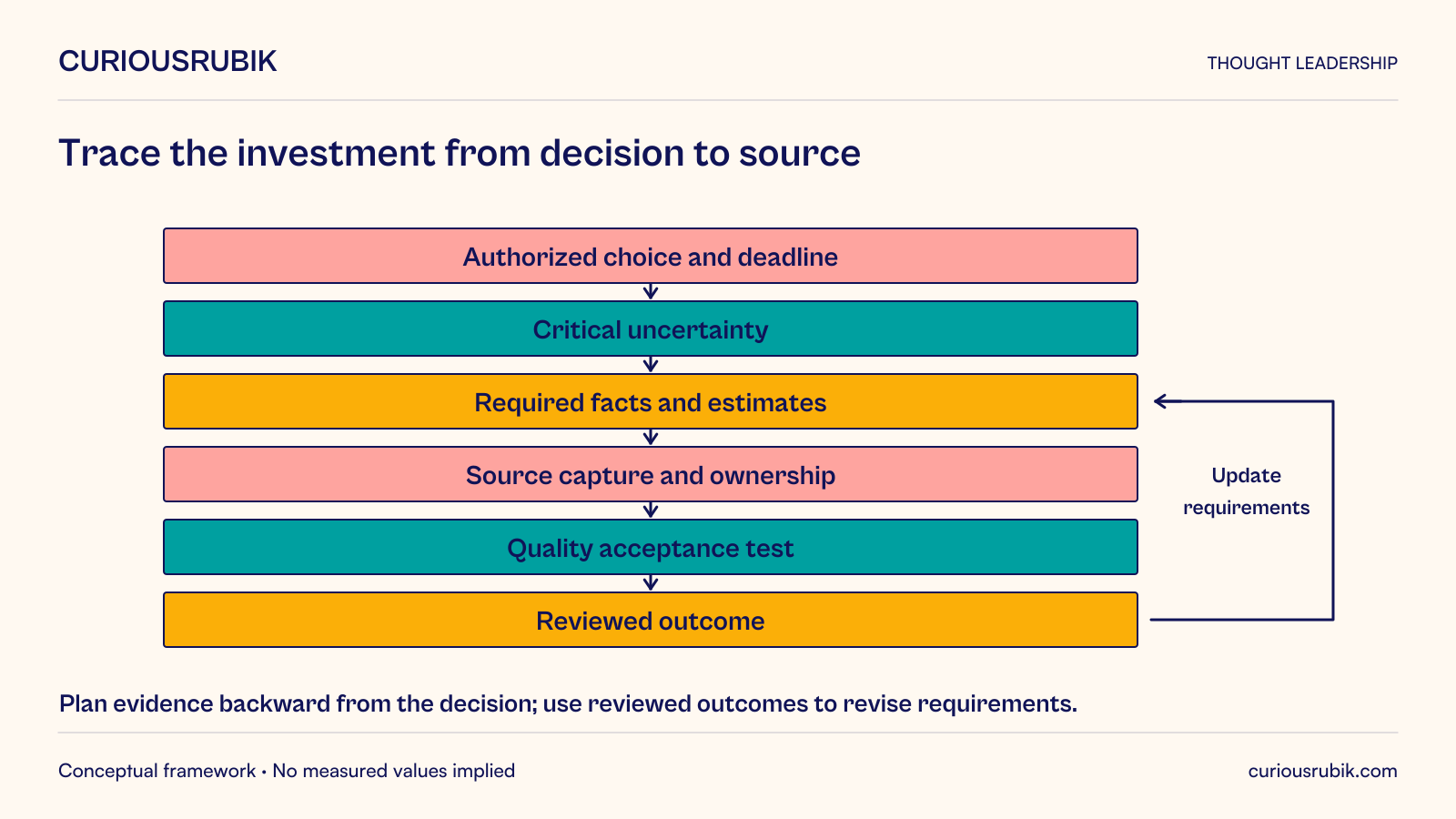
A data strategy should identify which decisions the organization needs to improve, the evidence those decisions require, and the changes needed to produce that evidence reliably. Starting with a platform or a comprehensive data inventory reverses the dependency. The organization can accumulate well-organized information without resolving the uncertainty that prevents useful action.
For a chief operating officer planning field-service capacity, the immediate decision might be whether next week’s committed work can be delivered with the available skills and hours. The corresponding data investment should make that decision more dependable. It may require better job classification and effort estimates before it requires a new enterprise repository.
Beginning with decisions does not mean every data asset must justify itself through one short-term use case. Shared identity, history, security, and integration capabilities can support several decisions. Their value becomes clearer when the strategy shows which decisions depend on them and what happens if they remain weak.
A useful decision statement identifies an owner, a time window, feasible actions, constraints, and a consequence. “Increase productivity” is an objective. “By Thursday, decide whether to rebalance next week’s jobs, obtain additional qualified capacity, or renegotiate specific commitments through the authorized process” is an actionable question.
Ask what the owner would do differently with better evidence. If a report cannot change any available action, it may serve explanation or oversight rather than immediate decision support. That can still be valuable, but its freshness, precision, and completeness requirements will differ.
Document the decision’s boundaries. The operations leader may control scheduling but not employment policy, contract changes, or specialist qualifications. Data should inform the available choices without silently assuming authority the decision-maker does not possess.
Also identify the cost of delay. A staffing decision made after the schedule is published may create more disruption than the same decision made two days earlier. The useful information deadline is therefore part of the data requirement, not a service-level target invented after the pipeline is built.
Work backward from each feasible action. Rebalancing jobs requires remaining effort, skill requirements, location, parts readiness, promised dates, and available capacity. It may not require every historical customer attribute or every field in the service application.
Separate facts, estimates, and policy. A promised date is a recorded commitment. Remaining effort may be an estimate. The priority given to an overdue job is a policy choice. Mixing these into one unexplained score makes it difficult to challenge the recommendation or improve the source data.
For each input, state the unit, population, timing, quality requirement, and owner. “Hours available” should explain whether travel, planned absence, training, and already committed work are included. “Open jobs” should distinguish work that can actually be scheduled from work awaiting a prerequisite.
The UK Government Data Quality Framework treats quality as fitness for intended purpose and recognizes that dimensions can involve tradeoffs. It is a government framework, but that principle is a useful design reference for enterprise decision evidence. The Government Data Quality Framework
Do not require perfect data everywhere. Identify which uncertainty could change the decision and which imperfections can be disclosed without making the result unusable. This is a prioritization judgment, not permission to ignore applicable obligations or knowingly publish misleading information.
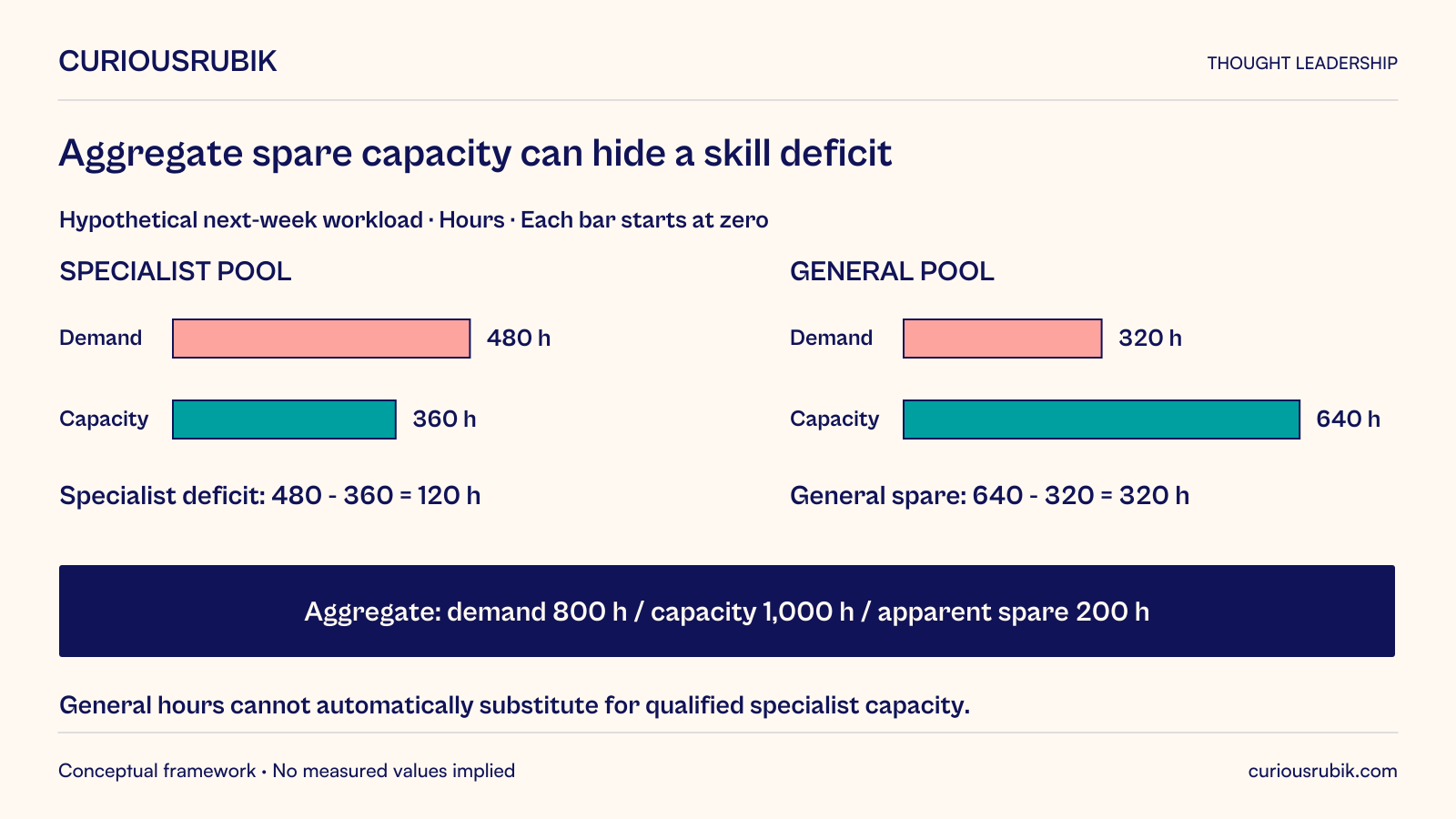
Consider a hypothetical service business with 240 jobs committed for next week. A simple workload view shows 800 estimated delivery hours against 1,000 available hours, suggesting 200 hours of spare capacity.
The jobs include eighty specialist tasks requiring six hours each, or 480 specialist hours, and 160 general tasks requiring two hours each, or 320 general hours. Available capacity consists of 360 specialist hours and 640 general hours. The aggregate still totals 1,000, but the specialist requirement exceeds its capacity by 120 hours.
General capacity cannot automatically substitute for specialist capacity. The actual options depend on qualifications, task design, location, customer commitments, and other operational constraints. The example does not recommend overtime, outsourcing, or changing contracts. It shows that the original aggregate could not support the decision it appeared to answer.
Suppose the current system records total estimated hours but leaves skill requirements in free-text job notes. Funding a more frequent refresh of the aggregate dashboard would not resolve the problem. A focused data initiative would define the relevant skill categories, capture them in the scheduling workflow, validate exceptions, and reconcile capacity on the same basis.
The team should then test the decision with representative jobs. Are the categories sufficiently specific? Are some jobs waiting for parts? Do estimates include travel? Can an authorized planner explain why a job is assigned to a particular capacity pool? Those questions determine whether the evidence is usable.
All quantities are hypothetical. The lesson for data strategy is that a missing relationship between demand and qualified capacity can matter more than the volume or refresh rate of the available dataset.
An evidence product is a working term for a maintained dataset, model, and explanation designed for a recurring decision. It is not a new industry standard. Its definition should include the user, required inputs, transformations, limitations, output, and operating owner.
For the capacity decision, acceptance might require that every included job has a supported effort estimate and skill classification or appears in a visible exception population. Capacity must use the same categories and period. The planner must be able to trace a constraint back to the jobs and resources that create it.
A successful technical load is only part of acceptance. Test a new skill category, a missing estimate, a canceled job, a late capacity change, and a record that belongs outside the planning window. Agree on the expected handling before implementation.
Preserve the version used for the decision. If estimates change afterward, the organization should distinguish new information from an error in the earlier model. This supports learning without pretending that a past decision could have used facts that were unavailable at the time.
Several decision products may need the same job identifier, location model, or service classification. That creates a concrete case for shared capability. The strategy should show the dependent products, the common requirement, and the owner who can maintain it.
Avoid treating every similar term as one enterprise definition. “Completed job” may mean operational work finished in one context and all commercial obligations resolved in another. Agree on the relationship between definitions instead of forcing a convenient label across incompatible uses.
Sequence foundations with useful delivery. A narrow identity and classification service can be established through the first scheduling use case and extended after its assumptions are tested. Building a universal model before any consumer uses it risks spending heavily on requirements that remain speculative.
Maintain a source-to-decision map. It should connect the operational capture point, the authoritative system, transformations, quality checks, evidence product, and decision owner. This map makes it possible to assign a defect to the place where it can be prevented, rather than repeatedly repairing the final report.
Better information has value when it changes a consequential choice or reduces a meaningful uncertainty. Before commissioning a large pipeline, test the decision manually on a bounded sample using authorized existing sources. The purpose is to establish whether the proposed information can influence the action, not to create a permanent manual workaround.
Record the decision made with the current evidence and the decision made after the additional information is available. Investigate differences. If the action does not change, ask whether the information improves confidence, exposes risk, or merely adds detail. Those are different benefits and should be described honestly.
Do not claim that a changed decision is automatically a better one. Follow the outcome over a suitable period and consider other influences. The decision process should preserve assumptions and limitations so later results can improve the model rather than simply validate the team’s preferred story.
There are limits to decision-first prioritization. Some data work supports resilience, required reporting, preservation of evidence, or future options that are difficult to value through immediate actions. Keep these commitments explicit. The strategy should balance them with decision products, not force every obligation into an invented return-on-investment figure.
A strategy becomes stale when business choices, source systems, or available actions change. Review the important decision products with their owners: is the decision still made, does the evidence arrive in time, and do people trust and use it appropriately?
Retire reports and datasets whose purpose has disappeared, subject to retention and dependency requirements. Maintaining unused outputs consumes capacity and can preserve conflicting definitions. Conversely, a heavily reused dataset may need stronger support than its original pilot arrangement provided.
Measure the work in terms of usable decisions and reliable evidence: unresolved critical inputs, time spent reconstructing facts, traceability, quality incidents, and whether agreed actions are reviewed. A count of dashboards or ingested tables describes production activity without establishing usefulness.
Start by choosing three recurring decisions with named owners. For each, document the action, deadline, critical uncertainty, and minimum evidence needed. Fund the first data change that can make one of those decisions materially more dependable, then build the shared foundations that the next decisions genuinely require.