Digital transformation can fail when the new service requires departments to behave differently while their budgets, measures, and authority still reward the old behavior. A shared platform may expose work across the business, yet each unit remains accountable for its own cost and output. The technology makes coordination possible without making it rational or feasible for the people expected to coordinate.
For a chief operating officer launching a cross-branch digital service, the decision is which organizational arrangements must change alongside the platform. The answer may involve management measures, resource allocation, decision rights, or ownership of shared work. It does not automatically require a new organization chart.
A useful starting point is to trace where the proposed service creates value and where it imposes work. This article uses a hypothetical bicycle retailer introducing store-based online fulfillment. The central issue is the internal exchange between the online channel and local stores, rather than software configuration or a generic appeal for better communication.
Map the end-to-end service and identify which teams perform each part. Include work that the formal project plan may overlook: locating stock, resolving an unavailable item, answering a customer question, handling collection, and reconciling a cancellation.
For each activity, record who receives the benefit, who supplies capacity, and who bears the consequences of failure. A channel can report increased sales while another team absorbs the labor and customer frustration. The aggregate business case may look attractive even as the local operating arrangement discourages participation.
Examine the current measures and budgets. If store managers are assessed on walk-in sales and local labor cost, an online order assigned to their store may look like extra work with little recognized contribution. Asking managers to support the enterprise strategy does not remove that conflict.
Distinguish deliberate local accountability from accidental misalignment. Local measures can be useful when they reflect real operating responsibility. The task is to adjust them where the new service changes the work, while preserving appropriate discipline over cost and service quality.
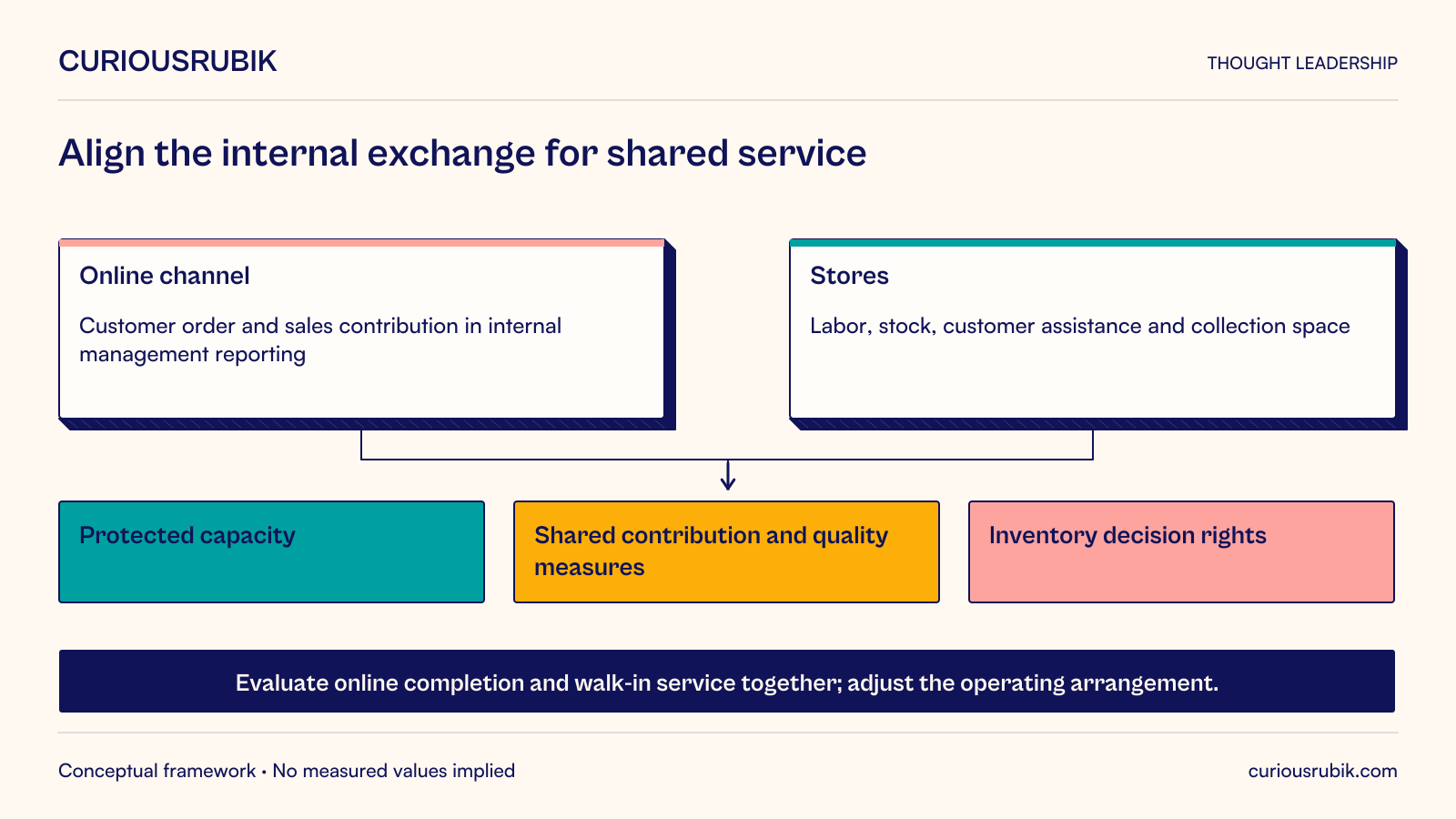
Imagine a hypothetical bicycle retailer with six stores and an online sales channel. The new platform allows customers to order an accessory online and collect it from a store showing available stock. The online team receives credit in management reporting for the sale, while the store supplies picking, customer assistance, and collection space.
During the pilot, some stores delay accepting online tasks. The first explanation is resistance to the new system. Interviews reveal a more specific issue: online fulfillment adds work during the same periods when managers are expected to keep walk-in service responsive, and the existing staffing plan does not recognize that demand.
The platform also allows the online channel to reserve the last available item. Store managers previously used local judgment to protect stock for expected walk-in demand. The new service has therefore changed both capacity allocation and inventory decision rights, even though the project was presented as a channel enhancement.
The organization has several options. It can fund dedicated fulfillment capacity at selected stores, recognize fulfillment contribution in internal management measures, centralize more online work, or limit the service promise during periods that cannot be supported. The choice should follow actual demand and economics, not an assumption that all stores must operate identically.
Suppose management chooses a bounded service at four suitable stores, with protected capacity and an agreed inventory-allocation policy. Finance and operations define how the service’s contribution and cost will appear in management reporting. This is an internal operating arrangement, not a prescription for statutory revenue recognition or tax treatment.
The pilot now evaluates both online completion and local service. If online collection improves while walk-in customers wait longer or stock exceptions rise, the organizational design still needs adjustment. The platform’s successful deployment is only one condition of a viable cross-channel service.
Make the service relationship explicit. The online channel should know what stores can accept, under which conditions, and what information they need. Stores should know the service promise, escalation route, and resources available when demand exceeds the agreed envelope.
Define who can change those conditions. A local manager may need authority to pause new fulfillment during a verified operating disruption. The channel owner may need authority to redirect work. Establish the boundaries and customer communication process so local control does not become arbitrary avoidance.
Use internal measures that reflect the shared outcome. That might include accepted fulfillment, correct collection, cancellations caused by stock error, and the effect on local service. Avoid giving one team credit for an order while another carries all visible failure measures.
Review the potential for gaming. A narrow fulfillment-speed target may encourage stores to mark orders ready before they are physically prepared. A volume credit may encourage accepting work beyond capacity. Pair measures with evidence and quality checks that reflect the actual customer outcome.
Plan the transition between old and new measures. If the service launches before the next management-reporting cycle, document the interim treatment and who resolves disputes. A store should not discover after accepting new work that its manager is still assessed against an incompatible target. Review the temporary arrangement when actual demand becomes visible, and retire it deliberately rather than allowing an informal exception to become permanent.
Describe which responsibilities change for each role. A store colleague may become responsible for a queue that did not previously exist. A manager may need to plan labor for digital demand. A central team may need to resolve cross-store exceptions rather than pass them back to the original branch.
Specify what stops or reduces to create capacity. Adding a new responsibility without changing existing work creates an assumption about extra effort. Training and enthusiasm cannot supply unlimited operating time.
Give managers the information needed to perform the new role. A forecast of likely collection demand may support staffing, while a live exception queue supports intervention. Providing the same dashboard to every role can obscure the different decisions they need to make.
GAO’s organizational-transformation guidance includes employee involvement, communication, and alignment of performance management with organizational goals. Its context is government transformation; applying those considerations to retail is a management recommendation, not evidence of a guaranteed commercial result. GAO-03-669, Results-Oriented Cultures, 2003
Separate lack of knowledge from conflicting incentives, insufficient authority, and inadequate capacity. An employee who cannot find the collection task may need interface help. A manager who must choose between two incompatible service targets needs an operating decision.
Use real cases to make the conflict visible. Ask a store and the central channel team to walk through an order involving the last item, an absent customer, or a busy collection period. Identify where each team believes responsibility begins and ends.
Record the unresolved choice, its owner, and the latest useful decision point. The project team should not settle a material commercial conflict by implementing whichever assumption keeps development moving. That would turn organizational ambiguity into software behavior.
Communicate the resulting decision through measures, staffing, permissions, and procedures. A leadership statement that everyone supports the service is incomplete if local managers are still evaluated under the old arrangement.
A pilot should reproduce ordinary operating constraints, not depend on temporary project staff doing the difficult work invisibly. Record which extra resources are present and whether they will remain after rollout. Otherwise, the pilot tests a different organization from the one expected to operate the service.
Observe acceptance, exception handling, and handoffs across teams. Can a store decline work for a legitimate reason? Does the central team respond? Can both sides explain how contribution and cost are assessed? Those are readiness questions alongside technical reliability.
Measure the receiving customer experience and the work displaced elsewhere. A shorter online journey may create more store contacts or returns. Include those effects in the review rather than treating them as another department’s problem.
Adjust the organizational arrangement before expanding. Some stores may need different capacity, a narrower promise, or a different fulfillment model. Standardize the core commitment while allowing justified variation where operating conditions genuinely differ.
Organizational change does not always mean centralization or a new department. A clear service agreement, adjusted management measures, funded capacity, and delegated authority may be sufficient. Reorganizing reporting lines without changing those mechanisms can leave the same conflict under new titles.
Conversely, a shared service may need a dedicated owner when work repeatedly falls between functions and no existing role has the required authority. Make that case from the operating problem rather than assuming a new transformation office is the answer.
Respect legitimate constraints. A store may lack suitable space or staffing for the promised collection service. The organization can choose a different model instead of interpreting every limitation as unwillingness to change. The objective is a sustainable service, not uniform participation at any cost.
Before the next rollout decision, compare the proposed work with current budgets, measures, and authority. Identify where a team would be penalized for doing what the new service requires. Resolve those conflicts and test the resulting arrangement with ordinary staffing. Digital transformation becomes workable when the organization makes the new behavior feasible and accountable, rather than depending on people to overcome its own design every day.