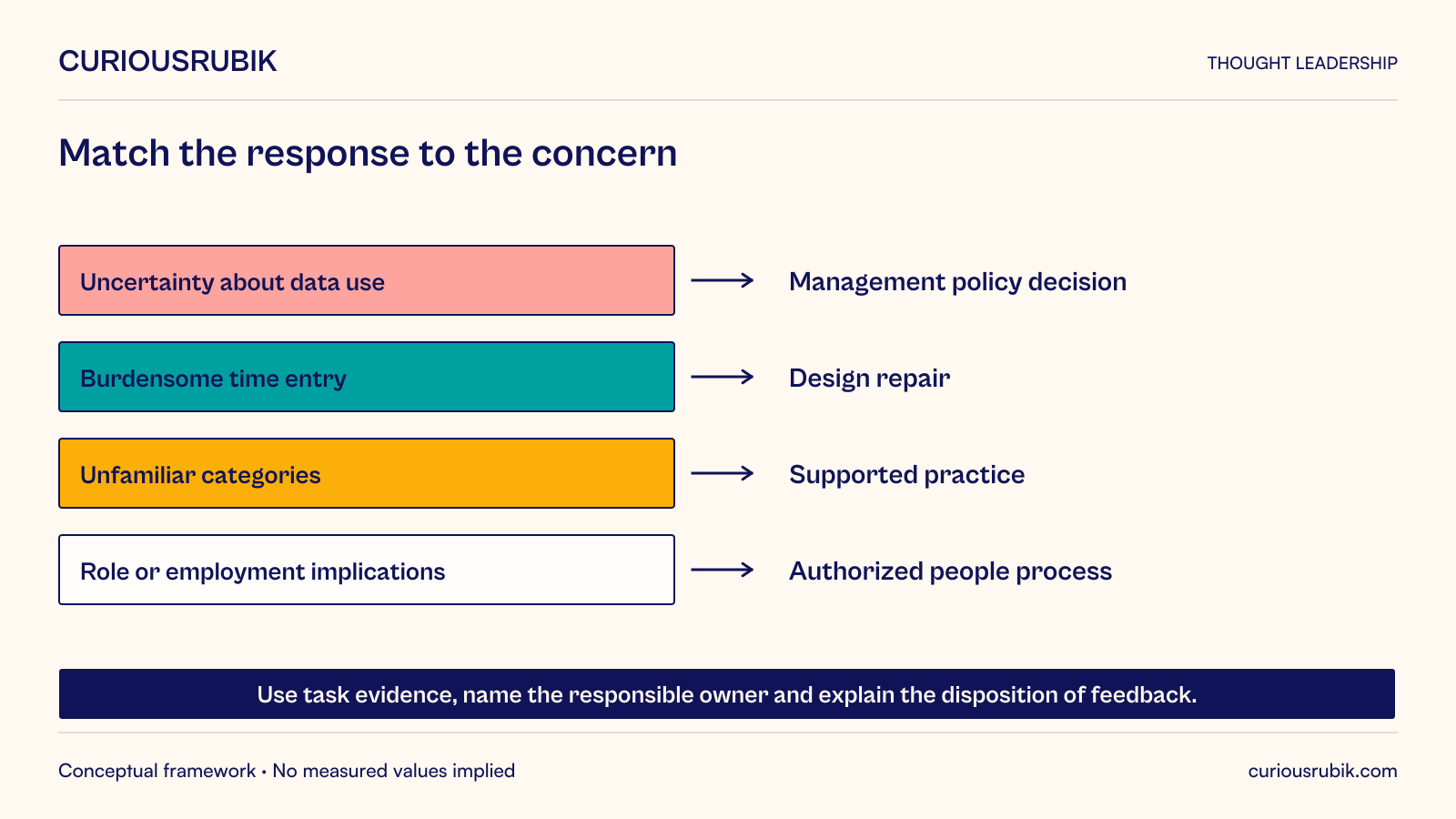
Employees may resist a new enterprise system because it changes more than the interface. It can expose work differently, alter professional discretion, redistribute administrative effort, or create uncertainty about how performance will be judged. Some objections reveal a design problem. Others concern legitimate disagreements about the operating change itself.
For a transformation leader facing opposition to a new time-recording system, the decision is how to distinguish learning needs from concerns about fairness, trust, and role consequences. Treating every objection as a training gap can leave the real issue untouched. Treating every objection as proof that the project is wrong can also prevent a necessary improvement.
A useful response is an evidence-based conversation about the specific change, its consequences, and what can genuinely be influenced. This article uses a hypothetical engineering consultancy to show how resistance can reveal a conflict between accurate records and the way managers use them. It does not diagnose individual employees or claim that all resistance has one cause.
Identify the work, decisions, and visibility that differ from today. A new tool may make previously informal activity measurable, require a different skill, or remove a familiar route for handling exceptions. Those changes can affect competence, autonomy, reputation, and workload.
Separate the stated purpose from possible uses. Management may introduce time recording to understand project cost, while employees worry that every nonbillable hour will be treated as poor performance. If the organization has not decided how the information will be used, reassurance alone is weak evidence.
Look at the employee’s prior experience. A previous system may have promised simplification but added duplicate entry, or a past feedback exercise may have produced no visible response. These histories do not prove the new project will fail, but they influence whether its commitments are credible.
Do not assume silence means agreement. People may avoid raising concerns when the project is presented as an executive priority or when criticism could affect their standing. Provide more than one way to surface issues and be clear about who will see the information.
Imagine a hypothetical engineering consultancy replacing weekly timesheets with a more detailed project-recording system. The stated goal is to understand project effort and improve estimates. Staff are asked to distinguish client delivery, internal coordination, rework, training, and general administration.
Some engineers object to the additional categories. The project initially treats this as reluctance to learn the tool. In discussion, employees explain that internal coordination is necessary for delivery but has historically been treated as an unfavorable utilization result in management reviews.
The new system creates a conflict. Accurate recording makes necessary coordination more visible, while the existing measure can make that visibility costly to the employee or project team. Training people to choose the correct category will not resolve the incentive to hide or reclassify the work.
The business must decide how those categories will be interpreted. Project and finance leaders clarify the purpose of cost analysis, distinguish resource planning from individual performance assessment, and identify which management practices need revision. HR and appropriate employee representatives review implications within the relevant organizational and legal context.
The team also discovers a genuine usability issue: a short coordination task split across several projects takes too much effort to record. A simpler permitted entry method can address that burden without weakening the required allocation logic. The operating-policy concern and the interface concern need different remedies.
The pilot therefore tests both accurate task entry and whether managers use the information as stated. If employees see the same old punitive interpretation applied to the new categories, trust will not be restored by a smoother screen. Credibility depends on the organization’s behavior after the promise.
A knowledge concern asks how to perform the task. A capability concern asks whether the employee can do it under actual conditions. A fairness concern asks whether the resulting burden or judgment is reasonable. A role concern asks what the change means for responsibility, status, or future work.
These are working categories for inquiry, not labels to attach permanently to people. One employee may raise several concerns, and the same objection may have different causes in different teams. Ask for a recent example and trace the consequence rather than inferring motivation from attitude.
Check whether the objection identifies a necessary control or exception. A veteran employee may defend a workaround because it compensates for missing information. Removing it without replacing its protective function can make the new process worse. Equally, some workarounds may be obsolete or inappropriate and should change through a clear decision.
Record what evidence would resolve the issue. A demonstration may answer a feature question. A revised staffing plan may answer a capacity concern. A formal policy and observed management behavior may be needed for a data-use concern. Match the response to the actual uncertainty.
Explain which decisions are fixed, which are still open, and who can change them. A consultation that invites views on a decision already made should not imply that every option remains available. Employees can still shape implementation, support, and exception handling if those choices are genuinely open.
Do not promise outcomes outside the sponsor’s authority. If role changes or staffing decisions remain uncertain, say what is known, who decides, and when more information is expected. Unsupported reassurance can create a larger trust problem when the actual decision arrives.
Include the appropriate workforce processes. Changes affecting employment terms, monitoring, privacy, or representation may require specialist review and consultation under the applicable circumstances. A generic technology-adoption plan is not a substitute for those responsibilities.
GAO’s transformation guidance includes employee involvement and a communication strategy that addresses change over time. Its public-sector context does not prove a particular private-sector intervention will work, but it supports treating participation as operating work rather than a launch announcement. GAO-03-669, Results-Oriented Cultures, 2003
Give employees a route to influence the design with concrete evidence. Ask them to demonstrate a difficult task, identify a missing exception, or explain where the proposed process conflicts with real work. Participation becomes more useful when it is connected to decisions the project can actually make.
Publish the disposition of material feedback. State what changed, what did not, and why. A reasonable explanation for declining a request can be more credible than a vague promise to consider it. Keep sensitive employee information out of broad status reports.
Include people beyond the most enthusiastic users. Different shifts, locations, experience levels, and accessibility needs may reveal constraints absent from a volunteer group. Representation should follow the work and affected population rather than convenience alone.
Avoid making participation an unpaid or invisible extra burden. Managers should protect appropriate time for testing and feedback, and clarify which normal work is reduced. Asking already stretched employees to rescue the project can reinforce the concerns the engagement effort is meant to address.
A new system can temporarily make an experienced employee slower or less confident. Provide practice on realistic tasks, with a safe route to ask questions and correct mistakes. Recognize the distinction between learning a new interaction and lacking professional ability.
Teach the meaning of categories and decisions, not only the sequence of clicks. In the consultancy example, employees need to understand how coordination and rework are defined and how ambiguous cases are handled. Consistent interpretation matters more than memorizing a menu.
Provide support close to the work. A concise example, a knowledgeable peer, or a staffed help route can resolve uncertainty before it becomes a workaround. Keep the guidance current as the process changes during the pilot.
Check whether managers have learned the new process too. Employees will follow the behavior that supervisors reinforce. If a manager continues requesting old reports or interpreting new categories under obsolete rules, the organization is teaching two conflicting systems at once.
Engagement does not mean every employee can opt out indefinitely. Once the organization has made an authorized decision, supplied a workable process, and addressed relevant obligations, it can set clear expectations for use. Explain those expectations and the support available.
Distinguish inability, unresolved defect, and deliberate noncompliance using evidence and the organization’s appropriate people-management process. Do not infer misconduct from low usage alone. Access failures, task eligibility, and local instructions may explain behavior that looks resistant in a dashboard.
Use early operating evidence to test the organization’s commitments. Are employees able to record work accurately? Are managers responding to exceptions consistently? Has duplicate effort actually stopped? Those observations matter more than whether a launch survey reports enthusiasm.
If a concern remains valid, change the design or the operating arrangement rather than escalating persuasion. A project gains credibility when it can acknowledge and correct a real problem while maintaining a clear purpose.
Select a small set of objections and reconstruct the work behind each one. Identify the changed consequence, the evidence supporting the concern, the owner who can respond, and the decision that follows. Keep the inquiry respectful and specific.
The transformation leader should aim for informed participation and a workable operating agreement, not universal enthusiasm. People may still prefer the familiar process while using the new one responsibly. Resistance becomes less mysterious when the organization examines what employees stand to lose, learn, or carry, and makes the resulting choices honestly.