Enterprise mobile apps fail to achieve adoption when they add work, leave important tasks unfinished, or ask employees to trust a process that gives them little feedback. Training can help people learn an unfamiliar interaction. It cannot make duplicate reporting useful, clarify an unowned exception, or compensate for a device that is unavailable when the task occurs.
For an operations sponsor facing weak use after launch, the decision is whether to expand training, repair the product, change the operating process, or reconsider the rollout. Treating every low-use result as employee resistance sends the project toward the wrong remedy. The first task is to find where eligible work stops moving through the intended path.
A useful adoption measure is the proportion of relevant tasks completed through the application to an accepted operational outcome. Downloads, logins, and active-user counts can support diagnosis, but none proves that the app has become a dependable way to do the work.
Write the intended behavior as an observable task. “Use the mobile app” is not specific enough. “At shift handover, submit the required equipment status and unresolved issues so the incoming team can acknowledge them” identifies an opportunity, an action, and a receiving outcome.
Define who is eligible to perform that task and when the opportunity exists. A worker on leave, a manager without a scheduled handover, or an employee assigned to an excluded process should not count as a failed adopter. The denominator should represent real opportunities rather than the total employee directory.
Separate initial access from repeat use. People may fail to start because enrollment is confusing or the device is missing. They may stop after starting because saved work disappears, approvals remain unresolved, or a supervisor still requires the old report. These are different failure mechanisms and require different owners.
Agree on what constitutes an accepted outcome. A submitted handover that the next shift cannot interpret is incomplete operationally, even if the app records a successful button press. Adoption should reflect whether the workflow works for both the sender and receiver.
Ask what the employee gives and receives. They may provide structured data, photographs, or a more timely report. In return, the app should remove some burden or improve a result they can recognize: less re-entry, fewer clarification calls, quicker resolution, or clearer instructions.
The benefit need not be immediate personal convenience in every case. Some reporting exists for legitimate organizational control. But the requirement should be understandable, proportionate, and integrated into the actual job. Hiding its purpose behind vague promises of digital transformation weakens the rollout conversation.
Look for parallel systems. If the employee must complete the app, update a spreadsheet, and send the same information in a message, low enthusiasm is unsurprising. Determine which duplicate channel can be retired and which remains necessary for a distinct control or fallback. Do not remove a required record without the responsible owner’s approval.
Check whether managers use the submitted information. If employees continue to receive questions already answered in the app, they learn that the official workflow is not the real workflow. Adoption requires a change in receiving behavior as well as data entry.
Consider a hypothetical manufacturer introducing a mobile handover application on shared shift devices. Outgoing team leaders record equipment status, unfinished work, and issues needing attention. Incoming leaders review the record and acknowledge responsibility through the approved process. The app supplements rather than replaces any required safety procedure.
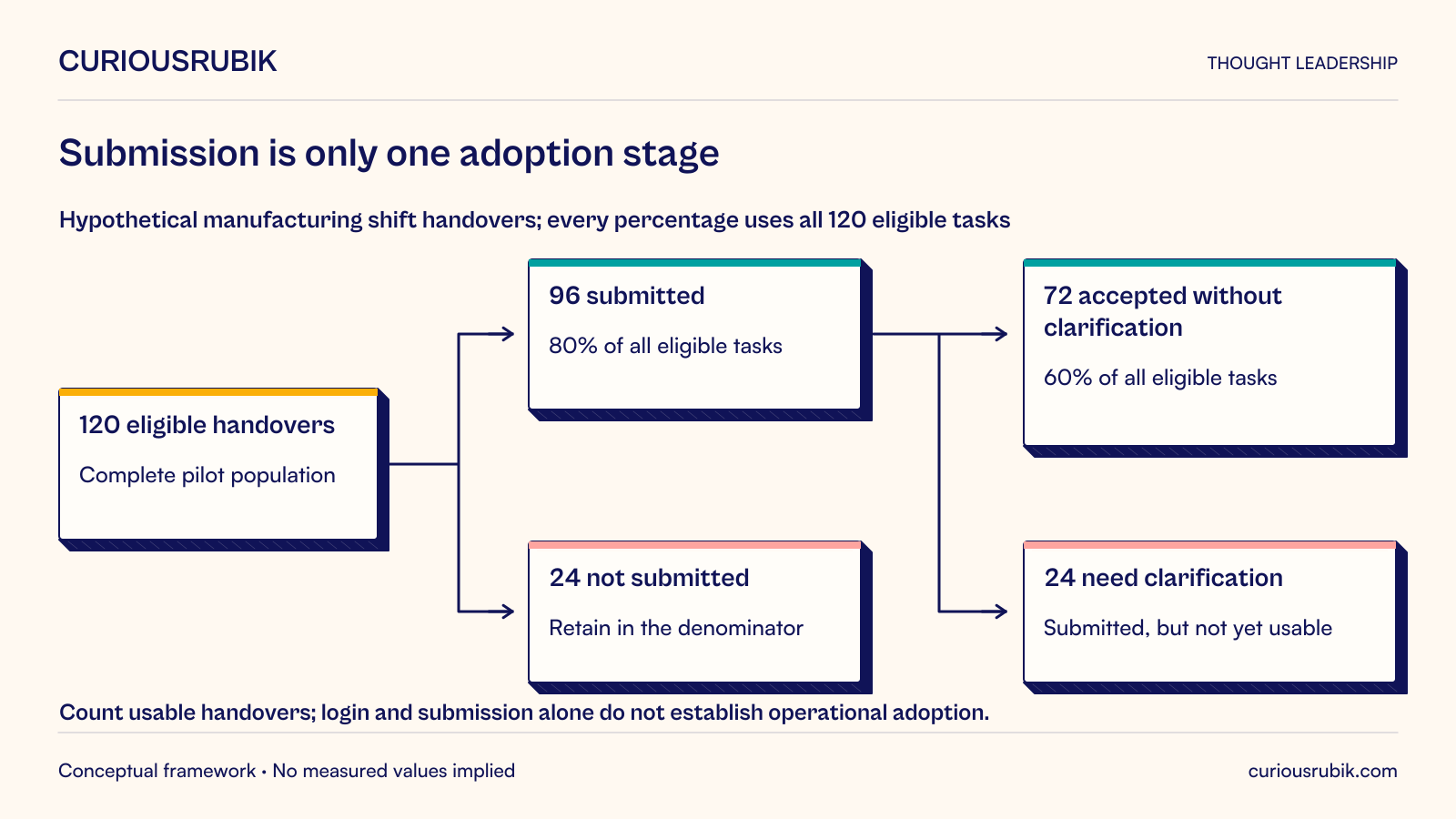
During an illustrative pilot, there are 120 eligible handovers. The application records 96 submissions. Of those, 72 are accepted without clarification and 24 need additional information because an equipment identifier or next owner is missing. The remaining 24 eligible handovers never reach submission. These figures are invented to demonstrate the analysis.
The submission rate is 96 divided by 120, or 80 percent. The usable accepted-outcome rate is 72 divided by 120, or 60 percent. Describing the pilot simply as 80 percent adopted would conceal both incomplete records and non-submission. Counting registered employees would reveal even less about the handover process.
Interviews and observation then distinguish causes. Some teams cannot access a charged device at the handover point. Others submit successfully but also complete the old paper sheet because the incoming supervisor still expects it. Several users cannot tell whether their record was saved locally or accepted by the receiving system.
The remedies differ. Equipment availability requires an operational owner. Duplicate paper requires a controlled process decision. Unclear status requires interface and synchronization work. Missing identifiers may require better task context or form design, not another general training session.
The pilot team should revisit the same handover population after those changes and inspect accepted records. If use rises but clarification remains high, the app still has not achieved the intended outcome. If clarification falls while non-submission remains concentrated around device shortages, broadening the rollout would reproduce that constraint.
Create a task funnel that reflects the real workflow: eligible opportunity, access available, task started, record saved, submission accepted, and receiving action completed. Use only stages the system can establish or an agreed observation method can validate.
A drop before start may indicate awareness, access, relevance, or device availability. A drop during entry may indicate excessive effort, unclear questions, or interruptions. A drop after submission may indicate integration failure or an unresponsive receiving team. Do not infer motivation from a single analytics event.
Combine telemetry with direct observation and short interviews. Ask employees to show a recent difficult task and describe what they did next. Inspect the surrounding work rather than asking whether they “like the app.” The useful finding is a reproducible obstacle and its consequence.
Segment by operating conditions. Shift, role, task type, device model, language, and connectivity can explain variation more usefully than a single company-wide average. Use such analysis responsibly and avoid treating limited task data as a complete evaluation of an individual’s performance.
Employees need to know whether work is saved, transmitted, accepted, or requires attention. Ambiguous status encourages repeated entry, screenshots, and fallback messages. Those workarounds may be rational responses to uncertainty rather than reluctance to adopt a new tool.
Error messages should explain the problem and a permitted next step. Preserve valid input when possible, identify the affected field, and provide a route for cases the form does not anticipate. A mandatory field that has no truthful answer for an ordinary exception can make correct use impossible.
WCAG 2.1 addresses programmatically determinable status messages and identification of input errors in web content. Those criteria provide specific review points for mobile web experiences; native applications also require appropriate platform accessibility testing. WCAG 2.1, criteria 4.1.3 and 3.3.1
Test interruption recovery with the people who do the work. Can they return after a call, resume on the shared device, or establish the outcome of a delayed submission? If recovery requires technical knowledge, training will need to compensate repeatedly for a design weakness.
Training is useful when employees need to understand new responsibilities, unfamiliar concepts, or a changed sequence of work. Teach complete tasks and exceptions with realistic examples. A tour of menu items rarely explains when a person should stop, correct, or escalate.
Give receiving managers the same attention. They need to know how to review records, acknowledge ownership, return incomplete submissions, and stop requesting retired duplicates. Otherwise, employees are taught one process while management reinforces another.
Provide help near the decision. A concise explanation of what belongs in a handover issue can be more effective than a long manual. Use examples from approved operating practice, and keep the content current when the process changes.
Allow time for practice and support in the rollout plan. Expecting employees to learn during an already compressed handover can turn manageable confusion into work avoidance. Budget the transition as an operational change, not just a software release.
Agree on expansion criteria before interpreting results. The application should support the intended roles, account for submitted work, produce usable outcomes, and have a functioning exception route. Numeric targets should reflect the baseline, consequences, and variation of the process rather than an invented universal adoption threshold.
Compare like with like. A pilot involving experienced day-shift leaders with reliable devices does not establish readiness for every shift. Include representative constraints and report limitations. If a changed workload or staffing pattern affects the result, describe that change instead of attributing all improvement to the application.
Sometimes the correct decision is to narrow the product. An app built around occasional administrative reporting may be less useful than a simpler responsive form. A task requiring extensive side-by-side analysis may remain better suited to a larger screen. Adoption is not an obligation to preserve the original implementation choice.
The next action is to review a small set of eligible tasks that succeeded, stalled, and bypassed the app. For each failure, identify the obstacle, the owner who can remove it, and the evidence that would show improvement. Expand training only where learning is the actual constraint. Expand deployment when employees and receiving teams can complete the work reliably through the intended process.