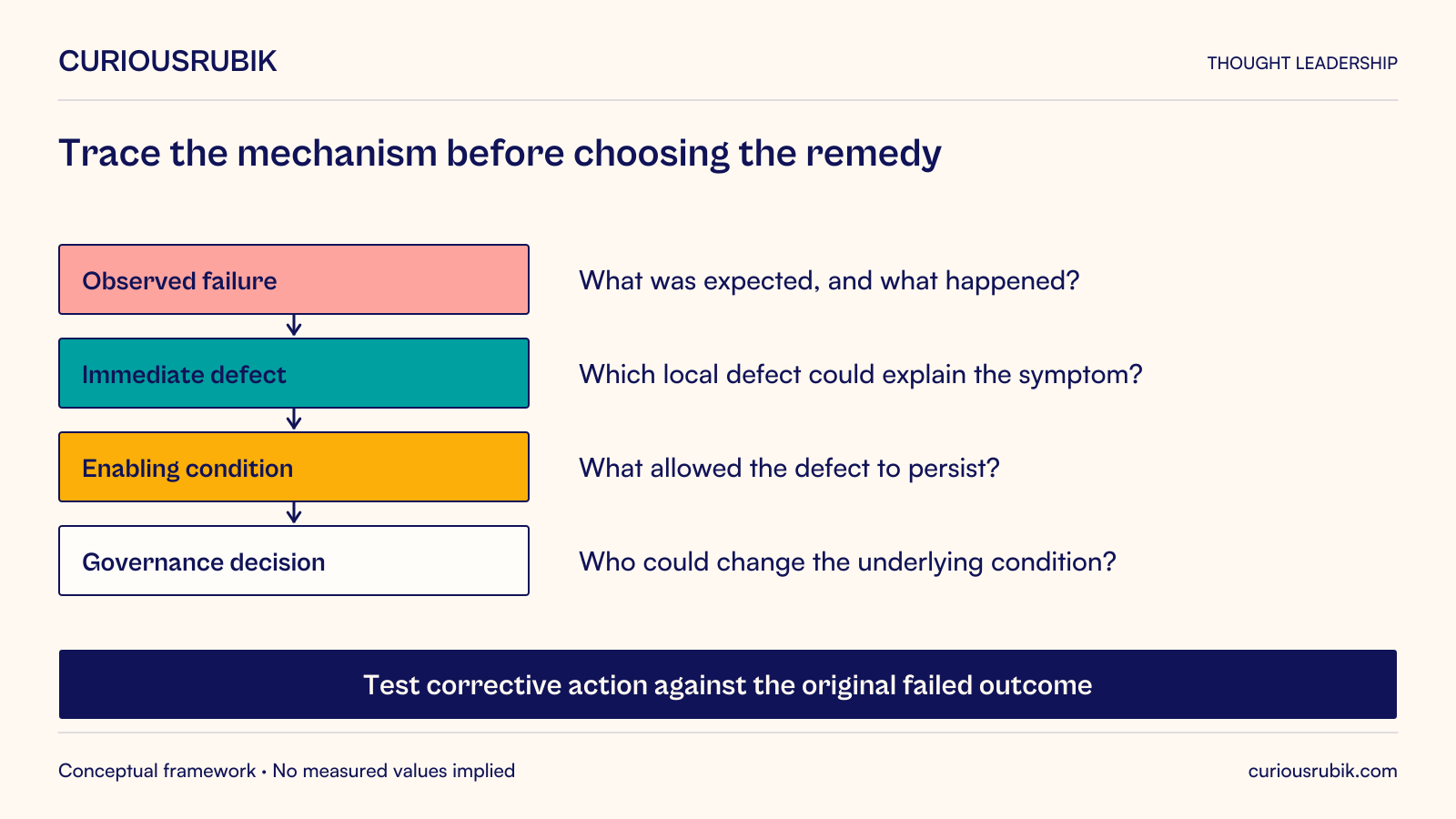
When an implementation misses a major milestone, the first explanation is often a label: poor requirements, weak change management, bad data or vendor underperformance. A label can point toward a problem, but it does not explain the mechanism well enough to repair the program. Replacing a supplier will not resolve a business decision nobody has authority to make. Adding testers will not fix acceptance criteria that contradict one another.
For a steering committee responsible for an implementation already in difficulty, the priority is to reconstruct how the failure was produced and why the program’s controls did not expose it earlier. The useful output is a small set of testable causes, corrective decisions and evidence that the recovery is working.
This article focuses on diagnosis during delivery. Readiness before a project begins is important, but a live program also needs a way to distinguish inherited assumptions, emerging complexity and execution defects without reducing the investigation to blame.
“Implementation failure” can mean a canceled project, a delayed release, an unusable business process, excessive operating cost or benefits that never materialize. Those outcomes require different evidence. A project may miss its original schedule yet deliver useful capability; another may launch on time while leaving the business dependent on manual repairs.
State the observed outcome precisely. Which process, user population or control is affected? What was expected, on what basis, and what happened instead? Identify the relevant period and the consequence. “Migration is failing” becomes more useful as “the rehearsal cannot reconcile customer balances for two entities because approved mappings are missing.”
Separate facts from interpretations. A missed milestone is a fact. “The team lacked commitment” is an interpretation that may obscure capacity, decision rights or contradictory priorities. Start with records of decisions, dependencies, work completed and defects observed.
Also identify the success condition for recovery. If the problem is an unreliable cutover, adding more completed configuration tasks does not demonstrate improvement. The recovery evidence must address the failure being diagnosed.
Large implementations rarely fail through one isolated mistake. The UK’s National Audit Office’s July 2021 review of digital change identifies business and technical challenges across ambition, commercial relationships, legacy systems and data, capability, delivery methods and funding. Its evidence concerns government programs and does not establish a private-sector failure rate. It does support examining interactions rather than assuming technology alone explains the outcome. The challenges in implementing digital change.
In a commercial implementation, an unrealistic date may lead teams to defer data discovery. Deferred discovery can produce late design changes. Those changes can consume the same business experts needed for acceptance testing. A final test delay is then the visible end of a longer chain.
The immediate cause still matters. A defective conversion script needs correction. But if the program routinely schedules conversion before mappings are approved, fixing the script alone leaves the next failure likely. Distinguish the local defect, the enabling condition and the governance decision that allowed the condition to persist.
This distinction is a proposed diagnostic approach, not a validated root-cause scoring system. Its purpose is to make corrective action more specific.
First, uncertainty is discovered later than the plan assumes. Teams estimate a clean process but encounter exceptions, historical data or integration constraints only after design commitments are difficult to change. The issue is not simply that uncertainty exists; it is that the delivery plan treats an untested assumption as established fact.
Second, local progress is disconnected from end-to-end usability. Configuration, development and training can each report completion while no representative business transaction has crossed the entire process successfully. The schedule measures activity that is easier to count than the outcome the business needs.
Third, decisions wait longer than delivery can tolerate. A process owner may lack authority, an executive may be unavailable or several functions may hold incompatible policies. The project then accumulates provisional choices, rework or workarounds. More technical capacity cannot necessarily accelerate that decision queue.
Fourth, reporting suppresses corrective action. A team may fear escalating bad news, a contract may reward completion of narrow deliverables, or status reporting may compress substantial uncertainty into a green indicator. Leaders receive reassurance while the opportunity to make a smaller correction disappears.
These mechanisms can coexist. Treat them as questions to investigate, not a universal checklist proving that every delayed program has the same causes.
Consider a hypothetical professional-services group implementing a shared customer and project system. The example is illustrative, not a client case. In a rehearsal, customer records are merged incorrectly, and project teams cannot reliably identify the contracting entity. The initial diagnosis is poor migration quality.
The technical review finds that the matching rules behave as configured. The deeper issue is that the group has never agreed whether branches of the same customer should share a commercial record, maintain separate billing accounts or both. Different entities supplied different assumptions, and the migration team selected a rule to keep development moving.
Several causes are now visible. The local defect is an inappropriate matching rule for some records. The enabling condition is an unresolved identity model. The governance failure is that a consequential business rule was implemented without a named decision owner and approval evidence. The detection failure is that early tests used clean sample customers that did not represent the disputed cases.
The corrective plan therefore has four parts. An authorized business owner decides the relationship model with finance and operations. The team builds a representative set of disputed examples. Technical staff revise the transformation and preserve traceability to source records. Business testers verify the resulting relationships and balances before another large rehearsal.
The program should not claim the root cause is resolved merely because the revised script runs. It needs evidence that disputed cases now produce the intended result and that future identity decisions have an owner. The lesson is specific enough to change both the immediate artifact and the decision process.
For each proposed cause, ask what would be different if it were absent. If the theory is insufficient testing capacity, would additional qualified testers have been able to execute meaningful tests with the data and environment available? If not, capacity is only part of the explanation.
Look for contrasting cases. Did a similar workstream succeed under the same supplier but with earlier business decisions? Did the same interface fail only when a particular data condition appeared? Contrasts can narrow the investigation without pretending to prove causality through a simple comparison.
Use timelines, decision logs, defect histories and representative work products. Interview people across the boundary where the failure occurred, including the receiving operational team. Do not rely only on the person responsible for reporting the milestone.
Keep uncertainty explicit. A recovery plan may need to proceed before every cause is established, but it should distinguish confirmed findings from working hypotheses and specify what evidence will resolve them.
Late discovery may require a bounded investigation, a smaller release or a revised sequence of commitments. End-to-end fragmentation may require representative scenario tests and integrated acceptance criteria. Decision delay may require delegated authority, scheduled decision windows or executive resolution of policy conflicts. Misleading reporting may require evidence-based status and changed incentives.
A remedy has costs and limits. More discovery can delay visible delivery; a narrower release may defer benefits; stronger governance can become bureaucracy if every minor choice escalates. Choose the intervention proportionate to the observed mechanism and review its effects.
Avoid changing several major dimensions simultaneously without a way to learn. Replacing the supplier, changing methodology, rewriting scope and reorganizing the team at once may sometimes be necessary, but it makes diagnosis harder and creates new transition risk. State why each change is required and how continuity will be protected.
The recovery plan should identify an owner, a decision, an observable output and a review point for every action. “Improve communication” is insufficient. “Resolve and publish the customer relationship model before the next migration rehearsal” is testable.
Report the condition that justified the intervention and the evidence since it began. Show whether representative transactions now work, whether blocking decisions are being resolved and whether the revised plan reflects actual capacity and dependencies.
Do not replace one opaque status label with another. A short evidence pack can include the failed scenario, corrective decision, test result, remaining exposure and next commitment. The steering committee should understand what it is authorizing, including the option to stop or reduce scope.
Preserve lessons in the operating model. If a program recovers through extraordinary effort by a few individuals, it may still be fragile after launch. Assign ongoing ownership for the data rules, controls and exception routes that the investigation revealed.
The root-cause exercise is successful when it changes a consequential decision and the program can demonstrate a better result. Begin with one material failure, reconstruct its chain of conditions and test the most plausible explanation. A precise diagnosis offers a path to recovery that a familiar label cannot.