A stable business contract can make an application change easier by keeping consumers independent of the application’s internal representation. Integration architecture determines where that boundary exists, who owns it, and what happens when either side changes. The practical measure of agility is whether a useful business change can be released safely without forcing unrelated teams into the same deployment.
For a CIO planning a warehouse-system replacement, the immediate decision is whether to reproduce the existing connections or create an explicit inventory and fulfillment boundary. Reproducing connections may be the quickest first step. A boundary can make later replacements easier, but it adds translation, ownership, testing, and operational obligations. The choice should follow the actual sources of change and failure, not a general preference for more architectural layers.
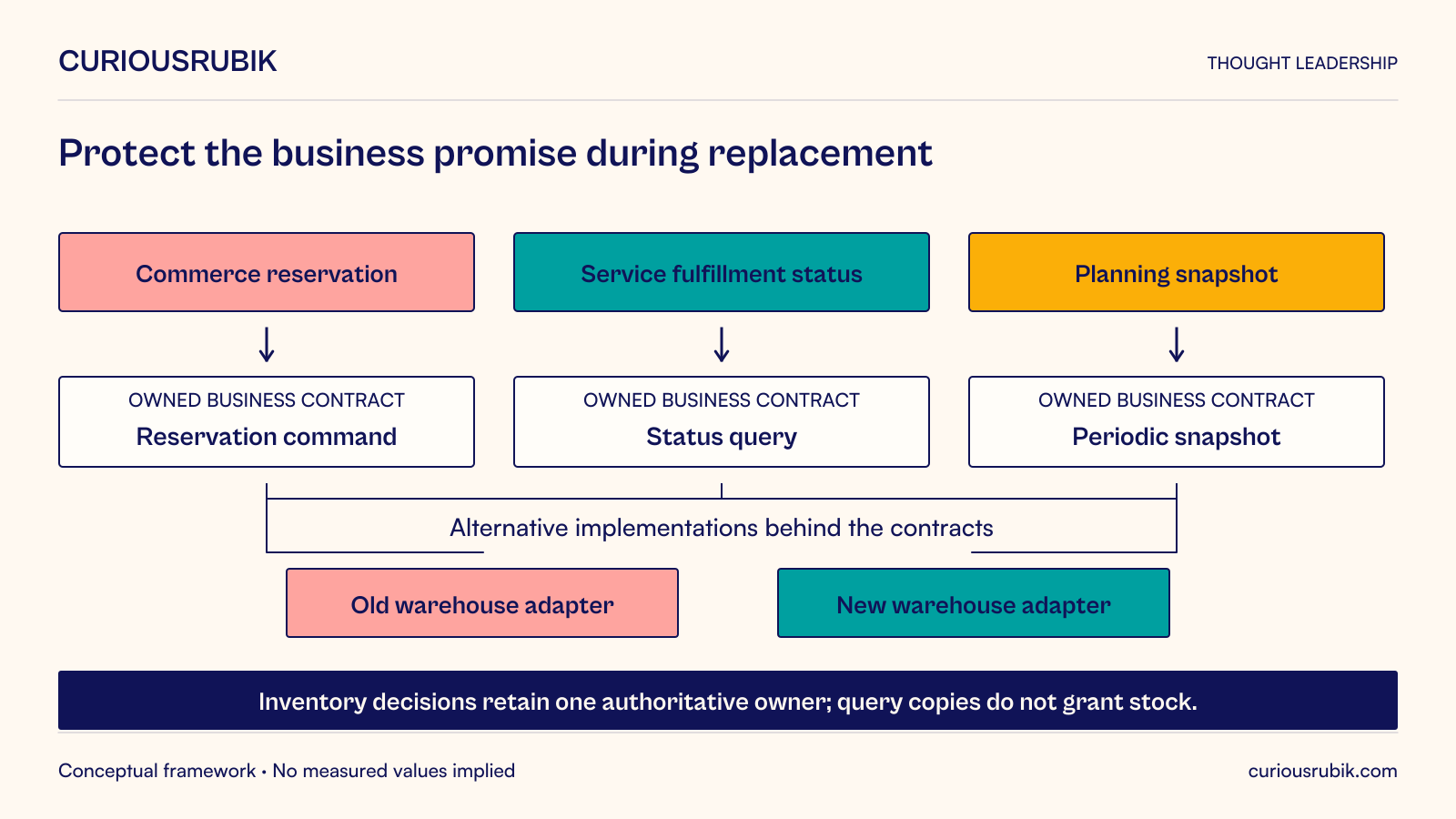
Begin by identifying what consumers need to know and do. A commerce application may need to request a reservation. Customer service may need fulfillment status. Planning may need a periodic inventory snapshot. These are different contracts even if they currently read from the same warehouse database.
A stable boundary describes an outcome or business fact that remains meaningful when the implementation changes. It should state identifiers, units, status meanings, authority, error behavior, and timing expectations. A field name and a data type are insufficient.
For inventory, define whether quantity means physical stock, unreserved stock, saleable stock, or expected inbound supply. State which location is represented, how units are expressed, and whether the value can be used to promise a customer delivery. Distinguish an informational availability query from a command that reserves stock. Reading a quantity does not prevent another order from consuming it before a later action.
Decide which system owns the authoritative state transition. A reservation command should reach the component authorized to accept or reject it under the inventory rules. Other systems can hold copies for display, but those copies should not independently grant the same scarce stock unless the design deliberately partitions authority.
The Message Translator pattern describes adapting information between differing application formats. That is a useful boundary mechanism, but a translator cannot infer missing business meaning. The meaning must be agreed by the owning teams. Enterprise Integration Patterns, Message Translator
Avoid designing one enormous enterprise object to cover every possible consumer. A customer-service view may need shipment status but not internal stock valuation. A smaller contract reduces unnecessary dependence and information exposure. Shared concepts should be consistent where needed without forcing every application to understand every field.
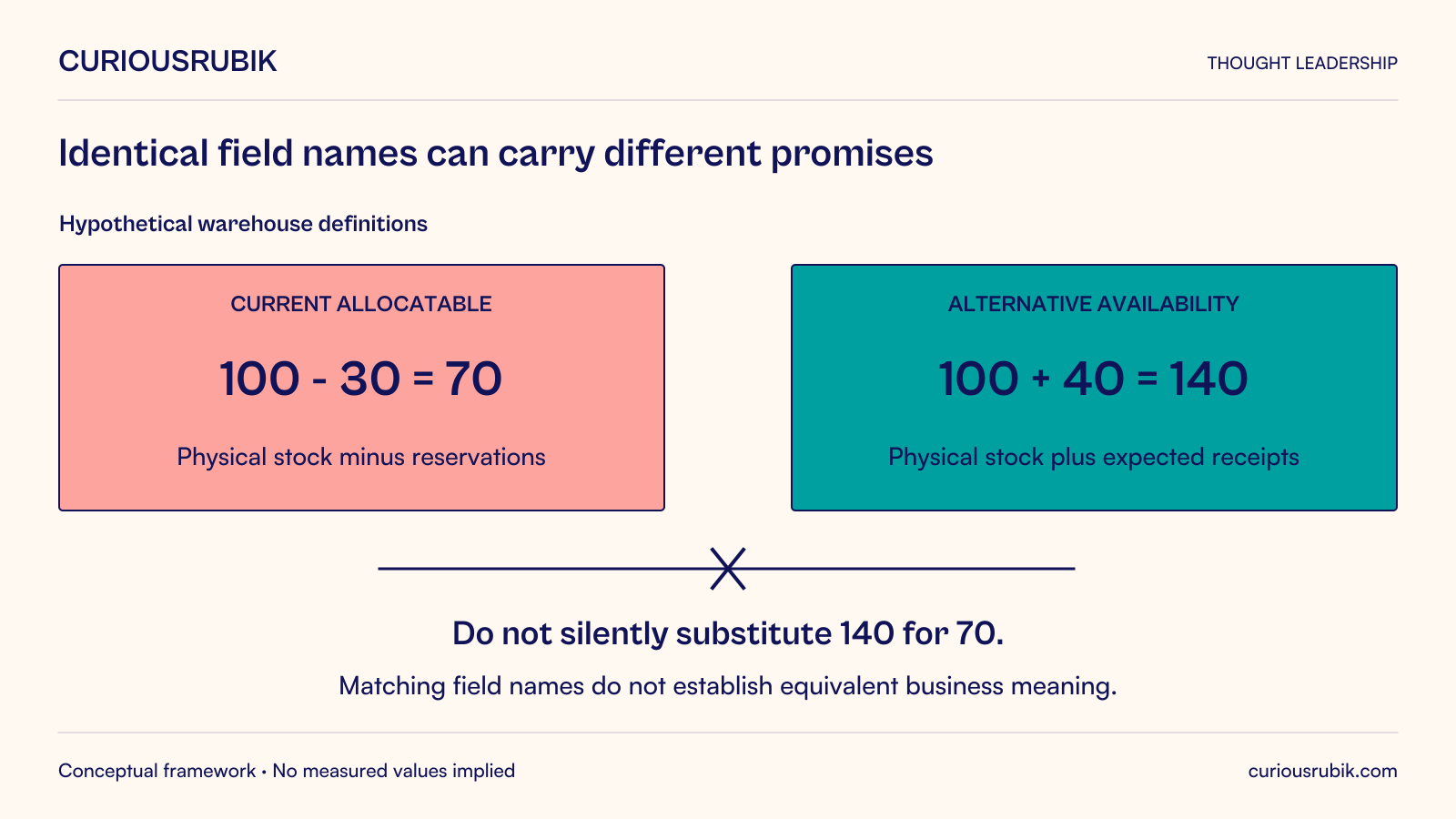
Consider a hypothetical distributor replacing the warehouse application at two locations. Its commerce site, service portal, and planning system currently consume a field called “available quantity.” In the old system, physical stock is 100 units and existing reservations are 30, so the field reports 70 units. The new system exposes physical stock of 100 and expected receipts of 40 under a different availability view.
Copying the new value into the old field could report 140 where the consumer expects 70 immediately allocatable units. Both values may be valid within their own definitions; the integration would be wrong because it changed the promise carried by the field.
The proposed boundary defines the commerce quantity as saleable, currently unreserved stock at a specified location under agreed exclusions. An adapter obtains the necessary new-system inputs and produces that view. If the new system cannot supply enough information to honor the definition, the adapter must return an explicit unavailable or unsupported state. Inventing a plausible number would preserve the interface while breaking its meaning.
The reservation operation receives an order reference, location, item, quantity, and a stable request identifier. It returns an accepted reservation reference or a defined rejection. For illustration, a request for 80 units against 70 eligible units is rejected or handled through an explicitly agreed partial-allocation rule. The architecture must not silently reinterpret rejection as a promise for future receipts.
The three consumers can then migrate according to their contracts. Commerce tests reservation behavior. Customer service tests fulfillment states. Planning tests snapshot coverage and cutoff. This is more work than comparing JSON field names, but it exposes the incompatibility before customers experience it.
The example is hypothetical. It demonstrates the conditions needed for a replaceable boundary, not a measured reduction in implementation time or an assertion that every warehouse product supports these operations.
Change coupling exists when one team’s modification requires another team to modify or redeploy. Runtime coupling exists when one component’s availability or performance directly affects another’s operation. A design can reduce one and increase the other.
A stable API can reduce change coupling while leaving a synchronous checkout dependent on the inventory service responding promptly. An event stream can reduce immediate runtime dependence for a service dashboard while introducing delay, duplicate handling, and a need to explain stale status. Choose these properties for each business interaction.
Place synchronous calls where the caller needs an authoritative decision before continuing. Place asynchronous updates where a delayed view is acceptable and the downstream action can be tracked independently. Use batch transfers where a defined periodic snapshot meets the need. One process may use all three.
Document the failure behavior at the boundary. If the reservation service is unavailable, does checkout stop, offer a clearly limited alternative, or accept an order pending later confirmation? That is a business decision with customer consequences. Engineers should not be forced to make it implicitly through a timeout setting.
An HTTP description can document operations, inputs, responses, and security requirements. OpenAPI 3.1.0 provides a standard interface-description format for such APIs. It does not prove that an implementation honors the described behavior or that the contract is commercially appropriate. OpenAPI Specification 3.1.0, Introduction and Operation Object
A contract is useful when changes are tested against it. Maintain representative consumer tests, including failure responses, unknown values, duplicate requests, missing records, and boundary quantities. Providers should run these checks before release; consumers should also verify the behavior they rely on.
Classify changes by effect rather than appearance. Adding an optional field may be compatible with consumers that ignore unknown fields but break a brittle parser. Adding a new status can break a consumer that assumes a closed list. Changing a field’s meaning is consequential even when the schema remains identical.
Use an explicit migration policy for incompatible changes. Identify affected consumers, provide a transition route, observe actual usage, and retire the old contract only after dependencies are resolved. Keeping every version forever transfers change risk into an expanding maintenance burden, so deprecation needs ownership and a realistic endpoint.
Where a new adapter sits between consumers and a replaced application, test both translation and end-to-end effects. A translator may preserve the apparent response while mishandling a source correction or losing a rejection reason. Parallel comparison can help, but agreement with the old system is not sufficient when its semantics were already ambiguous.
Preserve traceability across the boundary. A business request identifier should connect the consumer’s action, adapter processing, provider outcome, and any downstream update. Record enough context to investigate failures without placing unnecessary personal or confidential information in broad-access logs.
A shared integration layer can concentrate expertise and reusable capabilities. It can also become the place every team must wait for a minor change. Assign ownership at the business-contract level and standardize the common technical mechanisms without requiring one central team to implement every mapping.
Distinguish guardrails from delivery work. A platform team can provide authentication mechanisms, deployment templates, monitoring, and schema checks. A domain team can own the meaning and evolution of its inventory contract. The division should be explicit enough that incidents and changes do not bounce between teams.
Account for the layer’s own failure modes. Translation services need capacity, monitoring, access controls, recovery, and a supported deployment process. If every critical interaction crosses one fragile component, the architecture has created a shared operational risk. Redundancy and isolation should match the consequence of failure rather than follow a diagram aesthetic.
There are cases where a direct connection remains sensible. Two stable applications with one narrow, well-owned interaction may not justify a new abstraction. A short-lived migration bridge may be intentionally disposable. Document why the simpler option is appropriate and what change would trigger reassessment.
Before funding a broad integration redesign, choose one likely future change: a warehouse replacement, a new sales channel, a different fulfillment provider, or an additional entity. Trace which contracts, mappings, permissions, tests, and operating procedures would change under each proposed design.
Estimate the work from those concrete dependencies. Include consumer coordination and transition operation, not only connector development. The comparison should show where a boundary absorbs change and where it merely moves work into a shared service.
Then run a small technical exercise that demonstrates the hardest assumption. For the warehouse example, prove that the new source can supply the information necessary for the existing reservation promise, including rejection and correction. If it cannot, the business must revise the promise or choose another design.
Integration architecture supports agility when it makes change boundaries truthful and operable. The best next step is to define one business contract that must survive the next application change, give it an accountable owner, and test whether the proposed architecture can keep that promise under both normal operation and failure.