A support team can receive every design document and still be unable to resolve the first unfamiliar incident. The missing knowledge is often practical: which record is authoritative, why a rule exists, what a status really means, and which recovery action would create a duplicate or an unauthorized change.
Knowledge transfer should therefore be evaluated as demonstrated capability. The receiving team must be able to understand the service, diagnose representative problems, act within its authority, and verify the result without depending on the original implementer for every decision.
For a buyer, the central question is what the organization will be able to do after the project team leaves. Document counts and training attendance are weak substitutes for that answer. A useful transfer plan connects specific support responsibilities to usable evidence, practice, and acceptance criteria.
Identify the work the receiving team must perform: monitor operations, answer routine questions, diagnose incidents, correct authorized data issues, manage access, support releases, and coordinate suppliers as applicable.
Define the boundary of each responsibility. The support team may restore a failed job while a business owner decides whether a transaction should be changed. It may identify an access mismatch without having authority to broaden permissions.
List the decisions and failure modes that require the most important knowledge. Prioritize by consequence, frequency, and dependence on individual experts. A rarely used recovery procedure can matter more than a frequently used navigation guide.
This creates a capability map rather than an inventory of documents. The map states what someone must be able to do and which knowledge, access, and practice make that possible.
Configuration documents often describe what a setting contains without explaining why it was chosen. When circumstances change, support cannot tell whether the setting is essential, historical, or temporary.
Preserve the business rationale for consequential rules, mappings, thresholds, and exceptions. Record the alternatives considered where they help a future owner understand the tradeoff.
Distinguish approved policy from implementation convenience. A field may exist because of a temporary migration limitation, not because the business needs it permanently. A workaround may have been accepted only until a specific dependency was repaired.
The 2014 federal Green Book describes documentation as a way to communicate control operation and retain organizational knowledge. Used as a historical reference, it supports preserving the reasoning and responsibilities needed to operate beyond the tenure of a few individuals. GAO, 2014 Standards for Internal Control.
Support needs a service map showing critical components and dependencies; a business map showing important records and states; runbooks for recurring and consequential scenarios; and a clear ownership and escalation directory.
These artifacts should connect to one another. A runbook should identify the relevant component, business object, authority, and evidence. A service map should lead to the instructions needed when a dependency fails.
Keep secrets out of general documentation. Reference the approved credential-management process rather than copying passwords, tokens, or private keys into a handover file. Test whether authorized staff can obtain required access through the proper route.
Make documents searchable and versioned, with owners and review triggers. A large static folder that nobody maintains can create false confidence and make obsolete instructions difficult to distinguish from current ones.
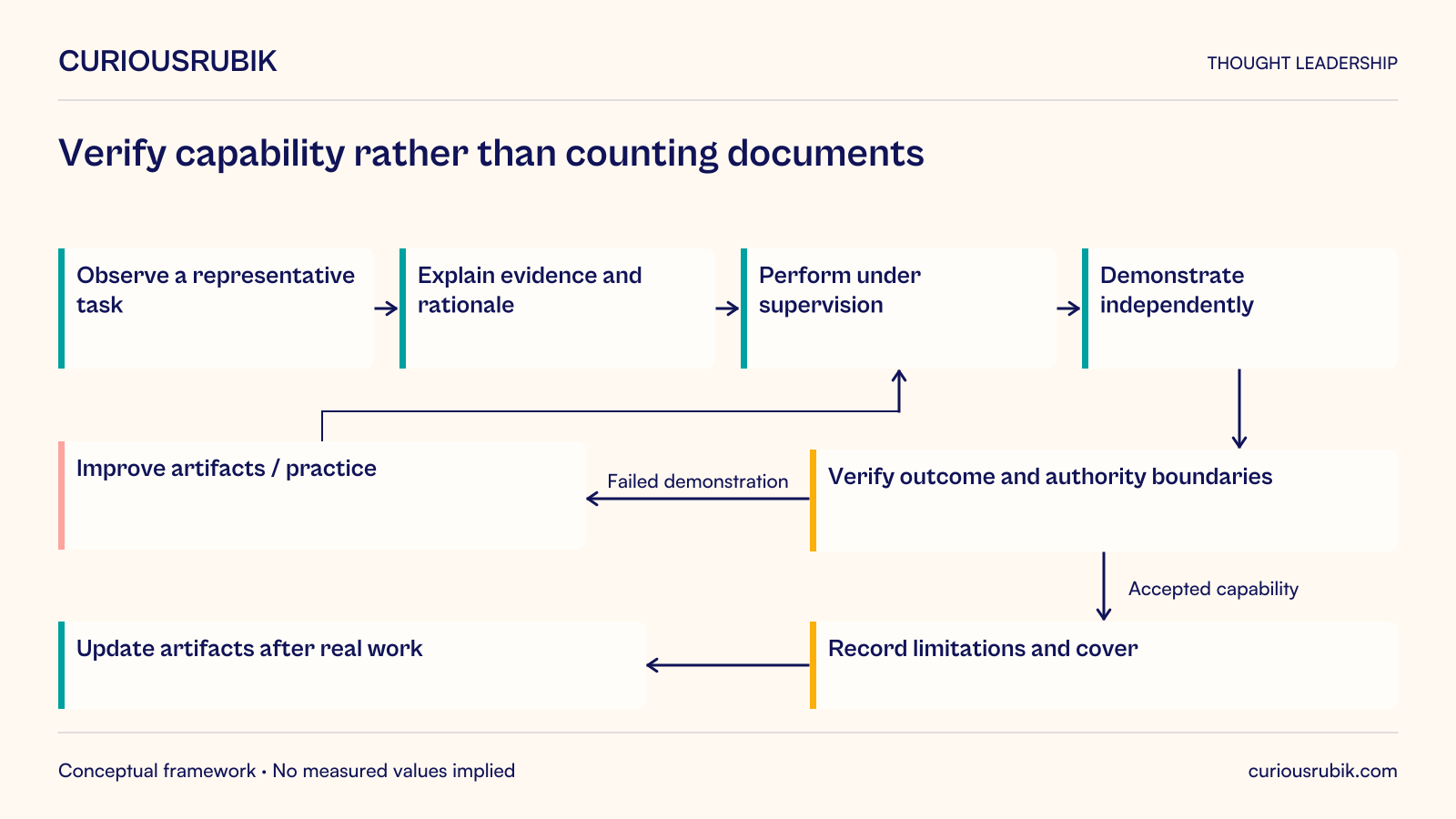
A practical working transfer method progresses from observing the task, to explaining the reasoning, to performing it under supervision, to verifying independent capability. This is a proposed learning sequence, not a formal certification.
Observation shows the work in context. Explanation reveals why the operator chooses one action rather than another. Supervised performance exposes gaps that passive training can hide. Independent verification tests whether the receiving team can act without continuous prompting.
The SRE onboarding material emphasizes structured preparation for operational responsibility rather than assuming that reading documentation alone makes a person ready for on-call work. The principle applies beyond SRE to enterprise support roles with different levels of authority and technical depth. Site Reliability Engineering, Accelerating SREs to On-Call and Beyond.
Choose representative tasks and use a safe environment where possible. The goal is to establish capability without creating unnecessary production risk.
Consider a hypothetical print business whose application connects customer artwork approval with production-job preparation. A support issue reports that a job refers to an older proof version even though the customer approved a revision.
The implementation team knows that customer approval, stored artwork, and production release are separate states connected by a version identifier. That distinction appears across several design documents but is not obvious in the support guide.
During transfer, the receiving team first observes an expert tracing the case. The expert explains how to establish the approved version, distinguish an uploaded revision from an approved one, and determine whether production release already occurred.
The receiving analyst then works through a safe test case with conflicting version labels. They must identify the authoritative approval evidence and explain why simply copying the newest file into the job could be incorrect. Any production or commercial decision remains with the authorized business owner.
A later exercise removes the implementer’s assistance. The analyst uses the runbook to diagnose a delayed integration and an uncertain prior update, chooses the permitted recovery route, and verifies that the job references the correct approved version without duplicating work.
The transfer record captures the demonstrated capability and any remaining limitation. If the analyst can navigate the system but cannot distinguish the business states, the task is not accepted as transferred. This hypothetical example illustrates competence-based handover, not a claim of fewer print errors or lower support cost.
A runbook should identify the symptom, prerequisites, evidence to inspect, decision points, permitted actions, verification, and escalation. It should explain when the procedure does not apply.
Avoid instructions that encourage blind execution. “Restart the job” is incomplete if the job may already have posted a transaction or sent an external message. The operator needs to establish the current state and understand the consequence of repeating the step.
Use concise explanations of important hazards. A short note explaining why a record must not be deleted can be more valuable than several pages of screenshots.
Test the runbook with someone who did not write it. Observe where they hesitate, infer a missing step, or require undocumented access. Update the artifact based on that evidence.
Some knowledge concerns people and organizations: which team owns a source record, how a supplier escalation works, and who can authorize an exception.
Make these routes role-based where possible and keep named contacts current. A directory containing only the implementation consultant’s details preserves dependency rather than transferring it.
Rehearse a cross-team incident. The receiving team should know how to establish a coordinating owner, provide useful evidence to a supplier, and confirm that the business outcome is restored after technical work is complete.
Include commercial support boundaries. Staff should understand what is covered, what requires a separate decision, and how urgent work is handled while responsibility is clarified. Avoid letting contract interpretation become an obstacle to immediate containment of a business problem.
Knowledge and access must align. A trained person who cannot inspect the approved support view cannot perform the role. A person with broad access but little understanding can create avoidable risk.
Provide the minimum permissions needed for the accepted responsibilities and test them through representative tasks. Use separate approval where an action changes protected data or creates a consequential external effect.
Do not preserve excessive project privileges merely because they make support convenient. Design a controlled route for exceptional access when it is genuinely needed, with appropriate approval and traceability.
Include the support environment itself in handover: approved tools, logging access, test data, deployment or recovery procedures, and the route for obtaining assistance when a dependency is unavailable.
A transfer to one capable person can leave the organization with a new single point of dependency. Decide which responsibilities need primary and backup coverage.
Match depth to role. First-line staff may need symptom recognition and evidence collection, while specialists need deeper diagnosis and recovery knowledge. Requiring everyone to know everything can make training expensive without improving response.
Maintain a capability record that shows what has been demonstrated, what remains supervised, and when practice or review is needed. Use it for coverage planning rather than as a permanent label of individual ability.
When staff change, the organization should be able to repeat the transfer using current artifacts and exercises. That repeatability is an important test of whether knowledge has become institutional.
Every material release, incident, or process change can alter what support needs to know. Include documentation and learning updates in completion criteria for those changes.
After an incident, ask whether a better runbook, diagnostic view, or explanation would have reduced uncertainty. Sometimes the right improvement is software that makes the state visible, rather than another paragraph of documentation.
Retire obsolete instructions. Preserve history where needed, but clearly separate current procedures from superseded ones. Searching should not require an operator to guess which version applies.
Review usage. An artifact nobody can find or use does not provide operational value merely because it exists. Keep the knowledge base organized around the questions support actually needs to answer.
Specify the roles, scenarios, evidence, and independent demonstrations required before responsibilities transfer. Include difficult but representative cases, not only the routine path.
Ask suppliers to identify remaining knowledge dependencies and the plan to resolve them. A transparent limitation is more useful than a signed handover that assumes competence without testing it.
Link final acceptance and support reduction to the agreed evidence where commercially appropriate. The buyer should know which capabilities it has acquired and which still depend on external help.
Knowledge transfer succeeds when the receiving team can understand the service well enough to act safely and verify its decisions. Documentation supports that outcome, but the outcome itself is demonstrated operational capability that remains usable when the original experts are no longer present.