A CFO reviewing a finance-platform proposal should ask which future business choices the design will make easier, which it will make expensive, and who will own the consequences. A purchase price and a savings estimate cannot answer those questions. Technology strategy belongs in the CFO’s remit because architecture determines how reliably the business can explain its performance, change its operating model, and recover when an important process fails.
That does not require the CFO to select database engines or supervise developers. It requires joint decision rights with technology and operating leaders. The CFO should own the financial meaning of the information, the investment assumptions, and the business consequences of failure. The technology leader should own the engineering assessment and technical operating model. Neither can make a sound investment decision with only half of that picture.
For a growing organization, the immediate decision is how to allocate a limited transformation budget across visible applications and less visible foundations. The useful question is whether a proposed investment removes a binding constraint or merely gives that constraint a better interface.
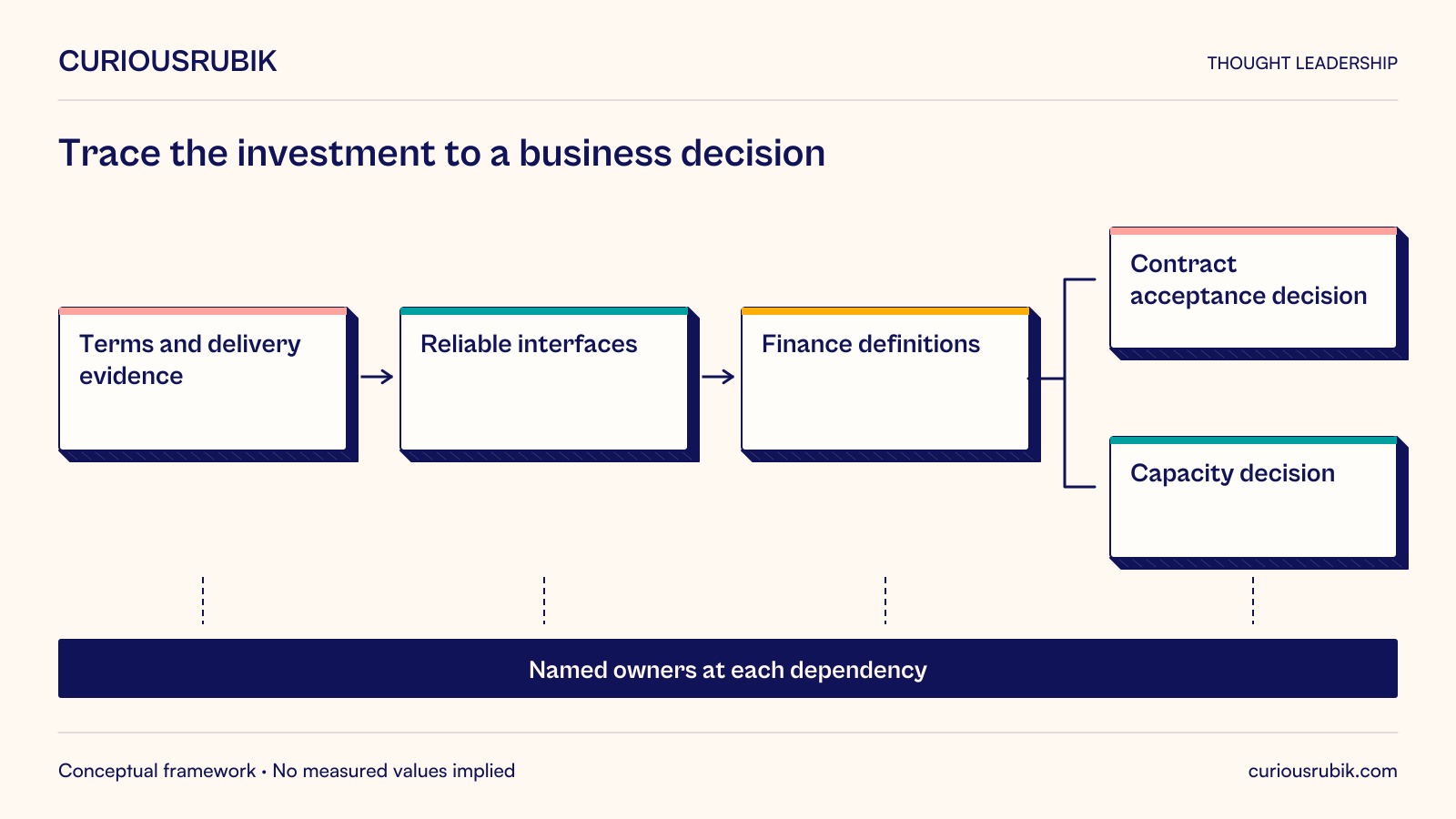
Consider the difference between “improve reporting” and “decide whether to accept a large contract before committing scarce delivery capacity.” The first statement invites a dashboard project. The second requires a chain of evidence: contract terms, delivery effort, capacity availability, incremental cost, cash timing, and accountable approval.
Map that chain before discussing software. Write down who makes the decision, when they must make it, which information they require, and what happens if the information is missing. Identify where the current process forces someone to estimate, rekey, reconcile, or wait. These are hypotheses about constraints, so verify them against actual cases rather than accepting the most senior person’s recollection.
The CFO can then distinguish three investment purposes. Some spending protects a necessary capability, such as restoring a reliable payment process after an outage. Some improves an existing capability, such as shortening the time required to assess a contract. Other spending creates an option, such as the ability to add another business entity without reconstructing every report. These purposes need different evidence. Combining them into one ambitious savings figure makes the proposal harder to challenge and less useful after approval.
A finance application may depend on customer identifiers owned by sales, project status maintained by delivery, or supplier records maintained by procurement. If those dependencies are absent from the investment case, finance can approve a solution that cannot produce its promised result.
Build a small dependency map for each candidate investment. Record the business input, authoritative owner, delivery obligation, failure response, and alternative if the dependency is unavailable. A delivery obligation should be specific enough to test: for example, accepted service milestones reach the reporting layer by the next working morning, with rejected records assigned to a named team.
Architecture then becomes a discussion about business exposure. What happens if the source changes its identifier? Can a correction be traced to the original transaction? Can one subsidiary keep operating while another is unavailable? Can the business retrieve usable records if a service is replaced? The CFO does not need to answer the engineering questions personally, but should insist that the investment decision includes the answers and their costs.
NIST’s 2018 Cybersecurity Framework provides a relevant precedent for connecting technology risk with organizational objectives through current and target profiles. Its purpose is cybersecurity risk management; using the same comparison discipline for finance investments is an analytical extension, not a NIST finance methodology. NIST Cybersecurity Framework Version 1.1, Sections 2.3 and 3.2
A hypothetical distributor has USD 600,000 available for its next phase of finance improvement. One proposal is a USD 450,000 planning platform with USD 90,000 in annual operating costs. Its headline benefit is 4,000 hours of analyst time a year. Another proposal combines customer-master repair, interface controls, and targeted reporting changes for USD 250,000, with USD 60,000 in annual operating costs.
Assume, solely for illustration, that the planning platform would remove 4,000 hours at a fully loaded internal cost of USD 50 per hour. That is USD 200,000 of capacity value, not automatically USD 200,000 of cash savings. If no hiring, contractor expenditure, or other cash outflow changes, the payroll remains. The investment case should explain what the released capacity will accomplish and how that change will be observed.
Now suppose examination of recent planning cycles shows that 2,500 of those hours concern inconsistent customer mappings. The platform can accelerate calculations but still requires the mappings to be corrected. The apparent platform benefit includes work that a prerequisite investment must remove first. Crediting the same 2,500 hours to both projects would overstate portfolio value.
The CFO should ask for three separate schedules: cash expenditure avoided, capacity released with an intended use, and options created. The option schedule could describe which future acquisition or operating-model change becomes feasible, what additional expenditure it would require, and what evidence would trigger it. It should not invent a monetary option value simply to make the return look attractive.
In this example, the foundation project may be the better first commitment. That conclusion changes if the existing planning process cannot support an imminent contractual requirement, if the foundation work cannot be delivered independently, or if the proposed platform replaces a costly service that will genuinely be retired. The analysis should expose those conditions rather than bury them in a single score.
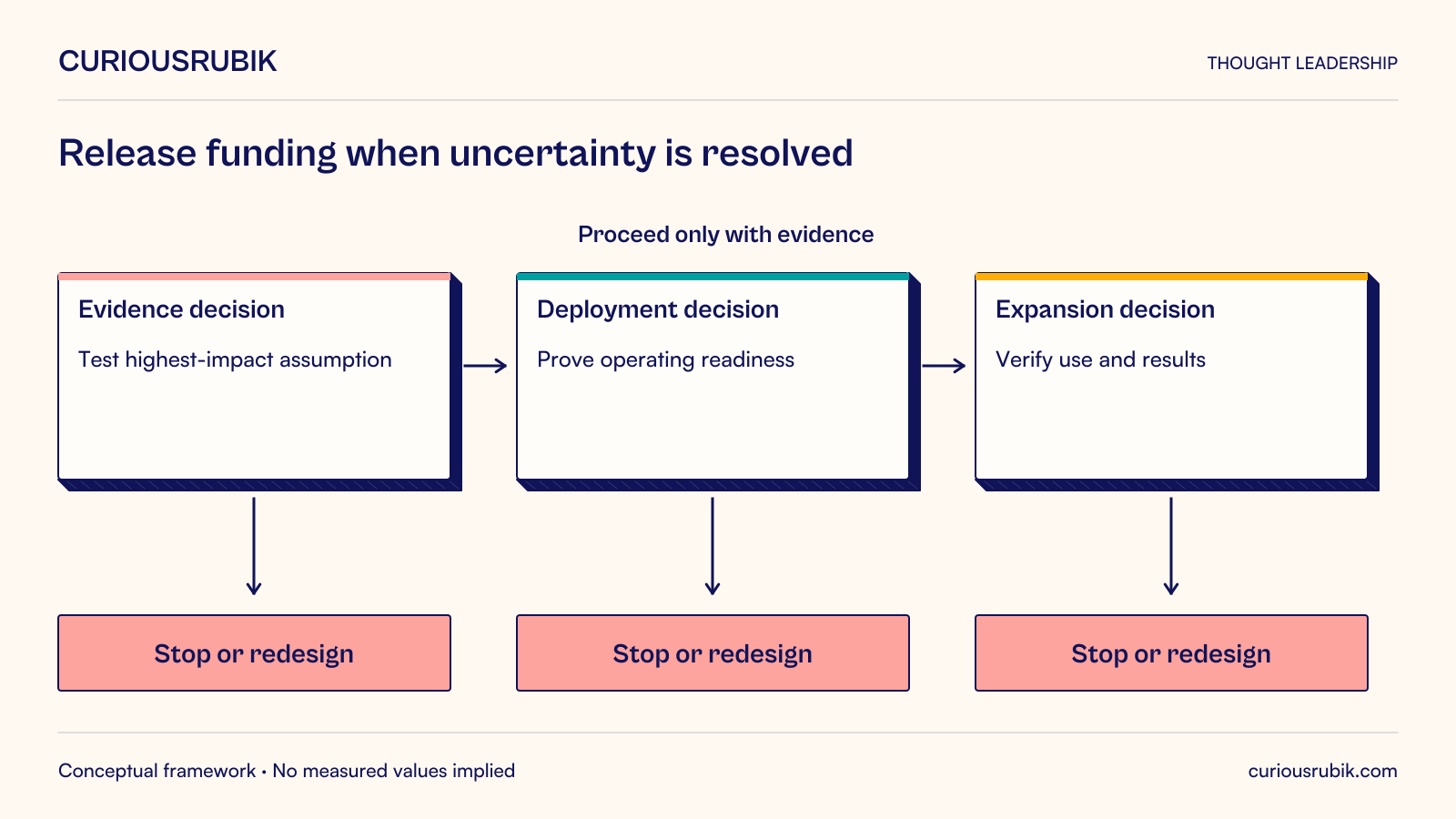
A working heuristic for the CFO is to divide approval into evidence, deployment, and expansion decisions. This is a practical way to stage commitment, not a universal investment standard.
The evidence decision funds a bounded test of the most consequential uncertainty. If benefit depends on removing reconciliation effort, test whether the proposed design reconciles a representative entity and explains exceptions. If benefit depends on business adoption, observe users making the intended decision with the proposed output. A demonstration with clean sample records cannot settle either question.
The deployment decision requires an operational owner, a supported integration design, a control assessment, a migration approach, and a fallback. The expansion decision requires evidence from use: adoption in the relevant workflow, manageable exceptions, recoverable failures, and realized benefits that have not been counted elsewhere.
Pre-agree the stop conditions. Examples include failure to obtain necessary data rights, inability to reproduce a financial total, or an exception workload that consumes the capacity the project was intended to release. A stop condition is useful only if leadership will honor it when enthusiasm and sunk expenditure make stopping uncomfortable.
Staged funding has costs. Multiple decision points can slow work, and an incomplete pilot may omit scale-dependent problems. Avoid endless experimentation by specifying what each stage can establish and which uncertainties will remain until a larger deployment. The goal is proportionate evidence, not certainty that no project can provide.
A technology investment needs a compact accountability agreement. Name one business owner responsible for the outcome, one technology owner responsible for service performance, and the finance owner responsible for benefit measurement. For controls affecting financial reporting, involve the controller early enough to shape the design rather than reviewing a finished configuration.
The agreement should identify the handful of decisions requiring joint approval: material changes to financial definitions, removal of a key review, changes to system access that affect sensitive responsibilities, and acceptance of a fallback that alters business exposure. Routine engineering decisions should remain with the engineering team. Requiring the CFO’s signature on every configuration change creates delay without ensuring informed review.
COSO’s 2013 framework explicitly includes technology-related control activities within internal control. That supports involving control owners in design; it does not prescribe a particular application, governance committee, or investment approval template. COSO Executive Summary, Principle 11
Include run costs in the same agreement. Someone must own interface monitoring, reference-data maintenance, report changes, access reviews, and incident recovery after the implementation team leaves. A lower purchase price can be outweighed by an operating model that depends on scarce internal specialists. Conversely, a higher service fee may be reasonable when it includes demonstrably useful responsibilities. Compare actual obligations, not labels such as “managed” or “fully integrated.”
Use a two-page decision record rather than a feature catalogue. The first page should state the business constraint, the affected decisions, the baseline evidence, the proposed change, and the credible alternatives, including doing less. It should separate benefits by type and name the owner of each assumption.
The second page should show dependencies, recurring obligations, material risks, reversibility, and the next decision point. Ask what the organization would lose if the service were unavailable for a day and how it would continue. Ask which costs remain even if adoption disappoints. Ask how an independent person could verify the claimed result six months later.
After approval, revisit the assumptions that could change the decision. A new acquisition, a major pricing change, a different reporting obligation, or loss of a critical specialist may alter the value of the original design. Strategy requires this feedback. Annual budget review alone is too coarse when the operating assumptions change inside the year.
The most useful first step is to take one active finance-technology proposal and rewrite its opening as a business decision with a deadline, evidence requirements, and a consequence. If the team cannot agree on that statement, defer the product comparison. The CFO becomes a technology strategist by making the economic and operational choices explicit enough for the organization to act on them.