A business-uniform supplier adds two garment families, another branding option, and a new delivery arrangement. Each addition looks manageable on its own. Together they change quoting, artwork checks, procurement, production instructions, delivery coordination, and billing. The sales increase appears in one revenue line; the operating consequences appear in many places.
Complexity does not inevitably grow faster than revenue. A business can grow by repeating a well-designed service, and additional variety can be profitable. The danger arises when growth multiplies distinct combinations and dependencies without a corresponding design for handling them. Revenue alone is a poor measure of that burden.
For a COO reviewing the next expansion in products or customer terms, the useful question is which new variation earns its operating cost and which creates avoidable coordination. The hypothetical uniform supplier below provides a way to examine that choice without pretending that a count of options is a validated complexity index.
Begin with dimensions that alter decisions or execution: product configuration, customer-specific terms, branding, delivery pattern, billing arrangement, service level, and exception policy. A new product code that follows an existing path may add little burden. One special contractual condition can create substantial work across several teams.
Trace the effect of each variation. Does it require a different input, specialist check, supplier interaction, production instruction, or customer communication? Record where the variation is interpreted and whether the same meaning is preserved downstream.
Distinguish volume from variety. More orders of an established type may support learning and reuse. More order types can require additional rules and knowledge even if total order count barely changes. The investment response should follow the actual driver.
Look for interactions. A branding option may be simple on one garment but need specialist review on another. A delivery pattern may be straightforward until the order is split across customer locations with different deadlines. The work lies partly in the combinations, not merely in the individual choices.
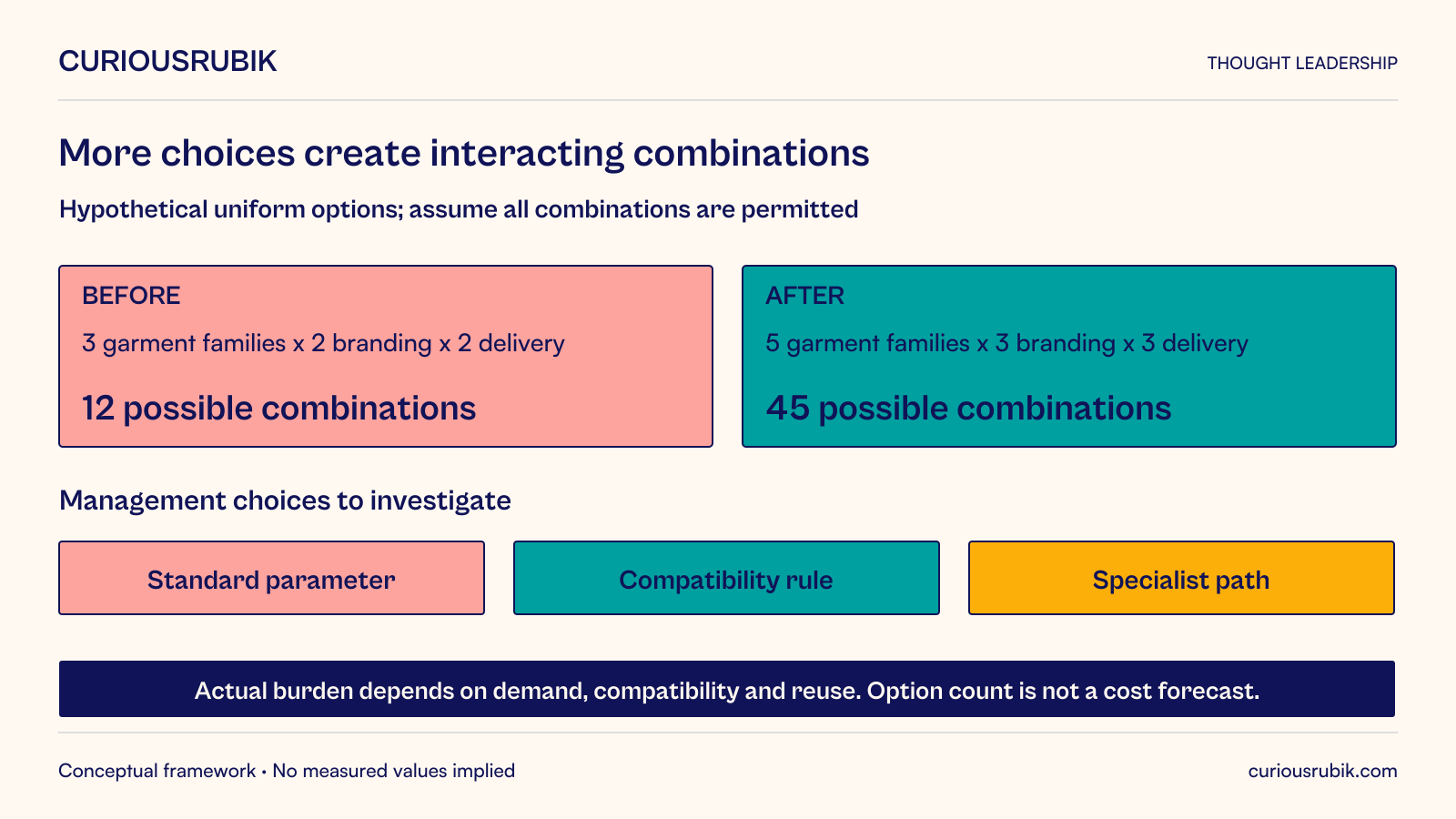
Suppose the uniform supplier initially offers three garment families, two branding choices, and two delivery patterns. If every combination is permitted, that creates twelve possible configurations: three times two times two. The example uses invented planning quantities.
The proposed expansion offers five garment families, three branding choices, and three delivery patterns. Under the same all-combinations-permitted assumption, there are forty-five possibilities. The option count grows from twelve to forty-five even though none of the individual dimensions grows by that factor.
This arithmetic does not mean workload or cost increases in direct proportion. Some combinations may use the same process, some may never be ordered, and some may be prohibited. The calculation is a prompt to inspect the operating consequences, not a forecast or measured complexity score.
The team reviews the proposed combinations and finds three kinds of treatment. Many fit the standard path with an additional parameter. Some need an explicit compatibility rule. A smaller group requires a specialist quotation because the delivery or branding condition changes the work materially.
A sales request to make every choice available immediately would hide those distinctions. A better commercial offer makes the standard combinations easy to buy, identifies choices requiring confirmation, and prices or accepts exceptional work through an authorized process. Customers receive a clearer promise and operations receives an interpretable request.
The company can still choose to offer demanding combinations when they create sufficient value. The decision should include the required expertise, lead time, and support rather than assuming that revenue from the option covers every consequence automatically.
A growing business often adds coordination between activities. A quotation depends on technical confirmation; production depends on approved branding; delivery depends on several completed components. Delays and misunderstandings can arise at those dependencies even when each team performs its own task competently.
Malone and Crowston’s coordination research examines how activities depend on one another, including shared resources and producer-consumer relationships. That perspective helps locate coordination work; it does not establish a universal law that complexity outpaces revenue. The Interdisciplinary Study of Coordination, 1994
Identify where information is translated repeatedly. If sales, artwork, production, and billing each interpret the customer’s delivery arrangement separately, one variation can create several opportunities for disagreement. A shared definition and controlled handoff may reduce that burden without reducing customer choice.
Watch for shared scarce resources. A few unusual combinations may all require the same specialist. Their volume can be small while their scheduling impact is large. Average order effort may hide the bottleneck and the resulting delay imposed on ordinary work.
Measure operational drivers that are close to the work: clarification contacts, specialist touches, setup changes, rework, split shipments, and time spent resolving commercial exceptions. Use a sample of actual cases to connect the driver to the variation.
Avoid assigning every overhead cost mechanically to an individual option. Some capacity is shared, fixed, or necessary for resilience. The analysis should support a decision about the offer and operating design, not produce a misleadingly precise unit cost for every possible combination.
Distinguish profitable complexity from accidental complexity. A customer may pay for a genuinely differentiated service that requires expertise. Duplicate definitions, unnecessary approval loops, and uncontrolled special terms usually offer less value. Treating both kinds as waste can damage the strategy.
Review the commercial acceptance process. Who can add a new customer-specific condition, and who assesses the downstream effect? A small concession in a sales conversation can become a lasting operating obligation if nobody owns its implementation and eventual retirement.
Compare similar orders when investigating a variation. A rush order from a new customer may require more clarification than a routine repeat, regardless of the garment choice. Record those differences before concluding that one option causes the burden. Small case reviews can identify a mechanism without supporting a precise cost estimate.
Include the supplier side of the offer. A standard-looking customer option may depend on a different minimum quantity, preparation method, or information requirement upstream. The business needs a reliable way to carry those conditions into quotation and fulfillment. Otherwise, apparent simplicity at the front of the process merely relocates complexity to the receiving team.
Review the knowledge needed to support a choice as well as the immediate transaction effort. An infrequent special arrangement may require training, testing, and retained expertise long after its initial sale. Decide who maintains that capability and whether it belongs in the standard offer, a specialist service, or a deliberately temporary exception.
Standardize the elements that do not create meaningful customer value. Common identifiers, units, status definitions, and handoff requirements can support a varied offer without forcing every team to invent its own interpretation.
Use parameters where the same process genuinely applies. A controlled delivery-location field may be sufficient for one variation. Do not disguise a fundamentally different service as another parameter simply to keep it inside the standard workflow.
Create an explicit specialist path for valuable exceptions. State the required evidence, authority, lead time, and ownership. The path should make the real cost and consequence visible to the commercial decision-maker, rather than leave employees to absorb the work informally.
Retire variations that no longer justify their burden. Review low-use options, obsolete customer concessions, and duplicated services. Withdrawal can itself require customer communication and approved commercial handling, so plan it rather than deleting an option from the system and assuming the obligation disappeared.
Before adding a product, channel, or service level, ask the receiving teams to describe the operating change. Identify new definitions, decisions, data, specialist capacity, and support needs. Keep the review proportionate to the consequence.
Document the intended scope of an exception. A one-time accommodation should not become a permanent default merely because its configuration remains available. Give temporary arrangements an owner and a review condition.
Test several realistic combinations before broad release. Include the cases where choices interact, not only one example of each individual option. A product can pass its own test while the combined service remains unclear.
Monitor the expansion after launch. Compare the expected and actual demand for special paths, the effort they require, and the effect on standard work. If a supposedly rare exception becomes common, redesign or reprice the service through the authorized business process rather than allowing the exception queue to grow indefinitely.
A rising revenue figure can coexist with deteriorating service, increasing coordination effort, or dependence on a few experienced employees. It can also coexist with healthy, deliberately managed variety. The financial result alone cannot distinguish those situations.
Review growth by the service patterns it creates. Which combinations are common and repeatable? Which require judgment? Which generate errors or disputes? Which customers value the extra work enough to support it? Those questions make the growth discussion operationally specific.
The uniform supplier’s next decision is not whether forty-five possibilities are inherently too many. It is whether the business can explain how the important combinations will be sold, interpreted, delivered, and supported. Approve new variety when that design is credible, and simplify where the coordination adds no corresponding value. Complexity becomes dangerous when it is accepted invisibly; it becomes manageable when the enterprise chooses it deliberately.