Revenue recognition becomes difficult when the accounting team receives a billing total without the facts that explain what the customer was promised, what has been delivered, and what changed. Better integration should connect those facts to a controlled accounting conclusion. It should not simply move an invoice amount into a revenue account faster.
For a revenue controller, the immediate design decision is which operational events and contract attributes the accounting process must receive, with what evidence and review. The answer depends on the applicable accounting framework and the arrangement’s facts. This article uses IFRS 15 as a clearly identified reference for the operating problem; it does not provide a complete recognition policy or assume the same requirements apply to every entity.
The IFRS Foundation’s overview describes a sequence involving the contract, performance obligations, transaction price, allocation, and satisfaction of obligations. That sequence explains why finance needs information from contracting and delivery as well as billing. IFRS Foundation, IFRS 15 overview
Start with representative contract types and have the responsible accounting specialists identify the facts needed for each. The list may include promised goods and services, contractual terms, approved prices, relevant estimates, delivery evidence, service periods, customer acceptance where relevant, and changes to the arrangement.
Do not ask an integration team to infer the policy from a set of current journals. Historical entries may include workarounds, unusual judgments, or errors. Translate the approved policy into explicit information requirements, and identify which conclusions remain human judgments.
Separate evidence from interpretation. A warehouse event can establish that goods were dispatched. Whether that event supports recognition depends on the terms and the applicable analysis. A completed project task can document work performed without establishing that a particular performance obligation has been satisfied. The integration should preserve the event and its context rather than encode an unsupported universal rule such as “shipment equals revenue.”
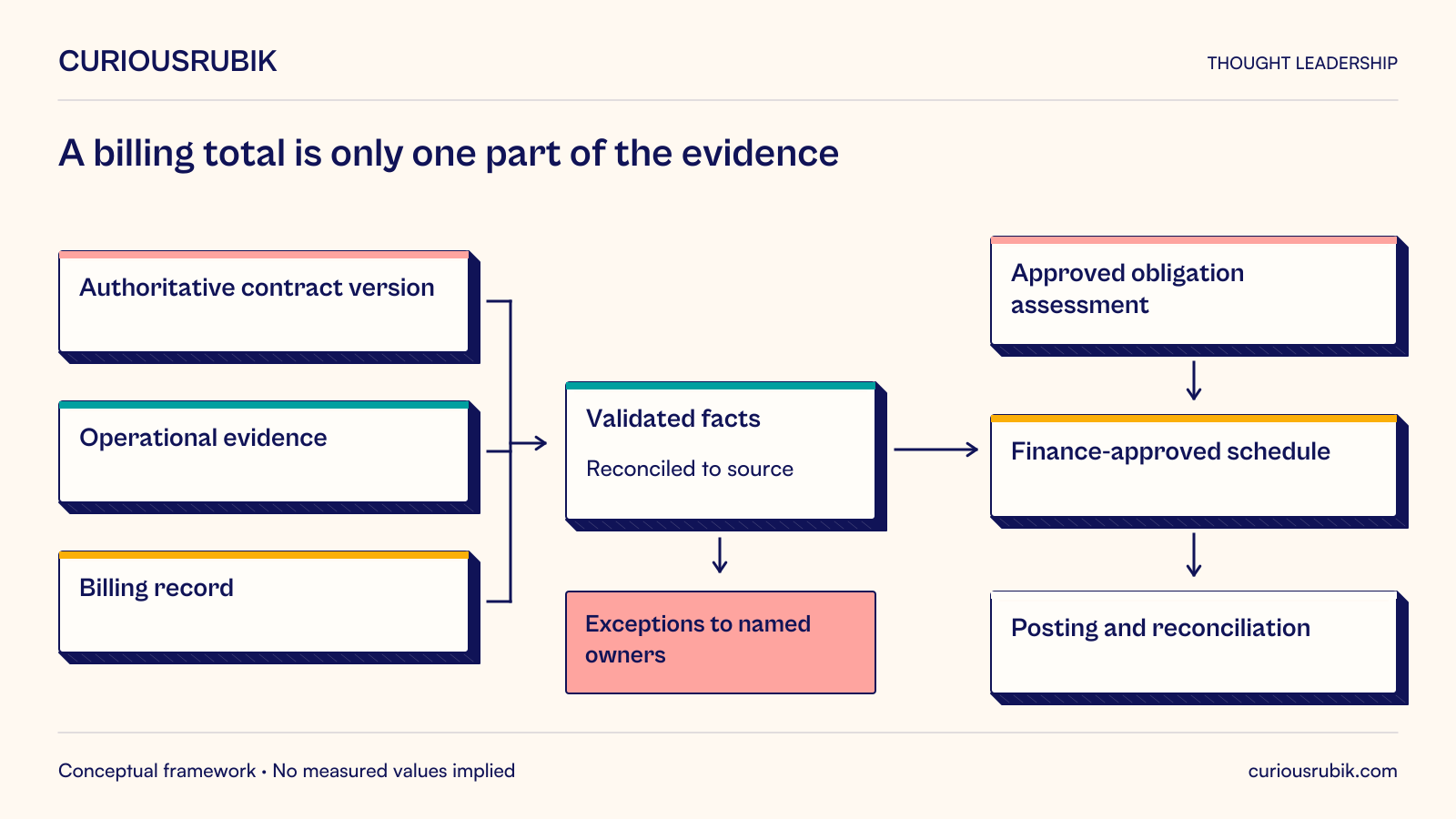
For each required fact, identify a source owner and a validation method. Contracting owns the authoritative agreement and approved amendments. Operations owns reliable delivery evidence. Finance owns the accounting interpretation and resulting schedule. The systems team owns dependable transmission and the technical controls around it. Shared responsibility works only when these individual obligations are clear.
A customer account identifier is not enough to support complex arrangements. The process should connect the contract, its relevant version, the items or services promised, operational events, billing activity, and accounting records. Keep those relationships stable when a contract is renewed, amended, or partially fulfilled.
An amendment can reach sales before it reaches finance or delivery. If each function acts on a different version, billing may reflect revised commercial terms while recognition follows an outdated schedule. The remedy is a controlled change notification that identifies what changed, when it became effective, the affected obligations, and who must reassess the consequences.
The accounting treatment of a modification requires the applicable technical analysis; the interface should not decide it merely because a new document exists. Route potentially relevant changes to finance with the original and revised facts. Record the approved conclusion and the schedule version it affects.
Retain prior versions for explanation and correction. Overwriting an old contract attribute can make it impossible to reconstruct why a prior period’s calculation was produced. The needed retention and access arrangements should follow the organization’s obligations and information policies.
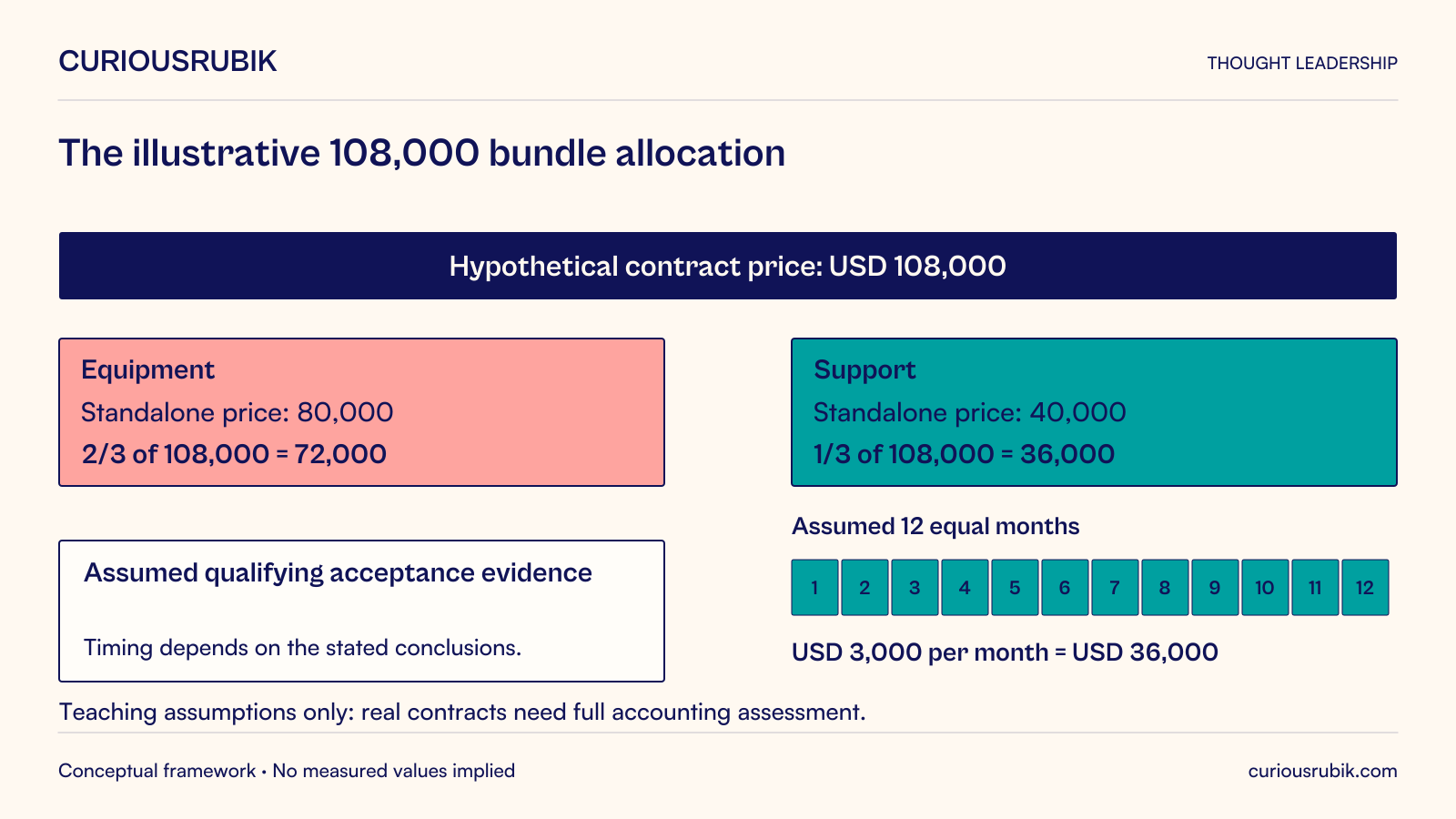
Consider a hypothetical arrangement in which a company charges USD 108,000 for equipment and twelve months of support. Assume qualified accounting review has already concluded, for this specific teaching example, that there are two distinct performance obligations and that relative standalone selling prices of USD 80,000 for equipment and USD 40,000 for support are appropriate. These conclusions are assumptions, not instructions for classifying a real contract.
The total standalone selling price is USD 120,000. Applying the assumed relative allocation gives USD 72,000 to equipment and USD 36,000 to support: USD 108,000 multiplied by two-thirds and one-third respectively. An invoice for the full USD 108,000 does not, by itself, establish that both obligations have been satisfied.
Assume the accounting team has separately concluded that the equipment obligation is satisfied when a specified control-transfer condition is met, evidenced in this arrangement by documented customer acceptance. Also assume support is satisfied evenly over a twelve-month period and that a time-based measure is appropriate. Under those assumptions, the support schedule is USD 3,000 per full month. Real arrangements can require different conclusions and measures.
The operational integration now has a precise job. It must deliver the relevant acceptance evidence, the approved support start and end dates, and any change that could invalidate the approved schedule. If the acceptance record is missing, the system should surface the missing evidence for assessment rather than infer satisfaction from invoice issuance. If support starts later than originally planned, the process must identify the discrepancy and have the schedule reviewed.
This example illustrates an information architecture, not a comprehensive accounting treatment. It omits matters that could materially change a real assessment, including variable consideration, returns, financing, options, principal-agent considerations, and modifications. The responsible professionals must evaluate the full arrangement.
For each relevant operational event, specify the identifier, event type, business-effective time, source system, supporting evidence reference, and processing status. Include the contract or obligation reference where the business model requires it. A generic “completed” message without scope cannot support a precise accounting conclusion.
Distinguish an event arriving from an event being accepted as usable evidence. Validation may establish that the reference exists, the event is not a duplicate, the source is authorized, and the timing is plausible. Finance may still need to review the accounting consequence. Those are separate decisions and should be visible in the workflow.
Make retries and corrections safe. If the same acceptance event is transmitted twice, it should not generate duplicate recognition. If the source later corrects the event, preserve the relationship to the original and route the effect for assessment. A reversal or correction must follow approved accounting and period-control procedures; deleting the original message is not a sufficient audit trail.
Reconcile the populations across the path. Compare relevant operational events received, events awaiting validation, approved accounting schedules, and resulting postings. A total-only reconciliation can miss a duplicate and an omitted event that happen to offset. Use identifiers and status counts as well as amounts where appropriate.
A revenue exception should state which fact or judgment prevents a conclusion. “Unable to process” leaves everyone guessing. “Support commencement differs between the approved contract schedule and the service record” gives contracting, operations, and finance a concrete question to resolve.
Assign ownership by the missing fact. Operations confirms what occurred. Contracting resolves which agreement applies. Finance determines the accounting consequence. The controller coordinates deadlines and escalation, but should not be expected to invent the missing business evidence during close.
Set a route for unusual arrangements before execution where practical. A new pricing structure or delivery promise may require additional data capture. Discovering that requirement after the work has been completed can make evidence difficult to reconstruct. Early finance review should identify information needs and policy questions without turning every ordinary transaction into a bespoke approval.
Measure exception age, recurring causes, late contract changes, missing operational evidence, and post-close corrections attributable to information failures. These measures explain whether integration is improving the reliability of the process. A high percentage of automatic postings alone does not establish that the accounting result is sound.
Use two complementary test sets. Accounting tests verify that approved facts produce the intended treatment under the policy. Integration tests verify that complete, accurate facts reach the process and remain traceable through retries, failures, and corrections. A system can pass one set and fail the other.
For the hypothetical bundle, accounting tests might verify the assumed allocation and support schedule. Integration tests should include a delayed acceptance message, duplicate event, amended support dates, an unknown contract identifier, and an event received after the period has closed. Expected handling should be approved in advance, including when the process stops for human review.
Parallel testing against an existing spreadsheet or application is useful, but agreement is not proof of correctness. Investigate differences and independently verify representative conclusions. Preserve the rationale for deliberate changes from the old process rather than forcing the new system to reproduce every historical workaround.
There are limits to automation. Novel arrangements, uncertain enforceability, complex estimates, or conflicting delivery evidence may continue to require substantial professional judgment. Good integration makes those judgments better informed and their consequences reproducible. It does not remove the need for qualified accounting ownership.
Begin with one recurring contract type that causes late revenue adjustments. Trace its authoritative agreement, operational evidence, billing record, and accounting schedule. Close the missing links, define the exceptions, and test a correction end to end. The most valuable integration is the one that lets finance explain why the revenue number is appropriate, not merely where it was copied from.